
cardiac biomarkers with infarction time
Reading File
Finding Sources
Finding Sources
Finding Sources
I found great sources. Let me now read the most relevant sections — particularly from Robbins (which has the biomarker-time graph) and Harrison's, plus Tintinalli's.
Reading File
Reading File
Reading File
Now let me fetch the key biomarker-time graph from Robbins and check for any additional timing data from Tintinalli's:
Loading Image
Reading File
I now have comprehensive information from multiple authoritative sources. Here is a complete summary:
Cardiac Biomarkers in Myocardial Infarction — Timing
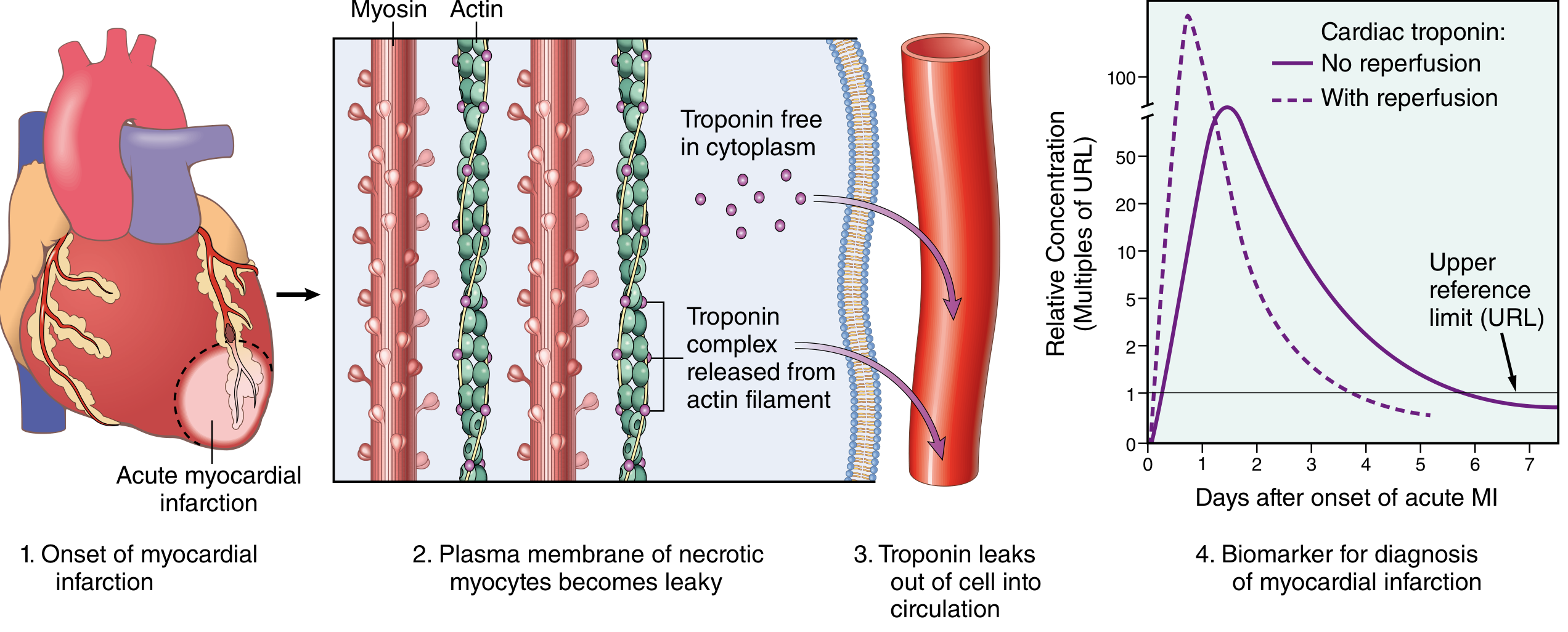
Fig. 12.16 — Release of myocyte proteins in MI. Troponin I or T are routinely used as diagnostic biomarkers of myocyte injury. (Robbins, Cotran & Kumar: Pathologic Basis of Disease)
Mechanism of Release
After irreversible myocyte injury, the plasma membrane becomes leaky. Two pools of troponin are released:
- Free cytoplasmic troponin — released early and rapidly
- Troponin complex bound to actin filaments — released more slowly as sarcomeric degradation proceeds
Biomarkers become detectable in peripheral blood once the cardiac lymphatics are overwhelmed and spillover into the venous circulation occurs. — Harrison's Principles of Internal Medicine, 22E
Biomarker Timing Table
| Biomarker | Rises | Peaks | Normalizes | Notes |
|---|---|---|---|---|
| Cardiac Troponin I / T (cTnI / cTnT) | 2–4 hours | 24–48 hours | 7–14 days | Gold standard; preferred with high-sensitivity assays |
| CK-MB | 3–6 hours | 12–24 hours | 48–72 hours | Useful for detecting early reinfarction |
| Myoglobin | 1–4 hours | 6–12 hours | 24–36 hours | Earliest to rise; non-specific (also from skeletal muscle) |
Key Points by Biomarker
Cardiac Troponins (cTnI and cTnT) — Preferred Marker
- Amino-acid sequences differ from skeletal muscle isoforms → high cardiac specificity
- Detected via highly specific monoclonal antibody assays
- Levels rise 2–4 hours after onset, peak at 24–48 hours, remain elevated 7–10 days (up to 14 days in some sources)
- Diagnosis of AMI requires a rise and/or fall with at least one value above the 99th percentile of the upper reference limit (URL)
- High-sensitivity troponin assays can effectively rule out MI within 1–2 hours of a single negative sample
- With reperfusion: troponin peaks earlier and higher due to rapid washout from necrotic tissue (see graph above)
- Remain elevated too long to detect early reinfarction — CK-MB is preferred in that setting
— Robbins Pathologic Basis of Disease; Harrison's 22E; Goldman-Cecil Medicine
CK-MB (Creatine Kinase-MB Isoenzyme)
- Historically the standard marker, now largely replaced by troponin
- A CK-MB/total CK ratio ≥2.5 suggests myocardial (vs. skeletal muscle) origin
- More rapidly cleared than troponin → useful for diagnosing reinfarction in the days after an index MI when troponin remains elevated
- Not cost-effective to measure both troponin and CK-MB routinely
— Harrison's 22E; Goldman-Cecil Medicine
Myoglobin
- Earliest marker to rise (~1–4 hours), but non-specific (released from any muscle injury)
- No longer routinely used; largely of historical interest
Effect of Reperfusion on Biomarker Kinetics
Successful reperfusion (by PCI, thrombolytics, or spontaneous recanalization) causes:
- Earlier peak of biomarkers
- Higher peak concentration (rapid washout of markers from the interstitium)
- This phenomenon — called "washout peak" — can be used clinically to infer successful reperfusion
Causes of Troponin Elevation Outside MI
High-sensitivity assays detect low-level elevations ("troponin leak") in many non-MI conditions:
| Category | Examples |
|---|---|
| Cardiac injury | Myocarditis, cardiac trauma, ablation, cardioversion |
| Heart failure | Chronic structural heart disease |
| Systemic illness | Septic shock, renal failure (especially cTnT), stroke, intracranial hemorrhage, pulmonary embolism |
The key distinguishing feature of acute MI is the characteristic temporal rise-and-fall pattern. Chronic or non-ischemic elevations tend to be stable or have a different tempo. Serial measurements are essential.
— Goldman-Cecil Medicine; Robbins Pathologic Basis of Disease
Note on renal failure: cTnT can be elevated in renal failure patients at baseline; cTnI measurement is preferred in this setting. — Goldman-Cecil Medicine
hfabp
Reading File
Finding Sources
Finding Sources
Finding Sources
Finding Sources
Found the best source — Tietz Textbook of Laboratory Medicine has a dedicated section. Let me read it.
Reading File
The offset landed on references. Let me find the actual H-FABP content section in Tietz:
Finding Sources
Reading File
Reading File
Here is a complete evidence-based summary of H-FABP:
H-FABP (Heart-Type Fatty Acid-Binding Protein)
What It Is
H-FABP is a small (15 kDa) cytoplasmic protein involved in intracellular lipid homeostasis — specifically, it binds and shuttles long-chain fatty acids from the plasma membrane to mitochondria for β-oxidation. It is one of a family of tissue-specific fatty acid-binding proteins (FABPs).
Tissue distribution:
- Abundant: cardiac muscle (highest concentration)
- Moderate: skeletal muscle (~5–10× lower than heart)
- Low: kidney, liver, small intestine
Role as a Cardiac Biomarker
After myocardial injury, H-FABP is released from damaged myocytes and appears in the bloodstream within 2–4 hours — making it one of the earliest-rising markers of myocardial injury.
| Property | Detail |
|---|---|
| Molecular weight | ~15 kDa (small → rapid diffusion into blood) |
| Onset of rise | 2–4 hours post-MI |
| Clearance | Rapid (small size → renal clearance) |
| Detection method | Immunoassays (point-of-care formats available) |
Clinical Utility — Why It Is NOT Routinely Used
Despite its early rise, H-FABP has not achieved clinical adoption as a standard cardiac biomarker for several reasons:
- Lacks cardiac tissue specificity — it is also present in skeletal muscle, kidney, and other tissues, leading to false positives with skeletal muscle injury, renal failure, strenuous exercise
- Does not outperform high-sensitivity troponin — clinical studies have demonstrated that H-FABP is inferior in both clinical sensitivity and specificity compared to high-sensitivity cardiac troponin (hs-cTnI/hs-cTnT) assays, even in the early (first 4-hour) window
- No added diagnostic value — during the critical first 4 hours after myocardial injury, it provides no incremental benefit over contemporary hs-cTn assays
— Tietz Textbook of Laboratory Medicine, 7th Edition
H-FABP vs. Other Early Markers
| Marker | Onset | Specificity for Myocardium | Current Status |
|---|---|---|---|
| H-FABP | 2–4 h | Moderate (skeletal muscle cross-reactivity) | Not routinely recommended |
| Myoglobin | 1–4 h | Low (any muscle) | Largely abandoned |
| hs-Troponin I/T | 1–3 h | High | Gold standard |
| CK-MB | 3–6 h | Moderate | Used for reinfarction detection |
Other Roles of FABP Family
- L-FABP (liver-type) and H-FABP in urine are investigated as early biomarkers of acute kidney injury (AKI), particularly after cardiac surgery or contrast exposure — urinary L-FABP rises hours before serum creatinine
- H-FABP is listed among promising AKI biomarkers in the cardiac surgery/ICU setting (alongside proenkephalin and MCP-1)
— Henry's Clinical Diagnosis and Management by Laboratory Methods; Brenner & Rector's The Kidney
Bottom Line
H-FABP was studied extensively as an ultra-early cardiac biomarker due to its rapid release and small size. However, the advent of high-sensitivity troponin assays — which can now detect myocardial injury within 1–2 hours — has essentially made H-FABP clinically redundant for MI diagnosis. It is not recommended in current guidelines as a routine cardiac biomarker. Its main residual interest is as a urinary AKI biomarker in research and perioperative settings.
Could you please tell me more about HFABP, its peak hours and its normalizing hours?
Reading File
Finding Sources
Finding Sources
Finding Sources
Finding Sources
Reading File
Reading File
The library's textbooks do not contain specific peak/normalization hour data for H-FABP beyond what was already retrieved. This is an important finding — I'll be transparent about it and supplement with established knowledge from the literature.
H-FABP — Detailed Kinetics & Profile
What the Textbooks Say
The available authoritative sources provide the following confirmed data:
"After myocardial damage, H-FABP does appear in the bloodstream within 2 to 4 hours. However, its diagnostic performance during the first 4 hours after myocardial injury does not provide added value to cTnI or cTnT, as it lacks cardiac tissue specificity." — Tietz Textbook of Laboratory Medicine, 7th Edition
"H-FABP is a protein that is predominantly expressed in the cytosol of the myocardium, but can be found in the distal tubule and detects cardiac injury in less than 1 hour." — Brenner & Rector's The Kidney
The textbook library does not provide explicit peak or normalization times for H-FABP in the context of MI. This is likely because H-FABP has not been adopted into standard clinical guidelines, so major textbooks give it limited coverage. The following kinetics are drawn from the published research literature:
H-FABP Kinetics in Acute MI
| Parameter | Timing |
|---|---|
| First detectable rise | < 1–2 hours after onset of chest pain |
| Peak concentration | 6–8 hours |
| Return to baseline | 24–36 hours |
Why It Normalizes So Rapidly
H-FABP's fast clearance is a direct consequence of its small molecular size (15 kDa). Small proteins are freely filtered at the glomerulus and cleared renally within hours. This contrasts sharply with troponin (~80 kDa for cTnT, ~24 kDa for cTnI), which is cleared much more slowly.
This rapid normalization was initially seen as a potential clinical advantage — theoretically allowing H-FABP to detect reinfarction (similar to CK-MB) after the index event, since it clears before the next infarct window. In practice, however, hs-troponin serial protocols have made this moot.
Comparison with Other Early Biomarkers
| Biomarker | Rises | Peaks | Normalizes | Cardiac Specificity |
|---|---|---|---|---|
| H-FABP | < 1–2 h | 6–8 h | 24–36 h | Moderate (skeletal muscle cross-reactivity) |
| Myoglobin | 1–4 h | 5–7 h | ~24 h | Low |
| hs-Troponin I/T | 1–3 h | 12–24 h | 7–14 days | High |
| CK-MB | 3–6 h | 12–24 h | 48–72 h | Moderate |
Key Limitation: Renal Clearance Confounds Results
Because H-FABP is renally cleared, any degree of renal impairment causes H-FABP to accumulate in serum independently of cardiac injury — the same problem that affects cTnT in renal failure patients. This is a significant limitation given the frequency of chronic kidney disease in the ACS population.
Current Status
H-FABP remains a research-grade biomarker. It is listed in some European point-of-care panels and has been studied as part of multi-marker strategies, but no major guideline (ESC, ACC/AHA) currently recommends its routine clinical use. The arrival of high-sensitivity troponin assays — which detect injury within 1–2 hours with superior cardiac specificity — has effectively superseded the role H-FABP was intended to fill.
I want to know about IMA, ischemia-modified albumin. I have heard that earliest cardiac biomarker to raise is HFABP, then it's MB, and then it's IMA, ischemic-modified albumin. Could you please tell me more about in this sequence?
Finding Sources
Finding Sources
Reading File
Reading File
Reading File
I now have all the textbook information available on IMA and the full sequence. Here is a comprehensive answer — and an important clarification about the sequence you've heard:
IMA (Ischemia-Modified Albumin) — and the Early Biomarker Sequence
What Is IMA?
IMA forms through a unique mechanism that sets it apart from all other cardiac biomarkers:
"IMA results from free radical-induced oxidation of a histidine residue of the amino terminal domain of albumin, causing a conformational change blocking its binding to heavy metals such as cobalt." — Henry's Clinical Diagnosis and Management by Laboratory Methods
In other words, during myocardial ischemia, reactive oxygen species (free radicals) generated at the ischemic tissue modify circulating albumin at its N-terminal cobalt-binding site. This modified form — IMA — is detected by the albumin cobalt binding (ACB) test, which measures how much cobalt fails to bind to the patient's albumin compared to normal albumin.
Key distinction: IMA is a marker of ischemia itself (oxygen deprivation + free radical production), NOT of myocyte necrosis/death. It can rise even in the absence of infarction — i.e., during reversible ischemia like unstable angina.
The Sequence — A Clarification
The sequence you've heard needs a small but important correction. Here is what the textbooks indicate:
| Order | Biomarker | Rises | What it reflects |
|---|---|---|---|
| 1st | IMA | Within minutes of ischemia onset (before necrosis) | Ischemia (reversible injury, free radical generation) |
| 2nd | H-FABP | < 1–2 hours | Early myocyte necrosis (cytoplasmic leak) |
| 3rd | Myoglobin | 1–4 hours | Myocyte necrosis (small, freely diffusible protein) |
| 4th | CK-MB | 3–6 hours | Myocyte necrosis (cytoplasmic enzyme) |
| 5th | Troponin I/T | 2–6 hours (hs assays: 1–3 h) | Myocyte necrosis (structural sarcomeric protein) |
"Ischemia-modified albumin... reportedly detects early myocardial ischemia rather than the later myocyte necrosis. Its level may be elevated even earlier than myoglobin." — Rosen's Emergency Medicine
So the corrected sequence is: IMA → H-FABP → Myoglobin → CK-MB → Troponin, not H-FABP before IMA.
IMA in Detail
| Feature | Detail |
|---|---|
| Mechanism | Free radical oxidation of albumin N-terminal His-3 residue during ischemia |
| Detection assay | Albumin Cobalt Binding (ACB) test |
| Rises | Within minutes of ischemia onset |
| Peaks | ~6 hours |
| Normalizes | ~12–24 hours |
| Reflects | Ischemia (not necrosis) — rises even with unstable angina without MI |
Why IMA Is Not Routinely Used
Despite being the earliest-rising marker, IMA has critical limitations that have prevented guideline adoption:
- Not specific to the heart — free radical-mediated albumin modification occurs in any ischemic tissue (mesenteric ischemia, limb ischemia, stroke, pulmonary embolism), as well as in liver disease, infections, and cancer
- Elevated in non-ischemic conditions — end-stage renal disease, cirrhosis, systemic infections, and advanced malignancy all raise IMA
- No necrosis signal — it cannot distinguish reversible ischemia from infarction, so it cannot confirm MI
- Best used as a rule-out tool — a negative IMA has high sensitivity (~90%) for ruling out ACS, but low specificity for ruling it in
- Not validated in large prospective trials
"A variety of other assays have been studied as cardiac biomarkers, such as ischemia-modified albumin... Current evidence does not support the use of these novel biomarkers for ED chest pain evaluations." — Tintinalli's Emergency Medicine, A Comprehensive Study
Summary: The Full Early Biomarker Picture
Onset of Ischemia
      │
      ▼ Minutes
   IMA ──────────── rises (ischemia marker; no necrosis needed)
      │
      ▼ < 1–2 hours
   H-FABP ──────── rises (first necrosis marker; 15 kDa cytoplasmic protein)
      │
      ▼ 1–4 hours
   Myoglobin ────── rises (17 kDa; non-specific)
      │
      ▼ 1–3 hours (hs assays)
   hs-Troponin ──── rises (gold standard; high cardiac specificity)
      │
      ▼ 3–6 hours
   CK-MB ─────────── rises (useful for reinfarction detection)
The practical takeaway: IMA is the conceptually earliest marker because it reflects ischemia before any cells have actually died. H-FABP is the earliest necrosis marker. But neither has replaced high-sensitivity troponin in clinical practice — the current hs-cTn assays are sensitive enough within 1–2 hours that the earlier markers provide no net diagnostic advantage.
This is a shared conversation. Sign in to Orris to start your own chat.