
anatomy of liver
Reading File
Finding Sources
Searching Images
liver anatomy lobes segments ligaments
Reading File
Reading File
Reading File
Loading Image
Loading Image
Loading Image
Here is a comprehensive overview of liver anatomy drawn from authoritative surgical and physiology textbooks.
Anatomy of the Liver
General Overview
The liver is the largest organ in the body, weighing approximately 1,500 g (about 2% of total body weight). It occupies the right upper abdominal cavity beneath the diaphragm, protected by the rib cage. It is reddish-brown in color and enclosed by a fibrous sheath called Glisson's capsule.
— Schwartz's Principles of Surgery, 11th Ed.
Ligaments and Peritoneal Attachments
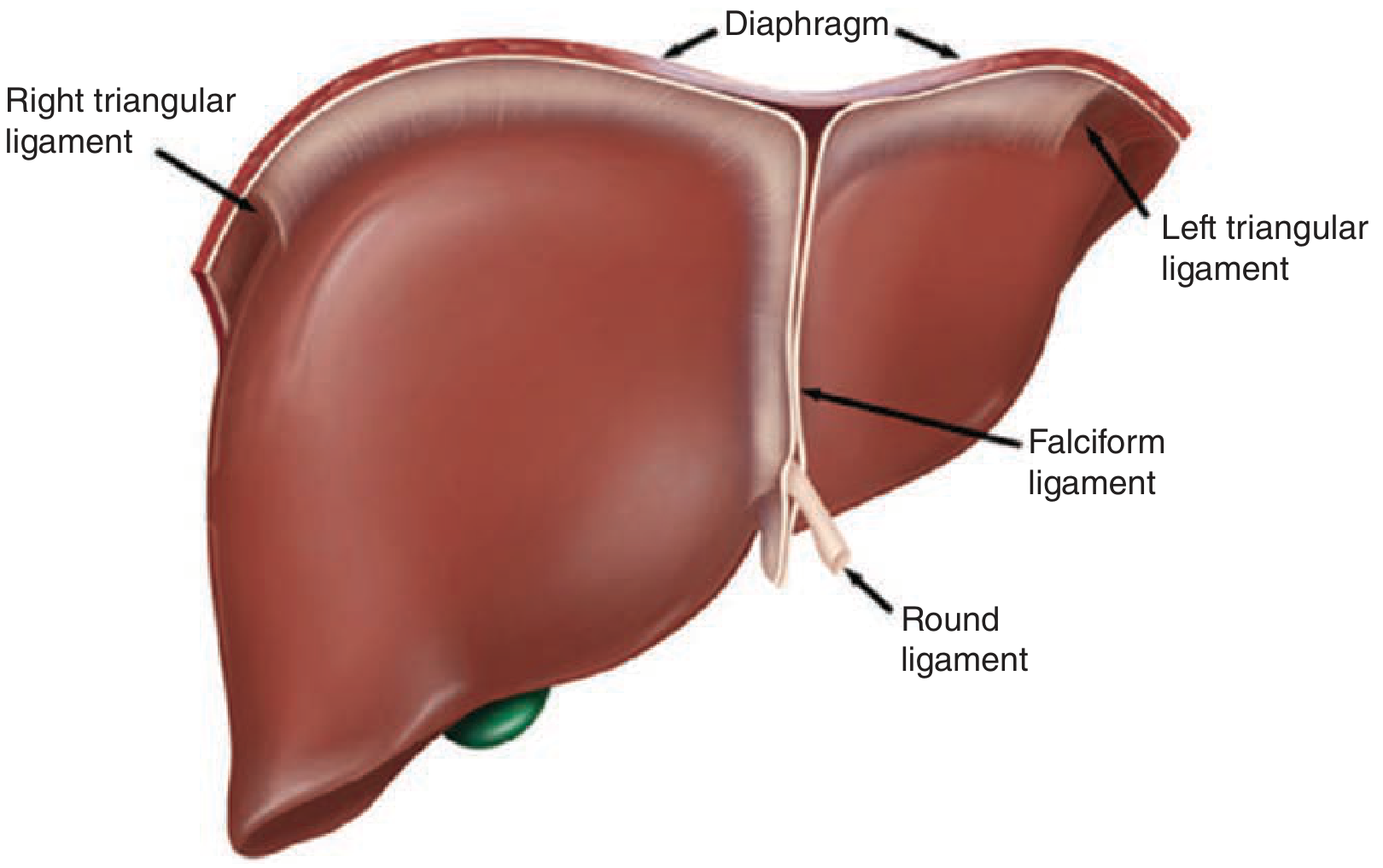
| Ligament | Description |
|---|---|
| Falciform ligament | Separates left lateral from left medial segment; anchors liver to anterior abdominal wall |
| Round ligament (ligamentum teres) | Remnant of the obliterated umbilical vein; enters the left liver hilum at the falciform's front edge |
| Ligamentum venosum (Arantius' ligament) | Obliterated ductus venosus; lies deep between caudate lobe and left lateral segment |
| Left & right triangular ligaments | Secure each side of the liver to the diaphragm |
| Coronary ligaments | Extend anteriorly from the triangular ligaments; right coronary also anchors liver to right retroperitoneum |
| Hepatoduodenal ligament (porta hepatis) | Contains the common bile duct, hepatic artery, and portal vein |
| Gastrohepatic ligament | Connects liver to lesser curvature of stomach |
The foramen of Winslow (epiploic foramen) lies posterior to the porta hepatis and connects to the lesser sac — clamping the hepatoduodenal ligament here (the Pringle maneuver) achieves complete vascular inflow control.
Lobes
Grossly, the liver is divided into right and left lobes by Cantlie's line — an imaginary plane from the gallbladder fossa to the inferior vena cava (IVC), in which the middle hepatic vein runs.
- Right lobe: ~60–70% of liver mass (segments V–VIII)
- Left lobe: segments II, III, IV
- Caudate lobe (segment I): lies anterior to the IVC; contains three subsegments — Spiegel lobe, paracaval portion, and caudate process
Note: The falciform ligament does not separate the right from the left lobe — it divides the left lateral segment (segments II & III) from the left medial segment (segment IV).
Couinaud's Segmental Anatomy
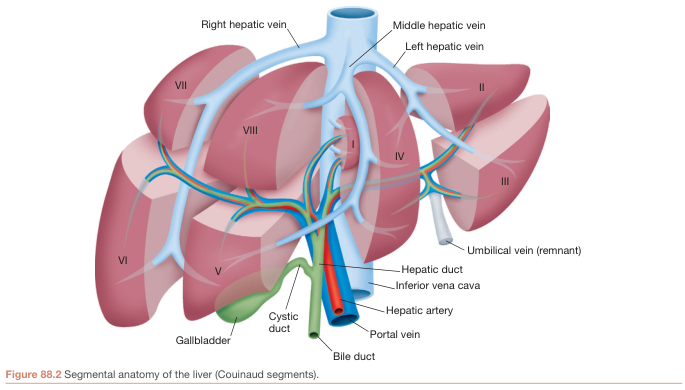
Based on the cast studies of French surgeon Claude Couinaud (1950s), the liver is divided into 8 functional segments, each with its own arterial, portal venous, and biliary supply, numbered clockwise starting with the caudate lobe:
| Segment | Location | Notes |
|---|---|---|
| I | Caudate lobe | Posterior, between IVC and ligamentum venosum |
| II | Left lateral superior | |
| III | Left lateral inferior | Segments II+III = left lateral section |
| IV (IVa/IVb) | Left medial | IVa = superior/cephalad; IVb = inferior/caudad |
| V | Right anterior inferior | |
| VI | Right posterior inferior | |
| VII | Right posterior superior | |
| VIII | Right anterior superior | Segments V–VIII = right lobe |
This segmental anatomy is the basis for modern hepatic resection surgery (e.g., a right hepatectomy removes segments V, VI, VII, VIII).
— Gray's Anatomy for Students; Schwartz's Principles of Surgery, 11th Ed.
Vascular Supply
Inflow
- Portal vein: ~1,050 mL/min (~75% of hepatic blood flow); carries nutrient-rich blood from the GI tract
- Hepatic artery: ~300 mL/min (~25%); carries oxygenated blood
- Total hepatic blood flow: ~1,350 mL/min = 27% of resting cardiac output
Portal pressure averages 9 mmHg; hepatic vein pressure ~0 mmHg — the low gradient reflects low sinusoidal resistance under normal conditions.
Outflow
- Three hepatic veins (right, middle, left) drain into the inferior vena cava (IVC)
- Right hepatic vein: between segments V/VIII and VI/VII
- Middle hepatic vein: runs in Cantlie's line (between IV and V/VIII)
- Left hepatic vein: between segments II/III and IV
— Guyton & Hall Textbook of Medical Physiology
Porta Hepatis
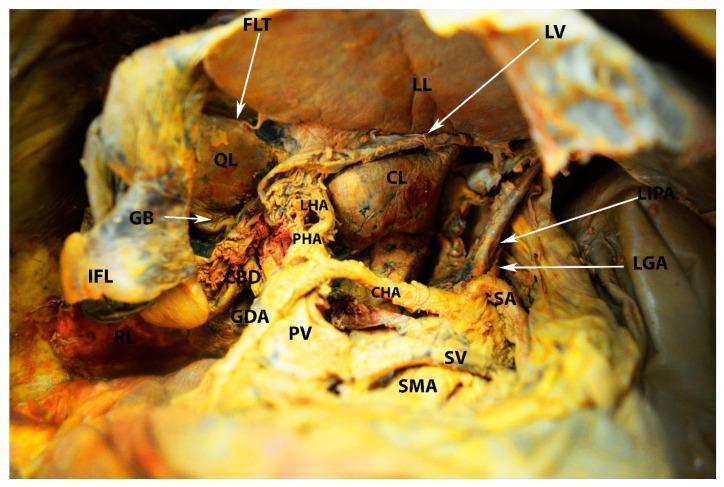
The hepatoduodenal ligament (porta hepatis) carries the three key structures entering/leaving the liver:
- Common bile duct (CBD) — right and anterior
- Hepatic artery proper — left
- Portal vein — posterior
Microanatomy: The Liver Lobule
The basic functional unit is the liver lobule — a cylindrical structure 0.8–2 mm in diameter. The human liver contains 50,000–100,000 lobules.
Structure of the lobule:
- Central vein → drains to hepatic veins → IVC
- Hepatic plates (2 cells thick) radiate from the central vein like spokes in a wheel
- Bile canaliculi run between hepatocytes → drain into bile ducts in fibrous septa (portal triads)
- Hepatic sinusoids: flat channels between hepatic plates, lined by:
- Endothelial cells (with large pores ~1 µm)
- Kupffer cells — resident macrophages, phagocytize bacteria and foreign matter
- Space of Disse (perisinusoidal space): narrow space between endothelium and hepatocytes; connects to lymphatics; plasma proteins diffuse freely here
Portal triads (at lobule periphery) contain:
- Portal venule
- Hepatic arteriole
- Bile duct
— Guyton & Hall Textbook of Medical Physiology
Summary Table
| Feature | Detail |
|---|---|
| Weight | ~1,500 g |
| Capsule | Glisson's capsule |
| Lobes (gross) | Right, Left, Caudate, Quadrate |
| Functional segments | 8 (Couinaud) |
| Blood supply | Portal vein (75%) + Hepatic artery (25%) |
| Total blood flow | ~1,350 mL/min (27% cardiac output) |
| Functional unit | Liver lobule |
| Key cell types | Hepatocytes, Kupffer cells, endothelial cells |
This is a shared conversation. Sign in to Orris to start your own chat.