
Incretin
Reading File
Incretin hormones are gut-derived peptides released after eating that amplify glucose-stimulated insulin secretion from the pancreatic beta cells - a phenomenon called the "incretin effect." The two main incretins are GLP-1 (glucagon-like peptide-1) and GIP (glucose-dependent insulinotropic peptide). They are the basis for drug classes like GLP-1 agonists (semaglutide, liraglutide) and DPP-4 inhibitors (sitagliptin).
Searching sources...
Finding Sources
Finding Sources
Searching PubMed
incretin GLP-1 GIP physiology diabetes
Reading File
Reading File
Reading File
Reading File
Finding Sources
Loading Image
Reading File
Loading Image
Here is a comprehensive overview of Incretins, drawn from multiple authoritative textbooks.
Incretins
1. The Incretin Effect
Oral intake of glucose produces a higher insulin response than an equivalent dose of glucose given intravenously. This amplification is called the "incretin effect" and accounts for 60-70% of postprandial insulin secretion.
The mechanism: the gut releases incretin hormones in response to a meal, which then potentiate glucose-stimulated insulin release from pancreatic beta cells.
In type 2 diabetes, the incretin effect is markedly reduced, primarily due to impaired GLP-1 secretion rather than increased degradation.
2. The Two Main Incretin Hormones
GLP-1 (Glucagon-Like Peptide-1)
- Synthesized from proglucagon by enteroendocrine L cells in the distal gut (and neurons in the nucleus tractus solitarius)
- Proglucagon is cleaved by PC1/3 to produce GLP-1, GLP-2, oxyntomodulin, glicentin, and IP-2
- Released within minutes of eating (via endocrine + neural signals, even before digestion is complete)
Actions of GLP-1:
| Action | Site |
|---|---|
| Stimulates insulin gene transcription | Pancreatic beta cells |
| Potentiates glucose-induced insulin secretion | Pancreatic beta cells |
| Suppresses glucagon secretion | Pancreatic alpha cells |
| Delays gastric emptying | GI tract |
| Reduces food intake / enhances satiety | Hypothalamus (CNS) |
| Reduces apoptosis of islet cells | Pancreas |
| Promotes beta-cell proliferation | Pancreas |
The insulin-stimulatory effect is glucose-dependent: pronounced when glucose is high, minimal when glucose is normal - this gives GLP-1 a lower hypoglycemia risk than sulfonylureas.
GIP (Glucose-Dependent Insulinotropic Polypeptide)
- Synthesized and secreted from K cells in the duodenum and proximal jejunum
- Like GLP-1, potentiates glucose-dependent insulin secretion
- In type 2 diabetes: GIP secretion may be preserved, but the beta-cell response to GIP is impaired (unlike GLP-1 infusion, where the beta-cell response remains intact)
- GIP and GLP-1 also act centrally on hypothalamic neurons to decrease food intake and on adipose tissue
3. Degradation of Incretins
GLP-1 is rapidly inactivated by the enzyme dipeptidyl peptidase 4 (DPP-4) and also by endopeptidase 24.11 and renal clearance. Its plasma half-life is very short (minutes). This is why native GLP-1 cannot be used as a drug directly.
4. Incretin-Based Drug Therapies
Two pharmacological strategies exploit the incretin system:
A. GLP-1 Receptor Agonists ("Incretin Mimetics")
Metabolically stable analogs resistant to DPP-4 degradation.
| Drug | Dosing | Notes |
|---|---|---|
| Semaglutide | Once weekly (SC) or once daily (oral) | Also approved for obesity |
| Dulaglutide | Once weekly (SC) | CV benefit shown |
| Liraglutide | Once daily (SC) | Also approved for obesity |
| Exenatide | Twice daily (SC) or once weekly (XR) | Based on exendin-4 from Gila monster venom |
| Lixisenatide | Once daily (SC) | Short-acting |
Mechanism of action: Improve glucose-dependent insulin secretion, slow gastric emptying, reduce food intake by enhancing satiety, decrease postprandial glucagon, promote beta-cell proliferation. Result: lower postprandial hyperglycemia, reduced A1C, weight loss.
Adverse effects:
- Nausea, vomiting, diarrhea, constipation (most common)
- Pancreatitis (avoid in chronic pancreatitis)
- Thyroid C-cell tumors in rodents - contraindicated in medullary thyroid carcinoma or MEN2
- Exenatide: avoid in severe renal impairment
B. DPP-4 Inhibitors ("Gliptins") - Incretin Enhancers
These oral agents block DPP-4, prolonging the action of endogenous GLP-1 and GIP.
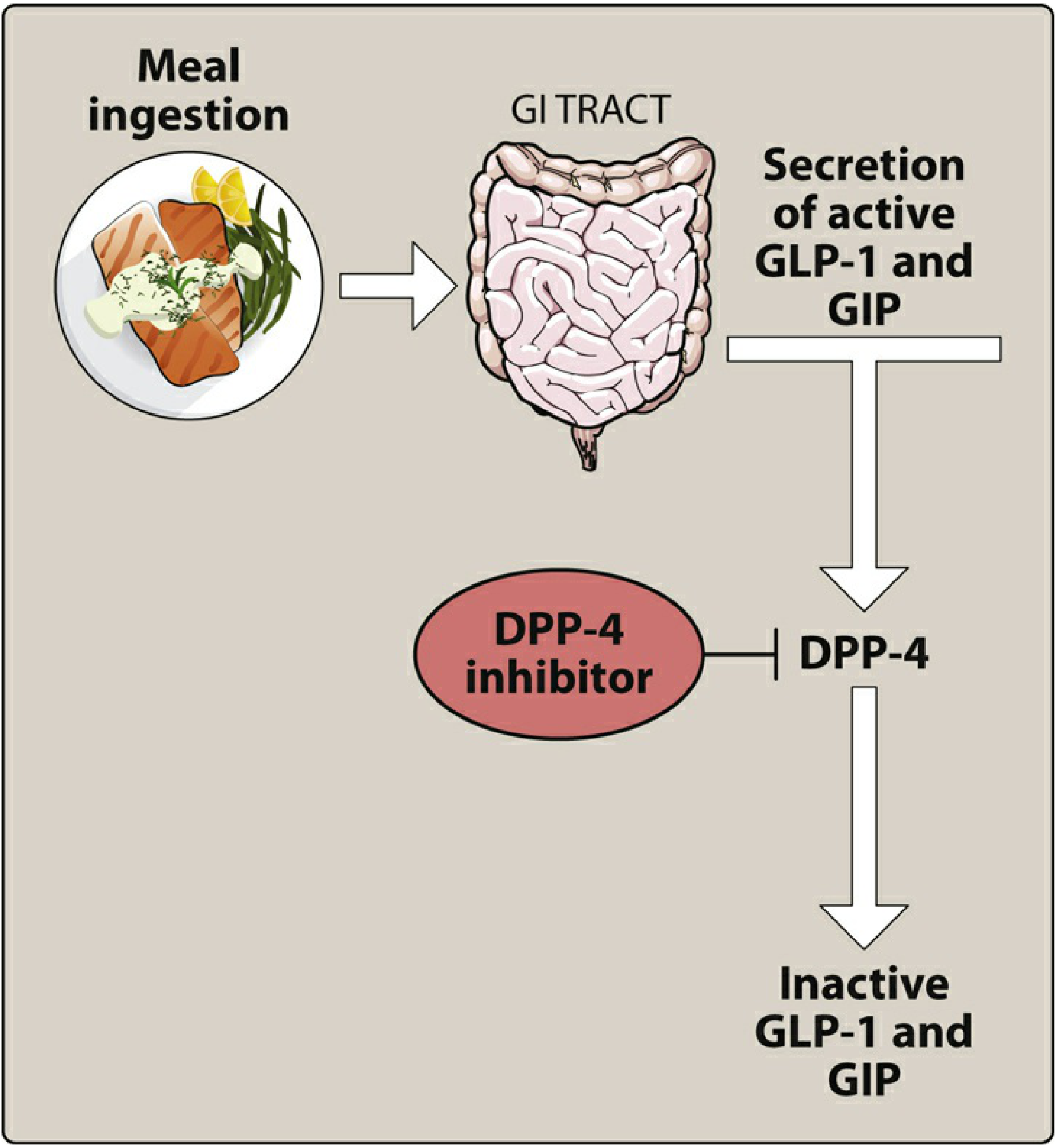
DPP-4 inhibitor mechanism (Lippincott Pharmacology)
| Drug | Elimination |
|---|---|
| Sitagliptin | Renal (unchanged) |
| Alogliptin | Renal (unchanged) |
| Linagliptin | Enterohepatic (NO renal dose adjustment needed) |
| Saxagliptin | Renal (CYP3A4/5 metabolite) |
Key points vs. GLP-1 agonists:
- Weight neutral (do not cause satiety)
- Do NOT combine with GLP-1 agonists (overlapping mechanism, increased toxicity risk)
- Saxagliptin increases risk of heart failure hospitalizations
- Common adverse effects: nasopharyngitis, headache; rare: pancreatitis, severe joint pain, hypersensitivity
- All except linagliptin require dose adjustment in renal dysfunction
5. Incretin Effect in Type 2 Diabetes
In T2DM, the incretin effect is significantly blunted:
- GLP-1 secretion is impaired (the primary defect)
- Beta-cell response to GIP is also impaired
- When GLP-1 is infused exogenously in T2DM patients, insulin response is preserved - supporting the therapeutic use of GLP-1 receptor agonists
6. Recent Evidence
A 2025 systematic review comparing incretin mimetics (PMID: 40212008) analyzed placebo-controlled trials across all currently approved agents. Additional recent meta-analyses have shown incretin-based therapies reduce blood pressure (PMID: 40899050, 2026) and benefit patients with heart failure and preserved/mildly reduced ejection fraction (PMID: 40497333, 2025).
Sources: Lippincott Illustrated Reviews Pharmacology, Katzung's Basic and Clinical Pharmacology 16th Ed., Tietz Textbook of Laboratory Medicine 7th Ed., Guyton & Hall Medical Physiology, Sleisenger & Fordtran's GI and Liver Disease, Robbins Pathologic Basis of Disease.
This is a shared conversation. Sign in to Orris to start your own chat.