
Create image Create a super aesthetic, handwritten-style revision note page for the topic: Pulmonary regurgitation • Make it look like neet pg exam notes written on a page (top view, clean layout, colorful headings, underlines, boxes). • Keep it crisp, high-yield, and exam-oriented. • Use clear headings and organize content like this (modify if needed for topic): ○ Definition ○ Etiology ○ Pathogenesis (flow/arrow style) ○ Clinical features ○ Radiographic features (if applicable) ○ Histopathology (if applicable) ○ Key features ○ Differential diagnosis ○ Management ○ Complications ○ Key points / last-minute revision box • Add simple important diagrams or labeled sketches wherever helpful. • Highlight important keywords. • Keep handwriting-style fonts, pastel colors, and clean spacing • Notes should be oriented from Harrison's (International Medicine textbook) • Add 3 tricky questions with answers which I should know about • Add 3 difficult questions for the exercise
A handwritten-style medical revision note page on "Pulmonary Regurgitation (PR)" for NEET PG exam preparation. Top-view of a clean white notebook page with colorful headings, underlines, boxes, arrows, and pastel highlights. Handwriting-style fonts throughout. Organized into the following sections with clear visual separation: TITLE at top: "PULMONARY REGURGITATION (PR)" in large bold blue handwriting with a double underline, surrounded by small stars. Section 1 - DEFINITION (green heading, underlined): "Backflow of blood from pulmonary artery → RV during diastole due to incompetent pulmonary valve" Section 2 - ETIOLOGY (orange heading, boxed): Two columns: PRIMARY: Congenital (absent/malformed valve), Endocarditis, Carcinoid tumor, Post-balloon valvuloplasty, Marfan syndrome, Rheumatic fever (rare). SECONDARY (Functional): Pulmonary HTN (MC cause) → annular dilation, Idiopathic PA dilation Section 3 - PATHOGENESIS (purple heading) with flow arrows diagram: "Pulmonary valve incompetence → Diastolic regurgitation of blood PA→RV → RV Volume Overload → RV Dilation & Hypertrophy → ↑ RV EDV → Eventually RV Dysfunction → Right Heart Failure" Section 4 - CLINICAL FEATURES (red heading, underlined): Symptoms: Usually ASYMPTOMATIC for long time | Exertional dyspnea, fatigue | Palpitations | Signs of right heart failure (late). Signs: RV heave/lift (parasternal lift) | Decrescendo diastolic murmur at LUSB (2nd-3rd left ICS) - "Graham Steell murmur" (in pulm. HTN) | P2 may be loud if pulm. HTN | JVP elevated | Hepatomegaly, edema (late). MURMUR highlight box: "Graham Steell Murmur = High-pitched decrescendo diastolic murmur at LUSB due to PR from pulmonary hypertension — INCREASES with INSPIRATION" Section 5 - INVESTIGATIONS (teal heading): ECG: RV hypertrophy, RBBB, right axis deviation. CXR: Cardiomegaly (RV enlargement), prominent PA. ECHO: Gold standard — shows regurgitant jet, RV dilation, RV function. CMR: Best for RV volume quantification. Cardiac Cath: Not routinely needed. Section 6 - MANAGEMENT (blue heading, boxed): Conservative: Treat underlying cause (especially pulm. HTN). Medical: Diuretics for RHF symptoms. Surgical/Interventional: Pulmonary valve replacement (PVR) — surgical or transcatheter (TPVR). Indications: Symptomatic severe PR + RV dysfunction, RV dilation (RVEDVI >160 mL/m²), QRS >180ms. Note: "TPVR = Transcatheter Pulmonary Valve Replacement (Melody/SAPIEN valves)" Section 7 - KEY POINTS / LAST MINUTE REVISION BOX (yellow sticky-note style): ★ MC cause = Pulmonary HTN (functional PR). ★ Graham Steell murmur = PR murmur in pulm. HTN. ★ Best investigation = ECHO; best for RV volumes = CMR. ★ PR is BEST TOLERATED of all valve regurgitations. ★ Carcinoid → right-sided valve lesions (PS + TR + PR). ★ RV volume overload is key pathophysiology. Section 8 - TRICKY Qs (pink box with question marks): Q1: Graham Steell murmur decreases in which position? - Sitting forward. Q2: Which valve regurgitation is best tolerated hemodynamically? - Pulmonary (PR). Q3: Carcinoid syndrome affects which side of heart? - RIGHT side (serotonin inactivated in lungs). Section 9 - EXERCISE Qs (light purple box): Q1: A patient post-TOF repair presents with exertional dyspnea and RV dilation — most likely diagnosis and next best investigation? Q2: Which finding on CMR would prompt pulmonary valve replacement in asymptomatic PR? Q3: Differentiate Graham Steell murmur from AR murmur — how to distinguish clinically? Small sketch in corner: Simple diagram of heart showing RV, pulmonary valve with regurgitant arrow (diastolic backflow), labeled "Diastole: PA → RV backflow". Clean pastel color scheme: soft blue, green, orange, pink, yellow highlights. Dense but organized layout with clear spacing.
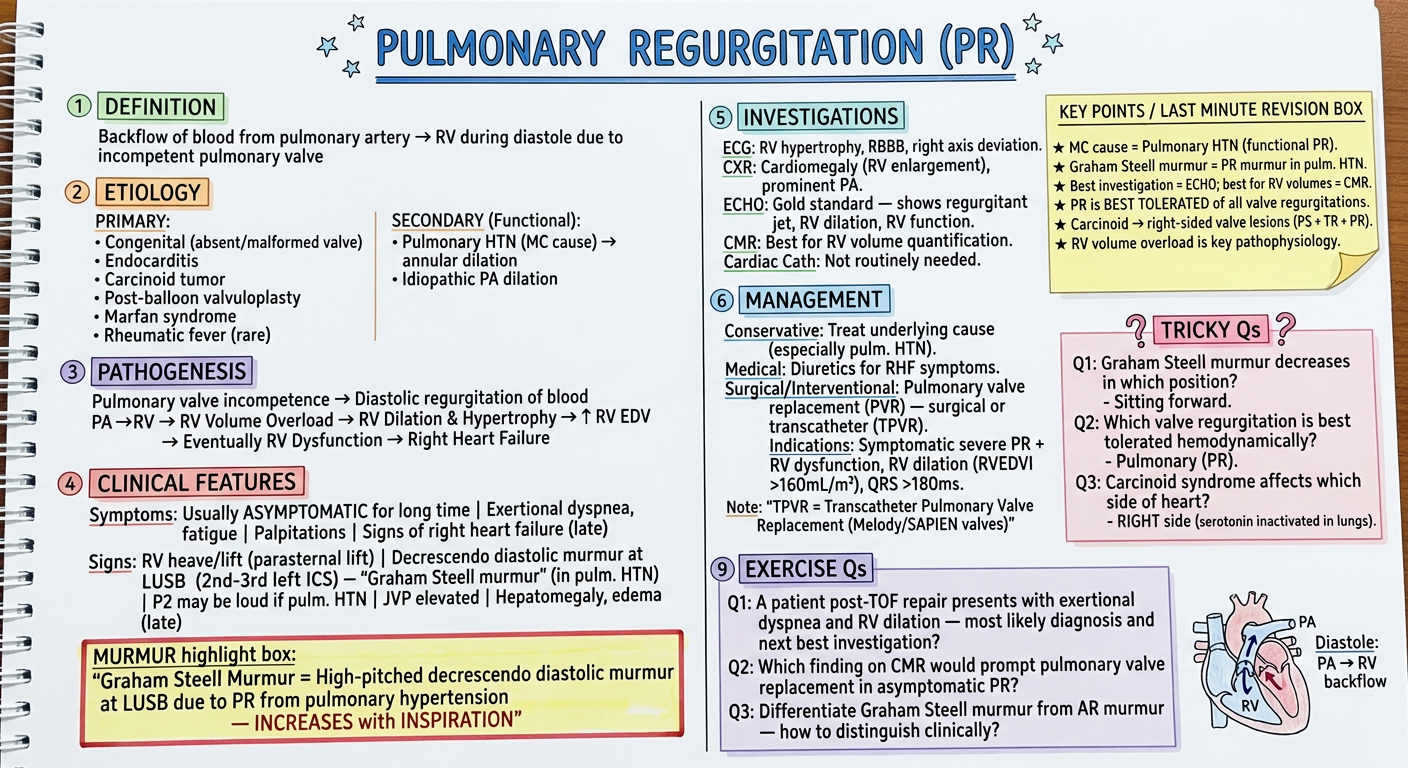
- Definition - Diastolic backflow from PA into RV due to incompetent pulmonic valve
- Etiology - Primary (congenital, endocarditis, carcinoid, Marfan, post-valvuloplasty) vs Secondary/Functional (pulmonary HTN - most common cause)
- Pathogenesis - Flow-arrow chain: valve incompetence → RV volume overload → RV dilation → RV dysfunction → RHF
- Graham Steell Murmur - High-pitched decrescendo diastolic murmur at LUSB, increases with inspiration, seen in functional PR from pulmonary HTN
- Management - Treat underlying cause; Pulmonary Valve Replacement (surgical or TPVR - Melody/SAPIEN) for severe symptomatic PR
- Graham Steell murmur and how to tell it from AR
- Which valve regurgitation is best tolerated? (Pulmonary)
- Why does carcinoid affect only right-sided valves? (Serotonin inactivated by lungs)
- Post-TOF repair patient with RV dilation - diagnosis + next investigation?
- CMR threshold for PVR in asymptomatic PR (RVEDVI >160 mL/m²)
- Clinical differentiation of Graham Steell murmur vs AR murmur