
Act of vomitting in simple
Vomiting is a reflex where the stomach forcefully expels its contents through the mouth. Here's how it works, simply:
Searching sources...
Reading File
Finding Sources
Finding Sources
Finding Sources
Reading File
Reading File
Finding Sources
Finding Sources
Reading File
Reading File
Reading File
Loading Image
Here is a simple, clear explanation of the act of vomiting:
The Act of Vomiting - Simply Explained
Vomiting (emesis) is the forceful expulsion of stomach contents through the mouth. It is a protective reflex coordinated by the brain.
Step 1 - Something Triggers the Brain
The brain has a "vomiting center" in the medulla (the lower part of the brainstem). It gets activated by signals from four main sources:
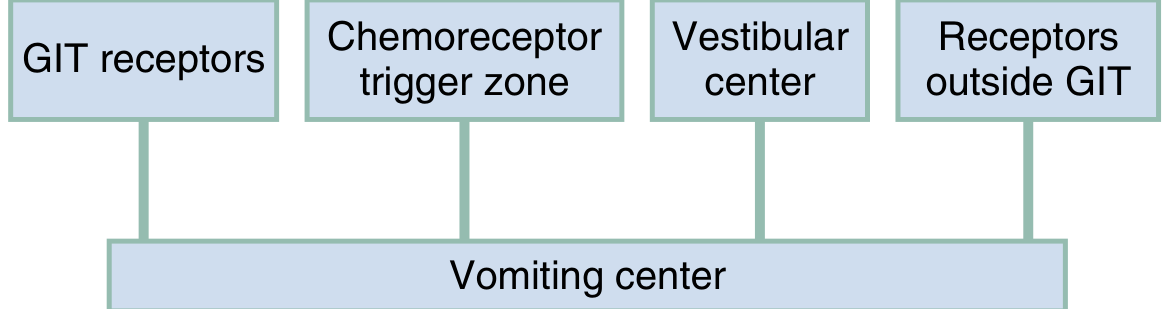
| Source | Example |
|---|---|
| GIT receptors (gut wall) | Stomach irritation, food poisoning |
| Chemoreceptor Trigger Zone (CTZ) | Drugs, toxins in the blood |
| Vestibular center (inner ear/balance) | Motion sickness |
| Receptors outside the GIT | Heart attack, kidney pain |
| Higher brain (cortex) | Seeing something disgusting, anxiety |
The CTZ is located at the floor of the 4th ventricle in the brain. It sits outside the blood-brain barrier, so it can directly detect toxins or drugs circulating in the blood.
Step 2 - The Body Prepares
Once the vomiting center fires, the body gets ready in a coordinated sequence:
- Deep breath is taken
- Larynx and hyoid bone lift up - opens the upper esophageal sphincter
- Glottis (airway) closes - protects the lungs from inhaling vomit
- Soft palate rises - closes off the nose
Step 3 - The Squeeze (The Actual Vomiting Act)
This is the explosive part:
- The diaphragm contracts forcefully downward
- The abdominal muscles contract hard simultaneously
- This squeezes the stomach like a tube of toothpaste
- Intragastric (stomach) pressure shoots up
- The lower esophageal sphincter relaxes completely
- Stomach contents are blasted up through the esophagus and out the mouth
Think of it like squeezing a water balloon from below while opening the top.
Nausea vs. Vomiting
Nausea usually comes first. It is the conscious feeling of wanting to vomit - produced by subconscious excitation near the vomiting center in the medulla. Vomiting can sometimes happen without nausea (e.g., in raised intracranial pressure).
Nerves Involved
The vomiting center sends signals out through:
- Vagus nerve - to the stomach and esophagus
- Phrenic nerve - to the diaphragm
- Spinal nerves - to the abdominal muscles
Rumination vs. Vomiting
Rumination is not vomiting. It is when stomach contents quietly dribble back into the mouth without force, without muscle contraction, and sometimes voluntarily.
Sources: Guyton and Hall Textbook of Medical Physiology; Rosen's Emergency Medicine
This is a shared conversation. Sign in to Orris to start your own chat.