
2.Presynaptic inhibition -advantage mbbs 1st year physiology
Reading File
Finding Sources
Finding Sources
Reading File
Reading File
Reading File
Loading Image
Reading File
Reading File
Here is a comprehensive MBBS 1st year physiology note on Presynaptic Inhibition and its advantages:
Presynaptic Inhibition
Definition
Presynaptic inhibition is inhibition that occurs at the presynaptic terminal before a signal ever reaches the postsynaptic neuron — it reduces or prevents neurotransmitter release from an excitatory nerve ending.
"Actions at the presynaptic nerve terminal can either reduce (presynaptic inhibition) or enhance (presynaptic facilitation) neurotransmitter release as a mechanism to fine-tune the strength of synaptic transmission." — Ganong's Review of Medical Physiology
Anatomical Basis — Axoaxonal Synapse
- Presynaptic inhibition is mediated by an inhibitory interneuron whose terminal sits on top of the excitatory presynaptic terminal → forms an axo-axonic synapse
- This is structurally distinct from postsynaptic inhibition (where the inhibitory neuron acts on the cell body/dendrites of the postsynaptic neuron)
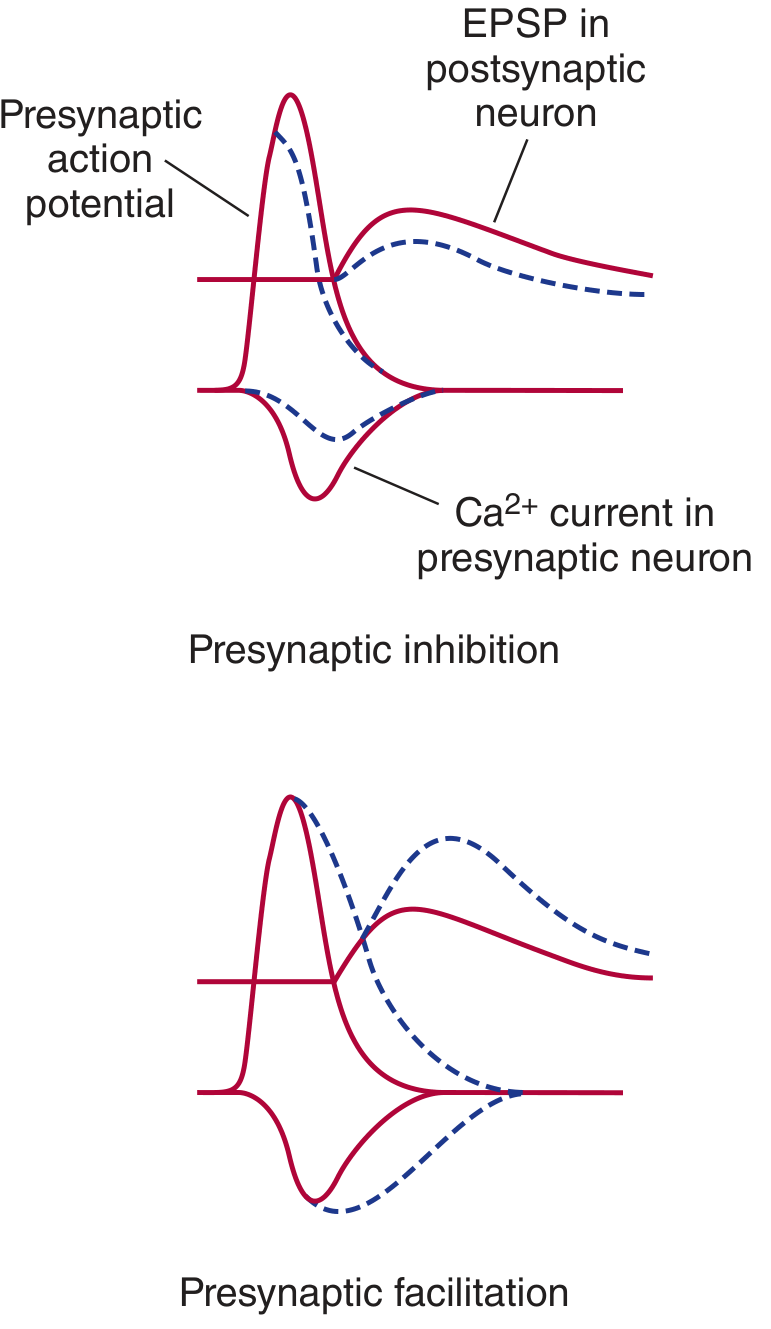
Mechanism
The principal transmitter is GABA, acting via:
| Receptor | Effect | Result |
|---|---|---|
| GABA-A | ↑ Cl⁻ conductance → Cl⁻ influx into terminal | Depolarization of the terminal; inactivates Na⁺ channels; reduces amplitude of arriving action potential |
| GABA-B | G-protein → ↑ K⁺ conductance + ↓ Ca²⁺ channel opening | K⁺ efflux reduces Ca²⁺ influx |
Net effect: ↓ Ca²⁺ entry → ↓ neurotransmitter vesicle release → smaller or absent EPSP in the postsynaptic neuron.
(Guyton & Hall: "GABA opens anion channels, allowing large numbers of chloride ions to diffuse into the terminal fibril. The negative charges cancel much of the excitatory effect of Na⁺ ions.")
Comparison with Postsynaptic Inhibition
| Feature | Presynaptic Inhibition | Postsynaptic Inhibition |
|---|---|---|
| Site of action | Presynaptic terminal (axoaxonal) | Postsynaptic cell body/dendrites |
| Mechanism | ↓ Neurotransmitter release | Hyperpolarization of postsynaptic membrane (IPSP) |
| Transmitter | Mainly GABA | GABA, Glycine |
| Selectivity | Highly selective (one input pathway at a time) | Less selective (whole neuron inhibited) |
| Effect on postsynaptic neuron | No direct effect on resting potential | Produces IPSP |
Advantages of Presynaptic Inhibition ⭐
These are the high-yield exam points:
1. Highly Selective Inhibition
Presynaptic inhibition can suppress one specific input to a neuron while leaving all other inputs fully functional. Postsynaptic inhibition, by contrast, suppresses the entire neuron indiscriminately. This selectivity allows the nervous system to "gate" individual channels of information.
2. Signal Focusing / Lateral Inhibition
Adjacent sensory nerve fibers mutually inhibit one another via presynaptic inhibition. This minimizes sideways spread and mixing of signals in sensory tracts (e.g., sharpens the boundary of a tactile stimulus — similar to the concept of a "spotlight" effect).
(Guyton & Hall: "adjacent sensory nerve fibers often mutually inhibit one another, which minimizes sideways spread and mixing of signals in sensory tracts.")
3. Modulation of Sensory Input During Movement
The nervous system predicts and suppresses expected sensory feedback during voluntary movements using presynaptic inhibition of Ia afferents:
- Presynaptic inhibition of Ia axons on antagonist motor neurons is increased at onset of agonist contraction → helps smooth coordinated movement
- Presynaptic inhibition of Ia axons on agonist motor neurons is reduced → allows efficient activation
- This prevents re-afferent signals from "confusing" the motor system during planned movements.
4. Pain Gate Control
Descending pathways terminate on afferent pathways in the dorsal horn via presynaptic inhibition. This is the anatomical basis for the gate control theory of pain — higher centers can suppress pain transmission by presynaptically inhibiting primary pain afferents.
(Ganong: "Presynaptic inhibition due to descending pathways that terminate on afferent pathways in the dorsal horn may be involved in the gating of pain transmission.")
5. Prevents Excessive / Oscillatory Feedback
Presynaptic inhibition stabilizes movement execution by preventing excessive sensory feedback and self-reinforcing oscillatory activity that could otherwise cause tremors or uncontrolled reflex loops.
(Kandel, Principles of Neural Science: "presynaptic inhibition may help stabilize the execution of movements by preventing excessive sensory feedback and associated self-reinforcing oscillatory activity.")
6. Regulates Gain of Reflex Arcs
By controlling how much signal reaches the synapse, presynaptic inhibition acts like a volume knob — adjusting the "gain" of reflex pathways without changing the excitability of the postsynaptic neuron itself.
Clinical Relevance
- Baclofen (GABA-B agonist) mimics presynaptic inhibition → used to treat spasticity in spinal cord injury and multiple sclerosis (administered intrathecally via implanted pump).
- Benzodiazepines / barbiturates enhance GABA-A-mediated Cl⁻ conductance → used as anxiolytics, sedatives, anticonvulsants.
Summary Table
| Point | Key Fact |
|---|---|
| Location | Axoaxonal synapse on excitatory terminal |
| Main transmitter | GABA |
| Mechanism | ↓ Ca²⁺ → ↓ NT release |
| Main advantage | Selective inhibition of specific inputs |
| Clinical drug | Baclofen (GABA-B agonist) |
| Role in sensation | Lateral inhibition, sharpens sensory signals |
| Role in movement | Suppresses predicted sensory feedback |
| Role in pain | Gate control (dorsal horn) |
Sources:
- Guyton and Hall Textbook of Medical Physiology, Ch. 46
- Ganong's Review of Medical Physiology, 26th Ed., Ch. 6
- Kandel's Principles of Neural Science, 6th Ed., Ch. 32
This is a shared conversation. Sign in to Orris to start your own chat.