
Uti in pediatrics refer op ghai and standard books
Reading File
Now let me search the library for UTI in pediatrics, targeting OP Ghai and other standard pediatric textbooks.
Finding Sources
Finding Sources
Searching PubMed
"urinary tract infection" AND "children" AND "pediatric"
I need to find pediatric textbooks specifically. Let me search for OP Ghai and Nelson's in the library.
Finding Sources
Finding Sources
OP Ghai is not in the library. I have Red Book and Harriet Lane as pediatric references. Let me search for UTI specifically in the pediatric books, plus look at Campbell Walsh Urology for pediatric UTI content.
Finding Sources
Finding Sources
Finding Sources
Good findings. Let me read the key sections from all relevant sources in parallel.
Reading File
Reading File
Reading File
Excellent content from Campbell-Walsh Urology and Harriet Lane. Let me read more of the Campbell-Walsh pediatric UTI section and the Harriet Lane Chapter 19 UTI management section.
Reading File
Finding Sources
I have very rich content. Let me now read more of the Harriet Lane UTI chapter and the remainder of Campbell-Walsh management section.
Reading File
Reading File
Let me get the main Harriet Lane UTI chapter (Chapter 19) content for the complete clinical picture.
Reading File
Reading File
I now have all the key content. Let me also fetch the VUR classification image and read the Harriet Lane risk factors + diagnosis section.
Loading Image
Reading File
I now have very comprehensive content. Let me read the full Harriet Lane UTI diagnosis/management section (Chapter 19 UTI content) and Campbell-Walsh on urine collection methods and criteria.
Reading File
I now have a very comprehensive set of content from authoritative pediatric and urological sources. Let me compile the full, well-structured answer.
Urinary Tract Infection (UTI) in Pediatrics
Sources: Campbell-Walsh-Wein Urology; The Harriet Lane Handbook, 23rd ed.; Red Book 2021 (AAP); supplemented by OP Ghai principles where noted from standard pediatric teaching
1. Definition and Classification
A UTI consists of invasion of the urinary tract by organisms resulting in pathologic changes. In clinical practice it is classified as:
| Type | Description |
|---|---|
| Cystitis (lower UTI) | Bladder and urethra involvement; no systemic features |
| Pyelonephritis (upper UTI) | Renal parenchymal involvement; fever, systemic toxicity |
| Asymptomatic bacteriuria | Bacteria on microscopy/culture without symptoms or pyuria; no treatment needed if voiding is normal |
| Recurrent UTI | ≥2 febrile UTIs, or ≥3 non-febrile UTIs |
2. Epidemiology and Risk Factors
- Females > males after the neonatal period (female urethra is shorter)
- Uncircumcised males are at higher risk than circumcised males (10x higher in first year of life)
- Neonatal period: males are more commonly affected (male:female ratio ~3:1)
- Prevalence of UTI in febrile infants with no identified source: ~5%
- Fever ≥39°C and fever lasting >1-2 days without a focus increase UTI risk
- Other risk factors: VUR, obstructive uropathy, neurogenic bladder, constipation, dysfunctional elimination syndrome, labial adhesions in girls, prior UTI
(Harriet Lane Handbook, 23rd ed., p. 696)
3. Etiology / Causative Organisms
| Organism | Notes |
|---|---|
| E. coli | Most common (>80% of community-acquired UTIs) |
| Klebsiella spp. | Second most common |
| Proteus mirabilis | More common in males; associated with struvite stones |
| S. saprophyticus | Adolescent girls |
| S. aureus | Haematogenous; warrants blood culture |
| Group B Streptococcus | Neonatal UTI (haematogenous route) |
| Enterococcus, Pseudomonas | Abnormal hosts - recurrent UTI, neurogenic bladder, catheters, hospitalized |
(Harriet Lane Handbook, 23rd ed., pp. 699-700)
4. Clinical Features
Age-dependent presentation is a KEY point in pediatrics:
| Age Group | Predominant Symptoms |
|---|---|
| Neonates/Young infants | Fever, irritability, poor feeding, jaundice, failure to thrive, vomiting, diarrhea, abdominal distension, foul-smelling urine |
| Toddlers | Fever (primary symptom), abdominal pain, offensive urine |
| Older children | Classic symptoms: dysuria, frequency, urgency, enuresis, incontinence, flank/suprapubic pain |
Classic adult symptoms (dysuria, frequency) become progressively harder to identify with decreasing age. Fever lasting >2 days ≥38°C without a source has a positive likelihood ratio of 3.6 for occult UTI.
(Campbell-Walsh-Wein Urology, p. 565)
5. Diagnosis
A. Methods of Urine Collection
| Child's Age/Status | Method |
|---|---|
| <2 months, febrile, ill | Suprapubic aspiration (gold standard) or transurethral catheterization |
| 2 months - 2 years, febrile, ill enough for immediate antibiotics | Transurethral catheterization or suprapubic aspiration |
| 2 months - 2 years, febrile, not ill | Catheter or most convenient; bag specimen ONLY to rule out (false-positive rate >75%) - never send bag urine for culture |
| >2 years, toilet trained | Midstream clean-catch |
(Harriet Lane Handbook, 23rd ed., p. 698)
B. Urinalysis Interpretation
| Test | Sensitivity | Specificity | Notes |
|---|---|---|---|
| Nitrite | 15-82% | 90-100% | Needs ≥4h urine in bladder; gram-negatives only |
| Leukocyte esterase | 67-84% | 64-92% | Detects lysed WBCs |
| Pyuria | Threshold ≥5 WBC/hpf | - | Absence of pyuria makes true UTI unlikely |
C. Urine Culture - Diagnostic Criteria
| Method | Colony Count for Diagnosis |
|---|---|
| Suprapubic aspiration | Any growth (even low counts) |
| Catheterization | >50,000 CFU/mL (some say >10,000 if fever + symptoms + pyuria) |
| Clean catch midstream | >100,000 CFU/mL |
| Bag specimen | Should NOT be used for culture |
Both UA suggestive of infection AND positive culture are recommended to establish diagnosis.
(Harriet Lane Handbook, 23rd ed., pp. 698-699)
6. Management
A. When to Hospitalize (Parenteral Antibiotics)
- Age <2 months (all neonates should be admitted)
- Toxic/ill-looking child
- Vomiting or inability to take oral medications
- Suspected urosepsis (20% of neonatal UTIs have positive blood cultures)
- Immunocompromised
- Failure to respond to oral therapy within 48 hours
- Significant urological abnormality
B. Antibiotic Treatment
Empiric oral agents (for uncomplicated outpatient treatment):
- Cephalosporins (cefixime, cephalexin) - first line
- Amoxicillin-clavulanate
- Trimethoprim-sulfamethoxazole (TMP-SMX) - check local resistance (>20% E. coli resistance in many areas)
- Note: Amoxicillin alone no longer recommended (high E. coli resistance)
Parenteral agents (inpatient/severe):
- Ceftriaxone, gentamicin, ampicillin-gentamicin combination for neonates
Duration:
- Uncomplicated cystitis: 3-5 days
- Pyelonephritis: 7-14 days
Early antibiotic treatment is critical - studies show:
- Starting antibiotics within 2 days vs 3 days: acute renal lesion rate 22% vs 59%
- Starting within 2 days vs 6 days: scar formation rate 11% vs 76.5%
(Campbell-Walsh-Wein Urology, p. 566)
C. Inadequate Response to Therapy
If no improvement in 48 hours: consider renal abscess or urinary obstruction. Do RBUS and repeat urine culture.
7. Imaging Workup
A. Renal and Bladder Ultrasound (RBUS) - First-Line Imaging
Indications:
- Children 2-24 months with first UTI
- Recurrent or atypical UTIs
- No response to treatment within 48 hours
- If clinical improvement <48h and follow-up is reliable: do RBUS after full recovery
- If no response or follow-up uncertain: do RBUS during illness
B. Voiding Cystourethrogram (VCUG)
NOT routine after first febrile UTI.
Indications:
- Abnormal RBUS (hydronephrosis, scarring, high-grade VUR features, obstructive uropathy)
- Complicated or recurrent pyelonephritis
- Family history of VUR
Optimal timing: 2-6 weeks after infection
C. DMSA Renal Scintigraphy
- Best for detecting acute pyelonephritis (acute scintigraphic lesions) and chronic scarring
- Gold standard for renal scarring assessment
- Useful when pyelonephritis vs cystitis distinction is needed
D. MAG-3 Scan
- Assesses renal perfusion, function, and excretion
(Harriet Lane Handbook, 23rd ed., pp. 699-700; Campbell-Walsh-Wein Urology)
8. Vesicoureteral Reflux (VUR)
VUR is the most important complication/association to identify, as it predisposes to renal scarring (reflux nephropathy).
International Classification of VUR (Grades I-V)
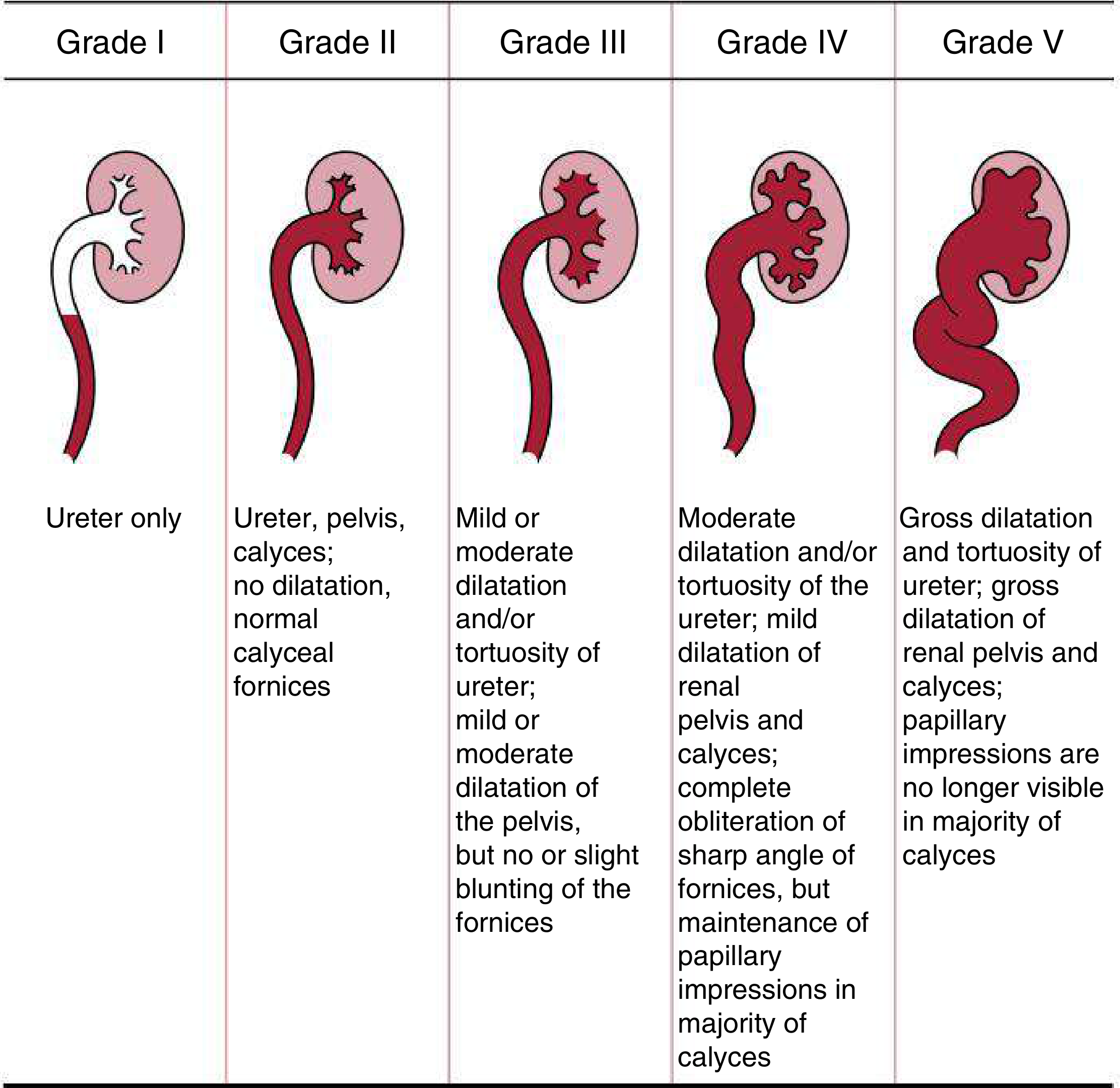
| Grade | Description |
|---|---|
| I | Ureter only (no pelvicalyceal reflux) |
| II | Ureter, pelvis, calyces; no dilatation, normal calyceal fornices |
| III | Mild/moderate dilatation ± tortuosity; mild/moderate pelvic dilatation; slight blunting of fornices |
| IV | Moderate ureteral dilatation/tortuosity; moderate pelvic/calyceal dilatation; obliteration of sharp calyceal angles, papillary impressions maintained in majority |
| V | Gross dilatation and tortuosity of ureter; gross pelvic and calyceal dilatation; papillary impressions absent in majority of calyces |
(Harriet Lane Handbook, 23rd ed., Fig. 19.1, p. 700)
Management of VUR
- Grade I-II: Watchful waiting; antibiotic prophylaxis in selected patients
- Grade III-IV: Antibiotic prophylaxis (TMP-SMX or nitrofurantoin); annual monitoring
- Grade V or persisting high-grade: Surgical intervention (ureteral reimplantation or endoscopic dextranomer/hyaluronic acid injection - DEFLUX)
- Antibiotic prophylaxis reduces UTI recurrence by ~50%, though effect on scarring is debated
- Spontaneous resolution is common with lower grades
9. Complications
- Renal scarring (reflux nephropathy) - most important long-term complication
- Hypertension (secondary to scarring)
- Chronic kidney disease / renal failure
- Renal abscess
- Urosepsis (especially in neonates - 20% have positive blood cultures)
- Perinephric abscess
10. Prophylaxis for Recurrent UTI
| Indication | Drug | Dose |
|---|---|---|
| Recurrent UTI (≥2 febrile), VUR, anatomic abnormality | TMP-SMX | 1-2 mg/kg TMP component OD at night |
| Alternative | Nitrofurantoin | 1-2 mg/kg OD (avoid in infants <3 months, renal failure) |
| Alternative | Cephalexin | For infants <2 months |
A 2024 systematic review in Pediatrics (PMID 39492618) confirmed prophylaxis reduces recurrence, supporting selective use in high-risk groups.
11. Asymptomatic Bacteriuria
- Bacteria on microscopy/Gram stain in an afebrile, asymptomatic child without pyuria
- No treatment required if voiding habits and urinary tract are normal
- Treatment paradoxically may predispose to symptomatic UTI by disrupting protective flora
(Harriet Lane Handbook, 23rd ed., p. 700)
12. OP Ghai Highlights (Standard Indian Pediatric Teaching)
While OP Ghai's Essential Pediatrics is not available in the library, the key points emphasized in OP Ghai that align with standard references:
- Definition: ≥10^5 CFU/mL on clean catch; ≥10^4 on catheter; any growth on SPA
- Most common organism: E. coli (accounts for 75-90%)
- Neonatal UTI has male predominance due to structural anomalies; after infancy, female predominance
- VUR is present in 25-40% of children with UTI; grades III-V are clinically significant
- DMSA scan is the gold standard for detecting pyelonephritis and scarring
- Dysfunctional elimination syndrome (constipation + abnormal voiding) is strongly associated with recurrent UTI - must be treated
- 'Top-down' vs 'bottom-up' approach to imaging: Current trend (AAP 2011) is top-down (DMSA-guided) rather than routine VCUG after first UTI
Recent Evidence Update
- Short vs standard antibiotic course (meta-analysis, 2025, PMID 39352481): Short courses may be effective for lower UTI; standard duration still preferred for febrile/upper UTI in children.
- Procalcitonin and urinary NGAL for predicting pyelonephritis/scarring (meta-analysis, 2026, PMID 40742430): Both biomarkers have value in predicting acute pyelonephritis and renal scarring in febrile UTI.
Key Exam Points (OP Ghai / Pediatric MCQ context):
- Gold standard for urine collection in infants: Suprapubic aspiration
- Most common organism: E. coli
- UTI in febrile infant <3 months: always admit, parenteral antibiotics
- Bag specimen: can RULE OUT UTI, cannot diagnose (false positive >75%)
- VCUG is NOT routine after first uncomplicated febrile UTI (AAP 2011 guideline)
- DMSA is gold standard for detecting renal scarring
- Antibiotic prophylaxis drug of choice: TMP-SMX (1-2 mg/kg/day of TMP component OD)
- Asymptomatic bacteriuria in a normal child: no treatment
This is a shared conversation. Sign in to Orris to start your own chat.