
Diaphragmatic hernia for pediatrics surgery everything
Reading File
Finding Sources
Finding Sources
The most comprehensive source appears to be
9780323828499 (with 8 paragraph blocks) and 9780443124341 (Sabiston, with multiple blocks). Let me read the richest sections in parallel.Reading File
Reading File
Excellent — I have very rich content from both sources. Let me now read the continuation of the Sabiston block (block29) for operative details, and also get the continuation of the first source for management details.
Reading File
I now have extremely comprehensive content from two authoritative sources. Let me compile the full answer.
Loading Image
Loading Image
I now have comprehensive, well-sourced content. Here is the full synthesis:
Congenital Diaphragmatic Hernia (CDH) — Pediatric Surgery
1. Definition & Overview
Congenital diaphragmatic hernia (CDH) is a structural defect occurring during embryonic life where abdominal organs herniate into the thorax through a diaphragmatic defect, leading to pulmonary hypoplasia and persistent pulmonary hypertension (PPH). It is not a single clinical entity — outcomes are accordingly diverse.
- Incidence: 1:2,000–5,000 births (some sources report 1:10,000–4:10,000)
- Survival: 65%–90% at major centers with modern management
- Isolated CDH: ~60% of cases; when associated with other anomalies, mortality >85%
— Sabiston Textbook of Surgery, p. 2675; Fanaroff & Martin's Neonatal-Perinatal Medicine
2. Embryology & Types
The diaphragm derives from:
- Septum transversum
- Pleuroperitoneal folds
- Components of the abdominal wall
- Dorsal mesentery
Fusion begins at 3–4 weeks gestation and is typically complete by 9 weeks. Incomplete fusion leads to:
| Type | Location | Frequency |
|---|---|---|
| Bochdalek (posterolateral) | Left (85%), Right (13%), Bilateral (2%) | 70%–75% |
| Morgagni (anterior/retrosternal) | Central/anterior | 23%–28% |
| Central | Central tendon | 2%–7% |
Bochdalek hernias are by far the most clinically significant in the neonatal period.
— Sabiston Textbook of Surgery, p. 2675
3. Pathophysiology
Once abdominal contents herniate into the thorax:
- Pulmonary hypoplasia — compression of the developing ipsilateral lung → fewer bronchial branches, reduced alveolar surface area; contralateral lung also affected
- Abnormal pulmonary vasculature — increased arteriolar smooth muscle thickness; hypersensitive to vasoactive stimuli
- Persistent pulmonary hypertension (PPH) — right-to-left shunting across PDA/PFO → severe hypoxemia
- Mediastinal shift — compresses the contralateral lung
The severity of pulmonary hypoplasia and PPH is the primary determinant of morbidity and mortality.
4. Prenatal Diagnosis & Prognostication
Diagnosis
- Routine ultrasound detects ~2/3 of cases prenatally, as early as 15 weeks gestation
- Sonographic findings at 22–24 weeks:
- Left-sided CDH: rightward cardiac/mediastinal shift, stomach/intestinal loops in chest, polyhydramnios
- Right-sided CDH: liver in right chest, leftward mediastinal shift, harder to diagnose (liver echogenicity similar to fetal lung)
- Liver herniation: difficult to distinguish sonographically; Doppler of umbilical vein/hepatic vessels helps
Differential Diagnosis (prenatal)
- CPAM, bronchogenic/enteric cysts, bronchopulmonary sequestration, bronchial atresia — no intra-abdominal organ displacement
Prognostic Markers
Lung-to-Head Ratio (LHR):
- Ratio of contralateral lung area to head circumference
- LHR < 1.0 → poor prognosis
- LHR > 1.4 → ~100% survival
Observed/Expected LHR (O/E LHR):
- Compares measured LHR to reference values for gestational age
- O/E LHR < 25% → survival < 20%
- More reliable than absolute LHR across gestational ages
Total Fetal Lung Volume (TFLV) by MRI:
- Used as supplement to ultrasound
- Predictive of mortality, ECMO use, and oxygen requirement at 30 days
Other poor prognostic factors:
- Liver herniation ("liver up")
- Right-sided CDH
- Associated cardiac or chromosomal anomalies
- Stomach herniation
— Sabiston Textbook of Surgery, p. 2715–2716; Fanaroff & Martin's Neonatal-Perinatal Medicine
5. Genetic Workup
- Genetic aberrations (trisomies, microdeletions, single-gene defects) occur in 6%–30% of CDH cases
- Array CGH / genome-wide comparative hybridization recommended
- ~30–40% of CDH cases have associated anomalies (congenital heart disease most common)
- Karyotyping + detailed fetal echo should be offered at diagnosis
6. Fetal Intervention — Fetal Endoscopic Tracheal Occlusion (FETO)
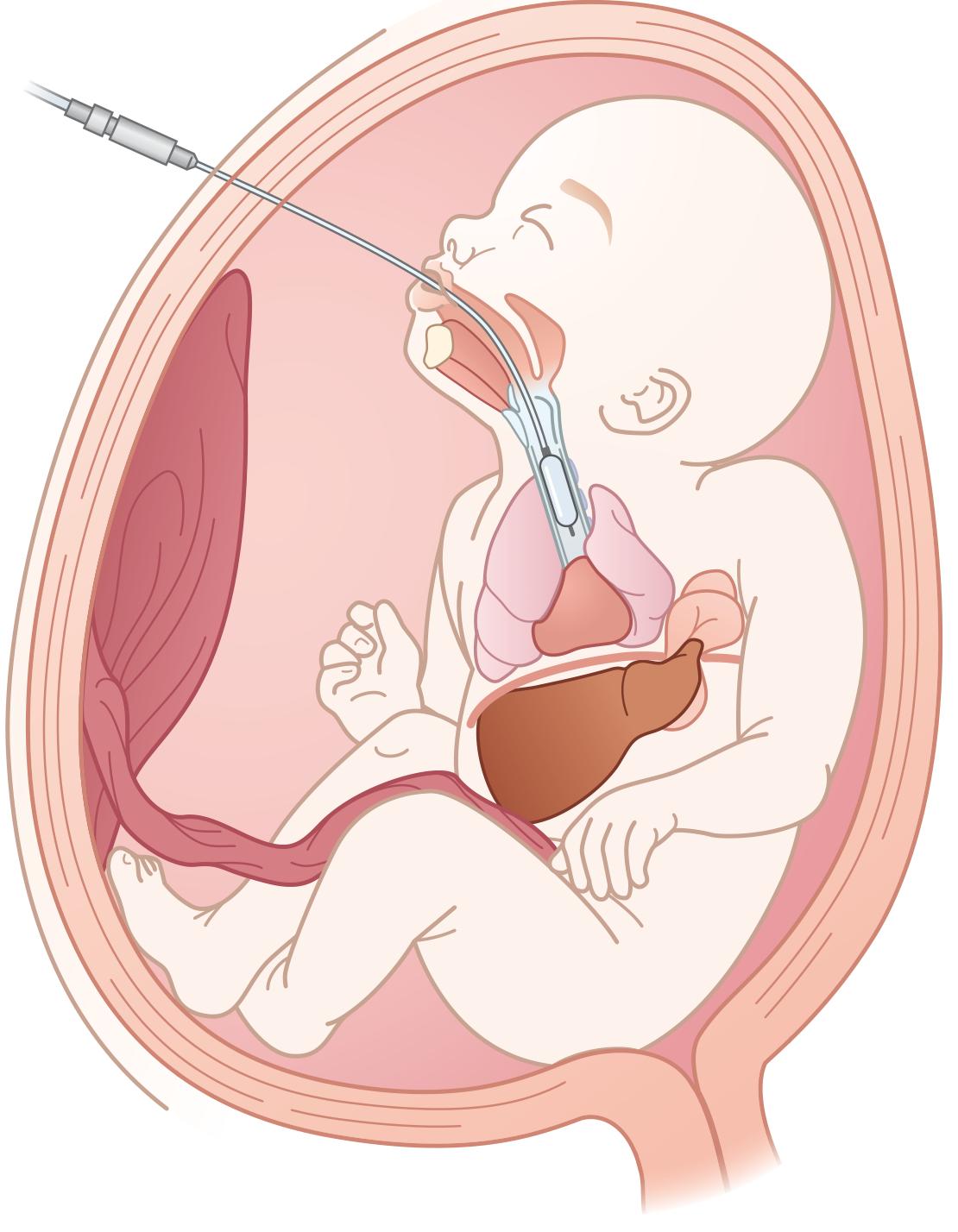
Rationale: Tracheal occlusion prevents egress of fetal lung fluid → fluid accumulation → lung growth and development
History:
- Open fetal CDH repair attempted in 1990s — no survival benefit over postnatal repair (even in severe cases) and increased prematurity risk
- Tracheal occlusion via metallic clip → tracheal stenosis, 15% survival
- Fetoscopic balloon (FETO) developed as minimally invasive alternative
The TOTAL Trials (landmark RCTs):
| Trial Arm | Criteria | Result |
|---|---|---|
| Severe TOTAL | O/E LHR <25% | 40% FETO survival vs. 15% expectant (stopped early for efficacy) |
| Moderate TOTAL | O/E LHR 25%–35% | No survival benefit vs. expectant management |
Current practice:
- FETO offered at select fetal centers for severe left-sided CDH (liver up + O/E LHR <25%)
- Balloon inserted fetoscopically at 27–29 weeks, removed at 34 weeks (or emergently if preterm labor)
- Main risk: preterm premature rupture of membranes (PPROM), preterm delivery
- Balloon must be removed before delivery to allow airway
— Sabiston Textbook of Surgery, p. 2716
7. Postnatal Clinical Presentation
Immediate neonatal presentation (Bochdalek):
- Respiratory distress at birth (tachypnea, grunting, cyanosis)
- Scaphoid abdomen (bowel in chest)
- Barrel-shaped chest
- Absent breath sounds on affected side (usually left)
- Bowel sounds auscultated in chest
- Heart sounds shifted to contralateral side
- NG tube coiling in chest on X-ray
Chest X-Ray findings:
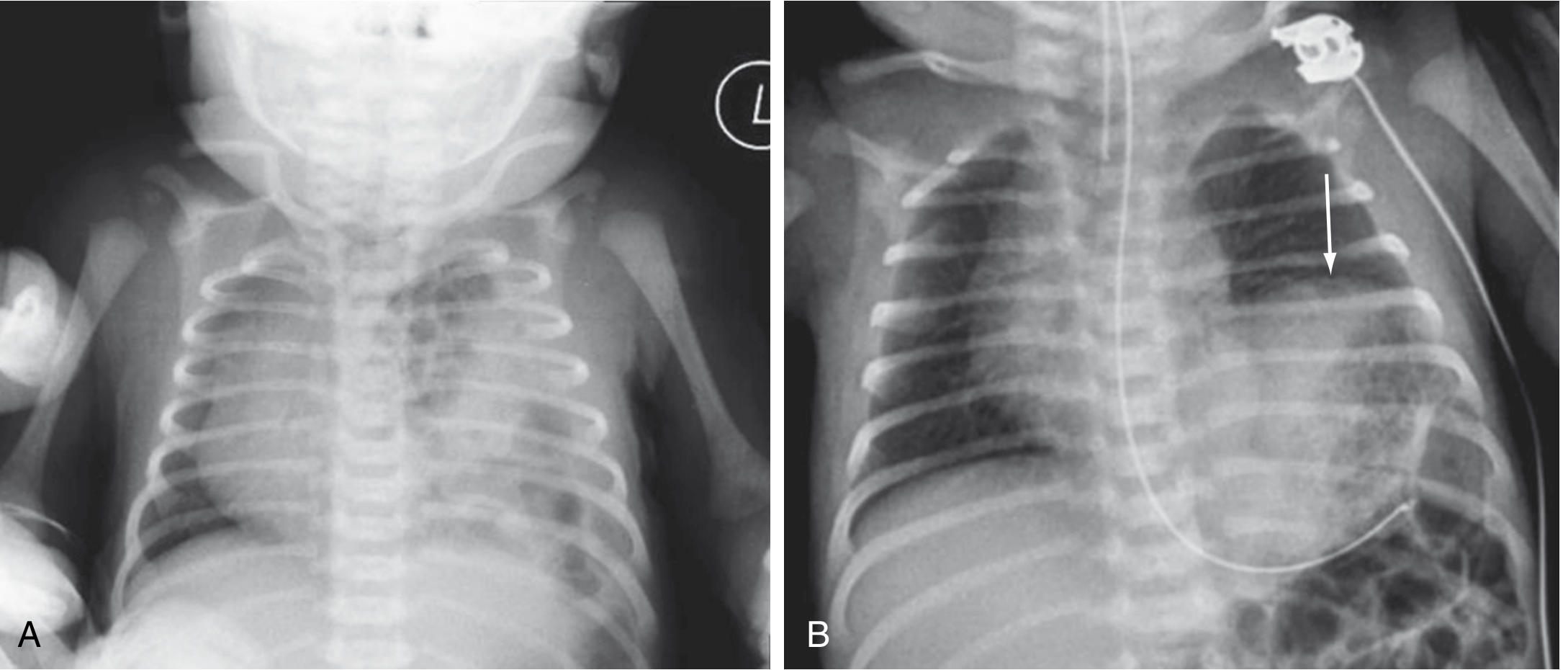
- Multiple gas-filled bowel loops in the hemithorax
- Mediastinal/cardiac shift to contralateral side
- Contralateral lung compression
- Paucity of bowel gas in abdomen
Delayed presentation (Morgagni / small Bochdalek):
- Can present weeks to years later with recurrent respiratory infections, GI symptoms, failure to thrive
8. Initial Stabilization & Resuscitation
Key principle: Stabilize FIRST, operate SECOND (surgery is not an emergency)
Airway & Ventilation
- Immediate intubation — avoid bag-mask ventilation (inflates herniated bowel → worsens lung compression)
- Gentle ventilation with low peak inspiratory pressures (PIP <25 cmH₂O) to prevent barotrauma to hypoplastic lungs
- Target: preductal SpO₂ 85%–95%, permissive hypercapnia (PaCO₂ 45–60 mmHg), preductal pH >7.25
- High-frequency oscillatory ventilation (HFOV) for refractory hypoxemia
Decompression
- Orogastric tube (Replogle) on suction — decompresses herniated bowel
Pulmonary Hypertension Management
- Inhaled nitric oxide (iNO): pulmonary vasodilator — first-line for PPH
- Sildenafil (PDE5 inhibitor): oral/IV pulmonary vasodilator
- Milrinone: inotrope + pulmonary vasodilator
- Avoid hypoxia, hypercarbia, acidosis, hypothermia — all worsen PPH
ECMO (Extracorporeal Membrane Oxygenation)
Indications when maximal medical therapy fails:
- Oxygenation index (OI) >40
- Unable to achieve preductal SpO₂ >85% despite iNO + maximal vent support
- VA-ECMO preferred (cardiac + respiratory support)
- VV-ECMO if cardiac function adequate
- Contraindications: severe pulmonary hypoplasia incompatible with survival, irreversible non-pulmonary conditions, gestational age <34 weeks / weight <2 kg (relative)
- Timing of surgery: can repair on ECMO or after decannulation — center-dependent
Target "Honeymoon Period"
After initial stabilization, a "honeymoon period" of relative improvement may occur before PPH worsens. Repair is planned once:
- Pulmonary hypertension is controlled/stabilized
- Ventilator settings are improving or stable
- iNO weaning initiated
- Adequate urine output
9. Surgical Repair
Timing
- NOT emergent — delay until physiologically stable (typically 24–72 hrs or longer)
- If on ECMO: may repair on ECMO to allow lung recovery
Approach
Open Repair:
- Subcostal (transabdominal) incision — most common in neonates; allows reduction of all herniated contents, patch repair if needed
- Thoracotomy approach: used in some right-sided CDH or for thoracoscopic approach
Minimally Invasive (Thoracoscopic/Laparoscopic) Repair:
- Increasingly used in hemodynamically stable, non-ECMO patients
- Advantages: less pain, faster recovery, smaller scars
- Risks: hypercapnia/acidosis from CO₂ insufflation in neonates with already compromised lungs, higher recurrence rates with patch repairs
Steps of Repair
- Reduce herniated abdominal contents back into abdomen
- Identify diaphragmatic defect margins
- Primary repair (preferred) — interrupted non-absorbable sutures if edges can be approximated without tension
- Patch repair (for large defects without adequate tissue) — using:
- Gore-Tex (PTFE) — most common synthetic patch
- Biological/acellular dermal matrix
- Muscle flap (latissimus dorsi, abdominal wall)
- Chest tube placement: controversial — most centers do NOT routinely place chest tubes to avoid mediastinal shift; if placed, kept on water seal (not suction)
- Gastrostomy: may be placed for anticipated feeding difficulties
Primary vs. Patch Repair
| Primary Repair | Patch Repair | |
|---|---|---|
| Indication | Small–moderate defects | Large defects, absent diaphragm |
| Recurrence | Low (~5%) | Higher (up to 50% for large patches) |
| Preferred material | Suture | Gore-Tex / bioprosthetic |
10. Postoperative Management
- Continue PPH management — do NOT expect immediate improvement
- Pulmonary hypertension may worsen 24–48 hrs post-repair (common)
- Continue iNO, sildenafil, milrinone as needed
- Extubation when off or minimal respiratory support
- Early enteral feeds (via NG or gastrostomy) once stable
- Watch for recurrence (especially with patch repairs)
11. Complications & Long-Term Morbidity
| Complication | Details |
|---|---|
| Pulmonary hypertension | Persists or recurs; may need chronic sildenafil |
| Bronchopulmonary dysplasia (BPD) | From barotrauma, O₂ toxicity |
| Gastroesophageal reflux (GER) | Very common (up to 50–80%); may need fundoplication |
| Feeding difficulties | Oral aversion, aspiration; often need G-tube |
| Hernia recurrence | 5% primary repair; up to 50% large patch repairs |
| Chest wall deformity | Scoliosis, pectus excavatum |
| Neurodevelopmental delay | Especially post-ECMO (sensorineural hearing loss, cognitive delays) |
| Intestinal obstruction | Malrotation, adhesions |
| Failure to thrive | Multifactorial |
12. Morgagni Hernia
- Anterior (retrosternal) defect through the foramen of Morgagni
- Usually presents later (beyond infancy) — often incidental or with recurrent chest infections, GI symptoms
- Less physiologically severe than Bochdalek
- CXR: anterior mediastinal mass or air-fluid levels in right cardiophrenic angle
- Repair: laparoscopic approach preferred; generally excellent outcomes
- Primary suture repair usually sufficient
13. Diaphragmatic Eventration
- Not a true hernia — thinned, non-muscularized diaphragm that paradoxically elevates with respiration
- Cause: phrenic nerve injury (birth trauma, cardiac surgery), developmental failure of muscularization
- May mimic CDH on imaging
- Management: plication of the diaphragm (open or thoracoscopic) when symptomatic
14. Survival & Prognosis Summary
| Factor | Better Prognosis | Worse Prognosis |
|---|---|---|
| Side | Right? | Left more common, bilateral worst |
| Liver position | Liver down | Liver up ("liver herniation") |
| O/E LHR | >35–45% | <25% |
| Associated anomalies | None (isolated) | Cardiac defect, chromosomal |
| ECMO requirement | Not needed | Required |
| Defect size | Small, primary repair | Large, requires patch |
Overall survival at experienced centers: 65%–90% (down from <50% in older era).
Sources:
- Sabiston Textbook of Surgery, 21st ed., Ch. 117 & 118 (pp. 2675–2716)
- Fanaroff & Martin's Neonatal-Perinatal Medicine, Ch. 34
This is a shared conversation. Sign in to Orris to start your own chat.