
Pharmacodynamic means
Pharmacodynamics is what a drug does to the body - covering mechanisms of action, receptor interactions, dose-response relationships, and drug effects. In contrast, pharmacokinetics is what the body does to the drug (absorption, distribution, metabolism, excretion).
Searching sources...
Reading File
Finding Sources
Reading File
Reading File
Finding Sources
Reading File
Loading Image
Pharmacodynamic of taste
The "pharmacodynamics of taste" refers to how taste-modifying substances (drugs, compounds) interact with taste receptors on the tongue to produce, alter, or block taste sensations. Taste perception involves receptor binding, signal transduction, and neural transmission - all classic pharmacodynamic processes.
Searching sources...
Finding Sources
Finding Sources
Reading File
Reading File
Reading File
Loading Image
Here is a thorough breakdown of the pharmacodynamics of taste - how tastant molecules (ligands) interact with specific receptors, activate signal transduction cascades, and ultimately generate the five recognized taste modalities.
Pharmacodynamics of Taste
Taste (gustation) is fundamentally a pharmacodynamic process: tastant molecules act as ligands, taste receptor cells (TRCs) carry the receptors, and binding triggers biochemical cascades that produce a nerve signal - exactly analogous to how a drug acts on a target receptor.
The Five Taste Modalities and Their Receptors
Each taste quality is mediated by a distinct receptor mechanism. There are two broad receptor types involved: ionotropic receptors (ligand-gated ion channels) and metabotropic receptors (G protein-coupled receptors, GPCRs).
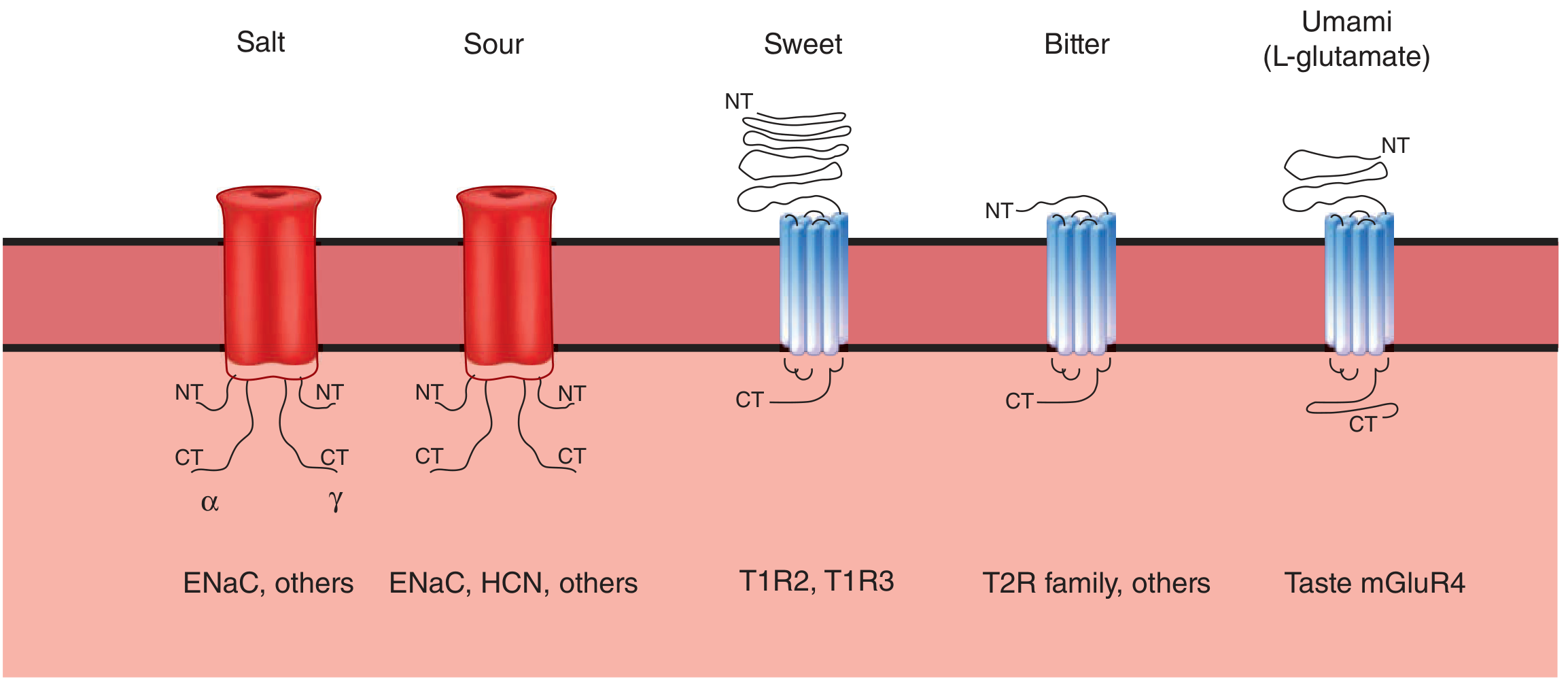
The five receptor types for the five taste modalities. Salt and sour use ionotropic channels; sweet, bitter, and umami use GPCRs.
1. Salt Taste
- Receptor: Epithelial sodium channel (ENaC) - an ionotropic receptor
- Mechanism: Na⁺ ions in salty food enter the taste cell directly through ENaC, depolarizing the membrane and generating a receptor potential
- Pharmacodynamic parallel: Na⁺ is the "agonist"; ENaC is the receptor; membrane depolarization is the effect
2. Sour Taste
- Receptor: ENaC + HCN (hyperpolarization-activated cyclic nucleotide-gated) channels + K⁺ channels
- Mechanism: Protons (H⁺) from acidic substances:
- Enter via ENaC directly
- Block K⁺-selective channels, reducing K⁺ permeability → membrane depolarization
- Activate HCN channels contributing additional depolarization
- Result: Multiple convergent mechanisms all depolarize the sour taste cell
3. Sweet Taste
- Receptor: T1R2/T1R3 heterodimer - a GPCR (metabotropic)
- Ligands: Sugars (sucrose, glucose), artificial sweeteners (saccharin, aspartame), sweet proteins (monellin, thaumatin), some D-amino acids
- Signal transduction:
- Tastant binds the large N-terminal extracellular domain of T1R2/T1R3
- Activates gustducin (the taste-specific G-protein)
- Raises cAMP and inositol phosphates (IP₃) → releases intracellular Ca²⁺ → depolarization
- Note: Sugars bind with low affinity (millimolar range), so only nutritionally significant concentrations trigger the response - a built-in threshold effect, as described in Principles of Neural Science, 6th Ed.
- Key pharmacological insight: IMP (inosine 5'-monophosphate) acts as a positive allosteric modulator of the T1R1/T1R3 (umami) receptor - a classic pharmacodynamic mechanism
4. Bitter Taste
- Receptor: T2R family (~25 different GPCRs in humans) - metabotropic
- Ligands: A wide variety of structurally unrelated compounds - quinine, strychnine, caffeine, many plant alkaloids and toxins
- Signal transduction:
- Many bitter tastants bind T2R GPCRs → activate gustducin → lower cAMP, increase IP₃ → Ca²⁺ release → depolarization
- Some compounds (e.g., quinine) are membrane-permeable and directly block K⁺ channels
- Evolutionary role: Bitterness signals potential toxins; the broad diversity of T2R receptors (each taste cell may express multiple T2Rs) maximizes detection of dangerous compounds
- Pharmacological relevance from Goodman & Gilman: Bitter taste receptor agonists (e.g., airway bitter taste receptors, TAS2Rs) are being studied therapeutically for bronchodilation and antimicrobial responses
5. Umami Taste
- Receptor: T1R1/T1R3 heterodimer (GPCR) + truncated metabotropic glutamate receptor mGluR4
- Primary ligand: L-glutamate (monosodium glutamate, MSG)
- Allosteric modulation: Purine nucleotides (IMP, GMP) act as strong positive allosteric modulators - they potentiate L-amino acid responsiveness of T1R1/T1R3, explaining why adding MSG + IMP to food dramatically enhances umami flavor
- Evolutionary importance: Umami detects proteins/amino acids, guiding consumption of nutritionally important foods
Summary Table
| Taste | Receptor Type | Receptor Name | Key Transduction Step |
|---|---|---|---|
| Salt | Ionotropic (ion channel) | ENaC | Na⁺ influx → depolarization |
| Sour | Ionotropic (ion channel) | ENaC, HCN, K⁺ channel block | H⁺ influx/channel block → depolarization |
| Sweet | GPCR (metabotropic) | T1R2/T1R3 | Gustducin → cAMP/IP₃ → Ca²⁺ → depolarization |
| Bitter | GPCR (metabotropic) | T2R family (~25 types) | Gustducin → IP₃ → Ca²⁺ → depolarization |
| Umami | GPCR (metabotropic) | T1R1/T1R3, mGluR4 | Gustducin → IP₃ → Ca²⁺ → depolarization |
Key Pharmacodynamic Concepts Applied to Taste
- Agonism: Tastants (sugars, glutamate, Na⁺) are the agonists that activate their respective receptors
- Antagonism: Some drugs can block taste receptors (e.g., gymnemic acid blocks sweet receptors; zinc sulfate can blunt taste)
- Allosteric modulation: IMP potentiates umami (positive allosteric modulator) - just as benzodiazepines potentiate GABA-A receptors
- Dose-response / threshold: A 30% change in tastant concentration is needed before an intensity difference is perceived (relatively crude discrimination). Taste threshold = minimum concentration needed to elicit perception
- Receptor saturation: At very high tastant concentrations, a plateau (maximum effect) is reached - identical to receptor saturation in classical pharmacodynamics
- Species differences in receptor pharmacology: Cats lack functional T1R2 (no sweet receptor); pandas lack umami receptor - illustrating receptor pharmacology varies between species, just as drug responses do
Sources: Ganong's Review of Medical Physiology, 26th Ed.; Eric Kandel's Principles of Neural Science, 6th Ed.; Goodman & Gilman's The Pharmacological Basis of Therapeutics
This is a shared conversation. Sign in to Orris to start your own chat.