
Types of dialyzer use in plasma exchange
Reading File
Finding Sources
Finding Sources
Finding Sources
Finding Sources
The best sources are in Brenner & Rector's Kidney and Henry's Clinical Diagnosis. Let me read the relevant sections.
Reading File
Reading File
Reading File
Reading File
I now have comprehensive information. Let me also fetch the diagram showing the centrifugal separator and membrane filtration systems.
Loading Image
Loading Image
Here is a comprehensive overview of the types of dialyzers (separation systems) used in plasma exchange (therapeutic plasmapheresis):
Plasma Separation Techniques in Plasma Exchange (TPE)
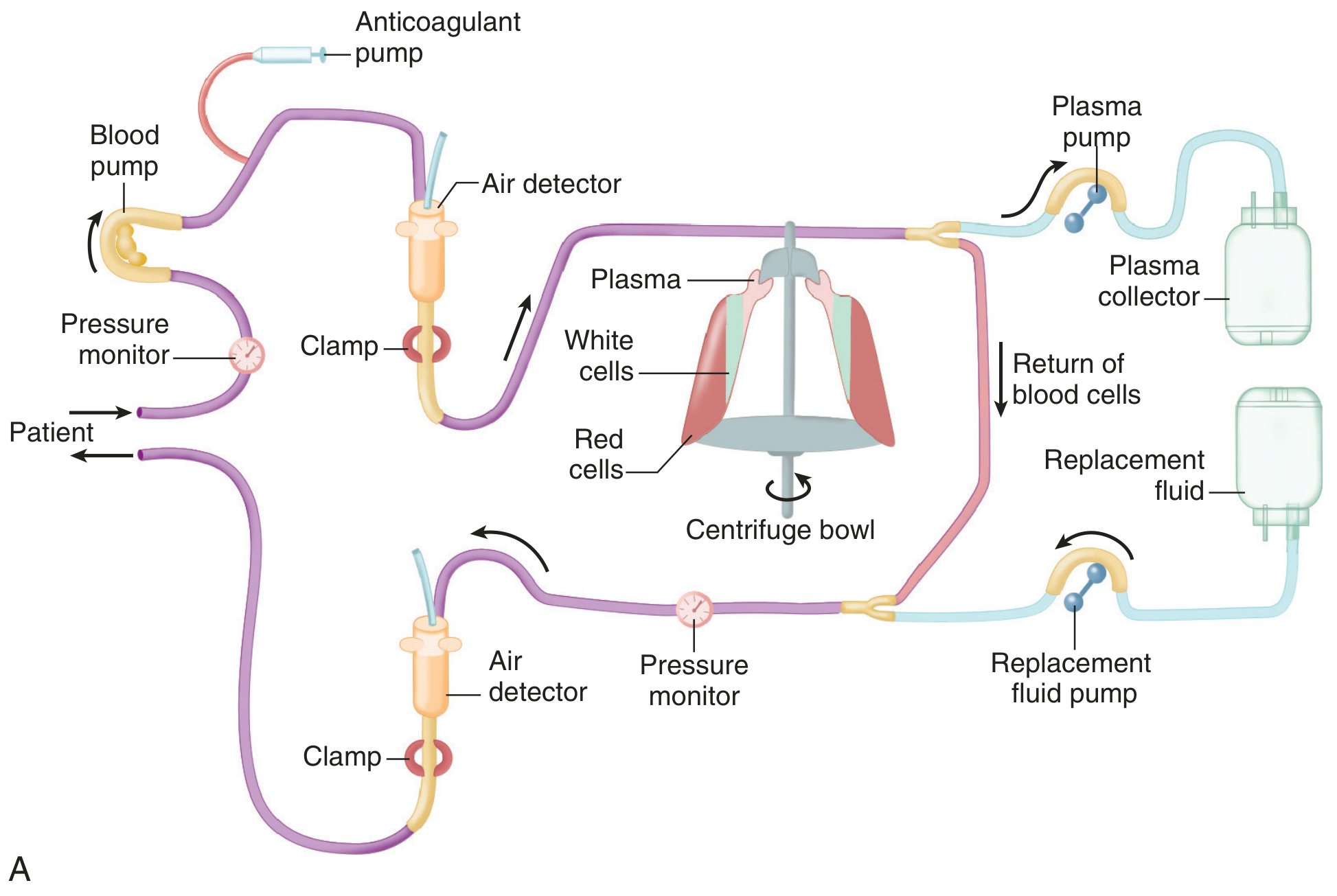
The two major modalities to separate plasma from blood during a TPE procedure are centrifugation and membrane filtration.
1. Centrifugation
Uses centrifugal force to separate whole blood into plasma and cellular fractions based on density.
A. Intermittent (Discontinuous) Centrifugation
- Sequential volumes of blood are removed and centrifuged in a bell-shaped rotating bowl
- Blood flow rate: up to 100 mL/min
- Denser cellular components are thrown against the lateral walls; plasma exits through a central outlet
- Each cycle removes ~500–700 mL of plasma; 5–6 cycles needed to achieve 2.5–4.0 L per session
- Advantages: Simple operation, portable, requires only a single-needle peripheral venipuncture
- Disadvantages: Slow (>4 hours per session), large extracorporeal volume per cycle
B. Continuous Flow Centrifugation
- Blood is pumped continuously into a rapidly rotating bowl; plasma and cells are separated simultaneously
- Cells + replacement fluid are returned to the patient in a continuous manner
- Advantages: Faster, more suitable for hemodynamically unstable patients
- Disadvantages: More costly, requires two venipunctures or a dual-lumen central venous catheter
2. Membrane Filtration (Membrane Plasmapheresis)
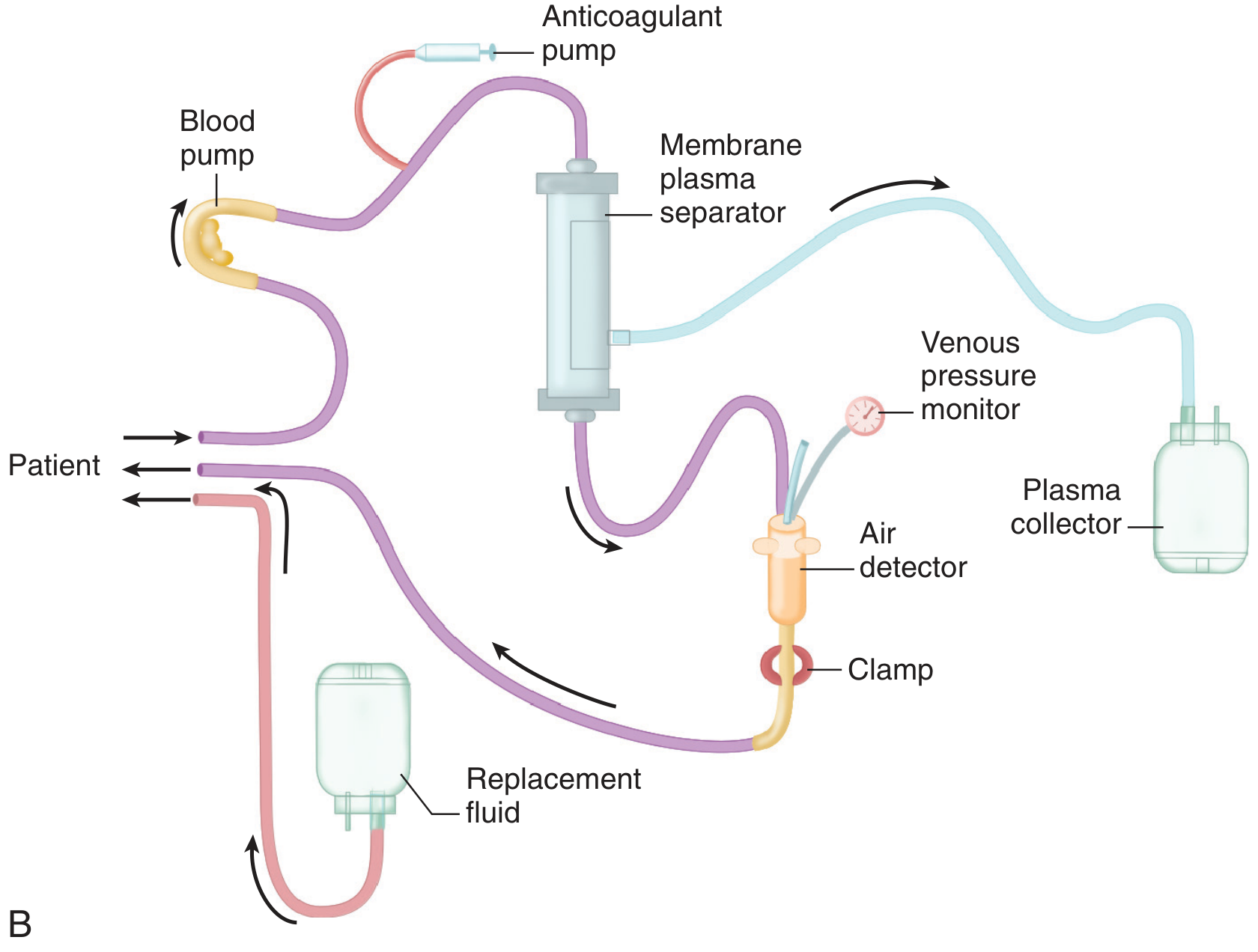
Uses a synthetic hollow-fiber membrane filter — similar in construction to a hemodialysis filter — but with larger pore sizes (0.2–0.6 μm diameter) to allow passage of plasma proteins while retaining blood cells.
- Blood is pumped through hollow fiber tubes at 100 (±20) mL/min
- Optimal transmembrane pressure: < 70 mm Hg
- Plasma removal rate: 30–50 mL/min
- Can be performed using conventional or continuous hemodialysis equipment
- If concurrent kidney failure is present, membrane filtration can be combined with standard hemodialysis
- Advantages: Can use existing HD equipment; compatible with dialysis
- Disadvantages: Requires a central venous catheter (to sustain >70 mL/min blood flow); risk of complement and leukocyte activation by the artificial membrane
3. Double Filtration Plasmapheresis (DFPP) / Cascade Filtration
A variation of membrane plasmapheresis using two sequential membrane filters:
- A primary filter separates plasma from cells (as above)
- The separated plasma then passes through a secondary filter with smaller pores or different adsorption characteristics
- High-molecular-weight proteins (e.g., pathological IgM, immune complexes) are discarded
- Low-molecular-weight substances including albumin are returned to the patient
- Only a small amount of albumin substitution fluid is needed, reducing replacement fluid requirements
4. Other Specialized Separation Modalities
| Technique | Principle | Application |
|---|---|---|
| Thermofiltration | Plasma filtration above physiologic temperature | Severe dyslipidemia |
| Cryofiltration | Plasma filtration below physiologic temperature | Removal of immunoglobulins, immune complexes |
| Immunoadsorption / Protein A columns | Affinity columns adsorb IgG and immune complexes | Autoimmune disease, ABO-incompatible transplant |
| Dextran sulfate columns | Negatively charged columns adsorb positively charged molecules | LDL and VLDL removal |
| Cytapheresis | Selective removal of leukocytes or platelets | Hyperleukocytosis, thrombocytosis, sickle cell crisis |
Summary Comparison
| Feature | Centrifugation | Membrane Filtration |
|---|---|---|
| Mechanism | Density separation | Pore-size filtration |
| Pore size | N/A | 0.2–0.6 μm |
| Blood flow | Up to 100 mL/min | 100 ± 20 mL/min |
| Venous access | Peripheral possible (intermittent) | Central catheter required |
| Can combine with HD | No | Yes |
| Membrane activation risk | No | Yes (complement, leukocytes) |
| Cost/expertise | Higher (continuous) | Lower (uses HD equipment) |
Both centrifugation and membrane filtration are safe and efficient; the main differences are cost and the expertise required to operate the equipment.
— Brenner and Rector's The Kidney, p. 2838–2840; Henry's Clinical Diagnosis and Management by Laboratory Methods, p. 912
Name of dialyzer
Based on the textbook content already retrieved, here are the names of the dialyzers/filters used in plasma exchange:
Names of Dialyzers Used in Plasma Exchange
1. Membrane Filtration (Plasmapheresis Filter)
- Plasmapheresis filter — the primary membrane filter (hollow fiber, pore size 0.2–0.6 μm) used to separate plasma from cells
- Also called: Membrane plasma separator
2. Double Filtration / Cascade Filtration
- Primary plasma separator — first filter (separates plasma from cells)
- Secondary filter — second membrane with smaller pores (separates high-MW from low-MW proteins)
3. Centrifugation-Based Devices (not dialyzers per se, but named machines)
- Fenwal CS3000 — centrifugation-based apheresis instrument
- COBE Spectra — continuous flow centrifugation apheresis machine
4. Adsorption Columns (used in immunoadsorption)
- Protein A column — removes IgG and immune complexes
- Dextran sulfate column — removes LDL, VLDL, and positively charged molecules
Key point: In membrane plasmapheresis, the filter is technically called a plasmapheresis filter (or plasma separator), not a "dialyzer" — a dialyzer has much smaller pores (for small solutes), whereas the plasmapheresis filter has large pores (0.2–0.6 μm) to allow whole plasma proteins to pass through.
— Brenner and Rector's The Kidney, p. 2838–2840
This is a shared conversation. Sign in to Orris to start your own chat.