
SAPE hypothesis swarts picture
The SAPE hypothesis (Savanna-based model of human evolution, also called the "Savanna-Ape" or "Savanna Hypothesis") is about human bipedalism evolving in open grasslands. However, "SAPE" more specifically refers to the Savanna Paleontological and Evolutionary context, and "Swarts picture" rings a bell in relation to a specific diagram or illustration.
Let me search for the exact reference you're looking for.
Searching sources...
Searching the Web
SAPE hypothesis Swarts picture diagram
Searching the Web
SAPE hypothesis paleoanthropology Swarts image illustration
The search results point clearly to the SAPE model in pancreatology (not paleoanthropology). Let me check the medical library for the SAPE hypothesis and the Swarts picture/diagram.
Reading File
Searching the Web
SAPE hypothesis sentinel acute pancreatitis Swarts picture diagram figure
Now I can clearly identify this. The SAPE hypothesis is by David C. Whitcomb, and "Swarts" likely refers to the figure/picture in Whitcomb's paper. Let me search the medical library for the SAPE content and also fetch the PMC article with the figure.
Finding Sources
Reading Web Page
https://pmc.ncbi.nlm.nih.gov/articles/PMC9421067
Found it in Schwartz's Principles of Surgery. Let me read that passage and also the Sleisenger textbook section which likely contains the "Swarts picture" (which is the Schwartz's textbook diagram).
Reading File
Reading File
I found the SAPE diagram from Schwartz's Principles of Surgery. The "Swarts picture" is the Schwartz's figure (Figure 33-19). Let me fetch that image now.
Loading Image
Here it is. "Swarts picture" = Schwartz's Figure 33-19 - the classic SAPE hypothesis diagram. Here is a full explanation:
SAPE Hypothesis - The "Schwartz's Picture" (Figure 33-19)
The Sentinel Acute Pancreatitis Event (SAPE) hypothesis was proposed by Whitcomb and colleagues to explain how a single episode of acute pancreatitis (AP) can trigger the progression to chronic pancreatitis (CP).
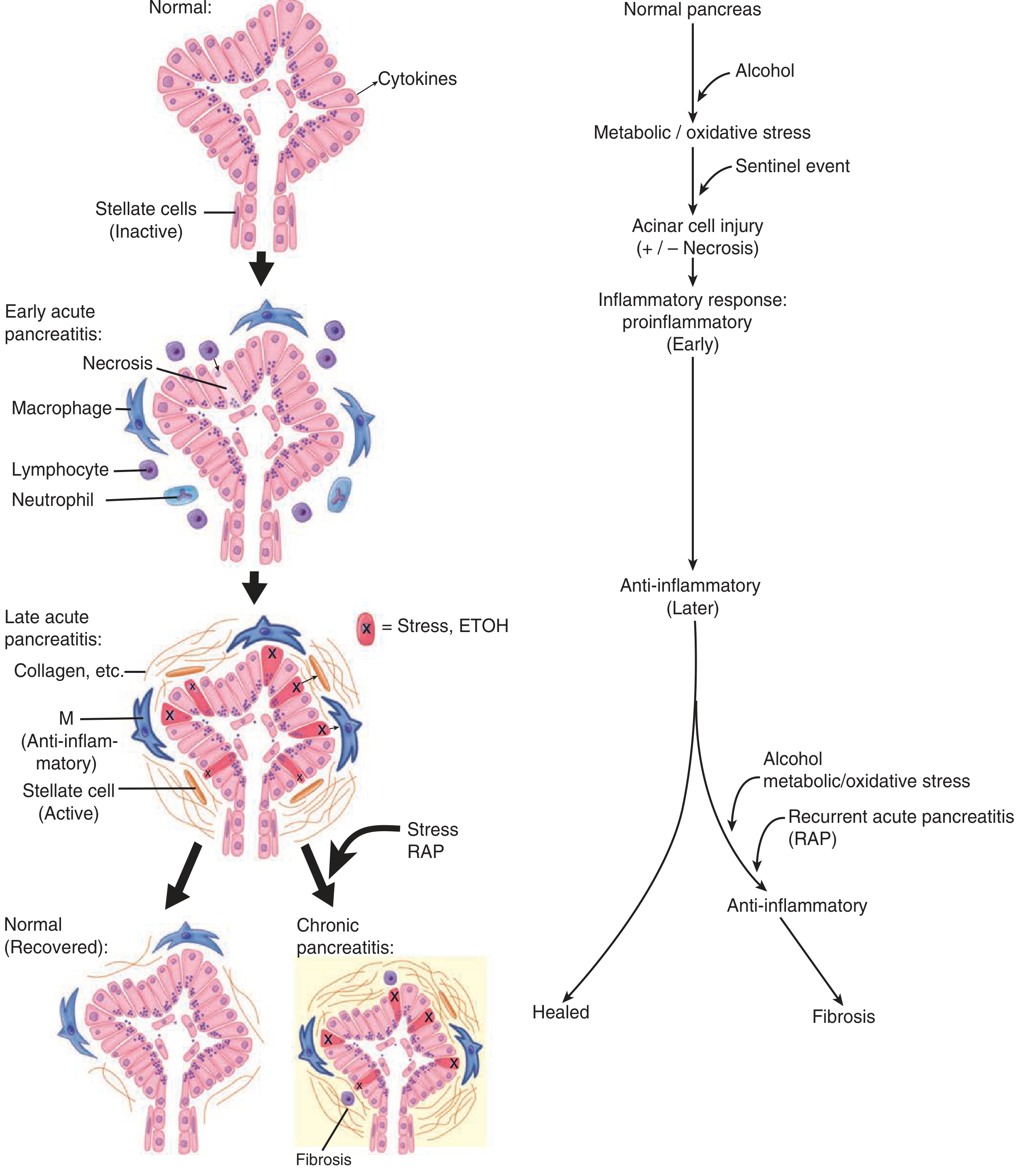
Figure 33-19 from Schwartz's Principles of Surgery, 11th ed. - The SAPE hypothesis (adapted from Schneider A, Whitcomb DC, Best Pract Res Clin Gastroenterol 2002)
What the diagram shows
Left side (cellular/morphological sequence):
| Stage | What happens |
|---|---|
| Normal pancreas | Acinar cells intact; stellate cells are inactive; cytokines at baseline |
| Early acute pancreatitis | A sentinel (first) AP episode causes acinar cell necrosis and recruitment of macrophages, lymphocytes, and neutrophils |
| Late acute pancreatitis | Anti-inflammatory macrophages (M2-type) persist; stellate cells become activated; they begin laying down collagen. Ongoing stress/ETOH (marked "X") continue to hit the sensitized gland |
| Two outcomes | (1) If the stressor is removed → Normal (recovered); (2) If stress/RAP continues → Chronic pancreatitis with fibrosis |
Right side (flowchart - mechanism):
- Normal pancreas
- Alcohol → Metabolic/oxidative stress + a Sentinel event (first AP attack)
- Acinar cell injury (+/- necrosis)
- Early proinflammatory response
- Later anti-inflammatory phase (shift from Th1 to Th2 macrophages)
- From here, two forks:
- If alcohol/oxidative stress/RAP continues → Anti-inflammatory response fails → Fibrosis
- If stressors are removed → Healed
Core concepts of the SAPE hypothesis
-
The "2-hit" model: The first AP episode (the "sentinel event") sensitizes the pancreas by activating resident/infiltrating immune cells and pancreatic stellate cells. The gland is now hypersensitive. A second hit (continued alcohol, another AP episode, smoking, genetic susceptibility) then triggers recurrent AP (RAP) and fibrosis.
-
Stellate cell activation is key: Cytokines released during the sentinel AP episode transform quiescent stellate cells into activated, collagen-secreting cells. This is the cellular basis of fibrosis.
-
Reversibility window: If the inciting factor (e.g., a drug or alcohol) is removed after the sentinel event, the pancreas can return to normal. If not removed, fibrosis continues - this is the rationale for early intervention and disease-modifying therapy.
-
Residual macrophages: Anti-inflammatory (M2/Th2) macrophages persist after the first AP episode throughout the parenchyma, and possibly cause epigenetic changes in acinar/duct cells that keep them pro-inflammatory, lowering the threshold for RAP.
-
Progression stages: Normal → SAPE (Stage B, the critical transition) → RAP → Early CP → Established CP → End-stage CP with exocrine/endocrine failure and risk of PDAC (pancreatic ductal adenocarcinoma).
Clinical significance
- The SAPE model explains why most CP patients have a history of prior AP and why RAP is the strongest proximal driver of CP.
- It defines an actionable window - after the sentinel event but before established fibrosis - where therapy (e.g., CFTR modulators, antioxidants, alcohol cessation) could prevent progression.
- The model is foundational to precision medicine approaches to CP, using the TIGAR-O classification (Toxic-metabolic, Idiopathic, Genetic, Autoimmune, Recurrent AP, Obstructive) to identify individual risk factors.
Sources: - Schwartz's Principles of Surgery, 11th ed., Fig. 33-19 | - Sleisenger & Fordtran's GI and Liver Disease | - Whitcomb DC, Front Pediatr 2022
This is a shared conversation. Sign in to Orris to start your own chat.