
Acute pancreatitis for 10 mark’s question
Reading File
Finding Sources
Finding Sources
The best sources are Sleisenger & Fordtran's (block14) and the Family Medicine textbook. Let me read the main content blocks in parallel.
Reading File
Reading File
I now have rich content. Let me also read the dedicated Sleisenger & Fordtran block for more clinical detail on management and severity scoring.
Reading File
That block was CF-related content. I already have excellent content from the Family Medicine textbook (block13) covering diagnosis, etiology, severity scoring, and management. Let me now compile the comprehensive answer from the content already retrieved.
Loading Image
I now have everything needed to write a comprehensive 10-mark answer. Here it is:
Acute Pancreatitis — 10-Mark Answer
Definition
Acute pancreatitis (AP) is a sudden inflammatory disease of the pancreas characterized by autodigestion of the gland by its own enzymes. Diagnosis requires at least two of the following three criteria:
- Abdominal pain consistent with the disease
- Serum amylase or lipase >3× the upper limit of normal
- Characteristic findings on abdominal imaging
— Textbook of Family Medicine 9e
Etiology (Causes) — "GET SMASHED"
| Category | Notes |
|---|---|
| Gallstones | Most common cause (>50% of cases); biliary sludge and microlithiasis included |
| Ethanol (Alcohol) | Second most common (~30%); may be a toxin or exacerbating factor |
| Hypertriglyceridemia | When triglycerides >1000 mg/dL with no gallstones/alcohol |
| Trauma | Blunt abdominal trauma; pancreas protected retroperitoneally |
| ERCP | Post-procedure pancreatitis; significant cause |
| Medications | Valproate, L-asparaginase, prednisone, 6-mercaptopurine, azathioprine, thiazides |
| Infections | Mumps, Coxsackievirus, EBV, Mycoplasma, ascariasis |
| Neoplasm | Consider in anyone >40 years with unexplained AP |
| Idiopathic | ~15% of cases |
| Metabolic | Hypercalcemia, renal failure |
| Structural | Pancreas divisum, bile/pancreatic duct anomalies |
Pathophysiology
The key initiating event is premature intracellular activation of pancreatic enzymes (especially trypsinogen → trypsin) within acinar cells, rather than in the duodenum. Activated trypsin triggers a cascade:
- Autodigestion of pancreatic parenchyma and peripancreatic fat
- Release of pro-inflammatory cytokines (IL-1, IL-6, TNF-α) → systemic inflammatory response
- In severe cases: parenchymal necrosis, fat necrosis, hemorrhage, and multisystem organ failure
Clinical Features
Symptoms:
- Severe, sudden-onset epigastric pain radiating to the back ("boring" pain)
- Pain worsens in supine position; relieved by leaning forward
- Nausea, vomiting, anorexia
- Fever
Signs:
- Epigastric tenderness, guarding, rigidity
- Cullen's sign — periumbilical ecchymosis (haemorrhagic pancreatitis)
- Grey-Turner's sign — flank ecchymosis
- Paralytic ileus, abdominal distension
- Jaundice (if biliary obstruction)
Investigations
Serum Enzymes
- Serum lipase — preferred marker; rises and falls more slowly than amylase; more specific
- Serum amylase — rises within 6–12 hours, returns to normal in 3–5 days; can be elevated in other conditions (e.g., salivary gland disease, perforated PUD)
- >3× ULN of either confirms diagnosis
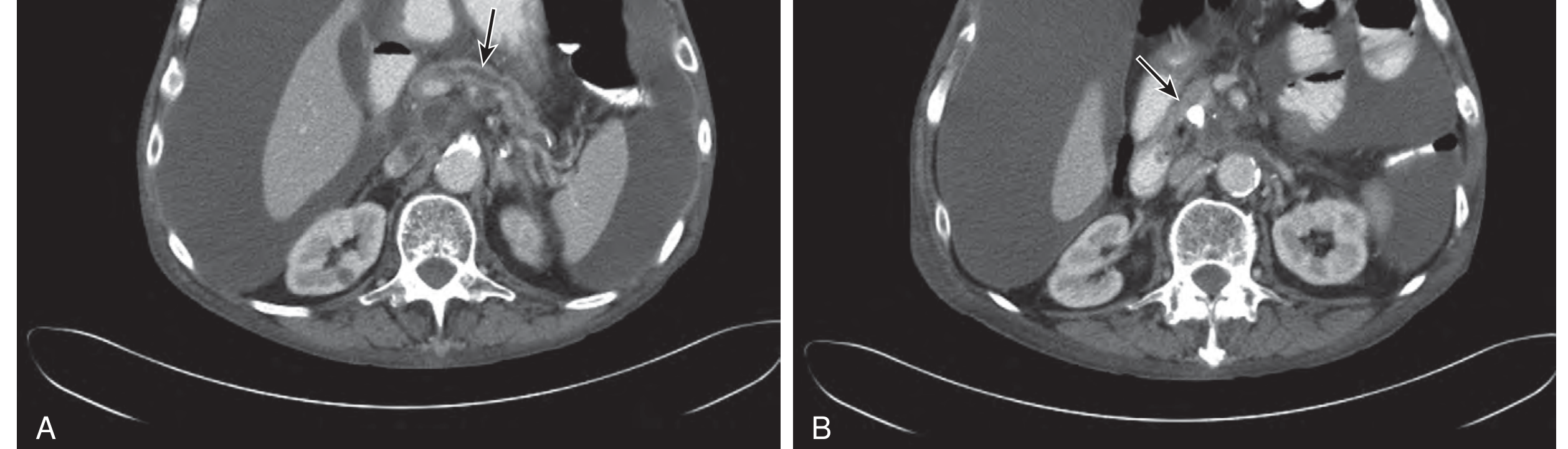
Imaging
- Ultrasound abdomen — first-line; detects gallstones, biliary dilation, peripancreatic fluid
- CT abdomen with contrast — gold standard for severity assessment; detects necrosis, abscesses, pseudocysts
Other Tests
- LFTs (ALT >3× ULN suggests gallstone etiology)
- Serum triglycerides, calcium
- CBC, CRP, BUN, creatinine
- Blood glucose
- Chest X-ray (pleural effusion, ARDS)
- MRCP — for bile duct anatomy without radiation
Severity Assessment
Ranson's Criteria
At Admission (0 hours):
| Parameter | Threshold |
|---|---|
| Age | >55 years |
| WBC | >16,000/mm³ |
| Blood glucose | >200 mg/dL |
| LDH | >350 IU/L |
| AST | >250 IU/L |
At 48 hours:
| Parameter | Threshold |
|---|---|
| Hematocrit fall | >10% |
| BUN rise | >5 mg/dL |
| Serum calcium | <8 mg/dL |
| PaO₂ | <60 mmHg |
| Base deficit | >4 mEq/L |
| Fluid sequestration | >6 L |
Scoring: 0–2 = mild; 3–4 = moderate; ≥5 = severe (mortality rises sharply)
BISAP Score (Bedside Index of Severity in AP)
- BUN >25 mg/dL
- Impaired mental status (Glasgow Coma Scale <15)
- SIRS (≥2 SIRS criteria)
- Age >60 years
- Pleural effusion
Score ≥3 = increased risk of mortality.
Atlanta Classification (Revised 2012)
- Mild AP — no organ failure, no local/systemic complications; resolves in 1 week
- Moderately Severe AP — transient organ failure (<48 h) or local complications
- Severe AP — persistent organ failure (>48 h), single or multi-organ
Complications
Local Complications
- Acute peripancreatic fluid collection (early, <4 weeks)
- Pancreatic pseudocyst (>4 weeks, non-epithelialized fluid collection)
- Acute necrotic collection (contains necrotic material, <4 weeks)
- Walled-off necrosis (WON) (organized necrosis, >4 weeks)
- Pancreatic abscess
- Pseudoaneurysm, splenic vein thrombosis
Systemic Complications
- ARDS (acute respiratory distress syndrome)
- Acute kidney injury
- Shock
- DIC (disseminated intravascular coagulation)
- Hypocalcemia (saponification of fat)
- Hyperglycemia
- GI bleeding
Management
General Principles (first 48–72 hours are critical)
-
IV Fluid Resuscitation — Most critical early intervention
- Aggressive isotonic fluid replacement (Ringer's lactate preferred over normal saline — reduces SIRS)
- Target urine output >0.5 mL/kg/hr
- Monitor for fluid overload
-
Analgesia
- IV opioids (morphine, hydromorphone, meperidine) — adequate pain control is essential
- NSAIDs/ketorolac for mild cases
-
NPO vs. Early Oral/Enteral Feeding
- Mild AP: resume clear liquids and advance diet when pain resolves and bowel sounds return
- Severe AP: early enteral nutrition via nasojejunal tube (preferred over TPN) — reduces bacterial translocation and infection
- TPN only if enteral route not tolerated
-
Antibiotics
- Not indicated prophylactically
- Used only when there is evidence of infected necrosis or sepsis
- Agents: imipenem, meropenem, or ciprofloxacin + metronidazole
-
Monitoring
- Frequent vitals, urine output, CBC, metabolic panel
- ICU admission for severe AP
Specific Interventions
- Gallstone pancreatitis: Early ERCP with sphincterotomy if cholangitis or persistent biliary obstruction; cholecystectomy during same admission for mild AP to prevent recurrence
- Hypertriglyceridemia: Plasmapheresis, insulin infusion (activates lipoprotein lipase)
- Infected necrosis: Endoscopic or surgical necrosectomy (step-up approach: drainage first, then necrosectomy)
Prognosis & Mortality
| Severity | Mortality |
|---|---|
| Mild (Ranson <3) | <1% |
| Moderate (Ranson 3–4) | 15–20% |
| Severe (Ranson ≥5) | 40–50%+ |
| With infected necrosis | Up to 80% historically |
Approximately 40% of acute cases are diagnosed only at autopsy, underlining the importance of early recognition.
Key Points Summary
- AP = autodigestion by premature enzyme activation
- Most common causes: gallstones > alcohol
- Diagnose with 2 of 3 criteria (pain + enzymes + imaging)
- Lipase is more sensitive and specific than amylase
- Severity: Ranson's, BISAP, Atlanta Classification
- Management: aggressive IV fluids, analgesia, early enteral feeding; antibiotics only for infected necrosis
- Gallstone AP → ERCP if obstruction → cholecystectomy before discharge
- Complications: pseudocyst, necrosis, ARDS, renal failure, hypocalcemia
Sources: Textbook of Family Medicine 9e; Sleisenger and Fordtran's Gastrointestinal and Liver Disease
This is a shared conversation. Sign in to Orris to start your own chat.