
Unit 1 Levels of Prevention ⭐⭐⭐ Scope of Community Health Nursing ⭐⭐⭐ Dimensions & Determinants of Health ⭐⭐⭐ Unit 2 Primary Health Care ⭐⭐⭐⭐⭐ Health Care Delivery System in India ⭐⭐⭐⭐ Ayushman Bharat ⭐⭐⭐ Universal Health Coverage (UHC) ⭐⭐⭐ Unit 3 Water Purification ⭐⭐⭐⭐⭐ Air Pollution ⭐⭐⭐⭐ Solid Waste Management ⭐⭐⭐ Hardness of Water ⭐⭐⭐ Unit 4 Meal Planning ⭐⭐⭐⭐⭐ Diet in Diabetes Mellitus ⭐⭐⭐⭐⭐ ICDS ⭐⭐⭐⭐ Mid-Day Meal Programme ⭐⭐⭐ Unit 5 Health Education ⭐⭐⭐⭐⭐ Barriers of Communication ⭐⭐⭐⭐ SBCC ⭐⭐⭐ BCC ⭐⭐⭐ Unit 6 Home Visit ⭐⭐⭐⭐⭐ Bag Technique ⭐⭐⭐⭐ Counselling ⭐⭐⭐⭐ Epidemiological Approaches ⭐⭐⭐ Qualities of Community Health Nurse ⭐⭐⭐⭐⭐ Unit 7 Women Empowerment ⭐⭐⭐⭐ Breast Self Examination (BSE) ⭐⭐⭐ Child Abuse ⭐⭐⭐ Unit 8 Descriptive Epidemiology ⭐⭐⭐⭐⭐ Case-Control Study ⭐⭐⭐⭐ Cohort Study ⭐⭐⭐⭐ Epidemic vs Endemic ⭐⭐⭐ Unit 9 (सबसे Important) 🔥 Tuberculosis ⭐⭐⭐⭐⭐ HIV/AIDS ⭐⭐⭐⭐⭐ Universal Immunization Programme ⭐⭐⭐⭐⭐ Mission Indradhanush ⭐⭐⭐⭐ Hepatitis ⭐⭐⭐⭐ Diarrhoea ⭐⭐⭐⭐ NVBDCP ⭐⭐⭐ BCG Vaccine ⭐⭐⭐ Mantoux Test ⭐⭐⭐ Unit 10 Diabetes Mellitus ⭐⭐⭐⭐⭐ Hypertension ⭐⭐⭐⭐⭐ NPCDCS ⭐⭐⭐⭐ Breast Cancer ⭐⭐⭐ Blindness Control Programme ⭐⭐⭐ Unit 11 School Health Services ⭐⭐⭐⭐⭐ Role of School Health Nurse ⭐⭐⭐⭐ Health Problems of School Children ⭐⭐⭐
What would you like me to do with these topics? · How detailed should the content be?
Create notes for my exam yesterday
You mentioned 'yesterday' - did you mean you have an upcoming exam and want notes for these topics? Or did you already write the exam and want post-exam notes for future reference?
mkdir -p /tmp/workspace/community-health-nursing-notes
~/community-health-nursing-notes/CHN_Exam_Notes.md
# COMMUNITY HEALTH NURSING - COMPLETE EXAM NOTES
### All 11 Units | Star-Marked Topics Covered
---

## UNIT 1

---

### ⭐⭐⭐ LEVELS OF PREVENTION

Prevention = action taken prior to onset of disease to intercept its causation.

**Leavell & Clark's 3 Levels of Prevention:**

| Level | Phase | Activities |
|-------|-------|-----------|
| **Primary Prevention** | Pre-pathogenesis | Health promotion + Specific protection |
| **Secondary Prevention** | Early pathogenesis | Early diagnosis & prompt treatment + Disability limitation |
| **Tertiary Prevention** | Advanced disease/recovery | Rehabilitation |

**Primary Prevention:**
- Health promotion: health education, nutrition, adequate housing, recreation, genetic counselling
- Specific protection: immunization, hygiene, use of specific nutrients, environmental sanitation, protection from accidents

**Secondary Prevention:**
- Early diagnosis & prompt treatment: case finding, screening surveys, individual/mass examination
- Disability limitation: adequate treatment to arrest disease, prevent complications

**Tertiary Prevention:**
- Rehabilitation: physical (restore function), social (reintegration), psychological (mental well-being), vocational (return to work)
- Goal: maximize residual capacity

**Primordial Prevention:** (4th level - recent addition)
- Prevention of emergence of risk factors in the first place (e.g., anti-tobacco policies before smoking becomes prevalent)

---

### ⭐⭐⭐ SCOPE OF COMMUNITY HEALTH NURSING

Community Health Nursing (CHN) = specialized field of nursing that combines nursing and public health practices to promote, protect, and preserve the health of populations.

**Scope includes:**
1. **Preventive services** - immunization, health screening, antenatal care
2. **Promotive services** - health education, nutrition counselling, hygiene promotion
3. **Curative services** - treating minor ailments, home nursing care, wound dressing
4. **Rehabilitative services** - follow-up care, home visit to chronic patients
5. **Environmental health** - sanitation, safe water, waste disposal
6. **Vital statistics & records** - birth/death registration, disease surveillance
7. **School health services** - physical examination, immunization, health education
8. **Occupational health** - health of workers
9. **Family welfare services** - MCH, family planning
10. **Disaster management** - relief nursing

**Settings:** Homes, schools, factories, primary health centers, sub-centers, rural areas

---

### ⭐⭐⭐ DIMENSIONS & DETERMINANTS OF HEALTH

**WHO Definition of Health:** "A state of complete physical, mental and social well-being and not merely the absence of disease or infirmity."

**Dimensions of Health:**
1. **Physical** - functional efficiency of body, absence of disease
2. **Mental** - ability to think clearly, make decisions (includes emotional health)
3. **Social** - ability to interact with others, maintain relationships
4. **Spiritual** - sense of purpose, values, beliefs
5. **Vocational** - ability to perform work/role in society
6. **Emotional** - ability to express and control emotions

**Determinants of Health:**

| Category | Factors |
|----------|---------|
| **Biological** | Genetics, age, sex, nutrition |
| **Behavioural/Lifestyle** | Diet, exercise, smoking, alcohol |
| **Environmental** | Water, air, sanitation, housing |
| **Socio-economic** | Education, income, employment, poverty |
| **Health services** | Access, availability, quality of care |
| **Political** | Health policies, governance |

**Positive Health Indicators:** Life expectancy, nutritional status, mortality rates, disease incidence

---

## UNIT 2

---

### ⭐⭐⭐⭐⭐ PRIMARY HEALTH CARE (PHC)

**Definition (Alma-Ata, 1978):**
"Essential health care based on practical, scientifically sound and socially acceptable methods and technology made universally accessible to individuals and families in the community through their full participation and at a cost that the community and the country can afford."

**Background:**
- International conference at Alma-Ata (USSR), 1978
- Jointly organized by WHO & UNICEF
- 134 governments attended
- Slogan: "Health for All by 2000 A.D."

**8 Essential Elements of PHC (MEDICINE):**
1. **Education** about prevailing health problems
2. **Maternal & Child Health** care including family planning
3. **Nutrition** - food supply and proper nutrition
4. **Immunization** against infectious diseases
5. **Control of endemic diseases**
6. **Injuries** - treatment of common diseases and injuries
7. **Nutrition** (essential drugs provision)
8. **Essential drugs** supply
9. **Water & sanitation** - safe water and basic sanitation

**Mnemonic: "E-MINCED-W"**
- Education, MCH+FP, Immunization, Nutrition, Control of endemic diseases, Essential drugs, Diarrhea treatment, Water & sanitation

**Principles of PHC (5):**
1. **Equitable distribution** - services accessible to all
2. **Community participation** - people involved in planning & implementation
3. **Intersectoral coordination** - health + education + agriculture etc.
4. **Appropriate technology** - cost-effective, scientifically sound
5. **Focus on prevention** - emphasis on promotive and preventive care

**Levels of PHC in India:**
- Sub-Centre: 5,000 population (plains) / 3,000 (hilly)
- Primary Health Centre (PHC): 30,000 population (plains) / 20,000 (hilly)
- Community Health Centre (CHC): 1,20,000 population (4 PHCs)

---

### ⭐⭐⭐⭐ HEALTH CARE DELIVERY SYSTEM IN INDIA

**Three-Tier System:**

| Tier | Institution | Population Served | Staff |
|------|------------|-------------------|-------|
| **1st (Peripheral)** | Sub-Centre | 5,000 (plains), 3,000 (hilly) | ANM + MPW |
| **2nd (Intermediate)** | PHC | 30,000 (plains), 20,000 (hilly) | MO + 14 staff |
| **3rd (Central)** | CHC / District Hospital | 1,20,000 | Specialists |

**Sub-Centre:**
- Peripheral outpost of health delivery
- 1 Female Health Worker (ANM) + 1 Male MPW
- Functions: MCH, FP, immunization, health education, first aid

**Primary Health Centre (PHC):**
- First contact with qualified doctor
- 1 Medical Officer + 14 paramedical staff
- 4-6 sub-centres per PHC
- 6 bedded facility
- Functions: OPD, MCH, FP, school health, disease control

**Community Health Centre (CHC):**
- 30 beds
- 4 medical specialists (surgeon, physician, gynecologist, pediatrician)
- First referral unit (FRU)

**District Hospital:**
- Secondary + tertiary care
- 200-300 beds
- Nodal point for supervision

---

### ⭐⭐⭐ AYUSHMAN BHARAT

**Full name:** Ayushman Bharat - Pradhan Mantri Jan Arogya Yojana (PM-JAY)
**Launched:** September 23, 2018
**Ministry:** Ministry of Health and Family Welfare

**Two Components:**
1. **Health and Wellness Centres (HWCs)** - upgraded sub-centres and PHCs to provide comprehensive primary care
2. **PM-JAY** - health insurance scheme for secondary and tertiary hospitalization

**PM-JAY Key Features:**
- Health cover of **Rs. 5 lakh per family per year**
- Covers **~10.74 crore poor and vulnerable families** (50 crore beneficiaries)
- Cashless and paperless access at empanelled hospitals
- No restriction on family size, age, or gender
- Pre and post-hospitalization expenses covered
- 1,350+ disease packages covered

**Health & Wellness Centres:**
- Transform 1.5 lakh sub-centres and PHCs into HWCs
- Provide 12 packages of comprehensive primary health care
- Staffed by Community Health Officers (CHO) / Nurse Practitioners

---

### ⭐⭐⭐ UNIVERSAL HEALTH COVERAGE (UHC)

**Definition (WHO):**
"All people and communities can use the promotive, preventive, curative, rehabilitative and palliative health services they need, of sufficient quality to be effective, while also ensuring that the use of these services does not expose the user to financial hardship."

**Three Dimensions (UHC Cube):**
1. **Population** - who is covered? (extend to all)
2. **Services** - which services are covered? (expand)
3. **Cost coverage** - what proportion of costs? (reduce out-of-pocket)

**Key Principles:**
- Equity (everyone should receive services as needed)
- Quality of services
- Financial protection (no one impoverished due to healthcare costs)

**SDG Goal 3.8** - Achieve UHC including financial risk protection

---

## UNIT 3

---

### ⭐⭐⭐⭐⭐ WATER PURIFICATION

**Criteria for Safe Water:**
- Colorless, odorless, tasteless
- No harmful microorganisms
- Free from chemical contaminants
- WHO standard: <1 coliform organism per 100 mL

**Steps of Water Treatment (Municipal):**
1. **Storage/Sedimentation** - allows suspended matter to settle (24-48 hrs)
2. **Coagulation/Flocculation** - add alum (aluminum sulfate) to form floc
3. **Filtration** - slow sand filter or rapid sand filter
4. **Disinfection** - chlorination (most common)

**Slow Sand Filtration:**
- Rate: 0.1-0.4 m/hour
- Effective biological filter (Schmutzdecke layer = biological film)
- No pre-treatment required
- Simple to operate, cheaper

**Rapid Sand Filtration:**
- Rate: 5-15 m/hour
- Requires pre-coagulation
- Backwashing needed every 24-48 hours

**Disinfection Methods:**
1. **Chlorination** - most practical; residual chlorine 0.5 mg/L at tap
   - Chlorine demand + Residual chlorine = Total chlorine added
2. **Boiling** - 100°C for 10 minutes; kills all organisms
3. **UV radiation** - no residual, no taste/odor issues
4. **Ozonation** - powerful oxidant, no residue

**Household Water Purification:**
- Boiling, ceramic filters, chlorine tablets (Halazone), bleaching powder, PuR sachets

**Hardness of Water:**
- **Temporary hardness** - due to carbonates; removed by boiling
- **Permanent hardness** - due to sulfates/chlorides; removed by Clark's process, ion exchange
- Hard water: >300 mg/L CaCO3; Soft water: <75 mg/L CaCO3

---

### ⭐⭐⭐⭐ AIR POLLUTION

**Definition:** Presence of substances in air in concentrations high enough to harm human health, environment, or property.

**Types of Pollutants:**

| Pollutant | Source | Health Effect |
|-----------|--------|--------------|
| **Carbon Monoxide (CO)** | Incomplete combustion, vehicles | Headache, asphyxia, death |
| **Sulfur Dioxide (SO2)** | Coal burning, power plants | Bronchospasm, acid rain |
| **Nitrogen Oxides (NOx)** | Vehicles, factories | Respiratory irritation, smog |
| **Particulate Matter (PM)** | Dust, smoke, diesel | Lung disease, cancer |
| **Lead** | Old paint, leaded petrol | Neurotoxicity, anemia |
| **Ozone** | Photochemical smog | Lung irritation |

**Indoor Air Pollution:**
- Cooking with biomass fuels (major problem in India)
- Tobacco smoke, mold, radon
- "Sick Building Syndrome"

**Health Effects of Air Pollution:**
- Acute: eye/nose/throat irritation, asthma, bronchitis
- Chronic: COPD, lung cancer, heart disease
- Children: impaired lung development

**Control Measures:**
- Source control (clean fuels, catalytic converters)
- Air quality monitoring (NAAQS - National Ambient Air Quality Standards)
- Afforestation
- Green building design

**Air Quality Index (AQI) Categories:** Good (0-50), Satisfactory (51-100), Moderate (101-200), Poor (201-300), Very Poor (301-400), Severe (401-500)

---

### ⭐⭐⭐ SOLID WASTE MANAGEMENT

**Definition:** Collection, transportation, processing, recycling, and disposal of solid materials that are discarded.

**Types of Solid Waste:**
1. Municipal solid waste (garbage, rubbish)
2. Biomedical/hospital waste
3. Industrial waste
4. Hazardous waste
5. E-waste

**Methods of Disposal:**

| Method | Description |
|--------|-------------|
| **Sanitary landfill** | Waste compacted and covered with soil daily |
| **Composting** | Biological decomposition; produces manure |
| **Incineration** | High-temperature burning; reduces volume by 90% |
| **Recycling** | Recovery of reusable materials |
| **Vermicomposting** | Using earthworms to decompose organic waste |

**Biomedical Waste:**
- Categories: Infectious, sharps, chemical, radioactive
- Color coding: Yellow (anatomical), Red (contaminated plastic), Blue (glass), Black (general)
- BMW Rules, 2016 (India)

**3R Principle:** Reduce, Reuse, Recycle

---

## UNIT 4

---

### ⭐⭐⭐⭐⭐ MEAL PLANNING

**Definition:** Selecting foods to be included in meals to meet nutritional requirements within a budget.

**Principles of Meal Planning:**
1. **Nutritional adequacy** - meet RDA for all nutrients
2. **Economy** - fit within available budget
3. **Variety** - different foods across days/weeks
4. **Satiety value** - feeling of fullness
5. **Food habits & preferences** - culturally acceptable
6. **Aesthetic value** - appealing color, texture, aroma
7. **Availability** - seasonal and locally available foods

**RDA (India - ICMR):**
- Adult man (sedentary): 2,000-2,110 kcal/day
- Adult woman (sedentary): 1,660-1,730 kcal/day
- Pregnant: +350 kcal/day
- Lactating: +600 kcal/day

**Food Groups (ICMR - 5 groups):**
1. Cereals, millets, pulses
2. Vegetables & fruits
3. Milk, meat, fish, eggs
4. Oils, fats, sugar
5. Nuts and oilseeds

**Basic Food Groups Planning:**
- Include foods from all groups
- Emphasize protein-rich and iron-rich foods for vulnerable groups
- Increase dark green leafy vegetables for iron, folate

---

### ⭐⭐⭐⭐⭐ DIET IN DIABETES MELLITUS

**Goals of Diabetic Diet:**
1. Achieve/maintain ideal body weight
2. Control blood glucose levels
3. Prevent hypoglycemia
4. Reduce cardiovascular risk
5. Provide adequate nutrition

**Key Dietary Principles:**

| Nutrient | Recommendation |
|----------|---------------|
| **Carbohydrates** | 45-60% of calories; complex carbs preferred, low GI foods |
| **Proteins** | 15-20% of calories (0.8-1 g/kg body weight) |
| **Fats** | 20-35%; reduce saturated + trans fats; omega-3 beneficial |
| **Fiber** | 25-35 g/day; slows glucose absorption |
| **Sodium** | <2,300 mg/day (or <1,500 if hypertensive) |

**Foods to INCLUDE:**
- Whole grains (brown rice, millets, oats)
- Legumes & pulses
- Non-starchy vegetables
- Low-fat dairy
- Fish (especially fatty fish)
- Nuts, olive oil

**Foods to AVOID/LIMIT:**
- Refined carbohydrates (white bread, maida)
- Sugary beverages
- Fried foods, bakery items
- High-GI foods (potatoes, white rice in excess)
- Alcohol

**Glycemic Index (GI):**
- Low GI (<55): lentils, most fruits, oats
- High GI (>70): white bread, rice, sugary foods

**Exchange Lists:** Used to plan varied meals within caloric/carb limits

---

### ⭐⭐⭐⭐ ICDS (Integrated Child Development Services)

**Launched:** October 2, 1975
**Implementing Agency:** Ministry of Women & Child Development
**Target Group:** Children 0-6 years, pregnant women, lactating mothers, adolescent girls

**6 Services of ICDS:**
1. Supplementary nutrition
2. Immunization
3. Health check-up
4. Referral services
5. Non-formal pre-school education (3-6 years)
6. Nutrition & health education (to mothers)

**Delivery Point:** Anganwadi Centre (AWC)
**Anganwadi Worker (AWW):** Community volunteer; 1 per 400-800 population

**ICDS Goals:**
- Reduce incidence of malnutrition, mortality, morbidity
- Lay foundation for proper psychological, physical, social development
- Reduce dropout in schools
- Achieve health & nutrition education to mothers

**Supplementary Nutrition:**
- Children 6 months - 6 years: 500 kcal + 12-15 g protein/day
- Severely malnourished: 800 kcal + 20-25 g protein/day
- Pregnant/lactating women: 600 kcal + 18-20 g protein/day

---

### ⭐⭐⭐ MID-DAY MEAL PROGRAMME

**Full name:** Pradhan Mantri Poshan Shakti Nirman (PM-POSHAN) - formerly Mid-Day Meal Scheme
**Launched:** 1995 (National Programme of Nutritional Support to Primary Education)
**Ministry:** Ministry of Education

**Target Group:** Children in Classes 1-8 in government and government-aided schools

**Objectives:**
1. Improve nutritional status of school-age children
2. Improve enrollment, retention, and attendance
3. Improve socialization among children

**Nutritional Standards:**
- Primary (Classes 1-5): 450 kcal, 12 g protein
- Upper Primary (Classes 6-8): 700 kcal, 20 g protein

**Key Achievements:**
- Largest school feeding programme in the world
- Covers over 11 crore children
- Reduces classroom hunger and malnutrition
- Promotes social equity (children of all castes eat together)

---

## UNIT 5

---

### ⭐⭐⭐⭐⭐ HEALTH EDUCATION

**Definition:** Any combination of learning experiences designed to help individuals and communities improve their health by increasing their knowledge or influencing their attitudes.

**Aims of Health Education:**
1. To provide knowledge about health
2. To develop positive health attitudes
3. To change unhealthy practices
4. To develop sense of responsibility for one's health
5. To motivate healthy behavior

**Principles of Health Education:**
1. Credibility - based on facts
2. Interest of the audience
3. Participation - community involvement
4. Comprehension - simple language
5. Reinforcement - repeated messages
6. Motivation
7. Feedback

**Methods of Health Education:**

| Type | Methods |
|------|---------|
| **Individual** | Counselling, interview, home visits |
| **Group** | Lectures, demonstrations, role play, group discussion |
| **Mass** | Posters, films, TV, radio, pamphlets |

**Audiovisual Aids:**
- Non-projected: charts, flannel board, flash cards, posters
- Projected: films, slides, OHP
- Electronic: TV, radio, internet

**Steps in Health Education:**
1. Assess educational needs
2. Set objectives
3. Plan content
4. Select methods & materials
5. Implement
6. Evaluate

---

### ⭐⭐⭐⭐ BARRIERS OF COMMUNICATION

**Communication Process:** Sender → Message → Channel → Receiver → Feedback

**Types of Barriers:**

1. **Physical/Environmental Barriers:**
   - Noise, distance, poor lighting, crowd
   - Time constraints

2. **Psychological Barriers:**
   - Fear, anxiety, distrust
   - Emotions, prejudice, biases

3. **Language/Semantic Barriers:**
   - Use of technical jargon
   - Language differences, low literacy

4. **Cultural Barriers:**
   - Different cultural beliefs, taboos
   - Social norms that prevent discussion

5. **Perceptual Barriers:**
   - Differences in perception of message
   - Stereotyping

6. **Organizational Barriers:**
   - Hierarchical barriers, poor organization

**Overcoming Barriers:**
- Use simple, clear language
- Use local language
- Use appropriate visual aids
- Active listening
- Feedback mechanism
- Repetition of key messages

---

### ⭐⭐⭐ SBCC (Social and Behaviour Change Communication)

**Definition:** A systematic process to promote positive behaviours and social norms using communication strategies and evidence-based approaches.

**Components:**
- Social mobilization
- Behaviour change communication
- Advocacy

**SBCC Framework:**
1. Identify problem
2. Analyze target audience
3. Develop communication strategy
4. Develop messages and materials
5. Implement
6. Monitor and evaluate

---

### ⭐⭐⭐ BCC (Behaviour Change Communication)

**Definition:** Communication strategies aimed at changing individual behaviours by addressing the determinants of behaviour - knowledge, attitudes, and practices (KAP).

**KAP Model:** Knowledge → Attitude → Practice (behaviour change)

**Principles:**
- Audience-centered approach
- Messages based on audience's knowledge and beliefs
- Uses participatory approach
- Multifaceted - multiple channels

---

## UNIT 6

---

### ⭐⭐⭐⭐⭐ HOME VISIT

**Definition:** A professional visit by the community health nurse to the client/family in their home for the purpose of providing nursing care and health services.

**Purposes:**
1. Assessment of health needs and environment
2. Health education and counselling
3. Providing nursing care (wound dressing, medications)
4. Follow-up of patients (TB, post-natal, post-surgery)
5. Detection of communicable diseases
6. MCH services
7. Rehabilitation

**Types of Home Visits:**
1. **Initial/First visit** - establishes relationship, surveys health needs
2. **Follow-up visit** - continuing care
3. **Periodic visit** - scheduled at regular intervals

**Steps of Home Visit:**
1. **Pre-visit planning** - review records, prepare bag, plan objectives
2. **Introduction** - rapport building with family
3. **Assessment** - physical, social, environmental
4. **Nursing care/intervention**
5. **Health education**
6. **Recording** - document findings
7. **Post-visit activities** - review, referral if needed

**Principles:**
- Prior appointment/notice
- Punctuality
- Maintain confidentiality
- Non-judgmental approach
- Family-centred care
- Carry bag technique equipment

---

### ⭐⭐⭐⭐ BAG TECHNIQUE

**Definition:** A systematic method of using the public health nursing bag to prevent cross-infection during home visits.

**Purpose of Bag Technique:**
- Prevent cross-infection between nurse and family
- Ensure cleanliness and orderliness
- Save time and energy
- Demonstrate the importance of cleanliness to family

**Contents of Public Health Bag:**
- Sterile supplies: gauge, cotton, bandage, adhesive tape
- Medications: spirit, antiseptic, ORS sachets
- Equipment: thermometer, BP apparatus, stethoscope, torch, scissors
- Hand hygiene: soap, hand sanitizer

**Procedure/Principles of Bag Technique:**
1. Never place bag on floor
2. Spread bag liner before opening bag
3. Wash hands before and after procedures
4. Maintain clean and dirty sides
5. Keep bag closed except when taking/placing items
6. Articles used on the client should not return to the bag without proper cleaning
7. Clean and restock bag after each visit

---

### ⭐⭐⭐⭐ COUNSELLING

**Definition:** A helping relationship in which the counsellor facilitates the client to understand themselves, their situation, and options, and to make their own informed decisions.

**Types of Counselling:**
1. Directive (counsellor-centered)
2. Non-directive/Client-centered (Rogers' model)
3. Eclectic (combination)

**Steps in Counselling (GATHER Model):**
- **G** - Greet the client warmly
- **A** - Ask about the problem
- **T** - Tell relevant information
- **H** - Help the client decide
- **E** - Explain how to use methods/services
- **R** - Return for follow-up

**Principles:**
- Confidentiality
- Respect and non-judgmental attitude
- Active listening
- Empathy
- Client's autonomy

---

### ⭐⭐⭐ EPIDEMIOLOGICAL APPROACHES

**Epidemiology:** Study of distribution and determinants of health-related states in specified populations and application of results to control health problems.

**Types of Studies:**
1. **Descriptive studies** - "who, where, when" (cross-sectional surveys)
2. **Analytical studies** - cause-effect (case-control, cohort)
3. **Experimental studies** - RCT, field trials

---

### ⭐⭐⭐⭐⭐ QUALITIES OF COMMUNITY HEALTH NURSE

**Personal Qualities:**
1. Good physical and mental health
2. Empathy and compassion
3. Patience and tolerance
4. Trustworthiness and honesty
5. Adaptability
6. Enthusiasm and positive attitude

**Professional Qualities:**
1. Sound knowledge base (nursing, public health, social sciences)
2. Clinical competence
3. Communication skills - verbal and non-verbal
4. Teaching skills (health education)
5. Organizational and management skills
6. Research skills
7. Leadership abilities
8. Record-keeping ability

**Roles of Community Health Nurse:**
1. **Care provider** - direct nursing care
2. **Health educator** - teaching health promotion
3. **Counsellor** - emotional/psychological support
4. **Coordinator/Collaborator** - team working
5. **Advocate** - speak for community's needs
6. **Case manager** - organize care resources
7. **Researcher** - participate in health research
8. **Change agent** - implement evidence-based changes
9. **Supervisor** - supervise health workers

---

## UNIT 7

---

### ⭐⭐⭐⭐ WOMEN EMPOWERMENT

**Definition:** Process of increasing women's social, economic, political, and legal strength to enable them to make independent decisions.

**Dimensions:**
1. Social empowerment - education, freedom from discrimination
2. Economic empowerment - employment, equal pay, property rights
3. Political empowerment - voting rights, representation
4. Health empowerment - reproductive rights, access to healthcare
5. Legal empowerment - laws protecting rights

**Key Issues:**
- Gender-based violence
- Child marriage
- Dowry and female foeticide
- Maternal mortality
- Literacy gap

**Government Schemes:**
- Beti Bachao Beti Padhao (BBBP)
- Mahila Shakti Kendras
- Ujjwala Yojana (LPG connections)
- PM Matru Vandana Yojana
- Poshan Abhiyan
- STEP (Support to Training & Employment Programme)

**Role of CHN in Women Empowerment:**
- Health education on reproductive rights
- Preventing gender-based violence
- Promoting institutional deliveries
- Antenatal and postnatal care
- Promoting girl child education

---

### ⭐⭐⭐ BREAST SELF EXAMINATION (BSE)

**Purpose:** Early detection of breast changes/cancer

**Recommended Frequency:** Monthly; 1 week after menstruation ends

**Steps of BSE:**

**Step 1 - Visual inspection (in mirror):**
- Arms at sides
- Arms raised above head
- Hands on hips (flex chest muscles)
- Look for: change in size/shape, dimpling, skin changes, nipple changes

**Step 2 - Palpation (lying down):**
- Right hand examines left breast
- Pillow under left shoulder
- Use 3 middle fingers; circular, up-down, or wedge pattern
- Examine entire breast from armpit to sternum
- Also check armpit for lymph nodes

**Step 3 - Standing/sitting:**
- Repeat palpation (easier for some women to feel tissue)
- Squeeze nipple gently - check for discharge

**Warning Signs (BREAST mnemonic):**
- **B** - Blood or discharge from nipple
- **R** - Redness or rash on breast/nipple
- **E** - Edge of breast or shape changes
- **A** - A lump in breast or armpit
- **S** - Swelling, thickening
- **T** - Thickening of skin (peau d'orange appearance)

---

### ⭐⭐⭐ CHILD ABUSE

**Definition:** Any act or failure to act by a parent/caretaker that results in actual or potential harm to a child.

**Types:**
1. **Physical abuse** - hitting, burning, shaking (non-accidental injury)
2. **Emotional/Psychological abuse** - constant criticism, rejection, threats
3. **Sexual abuse** - any sexual act or exposure involving a child
4. **Neglect** - failure to provide basic needs (food, shelter, medical care, education)

**Signs of Child Abuse:**

| Type | Signs |
|------|-------|
| Physical | Multiple bruises of different ages, fractures, burn marks |
| Emotional | Withdrawal, low self-esteem, depression |
| Sexual | Inappropriate sexual knowledge, physical trauma to genitals |
| Neglect | Poor hygiene, underweight, irregular school attendance |

**Legal Framework (India):**
- POCSO Act 2012 (Protection of Children from Sexual Offences)
- Juvenile Justice Act 2015
- Child Labour (Prohibition & Regulation) Act

**Role of Nurse:**
- Identify and report suspected cases
- Provide supportive care
- Document findings accurately (medicolegal importance)
- Refer to child welfare services

---

## UNIT 8

---

### ⭐⭐⭐⭐⭐ DESCRIPTIVE EPIDEMIOLOGY

**Definition:** Studies describing the distribution of disease in terms of person, place, and time. Answers "who, where, when."

**Three Aspects:**

**1. PERSON:**
- Age, sex, race, occupation, marital status, socioeconomic status
- Helps identify "who is at risk"
- E.g., malaria more common in rural, lower socioeconomic groups

**2. PLACE:**
- Geographic distribution - national, regional, local
- Urban vs rural differences
- Spot maps used to identify clusters
- E.g., fluorosis in specific regions with high fluoride water

**3. TIME:**
- Secular/long-term trends: changes over years/decades
- Seasonal variation: e.g., diarrhea in summer, flu in winter
- Epidemic curve: pattern of cases during an outbreak
- Point source epidemic vs propagated epidemic

**Types of Descriptive Studies:**
1. **Case reports** - detailed account of single case
2. **Case series** - series of cases with similar features
3. **Cross-sectional (prevalence) studies** - snapshot in time

**Purpose:**
- Generate hypotheses about causes
- Identify high-risk groups for targeted interventions
- Monitor disease trends
- Plan health services

---

### ⭐⭐⭐⭐ CASE-CONTROL STUDY

**Definition:** Starts with people who have the disease (cases) and people without the disease (controls), then looks BACKWARDS to determine exposure.

**Design:** Retrospective - goes back in time

```
EXPOSURE → DISEASE
Cases (have disease)    ← exposed?
Controls (no disease)   ← exposed?
```

**Measure of Association:** Odds Ratio (OR)
- OR >1: Exposure associated with increased disease risk
- OR = 1: No association
- OR <1: Protective effect

**Advantages:**
- Suitable for rare diseases
- Quick and cheap
- Smaller sample size needed
- Can study multiple exposures

**Disadvantages:**
- Recall bias (cases recall exposures differently)
- Selection bias
- Cannot calculate incidence
- Cannot establish temporality clearly

**Example:** Studying lung cancer (cases) vs no lung cancer (controls) → asking about smoking history

---

### ⭐⭐⭐⭐ COHORT STUDY

**Definition:** Follows a group (cohort) of exposed and non-exposed individuals FORWARD in time to see who develops disease.

**Design:** Prospective - follows into future (can also be retrospective cohort)

```
EXPOSURE (now) → Follow up → DISEASE (future)
Exposed group      →    Disease or no disease
Non-exposed group  →    Disease or no disease
```

**Measure of Association:** Relative Risk (RR) or Risk Ratio
- Can also calculate Attributable Risk, Incidence Rate

**Advantages:**
- Establishes temporal relationship (cause before effect)
- Can calculate incidence
- Multiple outcomes can be studied
- Less recall bias

**Disadvantages:**
- Expensive and time-consuming
- Loss to follow-up
- Not suitable for rare diseases
- Requires large sample size

**Example:** Following smokers and non-smokers for 20 years to compare lung cancer rates

**Comparison:**

| Feature | Case-Control | Cohort |
|---------|-------------|--------|
| Direction | Backward (retrospective) | Forward (prospective) |
| Starts with | Disease status | Exposure status |
| Measure | Odds Ratio | Relative Risk |
| Rare disease | Suitable | Not suitable |
| Cost | Cheaper | Expensive |
| Time | Short | Long |
| Bias | Recall bias | Loss to follow-up |

---

### ⭐⭐⭐ EPIDEMIC vs ENDEMIC

| Feature | Epidemic | Endemic |
|---------|---------|---------|
| **Definition** | Unusual increase in disease above expected level in a community in a given time | Constant presence of disease in a given area or population |
| **Occurrence** | Sudden increase | Regular, constant |
| **Example** | Cholera outbreak | Malaria in northeast India |
| **Timeframe** | Limited time | Ongoing |

**Pandemic:** Epidemic affecting multiple countries/worldwide (e.g., COVID-19)
**Sporadic:** Occasional, irregular cases (no pattern)
**Outbreak:** Epidemic limited to a small, localized area

**Epidemic Curve Types:**
- Point source: sharp peak, all exposed at same time (e.g., food poisoning at a party)
- Propagated: multiple peaks, person-to-person spread (e.g., measles)

---

## UNIT 9 🔥 (MOST IMPORTANT)

---

### ⭐⭐⭐⭐⭐ TUBERCULOSIS (TB)

**Causative agent:** Mycobacterium tuberculosis
**Transmission:** Airborne (droplet nuclei, 1-5 microns)
**Risk factors:** Poverty, malnutrition, overcrowding, HIV, diabetes, immunosuppression

**Classification:**
- Pulmonary TB (most common, 85%)
- Extra-pulmonary TB (lymph nodes, pleura, meninges, bones)

**Types Based on Drug Resistance:**
- Drug-Sensitive TB (DS-TB)
- Multi-Drug Resistant TB (MDR-TB) - resistant to INH + Rifampicin
- Extensively Drug Resistant TB (XDR-TB) - MDR + resistant to fluoroquinolones + second-line injectables

**Diagnosis:**
- Sputum smear microscopy (AFB smear)
- CB-NAAT/GeneXpert (molecular test - detects TB and rifampicin resistance)
- Chest X-ray
- Mantoux test / IGRA

**NIKSHAY DOOT/NIKSHAY POSHAN YOJANA:**
- Rs. 500/month nutritional support to all notified TB patients

**National TB Elimination Programme (NTEP):**
- Previously RNTCP (Revised National TB Control Programme)
- Goal: Eliminate TB by 2025 (ahead of global target of 2030)

**Treatment - DOTS (Directly Observed Treatment Short-course):**

| Category | Intensive Phase | Continuation Phase |
|----------|----------------|-------------------|
| New cases | 2HRZE (2 months: INH+Rifampicin+Pyrazinamide+Ethambutol) | 4HR (4 months: INH+Rifampicin) |
| Previously treated | 2HRZES/1HRZE | 5HRE |

**Drug Abbreviations:**
- H = Isoniazid (INH)
- R = Rifampicin
- Z = Pyrazinamide
- E = Ethambutol
- S = Streptomycin

**BCG Vaccine:**
- BCG = Bacillus Calmette-Guerin (attenuated M. bovis)
- Given at birth (or within first year)
- Protects against severe forms of childhood TB (meningitis, miliary TB)
- Does NOT prevent pulmonary TB in adults
- Route: Intradermal, left upper arm
- Dose: 0.05 mL (newborn), 0.1 mL (older)
- Contraindication: immunocompromised, HIV (unless CD4 adequate)

**Mantoux Test:**
- Intradermal injection of 5 TU (tuberculin units) of PPD (Purified Protein Derivative)
- Injected: inner aspect of forearm
- Read after 48-72 hours
- Measure induration (NOT redness)
- **Positive:** ≥10 mm (in immunocompetent); ≥5 mm (in HIV, immunocompromised)
- Positive = past exposure or BCG vaccination, NOT active disease

---

### ⭐⭐⭐⭐⭐ HIV/AIDS

**HIV = Human Immunodeficiency Virus**
**AIDS = Acquired Immunodeficiency Syndrome**

**Transmission Routes:**
1. Sexual contact (most common)
2. Blood and blood products (transfusions, sharing needles)
3. Mother to child (vertical transmission) - during pregnancy, delivery, breastfeeding
4. Occupational exposure (needlestick)

**NOT transmitted by:** casual contact, hugging, sharing utensils, mosquitoes

**Pathophysiology:**
- HIV infects CD4+ T lymphocytes (helper T cells)
- Viral replication → CD4 count falls
- AIDS defined when CD4 count <200 cells/μL OR AIDS-defining illness

**Clinical Stages (WHO):**
- Stage 1: Asymptomatic / persistent generalized lymphadenopathy
- Stage 2: Minor conditions (seborrheic dermatitis, recurrent URTI)
- Stage 3: Severe conditions (oral candidiasis, unexplained weight loss >10%, TB)
- Stage 4 (AIDS): Opportunistic infections (PCP, cryptococcal meningitis, CMV retinitis, toxoplasmosis)

**Diagnosis:**
- ELISA (screening)
- Western Blot (confirmatory)
- Rapid tests available at ICTC
- Viral load, CD4 count (monitoring)

**Treatment - ART (Antiretroviral Therapy):**
- WHO recommends "Treat All" - start ART regardless of CD4 count
- First-line regimen: TDF + 3TC + DTG (Tenofovir + Lamivudine + Dolutegravir)
- Children: ABC + 3TC + LPV/r (infants)
- PMTCT (Prevention of Mother-to-Child Transmission): ART to all HIV+ pregnant women

**National AIDS Control Programme (NACP):**
- NACO (National AIDS Control Organisation)
- ICTC: Integrated Counselling and Testing Centre
- SACS: State AIDS Control Society
- Targeted interventions for high-risk groups
- Free ART at ART centres

**Prevention:**
- ABC: Abstinence, Be faithful, Condom use
- Safe blood transfusion
- Harm reduction for PWID (needle exchange)
- Universal precautions
- PMTCT

---

### ⭐⭐⭐⭐⭐ UNIVERSAL IMMUNIZATION PROGRAMME (UIP)

**Launched:** 1985 (expanded from EPI - Expanded Programme on Immunization, 1978)
**Target:** All infants and pregnant women
**Ministry:** Ministry of Health and Family Welfare

**UIP Schedule (India - 2024):**

| Age | Vaccine | Disease Protected |
|-----|---------|------------------|
| At birth | BCG, OPV-0, Hepatitis B (1st) | TB, Polio, Hepatitis B |
| 6 weeks | OPV-1, IPV-1, Penta-1, RVV-1, fIPV-1 | Polio, DPT+HepB+Hib, Rota |
| 10 weeks | OPV-2, Penta-2, RVV-2 | As above |
| 14 weeks | OPV-3, IPV-2, Penta-3, RVV-3, fIPV-2 | As above |
| 9-12 months | MR-1, JE-1 (endemic areas), Vitamin A | Measles-Rubella, JE |
| 16-24 months | DPT booster-1, OPV booster, MR-2, JE-2 | Boosters |
| 5-6 years | DPT booster-2 | Booster |
| 10 years | Td | Tetanus, Diphtheria |
| 16 years | Td | Tetanus, Diphtheria |
| Pregnant women | TT-1, TT-2 or TT Booster | Tetanus |

**Pentavalent vaccine:** DPT + Hepatitis B + Hib (5 in one)
**Cold Chain:** Maintains vaccine potency; -2 to +8°C for most vaccines; OPV at -15 to -20°C (freezer)

**Key Abbreviations:**
- OPV = Oral Polio Vaccine
- IPV = Inactivated Polio Vaccine
- BCG = Bacillus Calmette-Guerin
- DPT = Diphtheria, Pertussis, Tetanus
- MR = Measles-Rubella
- RVV = Rotavirus Vaccine
- JE = Japanese Encephalitis

---

### ⭐⭐⭐⭐ MISSION INDRADHANUSH

**Launched:** December 25, 2014
**Updated:** Intensified Mission Indradhanush (IMI) 2.0, 3.0
**Target:** Children up to 2 years AND pregnant women in high-risk districts

**Goal:** Achieve >90% full immunization coverage
**Focus:** Reach unvaccinated and partially vaccinated children

**Vaccines covered (7 originally, now 12+):**
1. BCG
2. OPV
3. Hepatitis B
4. DPT
5. Measles (now MR)
6. Vitamin A
7. JE (in endemic areas)
Plus: IPV, Rotavirus, Pneumococcal vaccine (newer additions)

**Name significance:** "Indradhanush" = Rainbow = 7 vaccines (like 7 colors)

**Strategy:** Special immunization drives in blocks/districts with <90% coverage; monthly sessions

---

### ⭐⭐⭐⭐ HEPATITIS

**Types of Viral Hepatitis:**

| Type | Virus | Transmission | Vaccination | Chronicity |
|------|-------|-------------|-------------|----------|
| **Hep A** | HAV (RNA) | Feco-oral | Yes (HAV vaccine) | No |
| **Hep B** | HBV (DNA) | Blood, sexual, MTCT | Yes (HBV vaccine) | Yes (5-10%) |
| **Hep C** | HCV (RNA) | Blood (mainly) | No | Yes (70-80%) |
| **Hep D** | HDV (RNA) | Co-infection with HBV | HBV vaccine protective | Yes |
| **Hep E** | HEV (RNA) | Feco-oral | Yes (in China only) | No (except pregnancy) |

**Hepatitis B Markers:**
- HBsAg: Surface antigen = Active infection or carrier
- Anti-HBs: Antibody to surface antigen = Immunity (vaccination or recovery)
- HBeAg: e-antigen = Active replication, high infectivity
- Anti-HBc (IgM): Core antibody IgM = Recent/acute infection
- HBV DNA: Viral load = Confirmatory, monitor treatment

**Hepatitis B Prevention:**
- Universal vaccination (in UIP India)
- Birth dose within 24 hours
- Safe injection practices
- Blood screening

---

### ⭐⭐⭐⭐ DIARRHOEA

**Definition:** 3 or more loose/liquid stools per day

**Types:**
1. Acute watery diarrhoea (<14 days) - e.g., cholera, ETEC
2. Dysentery (bloody diarrhoea) - e.g., Shigella, amoeba
3. Persistent diarrhoea (≥14 days)
4. Chronic diarrhoea (>30 days)

**Causes:**
- Viral: Rotavirus (most common in children), Norovirus
- Bacterial: Vibrio cholerae, Salmonella, Shigella, ETEC, Campylobacter
- Parasitic: Giardia, Entamoeba histolytica, Cryptosporidium

**Dehydration Assessment:**

| Sign | No Dehydration | Some Dehydration | Severe Dehydration |
|------|---------------|-----------------|-------------------|
| Eyes | Normal | Sunken | Very sunken |
| Mouth | Moist | Dry | Very dry |
| Skin pinch | Returns quickly | Slowly | Very slowly (>2 sec) |
| Behaviour | Well, alert | Restless, irritable | Lethargic, unconscious |

**Treatment - ORS:**
- ORS composition (WHO standard): Na 75 mmol/L, Cl 65 mmol/L, Glucose 75 mmol/L, K 20 mmol/L, Citrate 10 mmol/L
- Osmolarity: 245 mOsm/L (reduced osmolarity ORS)

**IMNCI Approach:**
- Plan A (no dehydration): ORS at home
- Plan B (some dehydration): ORS in clinic for 4 hours
- Plan C (severe dehydration): IV fluids + urgent referral

**Zinc supplementation:** 20 mg/day for 10-14 days reduces severity and duration

**Control Measures (5 Fs):**
- Flies, Fingers, Food, Fluid, Feces (feco-oral route prevention)
- Safe water, hand washing, proper sanitation

---

### ⭐⭐⭐ NVBDCP

**Full name:** National Vector-Borne Disease Control Programme
**Ministry:** Ministry of Health and Family Welfare

**Diseases covered:**
1. Malaria
2. Dengue & Chikungunya
3. Lymphatic Filariasis
4. Kala-azar (Visceral Leishmaniasis)
5. Japanese Encephalitis
6. Acute Encephalitis Syndrome

**Malaria Control:**
- Vector: Anopheles mosquito (female); breeds in clear, stagnant water
- P. falciparum = severe malaria
- P. vivax = relapsing malaria
- Treatment: Chloroquine (P. vivax); ACT (Artemisinin-based Combination Therapy for P. falciparum)
- Prevention: ITN (Insecticide-Treated Nets), IRS (Indoor Residual Spraying), larval control

**Dengue Control:**
- Vector: Aedes aegypti (day-biting mosquito); breeds in clean, stagnant water in containers
- No specific treatment; supportive care
- Prevention: eliminate breeding sites, personal protection

**Filariasis:**
- Vector: Culex mosquito
- MDA (Mass Drug Administration): DEC + Albendazole annually

---

## UNIT 10

---

### ⭐⭐⭐⭐⭐ DIABETES MELLITUS

**Definition (WHO):** A metabolic disorder characterized by chronic hyperglycemia resulting from defects in insulin secretion, insulin action, or both.

**Classification:**
1. **Type 1 DM** - autoimmune destruction of beta cells; absolute insulin deficiency; juvenile onset
2. **Type 2 DM** - insulin resistance + relative insulin deficiency; most common (>90%)
3. **Gestational DM** - first detected during pregnancy
4. **Other types** - MODY, secondary DM (pancreatitis, Cushing's)

**Diagnostic Criteria (ADA):**
- Fasting plasma glucose ≥126 mg/dL
- 2-hr OGTT ≥200 mg/dL
- HbA1c ≥6.5%
- Random glucose ≥200 mg/dL + symptoms

**Pre-diabetes:**
- Fasting glucose: 100-125 mg/dL (IFG)
- OGTT 2-hr: 140-199 mg/dL (IGT)
- HbA1c: 5.7-6.4%

**Complications:**

| Microvascular | Macrovascular |
|--------------|--------------|
| Diabetic nephropathy | Coronary artery disease |
| Diabetic retinopathy | Stroke |
| Diabetic neuropathy | Peripheral vascular disease |

**Triad of symptoms:** Polyuria, Polydipsia, Polyphagia + unexplained weight loss

**Management:**
1. Medical Nutrition Therapy (diabetic diet)
2. Physical activity (150 min/week moderate intensity)
3. Oral hypoglycemic agents (Metformin first-line for Type 2)
4. Insulin (Type 1, gestational, advanced Type 2)
5. Regular monitoring (FBG, PPBG, HbA1c)
6. Foot care, eye care, kidney function monitoring

**National Programme:** NPCDCS (see below)

---

### ⭐⭐⭐⭐⭐ HYPERTENSION

**Definition (JNC 8 / WHO):** Sustained blood pressure ≥140/90 mmHg

**Classification (ACC/AHA 2017):**

| Category | Systolic | Diastolic |
|---------|---------|---------|
| Normal | <120 | <80 |
| Elevated | 120-129 | <80 |
| Stage 1 HTN | 130-139 | 80-89 |
| Stage 2 HTN | ≥140 | ≥90 |
| Hypertensive crisis | >180 | >120 |

**Types:**
- **Primary (Essential) HTN** - 90-95%; no identifiable cause
- **Secondary HTN** - 5-10%; identifiable cause (renal disease, Cushing's, pheochromocytoma, coarctation of aorta)

**Risk Factors:**
- Non-modifiable: age, sex, family history, race
- Modifiable: obesity, smoking, high salt diet, sedentary lifestyle, stress, alcohol, diabetes

**Complications (end-organ damage):**
- Heart: LVH, heart failure, MI
- Brain: stroke, TIA
- Kidney: chronic kidney disease
- Eyes: hypertensive retinopathy
- Blood vessels: aortic aneurysm, peripheral vascular disease

**Treatment:**
1. Lifestyle modification (first-line for Stage 1 without target organ damage):
   - DASH diet (low sodium <2g/day, high K, Mg, Ca)
   - Regular exercise
   - Weight reduction
   - Limit alcohol
   - Stop smoking

2. Drug therapy:
   - **First-line:** ACE inhibitors, ARBs, CCBs, Thiazide diuretics
   - Compelling indications guide choice (e.g., ACE inhibitors for diabetes+HTN, beta-blockers for heart failure+HTN)

**Hypertension in Pregnancy:**
- Gestational HTN: after 20 weeks
- Pre-eclampsia: HTN + proteinuria after 20 weeks
- Eclampsia: pre-eclampsia + convulsions

---

### ⭐⭐⭐⭐ NPCDCS

**Full name:** National Programme for Prevention and Control of Cancer, Diabetes, Cardiovascular Diseases and Stroke
**Launched:** 2010
**Ministry:** Ministry of Health and Family Welfare

**Objectives:**
1. Prevention and control of NCDs
2. Screening and early detection
3. Diagnosis and treatment (integrated into PHC)
4. Strengthen health infrastructure

**Target Diseases:** Cancer, Diabetes, CVD (coronary artery disease, stroke), Hypertension

**Key Features:**
- NCD Clinics at District Hospital and CHC level
- Integrated NCD screening at all PHCs
- Screening tools: CBP, blood glucose, BP measurement, clinical breast examination
- Population-based NCD screening for:
  - Hypertension: all adults ≥30 years
  - Diabetes: all adults ≥30 years
  - Common cancers: oral, cervical, breast cancers

---

### ⭐⭐⭐ BREAST CANCER

**Risk Factors:**
- Age >50 years
- BRCA1/BRCA2 gene mutations
- Family history
- Early menarche, late menopause
- Nulliparity or late first birth
- HRT (hormone replacement therapy)
- Obesity, alcohol

**Screening:**
- BSE (monthly, self)
- CBE (Clinical Breast Examination - annually by healthcare provider ≥40 years)
- Mammography (gold standard screening): every 1-2 years from age 40-50 onwards per country guidelines

**Warning Signs:**
- Painless lump
- Nipple discharge/retraction
- Skin dimpling (peau d'orange)
- Change in breast shape/size
- Axillary lymphadenopathy

---

### ⭐⭐⭐ BLINDNESS CONTROL PROGRAMME

**National Programme for Control of Blindness (NPCB) - now NPCBVI:**
Full name: National Programme for Control of Blindness and Visual Impairment

**Launched:** 1976

**Causes of Blindness in India:**
1. **Cataract** (most common, ~66%)
2. Refractive errors
3. Glaucoma
4. Corneal blindness
5. Diabetic retinopathy

**Key Activities:**
- Cataract surgeries (target: 6 million/year)
- School eye screening
- Spectacle correction for refractive errors
- Vitamin A supplementation (for keratomalacia in children)
- Training of eye care personnel

**Goal:** Reduce prevalence of blindness from 1.1% to <0.3%

---

## UNIT 11

---

### ⭐⭐⭐⭐⭐ SCHOOL HEALTH SERVICES

**Definition:** Health services provided to school-age children (6-18 years) in school settings.

**Objectives:**
1. Promote health of school children
2. Detect and treat health problems early
3. Prevent communicable diseases
4. Provide nutrition
5. Create health-conscious future citizens

**Components of School Health Services:**

1. **Health appraisal (Medical inspection)**
   - Annual physical examination of all school children
   - Assess height, weight, vision, hearing, dental health
   - Detect physical defects, communicable diseases

2. **Follow-up and remedial services**
   - Treat detected problems
   - Referral for specialist care
   - Follow-up to ensure correction

3. **Communicable disease control**
   - Exclusion of sick children
   - Immunization in school settings
   - Early detection of outbreaks

4. **Healthful school environment**
   - Safe drinking water and sanitation
   - Adequate lighting and ventilation
   - Safe playground

5. **School nutrition programme**
   - Mid-Day Meal
   - Nutritional assessment
   - Iron & folic acid supplementation

6. **Mental health services**
   - Guidance and counselling
   - Identify learning disabilities

7. **First aid**
   - Basic first aid facilities in school

8. **Health education**
   - Formal health education in curriculum
   - Personal hygiene

---

### ⭐⭐⭐⭐ ROLE OF SCHOOL HEALTH NURSE

**Key Roles:**

1. **Health assessment:**
   - Conduct physical examinations
   - Screen for vision, hearing, dental health
   - Anthropometric measurements

2. **Health promotion:**
   - Teaching personal hygiene (handwashing, dental care)
   - Nutrition education
   - Sexual health education for adolescents

3. **Disease prevention:**
   - Ensure immunization is up-to-date
   - Monitor for communicable disease outbreaks
   - Exclude sick children when necessary

4. **First aid provider:**
   - Manage injuries, acute illness
   - Maintain sick bay/health room

5. **Counsellor:**
   - Mental health support
   - Drug abuse prevention
   - Guidance on adolescent issues

6. **Liaison/Coordinator:**
   - Link between school, family, health services, community
   - Coordinate with teachers, parents, physicians

7. **Record keeping:**
   - Maintain health records of all students
   - Report notifiable diseases

8. **Programme implementation:**
   - MDM supervision
   - Iron and Folic Acid (IFA) tablet distribution
   - De-worming (National Deworming Day - Feb 10 & Aug 10)

---

### ⭐⭐⭐ HEALTH PROBLEMS OF SCHOOL CHILDREN

**Common Health Problems:**

1. **Nutritional problems:**
   - Protein-energy malnutrition
   - Iron-deficiency anaemia
   - Vitamin A & D deficiency
   - Obesity (urban schools)

2. **Communicable diseases:**
   - Diarrhoeal diseases
   - Respiratory infections (RTI, TB)
   - Measles, chickenpox
   - Pediculosis (head lice)
   - Scabies, ringworm

3. **Dental problems:**
   - Dental caries (very common)
   - Malocclusion
   - Fluorosis

4. **Visual problems:**
   - Refractive errors (myopia most common in school age)
   - Squint, colour blindness

5. **Hearing problems:**
   - Conductive hearing loss (otitis media)

6. **Orthopaedic problems:**
   - Scoliosis, flat foot, postural defects

7. **Mental health/Behavioural problems:**
   - Learning disabilities (dyslexia, ADHD)
   - Bullying, anxiety, depression
   - Drug abuse (adolescents)

8. **Skin conditions:**
   - Scabies, fungal infections, impetigo

9. **Worm infestations:**
   - Soil-transmitted helminths (ascariasis, hookworm)
   - National Deworming Day: Albendazole 400 mg

---

## QUICK REVISION TABLE - KEY FACTS

| Topic | Key Fact |
|-------|---------|
| Alma-Ata | 1978; USSR; 134 countries; "HFA by 2000" |
| PHC 8 elements | Education, MCH+FP, Immunization, Nutrition, Endemic control, Injuries treatment, Essential drugs, Water+sanitation |
| Sub-centre | 5,000 population; ANM + MPW |
| PHC | 30,000 population; 1 MO + 14 staff |
| CHC | 1,20,000 population; 30 beds; 4 specialists |
| PM-JAY | Rs. 5 lakh/family/year; 50 crore beneficiaries |
| BCG | Intradermal; birth; left arm; protects severe childhood TB |
| Mantoux | PPD 5TU; intradermal; read at 48-72 hours; +ve ≥10 mm induration |
| DOTS | 2HRZE + 4HR (new cases) |
| ART first line | TDF + 3TC + DTG |
| AIDS definition | CD4 <200 OR AIDS-defining illness |
| ORS composition | Na 75, K 20, Cl 65, Glucose 75, Citrate 10 (mOsm 245) |
| UIP Launched | 1985 |
| ICDS Launched | Oct 2, 1975; 6 services |
| MDM calories | Primary: 450 kcal; Upper Primary: 700 kcal |
| Mission Indradhanush | Dec 25, 2014; target >90% coverage |
| Descriptive Epi | Person, Place, Time |
| Case-control | Retrospective; Odds Ratio |
| Cohort | Prospective; Relative Risk |
| DM diagnostic | FPG ≥126; OGTT ≥200; HbA1c ≥6.5% |
| HTN diagnosis | ≥140/90 mmHg |
| NPCDCS | Launched 2010; Cancer, DM, CVD, Stroke |
| NVBDCP | Malaria, Dengue, Filariasis, Kala-azar, JE, AES |
| Cataract | Most common cause of blindness in India (~66%) |
| POCSO | 2012; protection of children from sexual offences |
| Deworming Day | Feb 10 & Aug 10; Albendazole 400 mg |
| BSE | Monthly; 1 week after menstruation |

---
*Sources: Park's Textbook of Preventive and Social Medicine; Standard Community Health Nursing textbooks*
*Prepared for exam revision - All starred topics from syllabus covered*
~/community-health-nursing-notes/create_notes.py
from docx import Document
from docx.shared import Pt, RGBColor, Inches
from docx.enum.text import WD_ALIGN_PARAGRAPH
from docx.oxml.ns import qn
from docx.oxml import OxmlElement

doc = Document()

# Set default font
style = doc.styles["Normal"]
style.font.name = "Arial"
style.font.size = Pt(11)

# Set margins
for section in doc.sections:
    section.top_margin = Inches(0.75)
    section.bottom_margin = Inches(0.75)
    section.left_margin = Inches(0.9)
    section.right_margin = Inches(0.9)

def add_title(doc, text):
    p = doc.add_paragraph()
    p.alignment = WD_ALIGN_PARAGRAPH.CENTER
    run = p.add_run(text)
    run.bold = True
    run.font.size = Pt(18)
    run.font.color.rgb = RGBColor(0x1A, 0x53, 0x76)  # dark blue
    p.space_after = Pt(4)

def add_subtitle(doc, text):
    p = doc.add_paragraph()
    p.alignment = WD_ALIGN_PARAGRAPH.CENTER
    run = p.add_run(text)
    run.font.size = Pt(12)
    run.font.color.rgb = RGBColor(0x55, 0x55, 0x55)
    p.space_after = Pt(12)

def add_unit_heading(doc, text):
    p = doc.add_paragraph()
    run = p.add_run(text)
    run.bold = True
    run.font.size = Pt(15)
    run.font.color.rgb = RGBColor(0xFF, 0xFF, 0xFF)
    p.paragraph_format.space_before = Pt(10)
    p.paragraph_format.space_after = Pt(6)
    # Background shade
    shd = OxmlElement('w:shd')
    shd.set(qn('w:val'), 'clear')
    shd.set(qn('w:color'), 'auto')
    shd.set(qn('w:fill'), '1A5376')
    p._p.get_or_add_pPr().append(shd)
    p.paragraph_format.left_indent = Inches(0.1)

def add_topic_heading(doc, text):
    p = doc.add_paragraph()
    run = p.add_run(text)
    run.bold = True
    run.font.size = Pt(13)
    run.font.color.rgb = RGBColor(0xFF, 0xFF, 0xFF)
    p.paragraph_format.space_before = Pt(8)
    p.paragraph_format.space_after = Pt(4)
    shd = OxmlElement('w:shd')
    shd.set(qn('w:val'), 'clear')
    shd.set(qn('w:color'), 'auto')
    shd.set(qn('w:fill'), 'E84545')
    p._p.get_or_add_pPr().append(shd)
    p.paragraph_format.left_indent = Inches(0.1)

def add_section_heading(doc, text):
    p = doc.add_paragraph()
    run = p.add_run(text)
    run.bold = True
    run.font.size = Pt(12)
    run.font.color.rgb = RGBColor(0x1A, 0x53, 0x76)
    p.paragraph_format.space_before = Pt(6)
    p.paragraph_format.space_after = Pt(2)

def add_body(doc, text, bold=False, indent=False):
    p = doc.add_paragraph()
    run = p.add_run(text)
    run.font.size = Pt(11)
    run.bold = bold
    if indent:
        p.paragraph_format.left_indent = Inches(0.3)
    p.paragraph_format.space_after = Pt(2)

def add_bullet(doc, text, level=0):
    p = doc.add_paragraph(style='List Bullet')
    run = p.add_run(text)
    run.font.size = Pt(11)
    p.paragraph_format.left_indent = Inches(0.3 + 0.2*level)
    p.paragraph_format.space_after = Pt(1)

def add_table(doc, headers, rows, col_widths=None):
    table = doc.add_table(rows=1+len(rows), cols=len(headers))
    table.style = 'Table Grid'
    # Header row
    hdr_cells = table.rows[0].cells
    for i, h in enumerate(headers):
        hdr_cells[i].text = h
        run = hdr_cells[i].paragraphs[0].runs[0]
        run.bold = True
        run.font.size = Pt(10)
        shd = OxmlElement('w:shd')
        shd.set(qn('w:val'), 'clear')
        shd.set(qn('w:color'), 'auto')
        shd.set(qn('w:fill'), '2980B9')
        hdr_cells[i].paragraphs[0]._p.get_or_add_pPr().append(shd)
        hdr_cells[i].paragraphs[0].runs[0].font.color.rgb = RGBColor(0xFF, 0xFF, 0xFF)
    # Data rows
    for ri, row in enumerate(rows):
        row_cells = table.rows[ri+1].cells
        for ci, cell_text in enumerate(row):
            row_cells[ci].text = cell_text
            row_cells[ci].paragraphs[0].runs[0].font.size = Pt(10)
            if ri % 2 == 0:
                shd = OxmlElement('w:shd')
                shd.set(qn('w:val'), 'clear')
                shd.set(qn('w:color'), 'auto')
                shd.set(qn('w:fill'), 'EBF5FB')
                row_cells[ci].paragraphs[0]._p.get_or_add_pPr().append(shd)
    if col_widths:
        for ci, w in enumerate(col_widths):
            for row in table.rows:
                row.cells[ci].width = Inches(w)
    doc.add_paragraph()

# ============================
# TITLE PAGE
# ============================
add_title(doc, "COMMUNITY HEALTH NURSING")
add_title(doc, "COMPLETE EXAM NOTES")
add_subtitle(doc, "All 11 Units | Star-Marked Topics | Quick Revision")
doc.add_paragraph()

# ============================
# UNIT 1
# ============================
add_unit_heading(doc, "UNIT 1")

add_topic_heading(doc, "⭐⭐⭐ LEVELS OF PREVENTION")
add_body(doc, "Leavell & Clark's 3 Levels of Prevention:")
add_table(doc,
    ["Level", "Phase", "Activities"],
    [
        ["Primary Prevention", "Pre-pathogenesis", "Health promotion + Specific protection"],
        ["Secondary Prevention", "Early pathogenesis", "Early diagnosis & prompt treatment + Disability limitation"],
        ["Tertiary Prevention", "Advanced/recovery", "Rehabilitation"],
        ["Primordial Prevention", "Before risk factors emerge", "Prevent emergence of risk factors (policies)"],
    ],
    col_widths=[1.5, 1.5, 3.5]
)
add_section_heading(doc, "Primary Prevention:")
add_bullet(doc, "Health promotion: health education, nutrition, adequate housing, genetic counselling")
add_bullet(doc, "Specific protection: immunization, hygiene, environmental sanitation, use of specific nutrients")
add_section_heading(doc, "Secondary Prevention:")
add_bullet(doc, "Early diagnosis & prompt treatment: screening surveys, case finding")
add_bullet(doc, "Disability limitation: adequate treatment to arrest disease, prevent complications")
add_section_heading(doc, "Tertiary Prevention:")
add_bullet(doc, "Rehabilitation: physical, social, psychological, vocational")
add_bullet(doc, "Goal: maximize residual capacity")

doc.add_paragraph()

add_topic_heading(doc, "⭐⭐⭐ SCOPE OF COMMUNITY HEALTH NURSING")
add_body(doc, "CHN = specialized nursing combining nursing and public health practices to promote, protect, and preserve population health.")
add_section_heading(doc, "Scope includes:")
for item in [
    "Preventive services - immunization, health screening, antenatal care",
    "Promotive services - health education, nutrition counselling",
    "Curative services - minor ailments, home nursing care, wound dressing",
    "Rehabilitative services - follow-up care for chronic patients",
    "Environmental health - sanitation, safe water, waste disposal",
    "Vital statistics & records - birth/death registration, disease surveillance",
    "School health services",
    "Occupational health - health of workers",
    "Family welfare services - MCH, family planning",
    "Disaster management - relief nursing",
]:
    add_bullet(doc, item)

doc.add_paragraph()

add_topic_heading(doc, "⭐⭐⭐ DIMENSIONS & DETERMINANTS OF HEALTH")
add_body(doc, 'WHO Definition: "A state of complete physical, mental and social well-being and not merely the absence of disease or infirmity."')
add_section_heading(doc, "Dimensions of Health:")
for d in ["Physical", "Mental", "Social", "Spiritual", "Vocational", "Emotional"]:
    add_bullet(doc, d)
add_section_heading(doc, "Determinants of Health:")
add_table(doc,
    ["Category", "Factors"],
    [
        ["Biological", "Genetics, age, sex, nutrition"],
        ["Behavioural/Lifestyle", "Diet, exercise, smoking, alcohol"],
        ["Environmental", "Water, air, sanitation, housing"],
        ["Socio-economic", "Education, income, employment, poverty"],
        ["Health services", "Access, availability, quality of care"],
        ["Political", "Health policies, governance"],
    ],
    col_widths=[2.0, 4.5]
)

# ============================
# UNIT 2
# ============================
add_unit_heading(doc, "UNIT 2")

add_topic_heading(doc, "⭐⭐⭐⭐⭐ PRIMARY HEALTH CARE (PHC)")
add_body(doc, 'Definition (Alma-Ata, 1978): "Essential health care based on practical, scientifically sound and socially acceptable methods and technology made universally accessible to individuals and families in the community through their full participation and at a cost that the community and the country can afford."')
add_section_heading(doc, "Background:")
add_bullet(doc, "International conference at Alma-Ata (USSR), 1978")
add_bullet(doc, "Jointly organized by WHO & UNICEF; 134 governments attended")
add_bullet(doc, "Slogan: 'Health for All by 2000 A.D.'")
add_section_heading(doc, "8 Essential Elements of PHC:")
for e in [
    "Education about prevailing health problems",
    "Maternal & Child Health care including family planning",
    "Promotion of food supply and proper nutrition",
    "Immunization against infectious diseases",
    "Prevention and control of endemic diseases",
    "Appropriate treatment of common diseases and injuries",
    "Provision of essential drugs",
    "Adequate supply of safe water and basic sanitation",
]:
    add_bullet(doc, e)
add_section_heading(doc, "5 Principles of PHC:")
for p in ["Equitable distribution", "Community participation", "Intersectoral coordination", "Appropriate technology", "Focus on prevention"]:
    add_bullet(doc, p)
add_section_heading(doc, "PHC Infrastructure (India):")
add_table(doc,
    ["Level", "Institution", "Population", "Staff"],
    [
        ["1st (Peripheral)", "Sub-Centre", "5,000 plains / 3,000 hilly", "ANM + MPW"],
        ["2nd (Intermediate)", "PHC", "30,000 plains / 20,000 hilly", "MO + 14 staff"],
        ["3rd (Central)", "CHC", "1,20,000", "4 Specialists, 30 beds"],
    ],
    col_widths=[1.4, 1.4, 2.2, 1.5]
)

add_topic_heading(doc, "⭐⭐⭐⭐ HEALTH CARE DELIVERY SYSTEM IN INDIA")
add_body(doc, "Three-Tier System:")
add_section_heading(doc, "Sub-Centre:")
add_bullet(doc, "1 Female Health Worker (ANM) + 1 Male MPW")
add_bullet(doc, "Functions: MCH, FP, immunization, health education, first aid")
add_section_heading(doc, "Primary Health Centre (PHC):")
add_bullet(doc, "First contact with qualified doctor (Medical Officer)")
add_bullet(doc, "1 MO + 14 paramedical staff; 4-6 sub-centres per PHC; 6 bedded")
add_section_heading(doc, "Community Health Centre (CHC):")
add_bullet(doc, "30 beds; 4 specialists (surgeon, physician, gynecologist, pediatrician)")
add_bullet(doc, "First Referral Unit (FRU)")

doc.add_paragraph()

add_topic_heading(doc, "⭐⭐⭐ AYUSHMAN BHARAT")
add_body(doc, "Full name: Ayushman Bharat - PM Jan Arogya Yojana (PM-JAY) | Launched: September 23, 2018")
add_section_heading(doc, "Two Components:")
add_bullet(doc, "Health & Wellness Centres (HWCs) - comprehensive primary care at sub-centres and PHCs")
add_bullet(doc, "PM-JAY - health insurance for secondary and tertiary hospitalization")
add_section_heading(doc, "PM-JAY Key Features:")
add_bullet(doc, "Health cover: Rs. 5 lakh per family per year")
add_bullet(doc, "Covers ~10.74 crore families (50 crore beneficiaries)")
add_bullet(doc, "Cashless and paperless; 1,350+ disease packages")
add_bullet(doc, "No restriction on family size, age, or gender")

doc.add_paragraph()

add_topic_heading(doc, "⭐⭐⭐ UNIVERSAL HEALTH COVERAGE (UHC)")
add_body(doc, 'WHO: "All people can use promotive, preventive, curative, rehabilitative and palliative health services of sufficient quality without financial hardship."')
add_section_heading(doc, "Three Dimensions (UHC Cube):")
add_bullet(doc, "Population - who is covered? → extend to all")
add_bullet(doc, "Services - which services? → expand package")
add_bullet(doc, "Cost coverage - what proportion of costs? → reduce OOP expenses")
add_body(doc, "SDG Goal 3.8: Achieve UHC including financial risk protection.")

# ============================
# UNIT 3
# ============================
add_unit_heading(doc, "UNIT 3")

add_topic_heading(doc, "⭐⭐⭐⭐⭐ WATER PURIFICATION")
add_section_heading(doc, "Steps of Municipal Water Treatment:")
for i, step in enumerate(["Storage/Sedimentation - suspended matter settles (24-48 hrs)", "Coagulation/Flocculation - add alum to form floc", "Filtration - slow/rapid sand filter", "Disinfection - chlorination (residual 0.5 mg/L at tap)"], 1):
    add_bullet(doc, f"{i}. {step}")
add_section_heading(doc, "Slow vs Rapid Sand Filtration:")
add_table(doc,
    ["Feature", "Slow Sand Filter", "Rapid Sand Filter"],
    [
        ["Rate", "0.1-0.4 m/hr", "5-15 m/hr"],
        ["Pre-treatment", "Not required", "Coagulation required"],
        ["Maintenance", "Simple; clean every few months", "Backwashing every 24-48 hrs"],
        ["Cost", "Cheaper", "More expensive"],
    ],
    col_widths=[1.5, 2.5, 2.5]
)
add_section_heading(doc, "Hardness of Water:")
add_bullet(doc, "Temporary hardness - due to carbonates; removed by BOILING or Clark's process")
add_bullet(doc, "Permanent hardness - due to sulfates/chlorides; removed by ion exchange or lime-soda process")
add_bullet(doc, "Hard water: >300 mg/L CaCO3 | Soft: <75 mg/L CaCO3")

doc.add_paragraph()

add_topic_heading(doc, "⭐⭐⭐⭐ AIR POLLUTION")
add_section_heading(doc, "Major Pollutants & Health Effects:")
add_table(doc,
    ["Pollutant", "Source", "Health Effect"],
    [
        ["CO", "Incomplete combustion, vehicles", "Headache, asphyxia, death"],
        ["SO2", "Coal burning, power plants", "Bronchospasm, acid rain"],
        ["NOx", "Vehicles, factories", "Respiratory irritation, smog"],
        ["PM2.5/PM10", "Dust, smoke, diesel", "Lung disease, cancer"],
        ["Lead", "Old paint, leaded petrol", "Neurotoxicity, anaemia"],
        ["Ozone", "Photochemical smog", "Lung irritation"],
    ],
    col_widths=[1.3, 2.5, 2.7]
)
add_section_heading(doc, "AQI Categories (India):")
add_bullet(doc, "Good (0-50) | Satisfactory (51-100) | Moderate (101-200)")
add_bullet(doc, "Poor (201-300) | Very Poor (301-400) | Severe (401-500)")

doc.add_paragraph()

add_topic_heading(doc, "⭐⭐⭐ SOLID WASTE MANAGEMENT")
add_section_heading(doc, "Methods of Disposal:")
add_table(doc,
    ["Method", "Description"],
    [
        ["Sanitary landfill", "Waste compacted and covered with soil daily"],
        ["Composting", "Biological decomposition; produces manure"],
        ["Incineration", "High-temperature burning; reduces volume by 90%"],
        ["Vermicomposting", "Using earthworms to decompose organic waste"],
        ["Recycling", "Recovery of reusable materials"],
    ],
    col_widths=[1.8, 4.7]
)
add_section_heading(doc, "Biomedical Waste Color Coding (BMW Rules 2016):")
add_bullet(doc, "Yellow - anatomical waste (human tissues, organs)")
add_bullet(doc, "Red - contaminated plastic waste (blood bags, syringes)")
add_bullet(doc, "Blue - glass waste")
add_bullet(doc, "Black - general waste")
add_body(doc, "3R Principle: Reduce, Reuse, Recycle")

# ============================
# UNIT 4
# ============================
add_unit_heading(doc, "UNIT 4")

add_topic_heading(doc, "⭐⭐⭐⭐⭐ MEAL PLANNING")
add_section_heading(doc, "Principles of Meal Planning (7):")
for p in ["Nutritional adequacy (meet RDA)", "Economy (fit budget)", "Variety", "Satiety value", "Food habits & preferences (culturally acceptable)", "Aesthetic value (color, texture, aroma)", "Availability (seasonal, local)"]:
    add_bullet(doc, p)
add_section_heading(doc, "RDA (India - ICMR):")
add_bullet(doc, "Adult man (sedentary): 2,000-2,110 kcal/day")
add_bullet(doc, "Adult woman (sedentary): 1,660-1,730 kcal/day")
add_bullet(doc, "Pregnant: +350 kcal/day | Lactating: +600 kcal/day")

doc.add_paragraph()

add_topic_heading(doc, "⭐⭐⭐⭐⭐ DIET IN DIABETES MELLITUS")
add_section_heading(doc, "Dietary Recommendations:")
add_table(doc,
    ["Nutrient", "Recommendation"],
    [
        ["Carbohydrates", "45-60% of calories; complex carbs, low GI foods preferred"],
        ["Proteins", "15-20% of calories; 0.8-1 g/kg body weight"],
        ["Fats", "20-35%; reduce saturated + trans fats; omega-3 beneficial"],
        ["Fiber", "25-35 g/day; slows glucose absorption"],
        ["Sodium", "<2,300 mg/day (<1,500 if hypertensive)"],
    ],
    col_widths=[1.5, 5.0]
)
add_section_heading(doc, "Foods to INCLUDE:")
add_bullet(doc, "Whole grains (brown rice, millets, oats), legumes, pulses")
add_bullet(doc, "Non-starchy vegetables, low-fat dairy, fish, nuts, olive oil")
add_section_heading(doc, "Foods to AVOID:")
add_bullet(doc, "Refined carbohydrates (maida, white bread), sugary beverages")
add_bullet(doc, "Fried foods, bakery items, high-GI foods in excess")
add_section_heading(doc, "Glycemic Index (GI):")
add_bullet(doc, "Low GI (<55): lentils, most fruits, oats")
add_bullet(doc, "High GI (>70): white bread, rice, sugary foods")

doc.add_paragraph()

add_topic_heading(doc, "⭐⭐⭐⭐ ICDS (Integrated Child Development Services)")
add_body(doc, "Launched: October 2, 1975 | Ministry: Women & Child Development")
add_body(doc, "Target: Children 0-6 years, pregnant women, lactating mothers, adolescent girls")
add_section_heading(doc, "6 Services of ICDS:")
for s in ["Supplementary nutrition", "Immunization", "Health check-up", "Referral services", "Non-formal pre-school education (3-6 years)", "Nutrition & health education (to mothers)"]:
    add_bullet(doc, s)
add_section_heading(doc, "Supplementary Nutrition:")
add_bullet(doc, "Children 6m-6yr: 500 kcal + 12-15 g protein/day")
add_bullet(doc, "Severely malnourished: 800 kcal + 20-25 g protein/day")
add_bullet(doc, "Pregnant/Lactating: 600 kcal + 18-20 g protein/day")
add_body(doc, "Delivery point: Anganwadi Centre (AWC) | Worker: AWW (1 per 400-800 population)")

doc.add_paragraph()

add_topic_heading(doc, "⭐⭐⭐ MID-DAY MEAL PROGRAMME (PM-POSHAN)")
add_body(doc, "Launched: 1995 | Ministry: Education | Target: Classes 1-8 in govt schools")
add_section_heading(doc, "Nutritional Standards:")
add_table(doc,
    ["Level", "Calories", "Protein"],
    [
        ["Primary (Classes 1-5)", "450 kcal", "12 g"],
        ["Upper Primary (Classes 6-8)", "700 kcal", "20 g"],
    ],
    col_widths=[2.5, 2.0, 2.0]
)
add_body(doc, "Key: Largest school feeding programme in world; covers 11+ crore children")

# ============================
# UNIT 5
# ============================
add_unit_heading(doc, "UNIT 5")

add_topic_heading(doc, "⭐⭐⭐⭐⭐ HEALTH EDUCATION")
add_body(doc, "Definition: Any combination of learning experiences designed to help individuals and communities improve their health by increasing knowledge or influencing attitudes.")
add_section_heading(doc, "Methods of Health Education:")
add_table(doc,
    ["Type", "Methods"],
    [
        ["Individual", "Counselling, interview, home visits"],
        ["Group", "Lectures, demonstrations, role play, group discussion, workshop"],
        ["Mass", "Posters, films, TV, radio, pamphlets, social media"],
    ],
    col_widths=[1.5, 5.0]
)
add_section_heading(doc, "Steps in Health Education:")
for s in ["Assess educational needs", "Set objectives", "Plan content", "Select methods & materials", "Implement", "Evaluate"]:
    add_bullet(doc, s)

doc.add_paragraph()

add_topic_heading(doc, "⭐⭐⭐⭐ BARRIERS OF COMMUNICATION")
add_body(doc, "Communication Process: Sender → Message → Channel → Receiver → Feedback")
add_section_heading(doc, "Types of Barriers:")
add_table(doc,
    ["Barrier Type", "Examples"],
    [
        ["Physical/Environmental", "Noise, distance, poor lighting, crowd, time constraints"],
        ["Psychological", "Fear, anxiety, distrust, emotions, prejudice"],
        ["Language/Semantic", "Technical jargon, language differences, low literacy"],
        ["Cultural", "Cultural beliefs, taboos, social norms"],
        ["Perceptual", "Differences in perception, stereotyping"],
    ],
    col_widths=[2.0, 4.5]
)

doc.add_paragraph()

add_topic_heading(doc, "⭐⭐⭐ SBCC & BCC")
add_section_heading(doc, "SBCC (Social and Behaviour Change Communication):")
add_bullet(doc, "Systematic process to promote positive behaviours using communication strategies")
add_bullet(doc, "Components: Social mobilization + BCC + Advocacy")
add_section_heading(doc, "BCC (Behaviour Change Communication):")
add_bullet(doc, "Communication strategies to change individual behaviours (KAP model)")
add_bullet(doc, "Knowledge → Attitude → Practice (behaviour change)")

# ============================
# UNIT 6
# ============================
add_unit_heading(doc, "UNIT 6")

add_topic_heading(doc, "⭐⭐⭐⭐⭐ HOME VISIT")
add_section_heading(doc, "Steps of Home Visit:")
for s in ["Pre-visit planning (review records, prepare bag, plan objectives)", "Introduction (rapport building)", "Assessment (physical, social, environmental)", "Nursing care/intervention", "Health education", "Recording (document findings)", "Post-visit activities (review, referral if needed)"]:
    add_bullet(doc, s)
add_section_heading(doc, "Types:")
add_bullet(doc, "Initial/First visit | Follow-up visit | Periodic visit")

doc.add_paragraph()

add_topic_heading(doc, "⭐⭐⭐⭐ BAG TECHNIQUE")
add_body(doc, "Systematic method of using the public health nursing bag to prevent cross-infection during home visits.")
add_section_heading(doc, "Principles:")
for p in ["Never place bag on floor", "Spread bag liner before opening bag", "Wash hands before and after procedures", "Maintain clean and dirty sides", "Keep bag closed except when taking/placing items", "Articles used on client should not return to bag without cleaning", "Clean and restock bag after each visit"]:
    add_bullet(doc, p)

doc.add_paragraph()

add_topic_heading(doc, "⭐⭐⭐⭐ COUNSELLING")
add_body(doc, "GATHER Model:")
for g in ["G - Greet the client warmly", "A - Ask about the problem", "T - Tell relevant information", "H - Help the client decide", "E - Explain how to use methods/services", "R - Return for follow-up"]:
    add_bullet(doc, g)
add_section_heading(doc, "Types:")
add_bullet(doc, "Directive (counsellor-centered) | Non-directive/Client-centered (Rogers) | Eclectic")

doc.add_paragraph()

add_topic_heading(doc, "⭐⭐⭐⭐⭐ QUALITIES OF COMMUNITY HEALTH NURSE")
add_section_heading(doc, "Roles:")
for r in ["Care provider", "Health educator", "Counsellor", "Coordinator/Collaborator", "Advocate", "Case manager", "Researcher", "Change agent", "Supervisor"]:
    add_bullet(doc, r)
add_section_heading(doc, "Key Professional Qualities:")
add_bullet(doc, "Sound knowledge base, clinical competence, communication skills, teaching skills, leadership, record-keeping")

# ============================
# UNIT 7
# ============================
add_unit_heading(doc, "UNIT 7")

add_topic_heading(doc, "⭐⭐⭐⭐ WOMEN EMPOWERMENT")
add_section_heading(doc, "Government Schemes:")
for s in ["Beti Bachao Beti Padhao (BBBP)", "Mahila Shakti Kendras", "Ujjwala Yojana", "PM Matru Vandana Yojana (PMMVY)", "Poshan Abhiyan", "STEP (Support to Training & Employment Programme)"]:
    add_bullet(doc, s)

doc.add_paragraph()

add_topic_heading(doc, "⭐⭐⭐ BREAST SELF EXAMINATION (BSE)")
add_body(doc, "Frequency: Monthly, 1 week after menstruation ends")
add_section_heading(doc, "Steps:")
add_bullet(doc, "Step 1 - Visual inspection in mirror (arms at sides, raised, hands on hips)")
add_bullet(doc, "Step 2 - Palpation lying down (3 middle fingers, circular/up-down/wedge pattern)")
add_bullet(doc, "Step 3 - Palpation standing/sitting + squeeze nipple for discharge")
add_section_heading(doc, "Warning Signs (BREAST):")
for w in ["B - Blood/discharge from nipple", "R - Redness or rash", "E - Edge/shape changes", "A - A lump in breast or armpit", "S - Swelling, thickening", "T - Thickening of skin (peau d'orange)"]:
    add_bullet(doc, w)

doc.add_paragraph()

add_topic_heading(doc, "⭐⭐⭐ CHILD ABUSE")
add_section_heading(doc, "Types:")
add_table(doc,
    ["Type", "Signs"],
    [
        ["Physical", "Multiple bruises of different ages, fractures, burn marks"],
        ["Emotional", "Withdrawal, low self-esteem, depression"],
        ["Sexual", "Inappropriate sexual knowledge, physical trauma to genitals"],
        ["Neglect", "Poor hygiene, underweight, irregular school attendance"],
    ],
    col_widths=[1.5, 5.0]
)
add_section_heading(doc, "Legal Framework (India):")
add_bullet(doc, "POCSO Act 2012 | Juvenile Justice Act 2015 | Child Labour Act")

# ============================
# UNIT 8
# ============================
add_unit_heading(doc, "UNIT 8")

add_topic_heading(doc, "⭐⭐⭐⭐⭐ DESCRIPTIVE EPIDEMIOLOGY")
add_body(doc, "Describes distribution of disease in terms of PERSON, PLACE, and TIME.")
add_section_heading(doc, "Three Aspects:")
add_bullet(doc, "PERSON: age, sex, occupation, socioeconomic status (who is at risk)")
add_bullet(doc, "PLACE: geographic distribution, urban vs rural (where)")
add_bullet(doc, "TIME: secular trends, seasonal variation, epidemic curves (when)")
add_section_heading(doc, "Types of Descriptive Studies:")
add_bullet(doc, "Case reports | Case series | Cross-sectional (prevalence) studies")

doc.add_paragraph()

add_topic_heading(doc, "⭐⭐⭐⭐ CASE-CONTROL vs COHORT STUDY")
add_table(doc,
    ["Feature", "Case-Control", "Cohort"],
    [
        ["Direction", "Backward (retrospective)", "Forward (prospective)"],
        ["Starts with", "Disease status (cases)", "Exposure status"],
        ["Measure", "Odds Ratio (OR)", "Relative Risk (RR)"],
        ["Rare disease", "Suitable", "Not suitable"],
        ["Cost", "Cheaper, faster", "Expensive, time-consuming"],
        ["Main bias", "Recall bias", "Loss to follow-up"],
    ],
    col_widths=[1.8, 2.6, 2.6]
)

doc.add_paragraph()

add_topic_heading(doc, "⭐⭐⭐ EPIDEMIC vs ENDEMIC")
add_table(doc,
    ["Feature", "Epidemic", "Endemic"],
    [
        ["Definition", "Unusual increase in disease above expected level in given time", "Constant presence of disease in a given area"],
        ["Occurrence", "Sudden increase", "Regular, constant"],
        ["Example", "Cholera outbreak", "Malaria in northeast India"],
    ],
    col_widths=[1.5, 3.0, 3.0]
)
add_body(doc, "Pandemic = worldwide epidemic | Sporadic = irregular, no pattern | Outbreak = small localized epidemic")

# ============================
# UNIT 9 - MOST IMPORTANT
# ============================
add_unit_heading(doc, "UNIT 9 🔥 (MOST IMPORTANT)")

add_topic_heading(doc, "⭐⭐⭐⭐⭐ TUBERCULOSIS (TB)")
add_body(doc, "Causative agent: Mycobacterium tuberculosis | Transmission: Airborne (droplet nuclei 1-5 microns)")
add_section_heading(doc, "Diagnosis:")
add_bullet(doc, "Sputum AFB smear | CB-NAAT/GeneXpert (detects TB + rifampicin resistance) | Chest X-ray | Mantoux/IGRA")
add_section_heading(doc, "Treatment - DOTS:")
add_table(doc,
    ["Category", "Intensive Phase", "Continuation Phase"],
    [
        ["New cases", "2HRZE (2 months)", "4HR (4 months)"],
        ["Previously treated", "2HRZES/1HRZE", "5HRE"],
    ],
    col_widths=[2.0, 2.5, 2.5]
)
add_body(doc, "Drug Key: H=Isoniazid | R=Rifampicin | Z=Pyrazinamide | E=Ethambutol | S=Streptomycin")
add_section_heading(doc, "BCG Vaccine:")
add_bullet(doc, "Attenuated M. bovis | Route: Intradermal, left upper arm | Given at birth")
add_bullet(doc, "Protects against severe childhood TB (meningitis, miliary) | Does NOT prevent pulmonary TB in adults")
add_section_heading(doc, "Mantoux Test:")
add_bullet(doc, "5 TU PPD, intradermal (inner forearm) | Read at 48-72 hours")
add_bullet(doc, "Positive: ≥10 mm induration (normal); ≥5 mm (HIV/immunocompromised)")
add_bullet(doc, "Positive = past exposure or BCG vaccination, NOT active disease")
add_body(doc, "NTEP Goal: Eliminate TB by 2025 | NIKSHAY POSHAN: Rs.500/month nutritional support")

doc.add_paragraph()

add_topic_heading(doc, "⭐⭐⭐⭐⭐ HIV/AIDS")
add_body(doc, "HIV = Human Immunodeficiency Virus | AIDS = Acquired Immunodeficiency Syndrome")
add_section_heading(doc, "Transmission:")
add_bullet(doc, "Sexual contact (most common) | Blood products | Mother to child (MTCT) | Needlestick")
add_bullet(doc, "NOT transmitted by: casual contact, hugging, sharing utensils, mosquitoes")
add_section_heading(doc, "AIDS Definition:")
add_bullet(doc, "CD4 count <200 cells/μL OR AIDS-defining opportunistic illness")
add_section_heading(doc, "Clinical Stages (WHO):")
for s in ["Stage 1: Asymptomatic / persistent generalized lymphadenopathy", "Stage 2: Minor conditions (seborrheic dermatitis, recurrent URTI)", "Stage 3: Oral candidiasis, weight loss >10%, TB", "Stage 4 (AIDS): PCP, cryptococcal meningitis, CMV retinitis, toxoplasmosis"]:
    add_bullet(doc, s)
add_section_heading(doc, "Treatment - ART:")
add_bullet(doc, "WHO 'Treat All': start ART regardless of CD4 count")
add_bullet(doc, "First-line: TDF + 3TC + DTG (Tenofovir + Lamivudine + Dolutegravir)")
add_bullet(doc, "PMTCT: ART to all HIV+ pregnant women")
add_section_heading(doc, "Prevention (ABC):")
add_bullet(doc, "Abstinence | Be faithful | Condom use | Safe blood | Universal precautions")

doc.add_paragraph()

add_topic_heading(doc, "⭐⭐⭐⭐⭐ UNIVERSAL IMMUNIZATION PROGRAMME (UIP)")
add_body(doc, "Launched: 1985 | Previously EPI (1978) | Ministry: Health & Family Welfare")
add_section_heading(doc, "Key Vaccines & Schedule:")
add_table(doc,
    ["Age", "Vaccines", "Disease"],
    [
        ["At birth", "BCG, OPV-0, HepB-1", "TB, Polio, Hepatitis B"],
        ["6 weeks", "OPV-1, IPV-1, Penta-1, RVV-1", "Polio, DPT+HepB+Hib, Rotavirus"],
        ["10 weeks", "OPV-2, Penta-2, RVV-2", "As above"],
        ["14 weeks", "OPV-3, IPV-2, Penta-3, RVV-3", "As above"],
        ["9-12 months", "MR-1, JE-1, Vitamin A", "Measles-Rubella, JE"],
        ["16-24 months", "DPT booster-1, OPV booster, MR-2", "Boosters"],
        ["5-6 years", "DPT booster-2", "Booster"],
        ["10 & 16 years", "Td", "Tetanus, Diphtheria"],
        ["Pregnant women", "TT-1, TT-2 or TT Booster", "Tetanus"],
    ],
    col_widths=[1.5, 2.5, 2.5]
)
add_body(doc, "Pentavalent = DPT + HepB + Hib | Cold chain: -2 to +8°C (most); OPV: -15 to -20°C")

doc.add_paragraph()

add_topic_heading(doc, "⭐⭐⭐⭐ MISSION INDRADHANUSH")
add_body(doc, "Launched: December 25, 2014 | Goal: >90% full immunization coverage")
add_bullet(doc, "Targets unvaccinated/partially vaccinated children up to 2 years + pregnant women")
add_bullet(doc, "Special drives in high-risk districts with <90% coverage")
add_bullet(doc, "Name: 'Indradhanush' = Rainbow = 7 colors = 7 original vaccines")
add_bullet(doc, "IMI 2.0, 3.0 launched subsequently for intensification")

doc.add_paragraph()

add_topic_heading(doc, "⭐⭐⭐⭐ HEPATITIS")
add_table(doc,
    ["Type", "Virus", "Transmission", "Vaccine", "Chronic?"],
    [
        ["Hep A", "HAV (RNA)", "Feco-oral", "Yes", "No"],
        ["Hep B", "HBV (DNA)", "Blood, sexual, MTCT", "Yes", "Yes (5-10%)"],
        ["Hep C", "HCV (RNA)", "Blood mainly", "No", "Yes (70-80%)"],
        ["Hep D", "HDV (RNA)", "Co-infection with HBV", "HBV protective", "Yes"],
        ["Hep E", "HEV (RNA)", "Feco-oral", "Only in China", "No"],
    ],
    col_widths=[0.8, 1.2, 1.8, 1.4, 1.3]
)
add_section_heading(doc, "Key HBV Markers:")
add_bullet(doc, "HBsAg = active infection/carrier | Anti-HBs = immunity | HBeAg = active replication")
add_bullet(doc, "Anti-HBc IgM = recent acute infection | HBV DNA = viral load")

doc.add_paragraph()

add_topic_heading(doc, "⭐⭐⭐⭐ DIARRHOEA")
add_body(doc, "Definition: 3 or more loose/liquid stools per day")
add_section_heading(doc, "Dehydration Assessment:")
add_table(doc,
    ["Sign", "No Dehydration", "Some Dehydration", "Severe"],
    [
        ["Eyes", "Normal", "Sunken", "Very sunken"],
        ["Mouth", "Moist", "Dry", "Very dry"],
        ["Skin pinch", "Returns quickly", "Returns slowly", "Very slowly (>2 sec)"],
        ["Behaviour", "Alert, well", "Restless, irritable", "Lethargic/unconscious"],
    ],
    col_widths=[1.3, 1.6, 1.8, 1.8]
)
add_section_heading(doc, "Treatment Plans (IMNCI):")
add_bullet(doc, "Plan A (no dehydration): ORS at home")
add_bullet(doc, "Plan B (some dehydration): ORS in clinic for 4 hours")
add_bullet(doc, "Plan C (severe): IV fluids + urgent referral")
add_body(doc, "ORS (WHO): Na 75, K 20, Cl 65, Glucose 75 mmol/L | Osmolarity 245 mOsm/L")
add_body(doc, "Zinc: 20 mg/day for 10-14 days | Prevention: 5 Fs (Flies, Fingers, Food, Fluid, Feces)")

doc.add_paragraph()

add_topic_heading(doc, "⭐⭐⭐ NVBDCP")
add_body(doc, "National Vector-Borne Disease Control Programme | Diseases: Malaria, Dengue, Filariasis, Kala-azar, JE, AES")
add_section_heading(doc, "Key Points:")
add_bullet(doc, "Malaria vector: Anopheles (female) | Breeds in clear stagnant water | P.falciparum = severe")
add_bullet(doc, "Dengue vector: Aedes aegypti (day-biting) | Breeds in clean stagnant water in containers")
add_bullet(doc, "Filariasis vector: Culex | Treatment: MDA (DEC + Albendazole)")

# ============================
# UNIT 10
# ============================
add_unit_heading(doc, "UNIT 10")

add_topic_heading(doc, "⭐⭐⭐⭐⭐ DIABETES MELLITUS")
add_section_heading(doc, "Diagnostic Criteria (ADA):")
add_bullet(doc, "Fasting plasma glucose ≥126 mg/dL")
add_bullet(doc, "2-hr OGTT ≥200 mg/dL")
add_bullet(doc, "HbA1c ≥6.5%")
add_bullet(doc, "Random glucose ≥200 mg/dL + symptoms")
add_section_heading(doc, "Types:")
add_bullet(doc, "Type 1 DM: Autoimmune, absolute insulin deficiency, juvenile onset")
add_bullet(doc, "Type 2 DM: Insulin resistance + relative deficiency; >90% of cases")
add_bullet(doc, "Gestational DM: First detected during pregnancy")
add_section_heading(doc, "Complications:")
add_table(doc,
    ["Microvascular", "Macrovascular"],
    [
        ["Diabetic nephropathy", "Coronary artery disease"],
        ["Diabetic retinopathy", "Stroke"],
        ["Diabetic neuropathy", "Peripheral vascular disease"],
    ],
    col_widths=[3.25, 3.25]
)
add_section_heading(doc, "Classic Triad:")
add_body(doc, "Polyuria + Polydipsia + Polyphagia + unexplained weight loss", bold=True)

doc.add_paragraph()

add_topic_heading(doc, "⭐⭐⭐⭐⭐ HYPERTENSION")
add_section_heading(doc, "Classification (JNC/WHO):")
add_table(doc,
    ["Category", "Systolic", "Diastolic"],
    [
        ["Normal", "<120", "<80"],
        ["Elevated", "120-129", "<80"],
        ["Stage 1 HTN", "130-139", "80-89"],
        ["Stage 2 HTN", "≥140", "≥90"],
        ["Hypertensive crisis", ">180", ">120"],
    ],
    col_widths=[2.0, 2.0, 2.0]
)
add_section_heading(doc, "Types:")
add_bullet(doc, "Primary (Essential) HTN: 90-95%; no identifiable cause")
add_bullet(doc, "Secondary HTN: 5-10%; identifiable cause (renal disease, Cushing's, pheochromocytoma)")
add_section_heading(doc, "Management:")
add_bullet(doc, "Lifestyle: DASH diet (low Na <2g/day), exercise, weight reduction, quit smoking, limit alcohol")
add_bullet(doc, "Drugs (first-line): ACE inhibitors, ARBs, CCBs, Thiazide diuretics")
add_section_heading(doc, "HTN in Pregnancy:")
add_bullet(doc, "Pre-eclampsia = HTN + proteinuria after 20 weeks")
add_bullet(doc, "Eclampsia = pre-eclampsia + convulsions")

doc.add_paragraph()

add_topic_heading(doc, "⭐⭐⭐⭐ NPCDCS")
add_body(doc, "National Programme for Prevention and Control of Cancer, Diabetes, CVD and Stroke | Launched: 2010")
add_section_heading(doc, "Key Features:")
add_bullet(doc, "NCD Clinics at District Hospital and CHC level")
add_bullet(doc, "Screening at all PHCs for Hypertension, Diabetes (all adults ≥30 years)")
add_bullet(doc, "Common cancer screening: oral, cervical, breast")

# ============================
# UNIT 11
# ============================
add_unit_heading(doc, "UNIT 11")

add_topic_heading(doc, "⭐⭐⭐⭐⭐ SCHOOL HEALTH SERVICES")
add_section_heading(doc, "Components:")
for c in [
    "Health appraisal (annual physical examination: height, weight, vision, hearing, dental)",
    "Follow-up and remedial services",
    "Communicable disease control (exclusion of sick children, immunization)",
    "Healthful school environment (safe water, sanitation, lighting, ventilation)",
    "School nutrition programme (MDM, nutritional assessment, IFA supplementation)",
    "Mental health services (guidance and counselling)",
    "First aid facilities",
    "Health education in curriculum",
]:
    add_bullet(doc, c)

doc.add_paragraph()

add_topic_heading(doc, "⭐⭐⭐⭐ ROLE OF SCHOOL HEALTH NURSE")
for r in [
    "Health assessment: physical exams, vision/hearing/dental screening, anthropometry",
    "Health promotion: hygiene teaching, nutrition & sexual health education",
    "Disease prevention: immunization check, communicable disease surveillance",
    "First aid: manage injuries, acute illness, maintain sick bay",
    "Counsellor: mental health, drug abuse prevention, adolescent guidance",
    "Liaison/Coordinator: school-family-health services-community link",
    "Record keeping: maintain health records, report notifiable diseases",
    "Programme implementation: MDM supervision, IFA tablets, deworming (Feb 10 & Aug 10)",
]:
    add_bullet(doc, r)

doc.add_paragraph()

add_topic_heading(doc, "⭐⭐⭐ HEALTH PROBLEMS OF SCHOOL CHILDREN")
add_table(doc,
    ["Category", "Specific Problems"],
    [
        ["Nutritional", "PEM, iron-deficiency anaemia, Vitamin A/D deficiency, obesity (urban)"],
        ["Communicable diseases", "Diarrhoea, RTI, TB, measles, pediculosis, scabies"],
        ["Dental", "Dental caries (very common), malocclusion, fluorosis"],
        ["Visual", "Refractive errors (myopia most common), squint, colour blindness"],
        ["Hearing", "Conductive hearing loss (otitis media)"],
        ["Orthopaedic", "Scoliosis, flat foot, postural defects"],
        ["Mental health", "Learning disabilities (dyslexia, ADHD), bullying, anxiety, drug abuse"],
        ["Worm infestations", "Soil-transmitted helminths; Albendazole 400 mg on deworming day"],
    ],
    col_widths=[1.8, 4.7]
)

# ============================
# QUICK REVISION TABLE
# ============================
add_unit_heading(doc, "QUICK REVISION - KEY FACTS")

add_table(doc,
    ["Topic", "Key Fact"],
    [
        ["Alma-Ata", "1978; USSR; 134 countries; 'HFA by 2000'"],
        ["PHC 8 Elements", "Education, MCH+FP, Immunization, Nutrition, Endemic control, Treatment of injuries, Essential drugs, Water+sanitation"],
        ["Sub-centre", "5,000 population; ANM + MPW"],
        ["PHC", "30,000 population; 1 MO + 14 staff; 6 beds"],
        ["CHC", "1,20,000 population; 30 beds; 4 specialists"],
        ["PM-JAY", "Rs.5 lakh/family/year; 50 crore beneficiaries; launched Sept 23, 2018"],
        ["BCG", "Intradermal; birth; left upper arm; protects severe childhood TB"],
        ["Mantoux", "PPD 5TU; intradermal; read at 48-72 hours; +ve ≥10 mm (normal)"],
        ["DOTS (new cases)", "2HRZE (intensive) + 4HR (continuation)"],
        ["ART first-line", "TDF + 3TC + DTG"],
        ["AIDS definition", "CD4 <200 OR AIDS-defining illness"],
        ["ORS (WHO)", "Na 75, K 20, Cl 65, Glucose 75 mmol/L; osmolarity 245"],
        ["UIP Launched", "1985 (EPI 1978)"],
        ["ICDS Launched", "October 2, 1975; 6 services; via Anganwadi"],
        ["MDM Calories", "Primary: 450 kcal | Upper Primary: 700 kcal"],
        ["Mission Indradhanush", "Dec 25, 2014; target >90% immunization coverage"],
        ["Case-Control", "Retrospective; Odds Ratio"],
        ["Cohort Study", "Prospective; Relative Risk"],
        ["DM Diagnosis", "FPG ≥126; OGTT ≥200; HbA1c ≥6.5%"],
        ["HTN Definition", "BP ≥140/90 mmHg; Primary 90-95%; Secondary 5-10%"],
        ["NPCDCS", "Launched 2010; Cancer, DM, CVD, Stroke"],
        ["NVBDCP", "Malaria, Dengue, Filariasis, Kala-azar, JE, AES"],
        ["Cataract", "Most common cause of blindness in India (~66%)"],
        ["POCSO", "2012; protection of children from sexual offences"],
        ["Deworming Day", "Feb 10 & Aug 10; Albendazole 400 mg"],
        ["BSE Frequency", "Monthly; 1 week after menstruation ends"],
        ["PM-POSHAN", "Mid-Day Meal; Ministry: Education; Classes 1-8"],
    ],
    col_widths=[2.0, 4.5]
)

doc.add_paragraph()
p = doc.add_paragraph()
run = p.add_run("Source: Park's Textbook of Preventive and Social Medicine | Standard Community Health Nursing textbooks")
run.font.size = Pt(9)
run.font.color.rgb = RGBColor(0x88, 0x88, 0x88)
p.alignment = WD_ALIGN_PARAGRAPH.CENTER

output_path = "/tmp/workspace/community-health-nursing-notes/CHN_Complete_Exam_Notes.docx"
doc.save(output_path)
print(f"Saved: {output_path}")
cd /tmp/workspace/community-health-nursing-notes && python3 create_notes.py 2>&1
Your CHN Exam Notes - Download
CHN Complete Exam Notes
Word Document · DOCX
What's Inside (All 11 Units, All Star Topics)
| Unit | Topics Covered |
|---|---|
| Unit 1 | Levels of Prevention, Scope of CHN, Dimensions & Determinants of Health |
| Unit 2 | PHC (Alma-Ata, 8 elements, principles), Health Care Delivery System, Ayushman Bharat, UHC |
| Unit 3 | Water Purification (treatment steps, filtration types), Air Pollution (AQI, pollutants), Solid Waste Management (color coding), Hardness of Water |
| Unit 4 | Meal Planning (RDA, principles), Diabetic Diet (GI, exchange lists), ICDS (6 services, nutrition values), Mid-Day Meal (PM-POSHAN, calories) |
| Unit 5 | Health Education (methods, steps), Barriers of Communication (5 types), SBCC, BCC/KAP model |
| Unit 6 | Home Visit (7 steps), Bag Technique (principles), Counselling (GATHER model), Epidemiological Approaches, Qualities of CHN (9 roles) |
| Unit 7 | Women Empowerment (schemes), BSE (BREAST mnemonic, steps), Child Abuse (POCSO 2012) |
| Unit 8 | Descriptive Epidemiology (Person-Place-Time), Case-Control vs Cohort comparison table, Epidemic vs Endemic |
| Unit 9 🔥 | TB (DOTS regimen, BCG, Mantoux), HIV/AIDS (ART, stages, NACP), UIP (full schedule), Mission Indradhanush, Hepatitis (all types), Diarrhoea (ORS, dehydration plans), NVBDCP |
| Unit 10 | Diabetes (diagnostic criteria, complications), Hypertension (stages, DASH diet, drugs), NPCDCS (2010), Breast Cancer, Blindness Control |
| Unit 11 | School Health Services (8 components), Role of School Health Nurse (8 roles), Health Problems of School Children |
Generate a one-page summary poster of High-Yield Topics
A one-page A4 study poster titled "COMMUNITY HEALTH NURSING — HIGH-YIELD TOPICS" for a nursing exam. Dark navy blue background with bright colored section boxes. Professional, clean, information-dense layout. Include these sections in colored boxes: TOP BANNER: "COMMUNITY HEALTH NURSING" in large white bold text, subtitle "HIGH-YIELD EXAM TOPICS" in gold/yellow, small text "Units 1–11 | Star Topics Only" Section 1 - RED box "🔥 UNIT 9 — MOST IMPORTANT": • TB: DOTS = 2HRZE + 4HR | Mantoux: ≥10mm +ve | BCG: intradermal, birth • HIV: CD4<200 = AIDS | ART: TDF+3TC+DTG | Stages 1–4 • UIP: BCG/OPV at birth | Penta at 6,10,14 wks | MR at 9–12 mths • Mission Indradhanush: Dec 25, 2014 | Goal >90% coverage • Diarrhoea: ORS (Na75, K20, Glu75) | Plan A/B/C | Zinc 20mg/10–14 days Section 2 - BLUE box "PHC & HEALTH SYSTEMS (Unit 2)": • PHC: Alma-Ata 1978 | USSR | 8 elements | HFA 2000 • Sub-centre: 5,000 pop | ANM+MPW • PHC: 30,000 pop | 1 MO + 14 staff • CHC: 1,20,000 pop | 30 beds | 4 specialists (FRU) • PM-JAY: Rs.5 lakh/family | 50 cr beneficiaries Section 3 - GREEN box "EPIDEMIOLOGY (Unit 8)": • Descriptive Epi: Person + Place + Time • Case-Control: Retrospective → Odds Ratio | Rare disease ✓ • Cohort: Prospective → Relative Risk | Incidence ✓ • Epidemic = sudden increase | Endemic = constant presence Section 4 - ORANGE box "NCDs (Unit 10)": • DM Diagnosis: FPG≥126 | OGTT≥200 | HbA1c≥6.5% • DM Triad: Polyuria + Polydipsia + Polyphagia • HTN: ≥140/90 mmHg | Primary 90–95% | DASH diet • NPCDCS: 2010 | Cancer, DM, CVD, Stroke screening ≥30yrs Section 5 - PURPLE box "NUTRITION & PROGRAMMES (Unit 4)": • ICDS: Oct 2 1975 | 6 services | Via Anganwadi • MDM/PM-POSHAN: Primary 450kcal | Upper 700kcal • Diabetic diet: Low GI | 45–60% CHO | 25–35g fiber Section 6 - TEAL box "CHN PRACTICE (Units 5,6)": • Home Visit: 7 steps | Bag Technique: never on floor • Health Ed methods: Individual / Group / Mass • GATHER counselling: Greet-Ask-Tell-Help-Explain-Return • Barriers: Physical, Psychological, Language, Cultural Section 7 - YELLOW/GOLD box "QUICK RECALL NUMBERS": • BCG: 0.05mL newborn | Mantoux: 5TU PPD | read 48–72hr • ORS osmolarity: 245 mOsm/L | Zinc: 20mg×14 days • ICDS nutrition: 500kcal child | 600kcal pregnant/lactating • School Deworming: Feb 10 & Aug 10 | Albendazole 400mg • Hepatitis B: birth dose within 24hrs | HBsAg = active infection BOTTOM: small footer "Source: Park's Preventive & Social Medicine | Prepared for CHN Exam" Use a visually balanced grid layout with each section in its colored rounded rectangle box. White text throughout. Star emojis (⭐) next to most important items. Bold key numbers. Clean professional medical poster style.
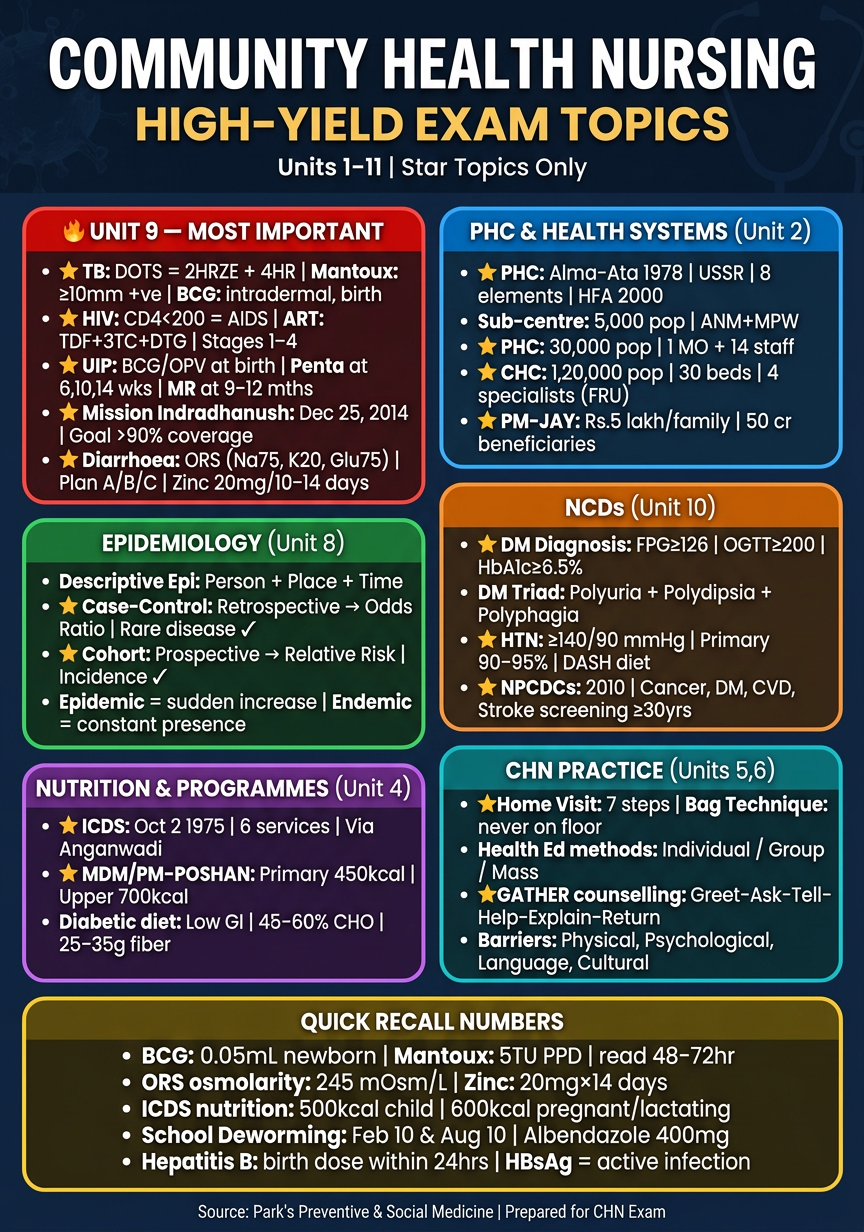
- 🔥 Red - Unit 9 (TB, HIV, UIP, Diarrhoea) - the highest priority
- 🔵 Blue - PHC & Health Systems (Alma-Ata, infrastructure numbers)
- 🟢 Green - Epidemiology (Case-control vs Cohort, Epidemic vs Endemic)
- 🟠 Orange - NCDs (DM diagnostic criteria, HTN, NPCDCS)
- 🟣 Purple - Nutrition & Programmes (ICDS, MDM, Diabetic diet)
- 🩵 Teal - CHN Practice (Home visit, Bag technique, GATHER)
- 🟡 Gold - Quick Recall Numbers (doses, dates, thresholds)
Make a practice question bank with answers by unit
What type of questions would you like? · What format for the output?
COMMUNITY HEALTH NURSING
PRACTICE QUESTION BANK — ALL 11 UNITS
UNIT 1 - Levels of Prevention, Scope of CHN, Dimensions & Determinants of Health
MCQs
- A) Primordial prevention
- B) Primary prevention — Specific protection ✅
- C) Secondary prevention
- D) Tertiary prevention
- A) Primary prevention
- B) Secondary prevention
- C) Tertiary prevention — Rehabilitation ✅
- D) Primordial prevention
- A) Universal Health Coverage
- B) Health for All (HFA) ✅
- C) Comprehensive Health Care
- D) Primary Health Care
- A) Early diagnosis of disease
- B) Preventing the emergence of risk factors themselves ✅
- C) Rehabilitation of disabled individuals
- D) Vaccination against diseases
- A) Physical
- B) Social
- C) Financial ✅
- D) Spiritual
- A) Biological
- B) Environmental
- C) Socio-economic ✅
- D) Behavioural
Short Answer Questions
| Level | Example |
|---|---|
| Primordial | Anti-tobacco advertising before smoking becomes prevalent |
| Primary - Health promotion | Health education on balanced diet |
| Primary - Specific protection | BCG vaccine for TB |
| Secondary - Early diagnosis | Mantoux test for TB detection |
| Secondary - Disability limitation | Antibiotics to prevent cardiac damage in rheumatic fever |
| Tertiary - Rehabilitation | Physiotherapy after stroke |
UNIT 2 - PHC, Health Care Delivery System, Ayushman Bharat, UHC
MCQs
- A) 1975
- B) 1977
- C) 1978 ✅
- D) 1981
- A) 5
- B) 6
- C) 7
- D) 8 ✅
- A) 3,000
- B) 5,000 ✅
- C) 10,000
- D) 30,000
- A) Sub-Centre
- B) PHC
- C) Community Health Centre (CHC) ✅
- D) District Hospital
- A) Rs. 1 lakh per family per year
- B) Rs. 2 lakh per family per year
- C) Rs. 5 lakh per family per year ✅
- D) Rs. 10 lakh per family per year
- A) Community participation
- B) Equitable distribution ✅
- C) Appropriate technology
- D) Intersectoral coordination
- A) SDG 1
- B) SDG 3.8 ✅
- C) SDG 5
- D) SDG 10
- A) 5,000
- B) 20,000
- C) 30,000 ✅
- D) 1,20,000
Short Answer Questions
- Education about prevailing health problems
- Maternal and Child Health care including family planning
- Promotion of food supply and proper nutrition
- Immunization against infectious diseases
- Prevention and control of endemic diseases
- Appropriate treatment of common diseases and injuries
- Provision of essential drugs
- Adequate supply of safe water and basic sanitation
| Feature | PHC | CHC |
|---|---|---|
| Population | 30,000 (plains) | 1,20,000 |
| Beds | 6 | 30 |
| Medical staff | 1 Medical Officer | 4 specialists |
| Role | First contact with doctor | First referral unit (FRU) |
| Sub-centres | 4-6 under each PHC | 4 PHCs under each CHC |
UNIT 3 - Water Purification, Air Pollution, Solid Waste Management, Hardness of Water
MCQs
- A) Biofilm
- B) Schmutzdecke ✅
- C) Zoogloea
- D) Algal mat
- A) 0.1 mg/L
- B) 0.2 mg/L
- C) 0.5 mg/L ✅
- D) 1.0 mg/L
- A) Sulfates
- B) Chlorides
- C) Carbonates ✅
- D) Nitrates
- A) Boiling
- B) UV radiation
- C) Chlorination ✅
- D) Ozonation
- A) Glass waste
- B) Contaminated plastic
- C) General waste
- D) Anatomical waste (human tissues) ✅
- A) Carbon monoxide
- B) Sulfur dioxide ✅
- C) Lead
- D) Ozone
- A) 0.1–0.4 m/hr
- B) 1–2 m/hr
- C) 5–15 m/hr ✅
- D) 20–30 m/hr
Short Answer Questions
- Storage/Sedimentation - raw water stored for 24-48 hrs; heavy particles settle
- Coagulation/Flocculation - alum (aluminum sulfate) added; fine particles clump into floc
- Filtration - slow or rapid sand filter removes suspended matter + microorganisms
- Disinfection - chlorination to kill remaining pathogens; residual 0.5 mg/L at tap
| Feature | Slow Sand | Rapid Sand |
|---|---|---|
| Rate | 0.1–0.4 m/hr | 5–15 m/hr |
| Pre-treatment | Not needed | Coagulation required |
| Mechanism | Biological (Schmutzdecke) | Physical/mechanical |
| Maintenance | Simple, clean every few months | Backwash every 24–48 hrs |
| Cost | Cheaper | More expensive |
UNIT 4 - Meal Planning, Diet in DM, ICDS, Mid-Day Meal
MCQs
- A) August 15, 1975
- B) October 2, 1975 ✅
- C) January 26, 1976
- D) November 14, 1975
- A) 4
- B) 5
- C) 6 ✅
- D) 8
- A) 300 kcal
- B) 450 kcal ✅
- C) 600 kcal
- D) 700 kcal
- A) Simple sugars
- B) High glycemic index foods
- C) Complex carbohydrates / low GI foods ✅
- D) Refined carbohydrates
- A) PHC
- B) Sub-Centre
- C) Anganwadi Centre ✅
- D) School
- A) 500 kcal + 12 g protein
- B) 600 kcal + 15 g protein
- C) 800 kcal + 20–25 g protein ✅
- D) 700 kcal + 18 g protein
Short Answer Questions
- Supplementary nutrition
- Immunization
- Health check-up
- Referral services
- Non-formal pre-school education (3-6 years)
- Nutrition and health education (to mothers)
UNIT 5 - Health Education, Barriers of Communication, SBCC, BCC
MCQs
- A) Individual counselling
- B) Group discussion
- C) Mass media (TV, radio) ✅
- D) Home visit
- A) Knowledge, Awareness, Practice
- B) Knowledge, Attitude, Practice ✅
- C) Knowledge, Action, Prevention
- D) Knowledge, Attitude, Prevention
- A) Physical barrier
- B) Psychological barrier
- C) Language/Semantic barrier ✅
- D) Cultural barrier
- A) Planning the content
- B) Assessing educational needs ✅
- C) Selecting teaching methods
- D) Implementation
- A) Social Behaviour Change Communication ✅
- B) Standard Behaviour Control Communication
- C) Social-Based Community Communication
- D) Systematic Behaviour Change Counselling
Short Answer Questions
- Physical/Environmental - noise, poor lighting, distance, crowd
- Psychological - fear, anxiety, prejudice, distrust
- Language/Semantic - jargon, low literacy, language differences
- Cultural - taboos, beliefs, social norms against discussion
- Perceptual - different interpretation of the same message, stereotyping
UNIT 6 - Home Visit, Bag Technique, Counselling, Epidemiological Approaches, Qualities of CHN
MCQs
- A) Save time during visits
- B) Prevent cross-infection ✅
- C) Impress the family
- D) Carry more equipment
- A) Health education
- B) History taking
- C) Help the client decide ✅
- D) Hand over information
- A) Nursing assessment
- B) Pre-visit planning ✅
- C) Building rapport
- D) Health education
- A) Educator
- B) Counsellor
- C) Advocate ✅
- D) Researcher
- A) On the table
- B) On a chair
- C) On the floor ✅
- D) On a clean surface
Short Answer Questions
- Pre-visit planning - review records, prepare nursing bag, set objectives
- Introduction - establish rapport with family, explain purpose
- Assessment - physical, social, and environmental assessment
- Nursing intervention - provide nursing care, dressing, medications
- Health education - teach relevant health topics
- Recording - document all findings and care provided
- Post-visit activities - review notes, make referrals if needed, plan next visit
- G - Greet the client warmly, establish rapport
- A - Ask about their problem, concerns, and needs
- T - Tell relevant information tailored to their situation
- H - Help the client make their own informed decision
- E - Explain how to use services/methods chosen
- R - Return for follow-up; schedule next appointment
UNIT 7 - Women Empowerment, BSE, Child Abuse
MCQs
- A) Maternal mortality
- B) Declining child sex ratio ✅
- C) Breast cancer
- D) Girl child nutrition
- A) Daily
- B) Weekly
- C) Monthly, 1 week after menstruation ends ✅
- D) Every 3 months
- A) Mastitis
- B) Benign fibrocystic disease
- C) Breast cancer ✅
- D) Breast abscess
- A) 2005
- B) 2010
- C) 2012 ✅
- D) 2015
- A) Bleeding disorder
- B) Physical abuse ✅
- C) Nutritional deficiency
- D) Normal childhood injuries
Short Answer Questions
- Arms at sides → look for asymmetry, skin changes
- Arms raised above head → look for dimpling
- Hands on hips → flex chest muscles to reveal changes
- Right hand examines left breast (and vice versa)
- Place pillow under shoulder being examined
- Use 3 middle fingers in circular/up-down/wedge pattern
- Cover entire breast from armpit to sternum
- Check axilla for lymph nodes
- Repeat palpation standing or sitting
- Gently squeeze nipple to check for discharge
UNIT 8 - Descriptive Epidemiology, Case-Control, Cohort, Epidemic vs Endemic
MCQs
- A) Case-control study
- B) Cross-sectional study
- C) Cohort study ✅
- D) Randomized controlled trial
- A) Relative Risk
- B) Odds Ratio ✅
- C) Incidence Rate
- D) Prevalence Rate
- A) Exposure and outcome
- B) Person, Place, Time ✅
- C) Risk factors and causes
- D) Incidence and prevalence
- A) Epidemic
- B) Pandemic
- C) Endemic ✅
- D) Sporadic
- A) Cohort study
- B) RCT
- C) Case-control study ✅
- D) Cross-sectional study
- A) Propagated epidemic
- B) Point-source epidemic ✅
- C) Slow pandemic
- D) Endemic disease
Short Answer Questions
| Feature | Case-Control | Cohort |
|---|---|---|
| Direction | Retrospective (backward) | Prospective (forward) |
| Starts with | Disease status (cases vs controls) | Exposure status (exposed vs unexposed) |
| Measure of association | Odds Ratio | Relative Risk |
| Rare diseases | Suitable ✓ | Not suitable |
| Can calculate incidence | No | Yes ✓ |
| Cost & time | Cheaper, faster | Expensive, time-consuming |
| Main bias | Recall bias | Loss to follow-up |
UNIT 9 🔥 - TB, HIV/AIDS, UIP, Mission Indradhanush, Hepatitis, Diarrhoea, NVBDCP
MCQs
- A) 2HR
- B) 4HR
- C) 2HRZE ✅
- D) 2HRZES
- A) Subcutaneous
- B) Intramuscular
- C) Intradermal ✅
- D) Oral
- A) 24 hours
- B) 36 hours
- C) 48–72 hours ✅
- D) 96 hours
- A) 500 cells/μL
- B) 350 cells/μL
- C) 200 cells/μL ✅
- D) 100 cells/μL
- A) AZT + 3TC + NVP
- B) TDF + 3TC + DTG ✅
- C) ABC + 3TC + EFV
- D) TDF + FTC + LPV/r
- A) 1978
- B) 1980
- C) 1985 ✅
- D) 1990
- A) 3 diseases
- B) 4 diseases
- C) 5 diseases ✅ (DPT + HepB + Hib)
- D) 6 diseases
- A) August 15, 2014
- B) November 14, 2014
- C) December 25, 2014 ✅
- D) January 26, 2015
- A) Anopheles mosquito
- B) Aedes aegypti ✅
- C) Culex mosquito
- D) Sandfly
- A) 311 mOsm/L
- B) 270 mOsm/L
- C) 245 mOsm/L ✅
- D) 200 mOsm/L
- A) Feco-oral route
- B) Sexual contact
- C) Blood (shared needles, transfusions) ✅
- D) Respiratory droplets
- A) Past infection, now immune
- B) Vaccination immunity
- C) Active infection or carrier state ✅
- D) Window period
- A) 5 days
- B) 7 days
- C) 10–14 days ✅
- D) 21 days
- A) Pulmonary TB in adults
- B) TB meningitis and miliary TB in children ✅
- C) TB lymphadenitis in adults
- D) Drug-resistant TB
Short Answer Questions
- Intensive phase: 2HRZE (2 months) - Daily Isoniazid (H) + Rifampicin (R) + Pyrazinamide (Z) + Ethambutol (E)
- Continuation phase: 4HR (4 months) - Daily Isoniazid (H) + Rifampicin (R)
- Total duration: 6 months
- Delivery: Under direct observation by a health worker (DOTS)
- Programme: National TB Elimination Programme (NTEP); Goal: Eliminate TB by 2025
- Sexual contact (unprotected sex - most common route)
- Blood and blood products (transfusions, contaminated needles, sharing syringes)
- Mother to child (vertical) - during pregnancy, labour/delivery, breastfeeding
- Occupational exposure (needlestick injuries in healthcare workers)
- Casual contact (shaking hands, hugging)
- Sharing utensils, clothes, toilets
- Mosquitoes or insect bites
- Coughing or sneezing
- Swimming pools
| Age | Vaccines |
|---|---|
| At birth | BCG + OPV-0 + Hepatitis B (birth dose, within 24 hrs) |
| 6 weeks | OPV-1 + IPV-1 + Pentavalent-1 + RVV-1 |
| 10 weeks | OPV-2 + Pentavalent-2 + RVV-2 |
| 14 weeks | OPV-3 + IPV-2 + Pentavalent-3 + RVV-3 |
| Plan | Dehydration status | Management |
|---|---|---|
| Plan A | No dehydration | ORS at home; continue breastfeeding; seek care if worsens |
| Plan B | Some dehydration | ORS 75 mL/kg over 4 hours in clinic; reassess after 4 hrs |
| Plan C | Severe dehydration | IV fluids (Ringer's Lactate); urgent referral; manage shock |
| All plans: Zinc 20 mg/day for 10-14 days + continue feeding |
UNIT 10 - Diabetes Mellitus, Hypertension, NPCDCS, Breast Cancer, Blindness Control
MCQs
- A) 100
- B) 110
- C) 126 ✅
- D) 140
- A) Fever, fatigue, weight loss
- B) Polyuria, Polydipsia, Polyphagia ✅
- C) Nausea, vomiting, dizziness
- D) Blurred vision, numbness, fatigue
- A) 120/80 mmHg
- B) 130/85 mmHg
- C) 140/90 mmHg ✅
- D) 150/90 mmHg
- A) Glaucoma
- B) Diabetic retinopathy
- C) Cataract ✅
- D) Refractive errors
- A) 2005
- B) 2008
- C) 2010 ✅
- D) 2012
- A) Insulin
- B) Glipizide
- C) Metformin ✅
- D) Sitagliptin
- A) 12 weeks
- B) 16 weeks
- C) 20 weeks ✅
- D) 28 weeks
- A) 5.7%
- B) 6.0%
- C) 6.5% ✅
- D) 7.0%
Short Answer Questions
- Fasting plasma glucose ≥ 126 mg/dL (after 8 hrs fasting)
- 2-hour plasma glucose ≥ 200 mg/dL during OGTT (75g glucose load)
- HbA1c ≥ 6.5%
- Random plasma glucose ≥ 200 mg/dL + symptoms of hyperglycemia
- Prevention and control of NCDs through behaviour change
- Screening and early detection at PHC level
- Diagnosis and management integrated into existing health services
- Population-based NCD screening for adults ≥30 years (HTN, DM, oral/cervical/breast cancer)
UNIT 11 - School Health Services, Role of School Health Nurse, Health Problems
MCQs
- A) Malocclusion
- B) Dental caries ✅
- C) Fluorosis
- D) Gingivitis
- A) Hypermetropia
- B) Astigmatism
- C) Myopia (short-sightedness) ✅
- D) Presbyopia
- A) January 10 and July 10
- B) February 10 and August 10 ✅
- C) March 10 and September 10
- D) April 10 and October 10
- A) Mebendazole 500 mg
- B) Pyrantel pamoate
- C) Albendazole 400 mg ✅
- D) Ivermectin
- A) Nutritional survey
- B) Medical inspection / Health appraisal ✅
- C) Environmental assessment
- D) Epidemiological survey
- A) 0–5 years
- B) 5–14 years
- C) 6–18 years ✅
- D) 10–18 years
Short Answer Questions
- Health appraisal - annual physical exam; vision, hearing, dental screening; anthropometry
- Follow-up & remedial services - treat defects found, refer if needed
- Communicable disease control - exclude sick children; ensure immunization; detect outbreaks
- Healthful school environment - safe water, proper sanitation, adequate lighting/ventilation
- School nutrition programme - Mid-Day Meal; nutritional assessment; IFA supplementation
- Mental health services - guidance and counselling; identify learning disabilities
- First aid - sick bay; management of injuries and acute illness
- Health education - hygiene, sanitation, personal health in curriculum
- Nutritional: PEM, iron deficiency anaemia, Vitamin A/D deficiency, obesity (urban)
- Communicable diseases: Diarrhoea, RTI, TB, measles, pediculosis, scabies
- Dental: Dental caries (most common), malocclusion, fluorosis
- Visual: Myopia (most common refractive error), squint
- Hearing: Conductive hearing loss (otitis media)
- Orthopaedic: Scoliosis, postural defects, flat foot
- Mental health: Dyslexia, ADHD, bullying, drug abuse (adolescents)
- Worm infestations: Soil-transmitted helminths (hookworm, roundworm)
MASTER ANSWER KEY - MCQs
| Q | Ans | Q | Ans | Q | Ans | Q | Ans | |||
|---|---|---|---|---|---|---|---|---|---|---|
| 1 | B | 21 | C | 41 | C | 61 | C | |||
| 2 | C | 22 | B | 42 | B | 62 | B | |||
| 3 | B | 23 | C | 43 | C | 63 | C | |||
| 4 | B | 24 | B | 44 | B | 64 | B | |||
| 5 | C | 25 | C | 45 | B | 65 | C | |||
| 6 | C | 26 | C | 46 | C | 66 | C | |||
| 7 | C | 27 | C | 47 | C | 67 | C | |||
| 8 | D | 28 | C | 48 | B | 68 | C | |||
| 9 | B | 29 | B | 49 | C | 69 | C | |||
| 10 | C | 30 | C | 50 | C | 70 | C | |||
| 11 | C | 31 | B | 51 | C | 71 | B | |||
| 12 | B | 32 | A | 52 | C | 72 | C | |||
| 13 | B | 33 | B | 53 | B | 73 | B | |||
| 14 | C | 34 | C | 54 | C | 74 | C | |||
| 15 | B | 35 | B | 55 | C | 75 | B | |||
| 16 | C | 36 | C | 56 | C | 76 | C | |||
| 17 | C | 37 | C | 57 | B | |||||
| 18 | C | 38 | B | 58 | C | |||||
| 19 | D | 39 | C | 59 | C | |||||
| 20 | B | 40 | C | 60 | C |