
How to approach recurrent hypocalcemia
I'll start by reading the medical library skill, then search for comprehensive information on recurrent hypocalcemia.
Quick Answer: Recurrent hypocalcemia is most commonly caused by hypoparathyroidism (post-surgical or autoimmune), vitamin D deficiency, hypomagnesemia, or pseudohypoparathyroidism. The workup focuses on PTH levels, vitamin D status, magnesium, renal function, and phosphate. Management involves correcting the underlying cause, oral calcium supplementation, and active vitamin D analogs (calcitriol) when PTH-dependent mechanisms are impaired.
Searching sources...
Reading File
Now I'll run parallel searches across the library and PubMed simultaneously.
Finding Sources
Finding Sources
Searching PubMed
"hypocalcemia" AND "hypoparathyroidism" AND management
Good. Now let me read the most relevant textbook sections - Henry's Clinical Diagnosis (lab methods), Goldman-Cecil Medicine, and Rosen's Emergency Medicine for a complete clinical picture. I'll also search for the etiology/causes section.
Reading File
Reading File
Finding Sources
Excellent content retrieved. Now let me get the Goldman-Cecil Medicine section on hypocalcemia workup and the Rosen's Emergency Medicine section, plus search for images.
Finding Sources
Finding Sources
Searching Images
hypocalcemia approach diagnosis algorithm PTH
Let me now read the key sections from Brenner & Rector (diagnostic workup) and Harrison's (treatment) for the most authoritative content.
Reading File
Reading File
Now let me get the diagnostic workup algorithm from Brenner & Rector and read a bit more of Harrison's for the vitamin D deficiency and CKD sections.
Reading File
Reading File
I have the diagnostic algorithm image and rich clinical content. Let me fetch that algorithm image and also get one more important section on management from Brenner & Rector.
Loading Image
Reading File
I now have comprehensive content from multiple authoritative sources. Let me compile the full clinical answer.
Approach to Recurrent Hypocalcemia
Step 1 - Confirm True Hypocalcemia
Before investigating further, exclude false (pseudo-)hypocalcemia:
- Correct for albumin: adjusted Ca = measured Ca + 0.8 × (4.0 - serum albumin g/dL)
- Measure ionized calcium directly when in doubt (e.g., acid-base disorders, paraproteinemias)
- Exclude lab artifacts: sample freezing/thawing, haemodialysis patients
The threshold for true hypocalcemia is serum calcium < 8.8 mg/dL (< 2.2 mmol/L); < 7 mg/dL in preterm infants, < 8 mg/dL in neonates.
Step 2 - Diagnostic Algorithm
The figure below from Brenner & Rector's The Kidney is the most structured approach:
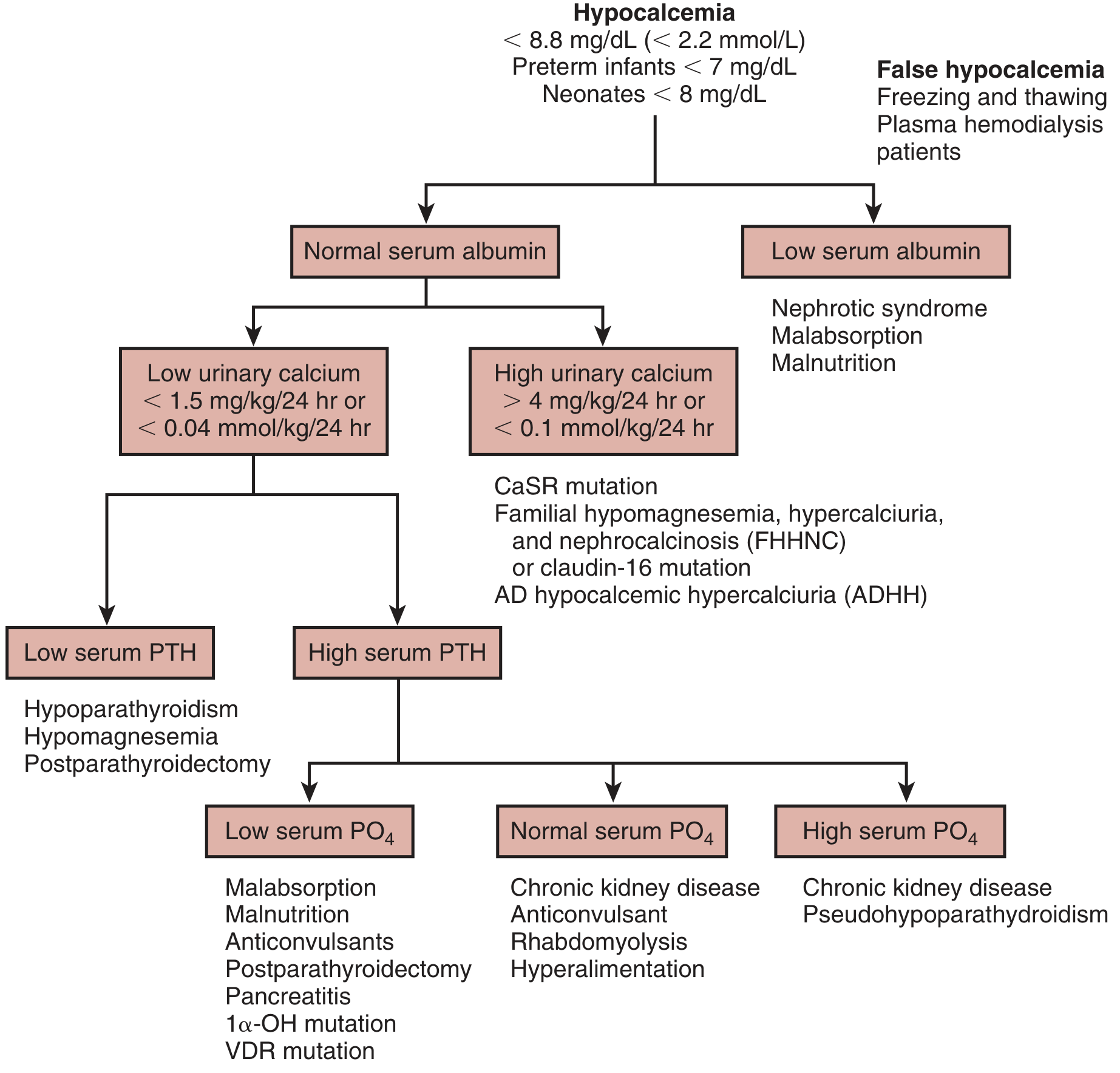
The branch points are:
2a. Serum Albumin
- Low albumin → think nephrotic syndrome, malabsorption, malnutrition (these cause hypoalbuminemia and therefore apparent hypocalcemia; ionized Ca may be normal)
- Normal albumin → proceed to urinary calcium
2b. Urinary Calcium (24-hour)
| Urinary Ca | Interpretation |
|---|---|
| Low (<1.5 mg/kg/24h) | Check serum PTH |
| High (>4 mg/kg/24h) | CaSR-activating mutation, FHHNC (claudin-16 mutation), AD hypocalcemic hypercalciuria (ADHH) |
2c. Serum PTH (when urine Ca is low)
| PTH | Phosphate | Diagnoses |
|---|---|---|
| Low/undetectable | High | Hypoparathyroidism, hypomagnesemia, post-parathyroidectomy |
| High | Low | Malabsorption, malnutrition, anticonvulsants, pancreatitis, 1α-OH mutation (VDDR type I), VDR mutation (VDDR type II) |
| High | Normal | CKD, anticonvulsants, rhabdomyolysis, hyperalimentation |
| High | High | CKD, pseudohypoparathyroidism |
(Brenner & Rector's The Kidney; Henry's Clinical Diagnosis and Management by Laboratory Methods)
Step 3 - Causes of Recurrent Hypocalcemia (Mechanism-Based)
A. PTH Deficiency (Low PTH)
| Cause | Key Features |
|---|---|
| Post-surgical hypoparathyroidism | Most common acquired cause; after thyroidectomy, parathyroidectomy, or radical neck dissection |
| Autoimmune hypoparathyroidism | Isolated or part of APS-1 (with adrenal failure, candidiasis, alopecia) |
| DiGeorge syndrome | Parathyroid + thymus maldevelopment; 22q11 deletion |
| Activating CaSR mutation | Gain-of-function mutation suppresses PTH release; associated with hypercalciuria |
| Hypomagnesemia | Impairs both PTH secretion and PTH receptor responsiveness; a very common and reversible cause |
| Infiltrative | Iron (thalassaemia, hemochromatosis), copper (Wilson's disease), tumor/granuloma |
| Radiation | High-dose to neck (rare) |
| Drugs | Asparaginase, alcohol |
B. PTH Resistance (High PTH)
| Cause | Key Features |
|---|---|
| Pseudohypoparathyroidism (PHP) | Albright hereditary osteodystrophy; defective Gs-protein; elevated PTH despite low Ca |
| Hypomagnesemia | Also causes end-organ resistance to PTH |
| Chronic kidney disease | Reduced 1α-hydroxylase activity + hyperphosphatemia |
C. Vitamin D Deficiency/Resistance
| Cause | Key Features |
|---|---|
| Nutritional deficiency | Inadequate sunlight, low dairy intake (especially elderly at northern latitudes) |
| Malabsorption | Celiac, Crohn's, post-bariatric surgery, biliary cirrhosis |
| Anticonvulsants | Induce cytochrome P450 enzymes, increasing conversion of vitamin D to inactive metabolites |
| Hepatic disease | Reduced 25-hydroxylation |
| VDDR Type I | CYP27B1 mutation → impaired 1α-hydroxylation; responds to calcitriol |
| VDDR Type II | VDR mutation → end-organ resistance; requires very high-dose calcitriol |
(Harrison's Principles of Internal Medicine 22E; Henry's Clinical Diagnosis)
Step 4 - Minimum Workup Panel
For any patient with recurrent/persistent hypocalcemia, order:
- Corrected serum calcium (or ionized calcium)
- Serum phosphate - high in hypoparathyroidism/CKD; low in vitamin D deficiency/malabsorption
- Intact PTH - the central branch point
- Serum magnesium - hypomagnesaemia causes refractory hypocalcaemia that doesn't respond to calcium/vitamin D alone
- 25-hydroxyvitamin D (25[OH]D) - screen for nutritional deficiency
- Serum creatinine/eGFR - assess renal function
- 24-hour urinary calcium - helps distinguish PTH-deficient from CaSR-mutation causes
- Alkaline phosphatase - elevated in vitamin D deficiency/osteomalacia
- Serum albumin
- Targeted extras: CaSR mutation testing if familial/hypercalciuric; ACTH stimulation in suspected APS-1; PTHrP if malignancy suspected
Step 5 - Red Flags for Recurrence
Hypocalcemia recurs because of one of these overlooked factors:
- Undertreated/unrecognized hypomagnesemia - the single most common reason calcium replacement fails; magnesium must be corrected first
- Non-adherence to oral calcium/calcitriol
- Medications causing hypocalcemia: bisphosphonates (hungry bone), denosumab, cinacalcet, foscarnet, EDTA-containing products, fluoride, citrated blood products
- Hungry bone syndrome after parathyroidectomy for long-standing hyperparathyroidism
- Worsening CKD reducing renal 1,25(OH)2D production
- Acquired CaSR-activating antibodies (rare, autoimmune)
- GI malabsorption - e.g., undiagnosed celiac disease preventing calcium/vitamin D absorption
Step 6 - Management Principles
Acute Symptomatic Hypocalcemia (tetany, seizure, QT prolongation)
- IV calcium gluconate 10%: 10-20 mL (90-180 mg elemental Ca) over 10 minutes, followed by continuous infusion (0.5-1.5 mg elemental Ca/kg/hr)
- Monitor ionized calcium every 4-6 hours; infusion solution must NOT contain phosphate or bicarbonate
- Concurrently correct hypomagnesemia (IV magnesium sulfate) and hyperphosphatemia
- (Brenner & Rector's The Kidney)
Chronic Management (by underlying cause)
| Cause | Treatment |
|---|---|
| Hypoparathyroidism | Oral calcium (500-2000 mg elemental Ca/day) + calcitriol 0.25-2 µg/day; target serum Ca at low-normal range to avoid hypercalciuria/nephrocalcinosis; thiazide diuretics can reduce urinary Ca loss |
| Vitamin D deficiency | Cholecalciferol (vitamin D3) 1000-5000 IU/day + adequate calcium intake |
| Hypomagnesemia | Oral magnesium supplementation (or IV in severe cases); treat underlying cause (PPI use, diuretics, alcohol) |
| CKD | Active vitamin D analogs (calcitriol or paricalcitol); phosphate restriction/binders; manage secondary hyperparathyroidism |
| PHP | Similar to hypoparathyroidism but often requires higher doses; target PTH at upper-normal |
| VDDR type I | Physiologic-dose calcitriol |
| VDDR type II | Very high-dose calcitriol; IV calcium infusions in resistant cases |
| Anticonvulsant-related | Increase vitamin D supplementation; monitor levels |
(Harrison's Principles of Internal Medicine 22E, 2025; Brenner & Rector's The Kidney; Textbook of Family Medicine 9e)
Emerging/PTH Replacement Therapy
- Palopegteriparatide (TransCon PTH): a sustained-release PTH(1-34) prodrug given SC once daily; FDA-approved for hypoparathyroidism; normalizes blood and urine calcium in phase 3 trials
- Eneboparatide: biased PTH receptor agonist with prolonged intracellular signaling; currently in phase 3 trials
- These address the root PTH deficiency rather than just compensating with calcium/vitamin D
- (Harrison's Principles of Internal Medicine 22E, 2025; Hypoparathyroidism review 2025, PMID: 39397231)
Step 7 - Monitoring on Long-term Treatment
- Serum calcium and phosphate every 3-6 months (or more frequently during dose titration)
- 24-hour urinary calcium annually to detect hypercalciuria (target <300 mg/day in men, <250 mg/day in women)
- Serum creatinine and renal imaging periodically for nephrocalcinosis in hypoparathyroidism
- 25(OH)D levels to guide vitamin D dosing
- In PHP, watch for over-correction during and after puberty as calcium needs decrease
Summary Mnemonics
Low PTH → think SHIM: Surgery, Hereditary (DiGeorge, APS-1), Infiltration, Magnesium deficiency
High PTH → think CRACK-P: CKD, Resistance (PHP), Anticonvulsants, Calcitriol deficiency (malabsorption, VDDR), panKreatitis, Postparathyroidectomy hungry bone
This is a shared conversation. Sign in to Orris to start your own chat.