
Osteoporosis drug classification
Reading File
Now let me search the library for osteoporosis drug classification content in parallel:
Finding Sources
Finding Sources
Let me search more specifically for osteoporosis treatment/pharmacology sections and also search Goldman-Cecil which is a great general medicine reference:
Finding Sources
Finding Sources
Excellent. I found the best sources: Lippincott Pharmacology (dedicated osteoporosis drug section) and Harrison's (pharmacologic treatment section). Let me read both in parallel:
Reading File
Reading File
I have excellent content from both sources. Let me read more of the Lippincott section for the remaining drug classes (SERMs, calcitonin, PTH analogs, denosumab) and the continuation of Harrison's:
Reading File
Reading File
I now have excellent, comprehensive content from both Lippincott Pharmacology and Harrison's. Let me also fetch the mechanism of action diagram for denosumab and get the SERMs/calcitonin section from Lippincott:
Reading File
Loading Image
I also need to find the SERMs and calcitonin sections from Lippincott. Let me also check what's before line 2596 (where I left off earlier between bisphosphonates and denosumab):
Reading File
I now have comprehensive content from both Lippincott and Harrison's covering all major drug classes. Let me now compile the full answer:
Osteoporosis Drug Classification
Osteoporosis drugs are divided into two broad functional categories: antiresorptive agents (which reduce bone breakdown) and anabolic agents (which stimulate bone formation). A third mixed-action category is increasingly recognized.
I. ANTIRESORPTIVE AGENTS
A. Bisphosphonates
First-line therapy for postmenopausal osteoporosis, osteoporosis in men, and glucocorticoid-induced osteoporosis.
Mechanism: Bind to hydroxyapatite crystals in bone and inhibit osteoclastic bone resorption, producing a small but sustained increase in bone mass and reduced fracture risk.
| Drug | Route | Dosing Frequency |
|---|---|---|
| Alendronate | Oral tablet | Daily or weekly |
| Risedronate | Oral tablet | Daily, weekly, or monthly |
| Ibandronate | Oral / IV | Monthly (oral); every 3 months (IV) |
| Zoledronic acid | IV | Yearly |
| Etidronate | Oral | Cyclic dosing |
| Pamidronate | IV | Variable |
Antiresorptive potency (relative to etidronate = 1):
Etidronate (1) < Tiludronate (10) < Pamidronate (100) < Alendronate (1,000) < Risedronate (5,000) < Ibandronate = Zoledronic acid (10,000)
Pharmacokinetics: Oral bioavailability is very poor (<1%). Zoledronic acid has the highest affinity for mineralized bone and suppresses resorption for up to 1 year after a single IV infusion. Eliminated predominantly via the kidney -- avoid in severe renal impairment.
Dosing instructions (oral): Take with plain water only, at least 30 minutes before food/other medications, remain upright for at least 30 minutes after.
Adverse effects:
- GI: Esophagitis, esophageal ulcers, diarrhea, abdominal pain
- Rare but serious: Osteonecrosis of the jaw (ONJ), atypical femur fractures (risk increases with long-term use)
- Acute-phase reaction with IV formulations (flu-like symptoms)
Drug holiday: Recommended after 5 years of oral bisphosphonates or 3 years of zoledronic acid in patients whose fracture risk has declined. Do NOT discontinue in patients who remain at high fracture risk.
B. RANKL Inhibitor - Denosumab
Mechanism: Monoclonal antibody that binds RANKL, preventing it from activating RANK receptors on osteoclasts. This inhibits osteoclast formation and function, reducing bone resorption. Unlike bisphosphonates, denosumab allows bone formation to continue, so BMD gains exceed those of direct antiresorptives.
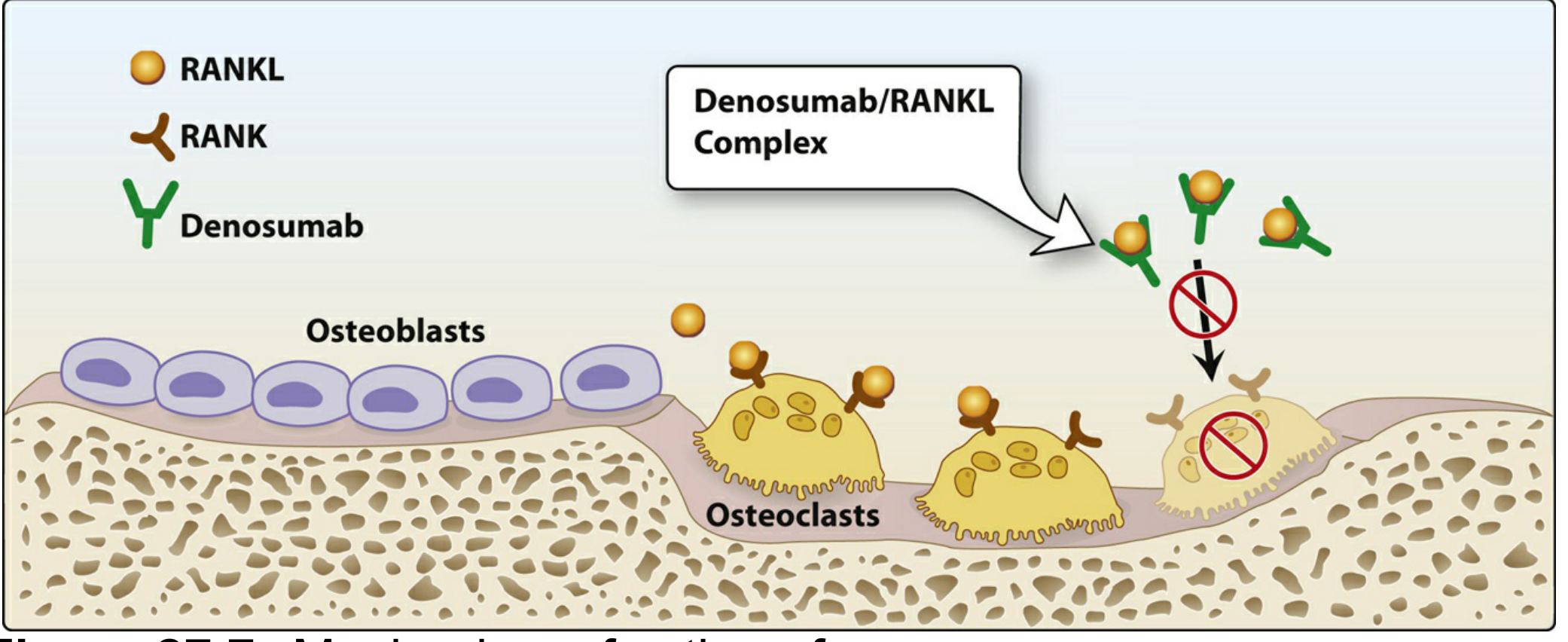
Route/Frequency: SC injection every 6 months.
Indications: Postmenopausal osteoporosis (high fracture risk), osteoporosis in men, glucocorticoid-induced osteoporosis. An alternative first-line agent, especially in patients with GI intolerance to bisphosphonates or renal impairment.
Key caution: Discontinuation causes rebound bone loss and elevated fracture risk. Patients stopping denosumab must be transitioned to a bisphosphonate.
Adverse effects: GI upset, bone pain, hypocalcemia, infections, dermatologic reactions, rare ONJ and atypical fractures.
Note: A separate denosumab formulation (higher dose) is used for hypercalcemia of malignancy and skeletal-related events in multiple myeloma / bone metastases.
C. Estrogens / Hormone Therapy
Mechanism: Estrogen receptor (ERα and ERβ) agonism in bone. Estrogen:
- Increases osteoprotegerin (OPG) production -- inhibits RANKL
- Decreases pro-resorptive cytokines (IL-1, IL-6, TNF)
- May directly inhibit osteoclasts
Types: Conjugated equine estrogens (CEE), estradiol, esterified estrogens, ethinyl estradiol, mestranol; oral and transdermal forms.
Efficacy: Epidemiologic data show ~50% reduction in osteoporotic fractures. WHI data showed 34% reduction in hip fracture and 24% reduction in all clinical fractures with combined estrogen-progestin.
Key risks (WHI data): +29% MI, +40% stroke, +100% venous thromboembolism, +26% breast cancer (combined HRT). Estrogen-only formulation (post-hysterectomy) has a more favorable profile -- no increased MI, decreased breast cancer risk compared to combined HRT.
Current role: Not recommended as first-line osteoporosis therapy due to the systemic risk profile. May be appropriate in younger postmenopausal women who also need menopausal symptom relief (benefit-risk more favorable when started within 10 years of menopause or before age 60).
D. Selective Estrogen Receptor Modulators (SERMs)
Mechanism: Tissue-selective ER agonist/antagonist. In bone, they act as estrogen agonists to reduce bone resorption. In breast and uterus, they are antagonists.
| Drug | Notes |
|---|---|
| Raloxifene | Approved for postmenopausal osteoporosis; also reduces breast cancer risk; increases VTE risk |
| Bazedoxifene | Used in combination with conjugated estrogens |
Key advantage over estrogens: No increased breast cancer risk (raloxifene actually reduces it). Does not stimulate the uterus.
Adverse effects: Hot flashes, VTE risk (similar to estrogen), leg cramps.
E. Calcitonin
Mechanism: Salmon calcitonin directly inhibits osteoclast activity via calcitonin receptors on osteoclasts.
Route: Intranasal spray or SC/IM injection.
Key limitation: Modest antifracture efficacy (primarily vertebral fractures); largely supplanted by bisphosphonates and denosumab in modern practice.
Additional use: Analgesic effect in acute vertebral fracture pain.
Adverse effect concern: The FDA noted a possible increased risk of malignancy with long-term nasal calcitonin use.
II. ANABOLIC AGENTS (Bone-Building)
A. Parathyroid Hormone (PTH) Analogs
Paradoxically, while sustained high PTH (as in hyperparathyroidism) causes bone loss, intermittent, once-daily subcutaneous PTH administration stimulates osteoblast activity and increases bone formation.
| Drug | Class | Notes |
|---|---|---|
| Teriparatide | Recombinant human PTH 1-34 | FDA-approved; up to 2 years cumulative use |
| Abaloparatide | PTH-related peptide analog | Also SC daily; up to 2 years |
Indications: Reserved for patients at very high fracture risk (e.g., T-score < -2.5 with fractures, multiple vertebral fractures) and those who have failed or cannot tolerate antiresorptives.
Adverse effects: Injection site reactions, hypercalcemia, orthostatic hypotension. Abaloparatide also causes hyperuricemia.
Osteosarcoma concern (rat studies): Both drugs are contraindicated in patients at increased risk for osteosarcoma (Paget's disease, prior radiation to the skeleton, unexplained elevations in alkaline phosphatase). Lifetime cumulative use should not exceed 2 years for either agent.
Critical sequencing rule: Following completion of PTH analog therapy, a bisphosphonate or other antiresorptive must be started immediately to preserve the BMD gains. Without this, bone loss resumes rapidly.
B. Sclerostin Inhibitor
Romosozumab - Monoclonal antibody against sclerostin.
Mechanism: Sclerostin is a Wnt-pathway inhibitor produced by osteocytes that suppresses osteoblast activity. By neutralizing sclerostin, romosozumab:
- Promotes osteoblast activity --> bone formation (primary effect)
- Secondarily reduces bone resorption
This dual action (anabolic + antiresorptive) makes it the most potent agent for rapid BMD gains.
Route/Frequency: SC injection once monthly for 12 months.
Indications: Postmenopausal women with osteoporosis at high fracture risk. Transitioned to antiresorptive therapy after 12-month course.
Key safety concern: Increased risk of cardiovascular events (MI, stroke) -- contraindicated in patients with a history of MI or stroke within the past year.
III. SUMMARY TABLE
| Drug Class | Mechanism | Examples | Route | Primary Use |
|---|---|---|---|---|
| Bisphosphonates | Inhibit osteoclast via hydroxyapatite binding | Alendronate, Risedronate, Zoledronic acid | Oral / IV | 1st line |
| RANKL inhibitor | Anti-RANKL mAb blocks osteoclast activation | Denosumab | SC every 6 months | 1st line alternative |
| Estrogen / HRT | ER agonist, reduces osteoclast activity | CEE, Estradiol | Oral / transdermal | Symptomatic menopause + osteoporosis |
| SERMs | Selective ER agonist in bone | Raloxifene | Oral daily | Alternative; also for breast cancer risk reduction |
| Calcitonin | Direct osteoclast inhibition | Salmon calcitonin | Intranasal / SC | Adjunct; mainly for pain in acute VF |
| PTH analogs | Stimulate osteoblasts (intermittent PTH) | Teriparatide, Abaloparatide | SC daily | Very high risk; post-antiresorptive failure |
| Sclerostin inhibitor | Anti-sclerostin mAb; activates Wnt, builds bone | Romosozumab | SC monthly x 12 months | Very high risk; fastest BMD gains |
IV. TREATMENT SEQUENCING
Current guidelines (Harrison's 22E, Lippincott Pharmacology) recommend:
- First-line: Bisphosphonates (alendronate, risedronate, zoledronic acid) or denosumab as alternative
- Very high risk (T-score < -2.5 + fractures, multiple vertebral fractures): Start with anabolic therapy (teriparatide, abaloparatide, or romosozumab) -- anabolic-first then antiresorptive consolidation
- After anabolic therapy: Mandatory transition to bisphosphonate or denosumab to preserve BMD gains
- After denosumab discontinuation: Mandatory bisphosphonate transition to prevent rebound bone loss
- Drug holiday: Applicable to bisphosphonates after 3-5 years in lower-risk patients; reassess every 2-3 years
Sources:
- Lippincott Illustrated Reviews: Pharmacology, Chapter 27 (Drugs for Bone Disorders)
- Harrison's Principles of Internal Medicine, 22nd Edition (2025), Chapter 423: Pharmacologic Treatment of Osteoporosis
This is a shared conversation. Sign in to Orris to start your own chat.