
TCA cycle
I'll give you a quick overview while pulling from the medical library for depth.
The TCA cycle (tricarboxylic acid cycle, also called the Krebs cycle or citric acid cycle) is a series of 8 enzymatic reactions in the mitochondrial matrix that oxidize acetyl-CoA to CO2, generating NADH, FADH2, and GTP. It is the central hub of aerobic metabolism, feeding electrons into the electron transport chain for ATP synthesis.
Searching sources...
Reading File
Finding Sources
Searching the Web
TCA cycle steps enzymes NADH FADH2 regulation
Reading File
Reading File
Reading File
Reading File
Loading Image
Here is a thorough breakdown of the TCA cycle, drawn from Harper's Illustrated Biochemistry and Guyton & Hall Medical Physiology.
The TCA Cycle (Citric Acid / Krebs Cycle)
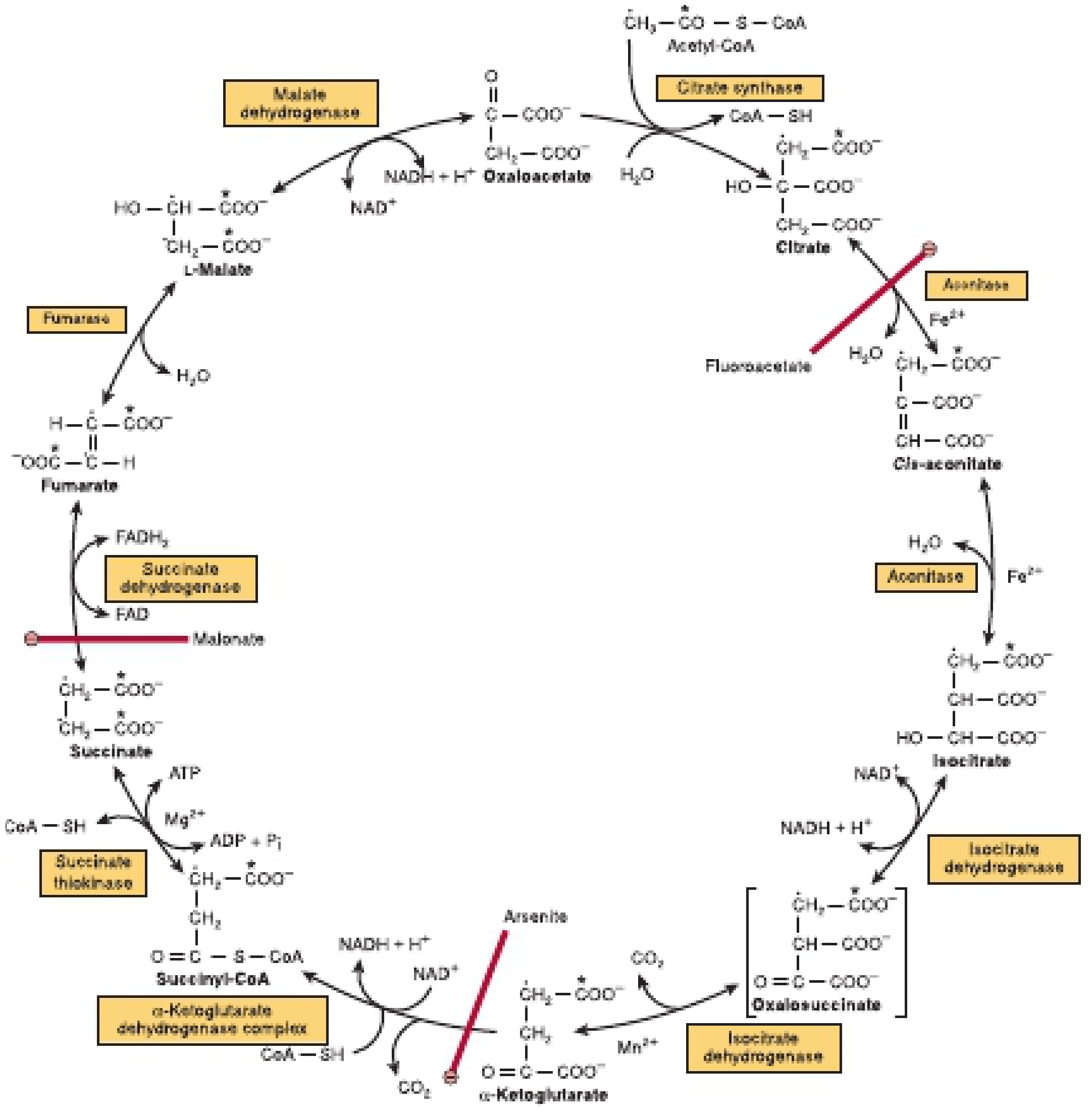
Location & Overview
- Occurs in the mitochondrial matrix (enzymes are free or bound to the inner mitochondrial membrane/cristae)
- Entry substrate: acetyl-CoA (2-carbon unit from carbohydrate, fat, and protein catabolism)
- Acetyl-CoA condenses with oxaloacetate (OAA, 4C) to form citrate (6C), then two CO2 are released and OAA is regenerated
- The cycle is amphibolic - serves both oxidative (energy) and biosynthetic (anabolic) functions
The 8 Reactions
| Step | Substrate → Product | Enzyme | Cofactor/Product |
|---|---|---|---|
| 1 | Acetyl-CoA + OAA → Citrate | Citrate synthase | CoA-SH released |
| 2 | Citrate → Isocitrate | Aconitase (via cis-aconitate) | Fe²⁺; H₂O removed then added |
| 3 | Isocitrate → α-Ketoglutarate + CO₂ | Isocitrate dehydrogenase | NADH produced; Mn²⁺ |
| 4 | α-Ketoglutarate → Succinyl-CoA + CO₂ | α-Ketoglutarate dehydrogenase complex | NADH produced; thiamine (B1), lipoate, FAD, CoA |
| 5 | Succinyl-CoA → Succinate | Succinate thiokinase | GTP (substrate-level phosphorylation); Mg²⁺ |
| 6 | Succinate → Fumarate | Succinate dehydrogenase | FADH₂ produced |
| 7 | Fumarate → Malate | Fumarase | H₂O added |
| 8 | Malate → Oxaloacetate | Malate dehydrogenase | NADH produced |
Steps 3 and 4 are the two CO₂-releasing steps.
Energy Yield Per Acetyl-CoA (One Turn)
| Product | Quantity | ATP equivalents |
|---|---|---|
| NADH | 3 | ~2.5 ATP each = 7.5 ATP |
| FADH₂ | 1 | ~1.5 ATP each = 1.5 ATP |
| GTP/ATP | 1 | 1 ATP (substrate-level) |
| Total | ~10 ATP |
Since one glucose yields 2 pyruvate → 2 acetyl-CoA, the TCA cycle contributes ~20 ATP per glucose (plus the 5 NADH from pyruvate dehydrogenase across two turns).
Vitamins Required
Four B vitamins are essential (Harper's, p. 171):
- Thiamine (B1) - thiamine diphosphate; cofactor for α-ketoglutarate dehydrogenase
- Riboflavin (B2) - FAD; cofactor for succinate dehydrogenase
- Niacin (B3) - NAD⁺; electron acceptor for isocitrate dehydrogenase, α-ketoglutarate dehydrogenase, and malate dehydrogenase
- Pantothenic acid (B5) - component of coenzyme A; needed to form acetyl-CoA and succinyl-CoA
Deficiency in any of these impairs TCA cycle function and energy metabolism.
Regulation
The three key regulatory enzymes are all inhibited by NADH and activated by ADP/NAD⁺ (reflecting energy status):
| Enzyme | Activated by | Inhibited by |
|---|---|---|
| Citrate synthase | Acetyl-CoA, OAA | NADH, citrate, succinyl-CoA, ATP |
| Isocitrate dehydrogenase | ADP, Ca²⁺, NAD⁺ | NADH, ATP |
| α-Ketoglutarate dehydrogenase complex | Ca²⁺, ADP | NADH, succinyl-CoA, ATP |
In high-energy states (high NADH, ATP), the cycle slows. In low-energy states (high ADP, NAD⁺), it accelerates.
Inhibitors (Toxicological/Experimental)
- Fluoroacetate (rat poison) - converted to fluorocitrate, inhibits aconitase (step 2)
- Malonate - competitive inhibitor of succinate dehydrogenase (step 6)
- Arsenite - inhibits the α-ketoglutarate dehydrogenase complex (step 4) by reacting with lipoate cofactor
Amphibolic Role: Beyond Energy
The TCA cycle also serves as a hub for biosynthesis (Harper's, p. 171):
- Gluconeogenesis - OAA → phosphoenolpyruvate via PEPCK
- Amino acid synthesis - transamination of α-ketoglutarate → glutamate; OAA → aspartate
- Fatty acid synthesis - citrate exported to cytoplasm → cleaved back to acetyl-CoA (by ATP-citrate lyase)
- Heme synthesis - succinyl-CoA condenses with glycine to form δ-aminolevulinic acid (ALA)
Anaplerosis and Cataplerosis
To sustain the cycle, carbon entering (anaplerosis) must equal carbon exiting (cataplerosis):
- Main anaplerotic reaction: pyruvate + CO₂ → OAA, catalyzed by pyruvate carboxylase (biotin-dependent; activated by acetyl-CoA)
- Other sources: glutamine/glutamate → α-ketoglutarate; propionyl-CoA → succinyl-CoA
- Cataplerosis: OAA → PEP (gluconeogenesis); citrate → cytoplasm (fatty acid synthesis)
Key Clinical Points
- Thiamine deficiency (beriberi, Wernicke's encephalopathy) - impairs α-ketoglutarate dehydrogenase, leading to accumulation of α-ketoglutarate and neurological dysfunction
- Pyruvate dehydrogenase deficiency - reduces acetyl-CoA supply to the cycle; lactic acidosis
- IDH1/IDH2 mutations (gliomas, AML) - mutant enzyme produces 2-hydroxyglutarate (oncometabolite) instead of α-ketoglutarate, disrupting epigenetic regulation
- Fumarate hydratase / succinate dehydrogenase mutations - tumor suppressors; loss causes accumulation of fumarate/succinate, inhibiting HIF prolyl hydroxylases → pseudo-hypoxia and tumor formation
Sources: Harper's Illustrated Biochemistry 32nd Ed, Chapter 16; Guyton & Hall Medical Physiology, Chapter 68
This is a shared conversation. Sign in to Orris to start your own chat.