
Treatment of head lice
I'll look this up in the medical library for you right away.
Reading File
Now let me search the library and PubMed in parallel.
Finding Sources
Searching PubMed
"head lice" AND treatment
Good. Now let me read the most comprehensive sources in parallel - Red Book (AAP guidelines) and the Dermatology treatments section are the most detailed.
Reading File
Reading File
Reading File
Let me get the Red Book treatment table and the Dermatology treatments section which were truncated.
Reading File
Reading File
Let me get the rest of the Red Book content on oral ivermectin and resistance/environmental measures.
Reading File
I now have comprehensive information. Let me fetch the life cycle diagram since it's directly relevant and visually useful.
Loading Image
I now have everything needed for a thorough answer. Here it is:
Treatment of Head Lice (Pediculosis Capitis)
Life Cycle - Why It Matters for Treatment
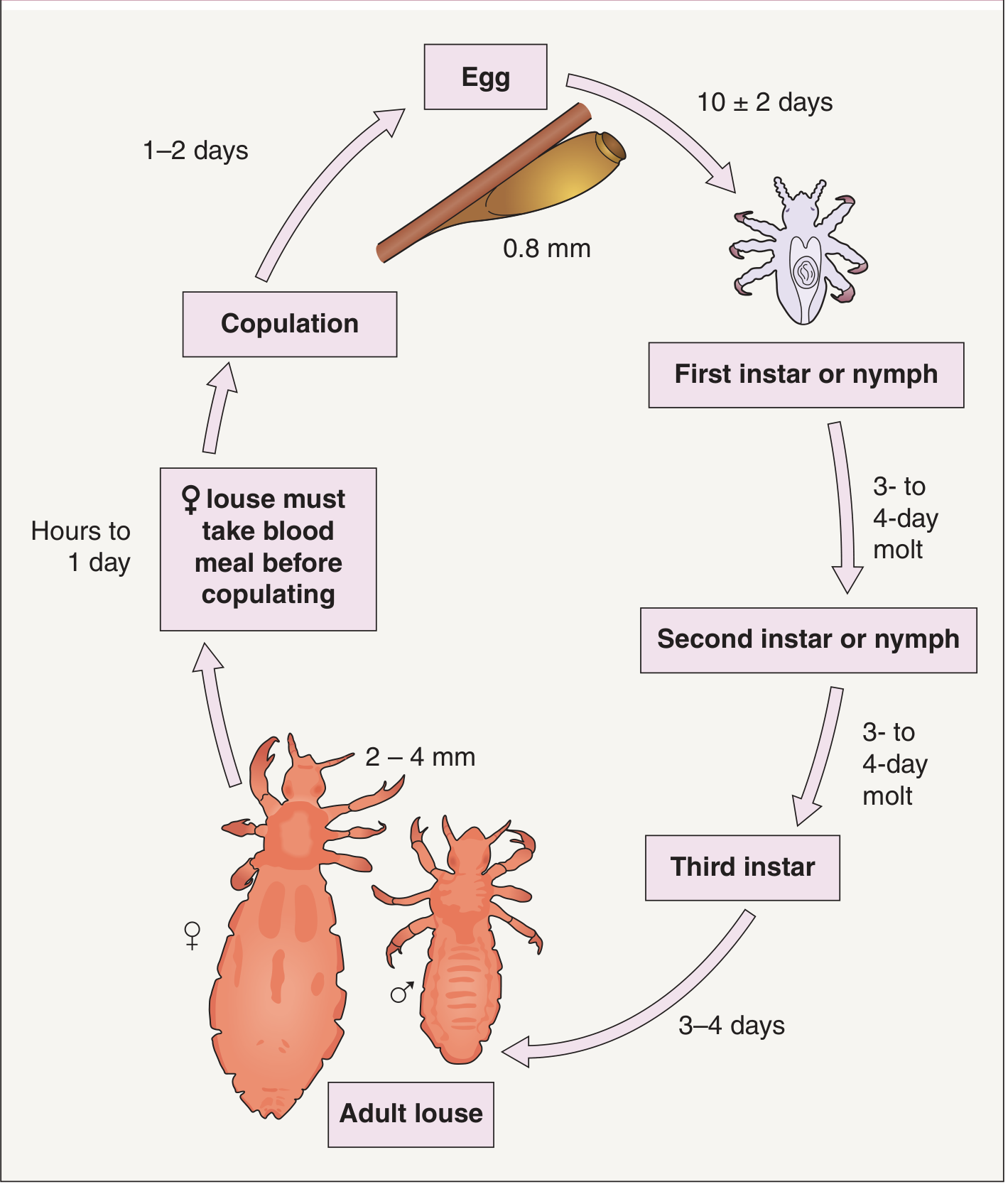
Eggs hatch in ~10 days; nymphs mature to reproductive adults in ~7 more days. This 17-day window explains why a second treatment 7-10 days after the first is essential for most agents - it catches newly hatched nymphs before they can lay eggs.
Diagnosis First
Treatment is only recommended for active infestation - defined as finding at least one live, crawling louse. Nits alone (especially >1 cm from the scalp) do not confirm active infestation and do not justify treatment. Wet-combing with a fine-tooth comb after applying conditioner improves detection.
Treatment Agents
First-Line (Over-the-Counter)
| Agent | Application | Repeat? | Notes |
|---|---|---|---|
| Permethrin 1% lotion (Nix) | Apply to towel-dried hair for 10 min, rinse | Day 9-10 recommended | Low toxicity; widespread resistance in US |
| Pyrethrins + piperonyl butoxide (RID, Pronto, A-200) | Apply to dry hair for 10 min, rinse | Day 9-10required | No residual activity; contraindicated in chrysanthemum/ragweed allergy |
Resistance to these pyrethroids is common and growing in the United States. Clinical failure should prompt switching to a different class.
Prescription Agents
| Agent | Application | Repeat? | Notes |
|---|---|---|---|
| Malathion 0.5% lotion | Apply to dry hair 8-12 hours, then wash | Day 7-9 if live lice remain | Highly flammable (alcohol base); do not use hair dryer or near open flame. Not in children <2 years; safety unclear <6 years. Excellent efficacy in US; resistance noted in Europe/Australia |
| Spinosad 0.9% suspension | Apply to dry hair 10 min, rinse | Day 7 if live lice remain | Derived from soil bacterium; pediculicidal; no resistance reported to date. Avoid in infants <6 months (benzyl alcohol content) |
| Ivermectin 0.5% lotion | Apply to dry hair 10 min, rinse | Single application usually sufficient | Not ovicidal but prevents nymph survival. Safe from 6 months of age; single resistance report to date |
| Benzyl alcohol 5% lotion | Apply to dry hair 10 min, rinse | Day 9 | Suffocates lice (not ovicidal); no resistance reported. Avoid <6 months |
| Abametapir 0.74% lotion | Apply to dry hair 10 min, rinse | Single application | Inhibits metalloproteinases needed for egg development; ovicidal. Avoid <6 months |
| Permethrin 5% cream (off-label) | Overnight application | Day 9 | Used for resistant cases |
Oral Therapy
Oral ivermectin (200-400 mcg/kg) given on days 1 and 8 is an option for resistant or widespread infestations. Efficacy is excellent. Not recommended for pregnant or breastfeeding women (FDA Category C), and safety is not well established in children weighing <15 kg. CNS toxicity is a concern in very young or low-weight children.
Lindane 1% lotion - although FDA approved, it is no longer recommended by the American Academy of Pediatrics due to potential CNS toxicity.
Dimethicone (4-100% silicone oil) is a non-pesticide option available in some countries; it works by physically coating/suffocating lice and has no resistance issues.
Practical Application Tips
- Rinse hair over a sink (not in a shower or bath) to minimize skin absorption.
- Use warm, not hot, water to reduce vasodilation-driven absorption.
- Do not apply extra amounts or combine multiple products concurrently.
- Flush product from eyes immediately with water if contact occurs.
- Post-treatment itching or scalp burning can persist for days as an inflammatory reaction - this is not a reason to retreat. Topical corticosteroids and oral antihistamines can help.
Handling Treatment Failure
Live lice found 24+ hours after treatment indicate one of:
- Incorrect application
- Reinfestation
- Resistance
After excluding application error, switch to a different pediculicide class and apply a second dose at the interval specified for that product.
Nit Removal
Manual nit removal after pediculicide treatment is helpful but not required for cure. It reduces diagnostic confusion and minor reinfestation risk. Fine-tooth nit combs work well. Vinegar rinses to loosen nits should be avoided, as they may reduce pediculicide effectiveness.
Environmental Control Measures
The AAP and Red Book emphasize that environmental measures are generally not required because lice survive <1 day away from the scalp and their eggs become non-viable within a week.
- Wash clothing, bedding, and towels used in the 2 days before treatment in hot water (>130°F/54°C) and dry on high heat (5 minutes at >130°F kills lice and eggs).
- Dry-clean or seal non-washable items in a plastic bag for 2 weeks.
- Soak combs and brushes in hot water (>130°F) for 3-10 minutes.
- Vacuum furniture and floors to remove shed hairs with viable eggs.
- Do not use pediculicide sprays on furniture or bedding.
- Do not treat pets (they play no role in transmission).
Household and School Contacts
- Examine all household contacts; treat those with active infestation.
- Bedmates of infested individuals should be treated prophylactically even if no live lice are found.
- Children should not be excluded from school based on nits alone. "No-nit" policies are discouraged by the AAP.
- Routine schoolwide screening is not cost-effective and is discouraged.
Special Populations
- Infants <6 months: avoid benzyl alcohol-containing products (spinosad, abametapir, benzyl alcohol lotion); permethrin 1% is preferred.
- Pregnancy: pyrethrins and permethrin are considered safer; avoid oral ivermectin (Category C) and lindane.
- Chrysanthemum/ragweed allergy: avoid pyrethrin-based products.
Sources: Red Book 2021 (AAP), pp. 884-889 | Dermatology 2-Volume Set 5e, pp. 1814-1820 | Textbook of Family Medicine 9e, p. 948
This is a shared conversation. Sign in to Orris to start your own chat.