
ASD types and clinical presentation
"autism spectrum disorder" classification clinical presentation
autism spectrum disorder clinical presentation social communication
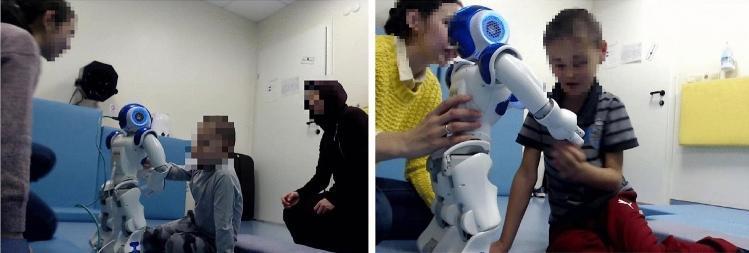
Two side-by-side clinical photographs illustrating a Socially Assistive Robot (SAR) intervention within a neurodevelopmental rehabilitation setting, likely for Autism Spectrum Disorder (ASD). The images demonstrate the experimental setup in a controlled environment featuring padded sports mats on the floors and walls for safety. The left panel shows a child sitting on the floor interacting with a blue and white humanoid robot while an adult (parent or therapist) observes closely. The right panel captures a more direct tactile interaction where the child touches the robot's arm, and the adult provides physical guidance or support. The setup is designed to evaluate social engagement, joint attention, and behavioral responses (such as chest-button pressing or verbalization) in pediatric patients during robot-mediated therapy. The presence of cameras on the walls indicates a recorded session for quantitative behavioral analysis, such as ADOS-2 scoring or engagement metrics. This clinical scenario highlights the use of assistive technology in therapeutic interventions to facilitate social communication and reduce aggressive behaviors in verbal and non-verbal children.
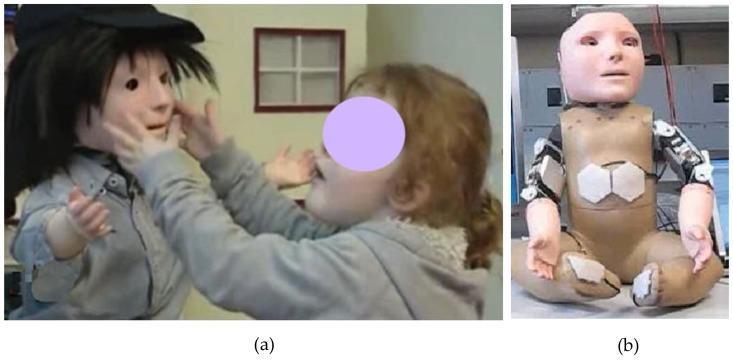
Educational photographs demonstrating the use of KASPAR, a child-sized humanoid social robot designed as a therapeutic tool for children with Autism Spectrum Disorder (ASD). Panel (a) shows a clinical interaction where a child is engaging in tactile contact by touching the robot's face, illustrating a social play scenario meant to encourage eye contact and modulate physical interaction. The robot is depicted with human-like features including hair, a hat, and clothing to facilitate anthropomorphic engagement. Panel (b) reveals the underlying technology, showing the robot's torso and limbs equipped with white, hexagon-shaped capacitive tactile sensors. These sensors are strategically placed on the torso, arms, and feet to detect the force and location of touch. The visual highlights the integration of robotics in behavioral therapy, specifically for training individuals with ASD to distinguish between gentle and harsh physical contact. This assistive technology serves as a learning companion to improve social-emotional communication and sensory processing in pediatric neurodevelopmental disorders.
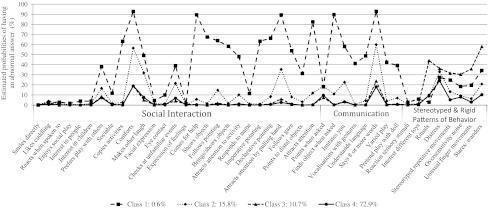
This infographic is a line graph representing a Latent Class Analysis (LCA) of behavioral traits associated with Autism Spectrum Disorder (ASD). The x-axis categorizes specific clinical items into three developmental domains: Social Interaction, Communication, and Stereotyped & Rigid Patterns of Behavior. The y-axis measures the 'Estimated probabilities of having an abnormal answer (%)', ranging from 0 to 100. Four distinct phenotypic classes are plotted. Class 1 (0.6%) exhibits the highest probability of impairment across Social Interaction and Communication items (e.g., 'Comes for help', 'Shows objects'). Class 2 (15.8%) shows intermediate impairment levels. Class 3 (10.7%) is characterized by a unique profile with relatively normal social/communication scores but high probabilities for restrictive behaviors, particularly 'Rituals' and 'Stares/wanders'. Class 4 (72.9%) represents the reference group with the lowest probability of abnormalities across all domains. This diagram illustrates the heterogeneity of ASD symptoms and the utility of LCA in identifying clinical subgroups based on symptom clusters at 18 months of age.
Autism Spectrum Disorder (ASD) - Types and Clinical Presentation
Historical Context and the Shift to a Spectrum Model
| Former DSM-IV / ICD-10 Category | Key Distinguishing Feature |
|---|---|
| Autistic Disorder | Core triad: social impairment + communication abnormalities + restricted/repetitive behaviors; onset before age 3 |
| Asperger Disorder | Social impairment + repetitive behaviors WITHOUT significant language or cognitive delay; later diagnosis (~7.2 yrs avg) |
| Childhood Disintegrative Disorder | Normal development for ~2 years, then marked regression in language, social skills, play, and motor/bowel function |
| Rett Syndrome | Almost exclusively females; normal development for ≥6 months then stereotyped hand-wringing, loss of purposeful hand use, social withdrawal, poor coordination |
| PDD-Not Otherwise Specified (PDD-NOS) | Subthreshold autism features; did not meet full criteria for above categories |
Note: Rett syndrome, now known to be caused by MECP2 mutations, was removed from DSM-5 and reclassified as a distinct neurological disorder.
DSM-5 Diagnostic Criteria
Domain A - Persistent Deficits in Social Communication and Social Interaction (all 3 required)
- Deficits in social-emotional reciprocity - abnormal social approach, failure of back-and-forth conversation, reduced sharing of emotions/affect, failure to initiate or respond to social interactions
- Deficits in nonverbal communicative behaviors - poorly integrated verbal/nonverbal communication, abnormalities in eye contact and body language, deficits in understanding/use of gestures, total lack of facial expressions
- Deficits in developing, maintaining, and understanding relationships - difficulty adjusting behavior to social contexts, difficulty sharing imaginative play or making friends, absence of interest in peers
Domain B - Restricted, Repetitive Patterns of Behavior, Interests, or Activities (at least 2 of 4)
- Stereotyped/repetitive motor movements, use of objects, or speech (echolalia, lining up toys, idiosyncratic phrases)
- Insistence on sameness - inflexible adherence to routines, extreme distress at small changes, rigid thinking, ritualized patterns
- Highly restricted, fixated interests - abnormal in intensity or focus, preoccupation with unusual objects
- Hyper- or hyporeactivity to sensory input - indifference to pain/temperature, adverse response to specific sounds or textures, excessive smelling/touching, visual fascination
Criteria C-E
- C: Symptoms present in early developmental period
- D: Clinically significant impairment in functioning
- E: Not better explained by intellectual disability or global developmental delay alone
DSM-5 Severity Levels
| Severity Level | Social Communication | Restricted/Repetitive Behaviors |
|---|---|---|
| Level 3 - "Requiring Very Substantial Support" | Severe deficits; very few intelligible words; rarely initiates; responds only to very direct approaches | Inflexibility markedly interferes with functioning in ALL spheres; extreme distress with any change |
| Level 2 - "Requiring Substantial Support" | Marked deficits; speaks only simple sentences; interaction limited to narrow interests; markedly odd nonverbal communication | Inflexibility and repetitive behaviors appear frequently, obvious to casual observer; distress/difficulty changing focus |
| Level 1 - "Requiring Support" | Without supports in place, noticeable deficits; difficulty initiating social interaction; atypical/unsuccessful responses to others; may appear to have decreased interest | Inflexibility causes significant interference in ≥1 context; difficulty switching between activities; organization problems |
DSM-5 Specifiers
- With or without accompanying intellectual impairment
- With or without accompanying language impairment
- Associated with a known medical/genetic condition or environmental factor (e.g., Fragile X, tuberous sclerosis, valproate exposure)
- Associated with another neurodevelopmental, mental, or behavioral disorder
- With catatonia
Clinical Features by Domain
Social Communication
- Infants: May not develop a social smile; lack anticipatory posture for being picked up; reduced eye contact
- Toddlers: Delayed language + diminished social behavior are often the first red flags; 25% have some language that is subsequently lost ("regression")
- School-age: Impaired spontaneous play with peers, lack of back-and-forth conversation, fewer shared interests, reduced body/facial gestures; higher-functioning children may compensate and go undetected until middle childhood when academic and social demands increase
- Older individuals: Awkward, inappropriate social behavior; difficulty understanding others' mental states ("mind blindness" / Theory of Mind deficits)
Restricted and Repetitive Behaviors
- Hand-flapping, toe-walking, rocking (motor stereotypies)
- Echolalia (immediate or delayed)
- Rigid adherence to routines - meltdowns with minor changes
- Intense, idiosyncratic interest in narrow topics
- Sensory hypersensitivity (e.g., to sounds, textures) or hyposensitivity (e.g., high pain tolerance)
Associated/Comorbid Features
- Intellectual disability: ~30-50% of individuals with ASD
- Seizure disorder: 4-32% (grand mal seizures)
- ADHD: Frequently co-occurring
- Anxiety and mood disorders: Common especially in higher-functioning individuals
- Sleep disturbances
- Typically higher performance IQ than verbal IQ on cognitive testing
Epidemiology
- Prevalence: ~1 in 59 children (US ADDM data); up to 2.6% for the full spectrum of social disability
- Sex ratio: ~4:1 male-to-female (though female bias in diagnosis is increasingly recognized; true ratio may be closer to 2-3:1)
- Occurs across all cultures, countries, and socioeconomic groups
- Sibling recurrence risk: 2-18%; high concordance in monozygotic twins
- Vaccines do NOT cause ASD - this theory has been thoroughly discredited
Age of Presentation
| Feature | Typical Age |
|---|---|
| First symptoms detectable in high-risk families | Within first year of life |
| Parents typically first notice | 12-18 months (language delay + social withdrawal) |
| Diagnosis - autistic disorder | ~3.1 years (average) |
| Diagnosis - PDD-NOS (now ASD) | ~3.9 years (average) |
| Diagnosis - former Asperger disorder | ~7.2 years (average) |
Key Differential Diagnoses
- Language disorder: Active use of gestures (vs. impaired in ASD); no restricted/repetitive behaviors
- Intellectual disability: Social development consistent with cognitive level; capable of forming attachments
- ADHD: Inattention/hyperactivity primary; social disinhibition not the core feature
- Reactive Attachment Disorder (RAD): History of neglect/maltreatment required; language not stereotyped/deviant; may show partial remission with stable caregiving
- Childhood-onset schizophrenia: Rare before age 5; hallucinations/delusions present; family history of schizophrenia; IQ pattern is more even
- Kaplan and Sadock's Synopsis of Psychiatry, Section 2.3
- Kaplan & Sadock's Comprehensive Textbook of Psychiatry
- Bradley and Daroff's Neurology in Clinical Practice, Box 90.1 & Table 90.1
- Eric Kandel's Principles of Neural Science, 6th Edition, p. 1572
- Tintinalli's Emergency Medicine