
Marasmus in psm
Marasmus is a form of severe acute malnutrition (SAM) - it results from severe deficiency of both calories and protein, leading to extreme wasting. Let me pull the full detail from the medical library.
Searching sources...
Reading File
Now let me search the library for Marasmus content, specifically in PSM (Preventive & Social Medicine) books.
Finding Sources
Finding Sources
Park's textbook is available. Let me read the relevant section on Marasmus and also search for related topics like PEM/malnutrition in PSM.
Reading File
Finding Sources
Excellent. Let me also read the broader PEM section and continue the marasmus/preventive measures section.
Reading File
Reading File
Now let me also get the broader Park's section on clinical features, classification, and epidemiology of PEM/Marasmus:
Finding Sources
Finding Sources
Now let me also check Robbins for clinical features of Marasmus to supplement Park's content:
Reading File
Reading File
I now have all the key content. Let me also fetch the clinical image of Marasmus from Robbins for visual reference:
Loading Image
I now have all the information needed for a comprehensive PSM-focused answer on Marasmus. Here is the complete write-up:
Marasmus - PSM (Park's Textbook of Preventive & Social Medicine)
Definition
Marasmus is a form of Protein-Energy Malnutrition (PEM) caused by inadequate intake of both protein and energy. It is a form of severe cachexia with weight loss resulting from wasting in infancy and childhood.
- Park's Textbook of Preventive and Social Medicine, p. 736
Context: PEM as a Public Health Problem
- PEM is a major health and nutrition problem in India, occurring particularly in children in the first years of life.
- It is an underlying cause in ~30% of deaths among children under age 5.
- Globally (2018): >21.9% of children under 5 were stunted; 7.3% had wasting.
- In India (NFHS 2015-16): 35.7% children under 5 are underweight; 7.5% have moderate-to-severe wasting; 38.4% have moderate-to-severe stunting.
- Malnutrition + infection form a vicious cycle - each worsens the other.
The Two Forms of PEM: Marasmus vs Kwashiorkor
| Feature | Marasmus | Kwashiorkor |
|---|---|---|
| Cause | Deficiency of both protein AND energy | Predominantly protein deficiency (low protein/energy ratio) |
| Oedema | Absent (little or no oedema) | Present (generalized) |
| Subcutaneous fat | Severely depleted | Relatively spared |
| Muscle wasting | Severe | Relatively spared |
| Serum albumin | Normal or near normal | Low (hypoalbuminaemia) |
| Liver | Normal | Enlarged, fatty (hepatomegaly + steatosis) |
| Skin/hair changes | Minimal | Yes - depigmentation, "flag sign" in hair |
| Appearance | Emaciated, "old man face," head appears large | Oedematous, "moon face" |
Clinical Features of Marasmus
- Severe wasting - loss of muscle mass and subcutaneous fat
- Little or no oedema
- Minimal subcutaneous fat - skin hangs in folds ("baggy pants" appearance)
- Severe muscle wasting - the extremities are emaciated
- Head appears disproportionately large for the emaciated body ("old man" facies)
- Non-normal serum albumin (near normal or only slightly reduced - visceral protein compartment is relatively preserved)
- Growth retardation
- Anaemia and signs of multivitamin deficiencies
- Immune deficiency - particularly T cell-mediated - leading to recurrent/concurrent infections
- Weight is typically <60% of expected weight-for-age (in SAM)
Robbins & Kumar Basic Pathology, p. 1823
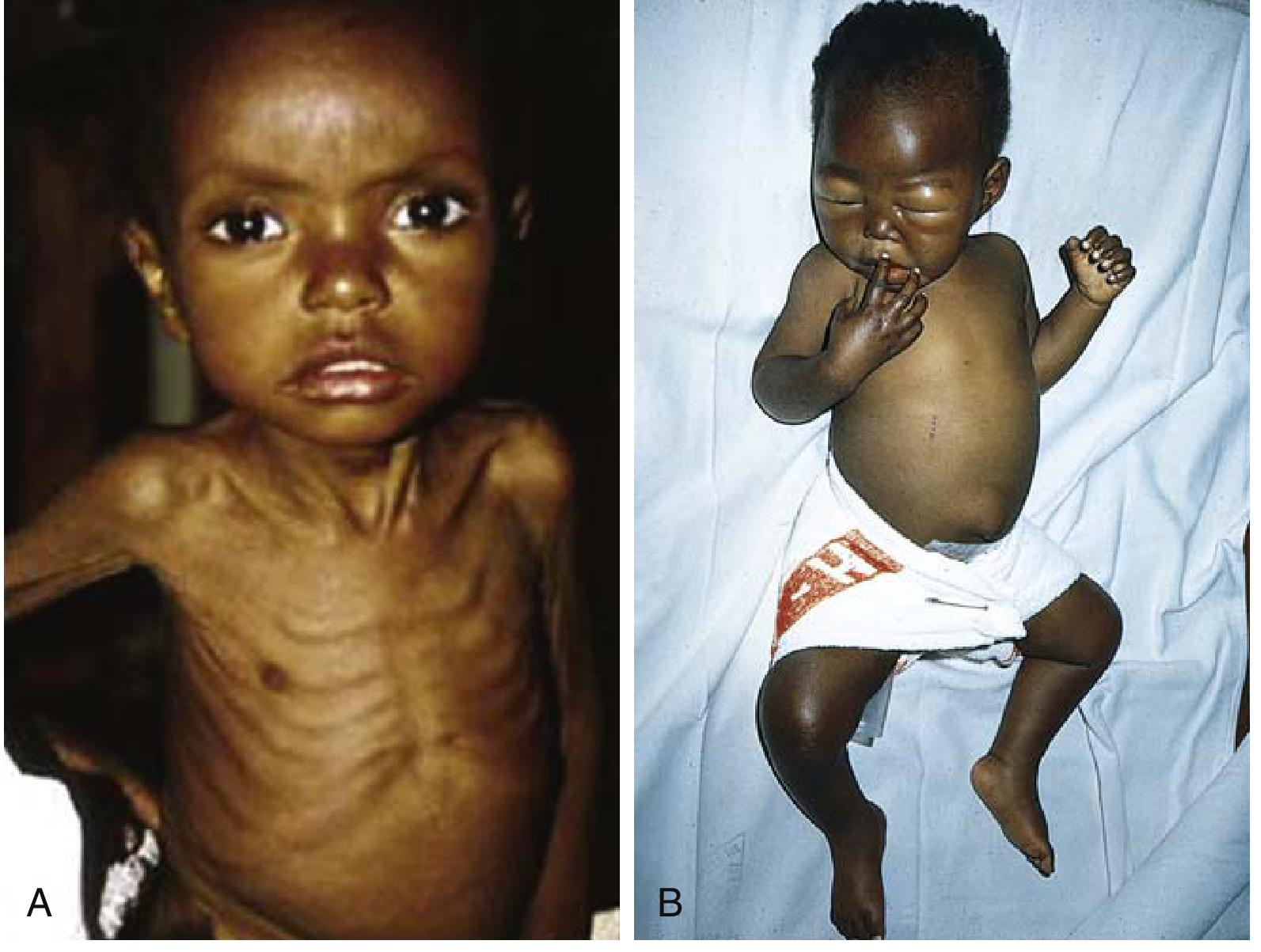
Pathophysiology (PSM Perspective)
- Body catabolizes somatic protein (muscle) to provide amino acids as energy source - this is an adaptive response.
- Visceral protein (serum albumin) is relatively preserved - hence NO oedema.
- Subcutaneous fat is mobilized as fuel.
- Leptin production is low → stimulates hypothalamic-pituitary-adrenal axis → high cortisol → lipolysis.
- T-cell immunity is compromised → secondary infections common.
Classification of Malnutrition (Anthropometric - PSM)
The three indices used (WHO Child Growth Standards, Z-scores):
| Index | Measures | Condition |
|---|---|---|
| Weight-for-Age | Composite | Underweight |
| Height/Length-for-Age | Chronic malnutrition | Stunting |
| Weight-for-Height/Length | Acute malnutrition | Wasting (Marasmus) |
- Underweight: Weight-for-age Z-score < -2 SD
- Wasting (Marasmus): Weight-for-height Z-score < -2 SD
- SAM: Weight-for-height Z-score < -3 SD OR MUAC < 115 mm OR nutritional oedema
Severe Acute Malnutrition (SAM)
SAM is defined by:
- Weight-for-height Z-score below -3 SD
- MUAC < 115 mm, OR
- Presence of nutritional oedema
Children who are severely wasted are 9 times more likely to die than well-nourished children. SAM increases case fatality in diarrhoea and pneumonia.
Early Detection of PEM (PSM Tools)
- Growth charts (weight-for-age) - most practical tool for field health workers; detects underweight early.
- Mid-Upper Arm Circumference (MUAC):
- > 13.5 cm = Satisfactory nutritional status
- 12.5-13.5 cm = Mild-moderate malnutrition
- < 12.5 cm = Severe malnutrition
- (Cannot be used before age 1 year; relatively stable between ages 1-5 years)
Prevention of PEM/Marasmus (FAO/WHO Framework - Park's)
(a) Health Promotion
- Measures for pregnant and lactating women (education + supplements)
- Promotion of exclusive breastfeeding (first 6 months)
- Development of low-cost weaning foods; frequent feeding
- Improvement of family diet
- Nutrition education - correct feeding practices
- Promotion of family planning and birth spacing
- Improving family environment
(b) Specific Protection
- Diet must contain protein and energy-rich foods (milk, eggs, fresh fruits)
- Immunization (prevents infections that worsen malnutrition)
- Food fortification
(c) Early Diagnosis and Treatment
- Periodic nutritional surveillance
- Early diagnosis of growth lag
- Early treatment of infections and diarrhoea
- Oral rehydration programmes
- Supplementary feeding programmes during epidemics
- Deworming of heavily infested children
(d) Rehabilitation
- Nutritional rehabilitation services
- Hospital treatment
- Follow-up care
Key Points for Exam
- Marasmus = deficiency of both calories AND protein (vs. Kwashiorkor = mainly protein)
- No oedema in Marasmus (key distinguishing feature)
- Serum albumin is normal or near-normal in Marasmus
- "Old man" face / baggy pants sign / loose skin folds
- Weight < 60% of expected for age (severe)
- SAM: MUAC < 115 mm or WHZ < -3 SD
- MUAC < 12.5 cm = severe malnutrition (field diagnosis)
- Infection-malnutrition vicious cycle is a core PSM concept
- Exclusive breastfeeding for first 6 months is the most important preventive measure
Sources: Park's Textbook of Preventive and Social Medicine, pp. 736-737 | Robbins & Kumar Basic Pathology, p. 1823
This is a shared conversation. Sign in to Orris to start your own chat.