
Neonatal sepsis
"neonatal sepsis"[MeSH Terms] AND management
neonatal sepsis signs symptoms management
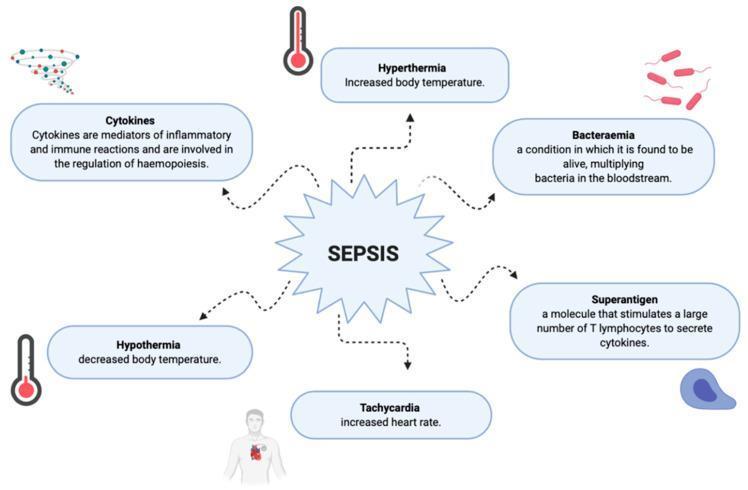
An educational pathophysiology diagram summarizing the potential symptoms and biological manifestations of sepsis. The central starburst label 'SEPSIS' connects via radial dashed lines to six descriptive boxes, each paired with a visual icon. Key clinical signs include 'Hyperthermia' (increased body temperature, represented by a high thermometer) and its counter-condition 'Hypothermia' (decreased body temperature, represented by a low thermometer), and 'Tachycardia' (increased heart rate, depicted by a highlighted heart on a human torso). Laboratory and biological features include 'Cytokines' (mediators of inflammation and haemopoiesis, shown as signaling molecules), 'Bacteraemia' (multiplying bacteria in the bloodstream, illustrated as bacilli), and the role of 'Superantigens' (molecules stimulating T lymphocytes to release cytokines, shown as a lymphocyte icon). This infographic serves as a basic to intermediate summary of systemic inflammatory response syndrome (SIRS) and the infectious triggers characterizing the septic state.
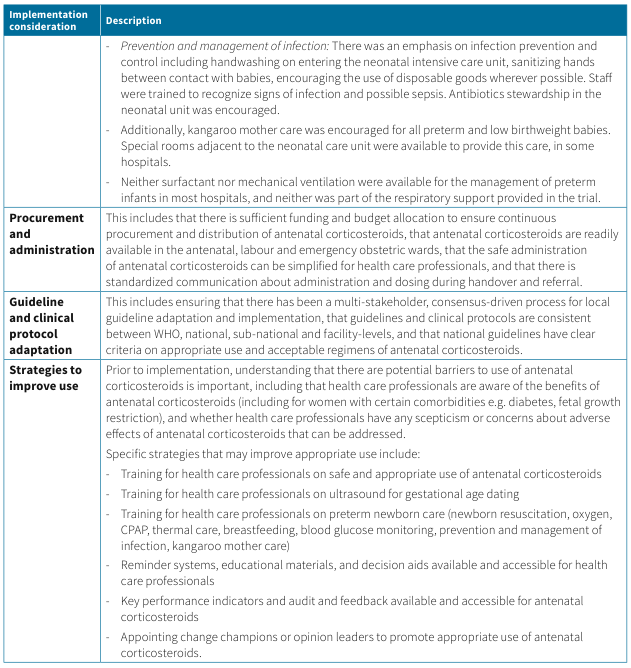
<table><thead><tr><th>Implementation consideration</th><th>Description</th></tr></thead><tbody><tr><td></td><td><ul><li>Prevention and management of infection: There was an emphasis on infection prevention and control including handwashing on entering the neonatal intensive care unit, sanitizing hands between contact with babies, encouraging the use of disposable goods wherever possible. Staff were trained to recognize signs of infection and possible sepsis. Antibiotics stewardship in the neonatal unit was encouraged.</li><li>Additionally, kangaroo mother care was encouraged for all preterm and low birthweight babies. Special rooms adjacent to the neonatal care unit were available to provide this care, in some hospitals.</li><li>Neither surfactant nor mechanical ventilation were available for the management of preterm infants in most hospitals, and neither was part of the respiratory support provided in the trial.</li></ul></td></tr><tr><td>Procurement and administration</td><td>This includes that there is sufficient funding and budget allocation to ensure continuous procurement and distribution of antenatal corticosteroids, that antenatal corticosteroids are readily available in the antenatal, labour and emergency obstetric wards, that the safe administration of antenatal corticosteroids can be simplified for health care professionals, and that there is standardized communication about administration and dosing during handover and referral.</td></tr><tr><td>Guideline and clinical protocol adaptation</td><td>This includes ensuring that there has been a multi-stakeholder, consensus-driven process for local guideline adaptation and implementation, that guidelines and clinical protocols are consistent between WHO, national, sub-national and facility-levels, and that national guidelines have clear criteria on appropriate use and acceptable regimens of antenatal corticosteroids.</td></tr><tr><td>Strategies to improve use</td><td>Prior to implementation, understanding that there are potential barriers to use of antenatal corticosteroids is important, including that health care professionals are aware of the benefits of antenatal corticosteroids (including for women with certain comorbidities e.g. diabetes, fetal growth restriction), and whether health care professionals have any scepticism or concerns about adverse effects of antenatal corticosteroids that can be addressed.</td></tr><tr><td></td><td>Specific strategies that may improve appropriate use include:</td></tr><tr><td></td><td><ul><li>Training for health care professionals on safe and appropriate use of antenatal corticosteroids</li><li>Training for health care professionals on ultrasound for gestational age dating</li><li>Training for health care professionals on preterm newborn care (newborn resuscitation, oxygen, CPAP, thermal care, breastfeeding, blood glucose monitoring, prevention and management of infection, kangaroo mother care)</li><li>Reminder systems, educational materials, and decision aids available and accessible for health care professionals</li><li>Key performance indicators and audit and feedback available and accessible for antenatal corticosteroids</li><li>Appointing change champions or opinion leaders to promote appropriate use of antenatal corticosteroids.</li></ul></td></tr></tbody></table>
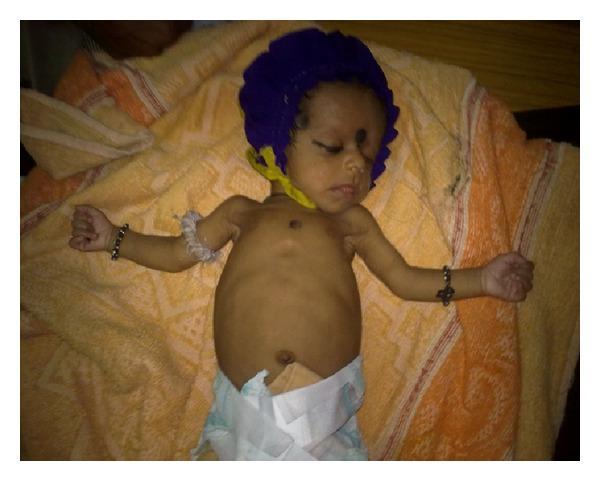
This clinical photograph shows a neonate in a supine position, documenting the clinical resolution of symptoms following treatment for congenital syphilis. The infant displays a significant improvement in spontaneous motor activity and posture compared to the initial presentation of Parrot's pseudoparalysis. The upper limbs are extended and abducted, showing no visible signs of the previously reported swelling in the elbow or knee joints. The skin is of normal color without evidence of rash, jaundice, or pallor. The infant appears calm with eyes closed, wearing a blue cap and a white diaper. Key clinical indicators illustrated here include the resolution of joint inflammation and the restoration of normal limb positioning and movement following antibiotic therapy (crystalline penicillin) for treponemal infection. The image serves as a post-treatment follow-up to confirm the efficacy of the management of neonatal syphilis.
Neonatal Sepsis
Classification: Early-Onset vs. Late-Onset
| Feature | Early-Onset Sepsis (EOS) | Late-Onset Sepsis (LOS) |
|---|---|---|
| Timing | First 7 days of life | After 7 days of life |
| Onset | Fulminant, rapid | More gradual |
| Risk factors | Maternal fever, GBS colonization, prolonged ROM, fetal distress | Nosocomial (IV lines, NICU) |
| Complications | Septic shock, neutropenia | Meningitis more common |
| Organisms | GBS, E. coli, Listeria | CoNS, Staph aureus, Candida (NICU) |
- Tintinalli's Emergency Medicine, p. 775
Pathophysiology & Immunology
-
Depressed cell-mediated immunity - increased susceptibility to viral and fungal infection
-
Diminished B-cell function - reduced immunoglobulin production
-
Maternal IgG provides partial protection, but levels reach a nadir at 2-3 months of age - when infection risk is highest
-
Premature infants are at especially high risk; signs and symptoms are often subtle regardless of gestational age
-
Miller's Anesthesia, p. 11455
Common Pathogens
Early-Onset Sepsis
- Group B Streptococcus (GBS) - historically the #1 cause; maternal screening + intrapartum prophylaxis has dramatically reduced EOS but NOT late-onset GBS
- Escherichia coli - now approaches similar rates to GBS
- Listeria monocytogenes - causes sepsis and meningitis; currently rare due to sporadic cases
- Haemophilus influenzae
Late-Onset Sepsis (especially NICU)
- Coagulase-negative Staphylococci (CoNS)
- Staphylococcus aureus
- Candida species
- Gram-negative enteric organisms (Klebsiella)
Viral
- Enteroviruses (coxsackievirus, echovirus) - acquired at delivery
- Herpes simplex virus - fulminant in neonates; active maternal lesions mandate cesarean section
- RSV and influenza A - postnatal acquisition
- Tintinalli's Emergency Medicine, p. 775; Tietz Textbook of Laboratory Medicine, p. 3155
Clinical Features (Signs & Symptoms)
| System | Signs |
|---|---|
| Temperature | Fever (rectal ≥38°C / 100.4°F) or hypothermia (<36.5°C / 97.7°F) |
| CNS | Lethargy, irritability, seizures |
| Respiratory | Tachypnea, grunting, apnea, respiratory distress |
| GI | Poor feeding, vomiting, gastric distension, diarrhea |
| Cardiovascular | Poor cutaneous perfusion, hypotension |
| Skin | Jaundice, rashes, petechiae |
| Metabolic | Hypoglycemia, metabolic acidosis |
Key point: Nuchal rigidity and Kernig/Brudzinski signs are present in only a minority of neonates with meningitis - their absence does NOT rule it out.
- Tintinalli's Emergency Medicine, p. 775; Miller's Anesthesia, p. 11456
Diagnosis & Workup
- Blood cultures (mandatory)
- Urine culture (catheterized specimen)
- CSF analysis and culture (lumbar puncture - do not omit even if no meningeal signs)
- CBC with differential - neutropenia is common in EOS
- CRP / Procalcitonin - useful adjuncts (though not definitive)
- Chest X-ray - if respiratory symptoms
- Glucose, metabolic panel
Only ~50% of neonates suspected of sepsis have positive cultures. Clinical suspicion guides treatment.
- Miller's Anesthesia, p. 11455
Risk Factors for EOS (GBS)
- Documented maternal GBS colonization
- Previous infant with GBS disease
- GBS bacteriuria during current pregnancy
- Intrapartum fever
- Gestational age <37 weeks
- Membrane rupture ≥18 hours
Treatment
Standard Empiric Regimen
| Drug | Dose | Coverage |
|---|---|---|
| Ampicillin | 50 mg/kg IV | GBS, Listeria |
| Gentamicin | 2.5 mg/kg IV | E. coli, gram-negative organisms |
If Gram-Negative Meningitis Strongly Suspected
- Replace gentamicin with cefotaxime or ceftazidime (50 mg/kg) - better CNS penetration
Special Considerations
- Avoid ceftriaxone in neonates - displaces bilirubin from albumin and can cause kernicterus
- Add acyclovir IV if:
- Maternal history of herpes simplex
- CSF shows lymphocyte and RBC predominance on non-traumatic LP
- Ill-appearing neonate of any etiology
TORCH Infections
- Tintinalli's Emergency Medicine, p. 775
Prevention
- Universal GBS screening at 35-37 weeks gestation (rectocervical culture)
- Intrapartum antibiotic prophylaxis (penicillin G preferred) for GBS-positive mothers or those with risk factors
- Hand hygiene and infection control in NICU
- Kangaroo mother care for preterm/low birth-weight infants