
Listhesias x-rays
Reading File
Now let me search for listhesis x-rays in parallel — heading and paragraph searches, plus medical images.
Finding Sources
Finding Sources
Searching Images
spondylolisthesis x-ray radiograph
Good results. Now let me read the most relevant textbook sections and fetch the key images in parallel.
Reading File
Reading File
Loading Image
Loading Image
Loading Image
Here is a comprehensive overview of listhesis (spondylolisthesis) on X-ray.
Listhesis — Radiographic Overview
Listhesis refers to the displacement of one vertebra relative to an adjacent one:
- Anterolisthesis (spondylolisthesis) — forward displacement of the superior vertebra
- Retrolisthesis — backward displacement of the superior vertebra
X-Ray Views Used
| View | What It Shows |
|---|---|
| Lateral | Best view — directly shows the step-off/displacement |
| AP (anteroposterior) | Coronal alignment; less sensitive for slip |
| Oblique | Shows pars interarticularis defect ("Scotty dog" sign) — 15% of lysis lesions visible here that the lateral misses |
Plain lateral radiographs demonstrate 80% of spondylolysis lesions; oblique views add another ~15%. — Miller's Review of Orthopaedics 9e
What to Look For on Lateral X-Ray
- Step-off — anterior displacement of the vertebral body relative to the one below
- Disc space narrowing — especially at the affected level
- Facet joint degeneration — joint space loss, sclerosis (degenerative type)
- Spinous process malalignment — in degenerative spondylolisthesis, the spinous process moves anteriorly with the slipped vertebra (distinguishes it from isthmic type)
- Pars defect — lucency at the pars interarticularis (isthmic type)
Meyerding Grading System
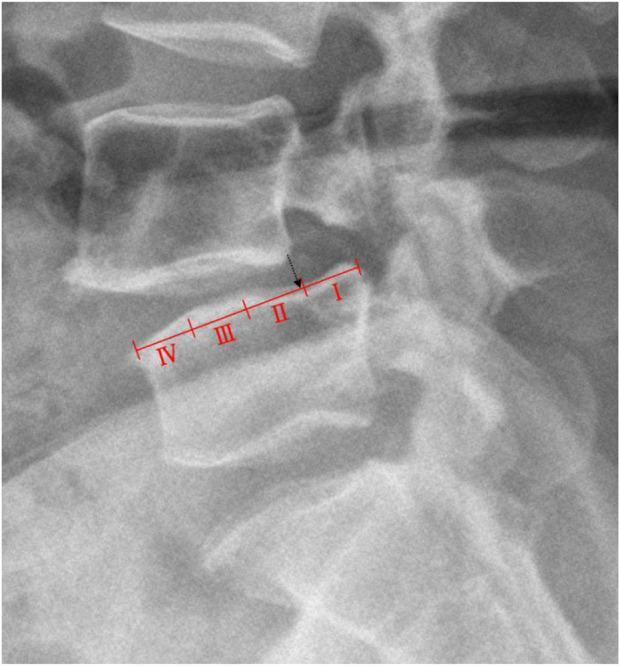
The superior endplate of the lower vertebra is divided into four equal quarters:
| Grade | Slip Amount |
|---|---|
| I | 0–25% |
| II | 25–50% |
| III | 50–75% |
| IV | >75% |
| V (spondyloptosis) | >100% |
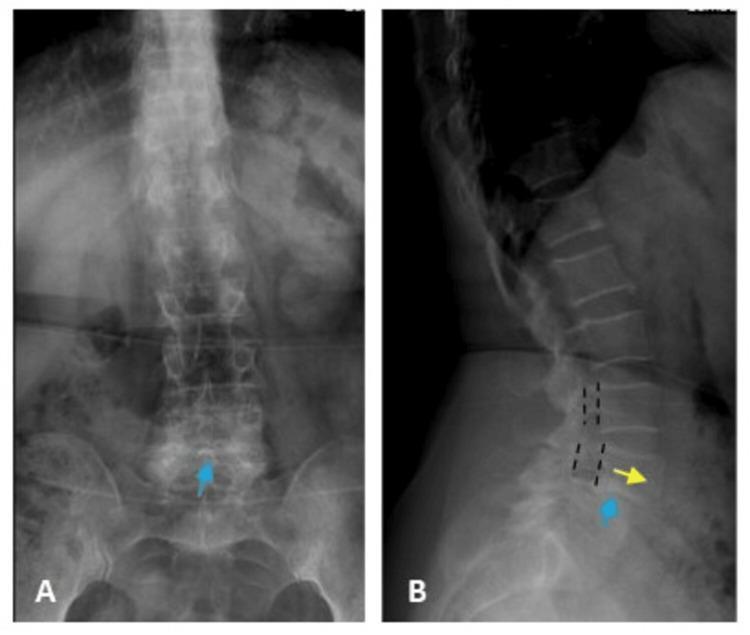
Two-View Example: Degenerative L4–L5 Spondylolisthesis
Types of Spondylolisthesis (Newman–Wiltse–McNab Classification)
| Type | Cause | Key X-ray Feature |
|---|---|---|
| I — Dysplastic/Congenital | Abnormal articular processes | Slip at L5–S1, no pars defect |
| II — Isthmic | Pars interarticularis defect | Oblique view: "Scotty dog" collar sign |
| III — Degenerative | Facet joint OA | Intact neural arch; anterior spinous process shift |
| IV — Traumatic | Neural arch fracture | Fracture line on plain film |
| V — Pathologic | Bone disorder (Paget's, tumor) | Generalized bone disease features |
| VI — Iatrogenic | Post-laminectomy | Surgical history |
Degenerative Type — Key Radiographic Points
- Most common cause of lumbar spondylolisthesis over age 50
- Most common level: L4–L5 (4× more common if L5 is sacralized)
- Women 4× more affected than men
- Lateral X-ray: anterolisthesis + facet joint narrowing/sclerosis + disc space narrowing
- The neural arch is intact — even a small slip can cause canal stenosis/cauda equina syndrome
- CT/MRI adds assessment of facet joint OA, foraminal narrowing, and ligamentum flavum hypertrophy
— Grainger & Allison's Diagnostic Radiology; Miller's Review of Orthopaedics 9e
Additional Measurements on Lateral X-Ray
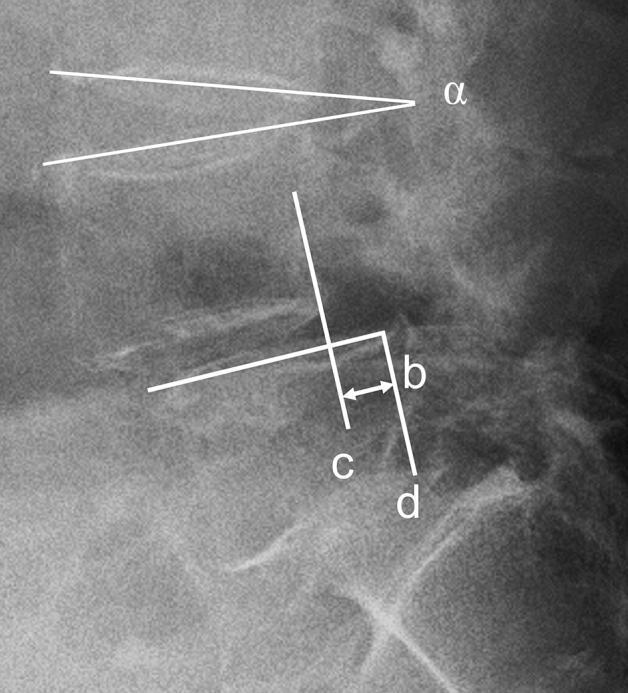
Beyond the Meyerding grade, the lateral film also allows assessment of:
- Slip angle (normally <0°, indicating lordosis at L5–S1)
- Sacral inclination (normally >30°)
- Pelvic incidence (normally ~50°) — used in surgical planning
This is a shared conversation. Sign in to Orris to start your own chat.