
CSF analysis in pediatrics
Reading File
Searching for CSF analysis in pediatrics across normal values, interpretation, and common pathologies.
search_medical_text
CSF analysis cerebrospinal fluid normal values pediatrics
Sexually Transmitted Infections
Page 54
search_medical_text
CSF interpretation meningitis pediatrics lumbar puncture findings
Harrison's Principles of Internal Medicine, Twenty First Edition
Page 4616
search_medical_image
CSF analysis interpretation table pediatrics
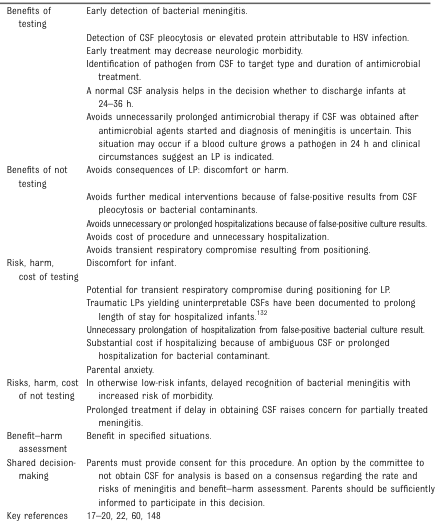
Evaluation and Management of Well-Appearing Febrile Infants 8 to 60 Days Old
Page 20
GradeResponse
GradeResponse
GradeResponse
search_medical_text
CSF normal reference values WBC protein glucose neonates infants children age-specific
search_medical_text
CSF findings bacterial viral fungal tuberculous meningitis differential diagnosis
Here is a comprehensive breakdown of CSF analysis in pediatrics.
CSF Analysis in Pediatrics
1. Normal CSF Reference Values (Age-Specific)
Normal CSF parameters vary significantly with age — neonates and preterm infants have markedly different baselines compared to older children.
| Parameter | Preterm Neonates | Term Neonates (0–28 days) | Infants (1–2 months) | Children (>3 months) |
|---|---|---|---|---|
| WBC (cells/mm³) | Up to 25–29 | ≤16–19 (95th percentile) | ≤9–11 | ≤5 |
| Protein (mg/dL) | Up to 150–200 | ≤115–118 (95th percentile) | ≤89–91 | 15–45 |
| Glucose (mg/dL) | 24–63 | 34–119 | 40–80 | 40–80 |
| CSF:Serum glucose ratio | ≥0.55 | ≥0.55–0.60 | ≥0.55 | ≥0.50 |
| Opening pressure (cmH₂O) | — | — | — | 10–28 (varies with position) |
| Appearance | Clear/xanthochromic | Clear | Clear | Clear, colorless |
| RBCs | 0 | 0 | 0 | 0 |
Key point: High WBC and protein in neonates are physiologically normal and must not be over-interpreted. Values normalize progressively through infancy (Kestenbaum et al., Pediatrics 2010; Shah et al., J Hosp Med 2011; Thomson et al., Pediatrics 2018, as cited in Sexually Transmitted Infections, p. 54).
2. CSF Findings in CNS Infections
The most clinically critical application of CSF analysis is distinguishing the cause of meningitis/encephalitis.
| Feature | Normal | Bacterial | Viral (Aseptic) | Tuberculous | Fungal |
|---|---|---|---|---|---|
| Appearance | Clear | Turbid/purulent | Clear or slightly turbid | Fibrin web/xanthochromic | Clear to turbid |
| Opening pressure | Normal | Elevated | Normal or mildly elevated | Elevated | Elevated |
| WBC (cells/mm³) | ≤5 | 1,000–10,000+ | 10–1,000 | 100–500 | 20–500 |
| Predominant cell | Lymphocytes | Neutrophils | Lymphocytes | Lymphocytes | Lymphocytes |
| Protein (mg/dL) | 15–45 | Markedly elevated (100–500+) | Normal to mildly elevated (50–100) | Elevated (100–500) | Elevated |
| Glucose (mg/dL) | 40–80 | Low (<40 or ratio <0.4) | Normal | Low | Low |
| Gram stain | Negative | Positive (60–80%) | Negative | Negative | Negative |
| Culture | Negative | Positive (70–85%) | Negative | Positive (slow, 45–90 days) | Positive |
| Special tests | — | CRP, PCT, blood culture | PCR (HSV, enterovirus) | AFB stain, ADA, TB PCR | India ink, cryptococcal Ag, fungal culture |
Per Harrison's Principles of Internal Medicine, 21st ed. (p. 4616): In bacterial meningitis (including meningococcal), CSF shows elevated protein, elevated WBC with neutrophilia, and decreased glucose — these findings are non-specific and require microbiological identification for definitive diagnosis.
3. Traumatic vs. True Bloody CSF
A traumatic lumbar puncture (LP) is common in pediatrics and must be distinguished from true subarachnoid hemorrhage (SAH).
| Feature | Traumatic LP | Subarachnoid Hemorrhage |
|---|---|---|
| Appearance over tubes 1→4 | Clears progressively | Uniformly bloody |
| Xanthochromia | Absent (unless >2–4 hrs) | Present (>2 hrs after bleed) |
| RBC:WBC ratio | ~700:1 (mirrors blood) | Exceeds predicted ratio |
| Crenated RBCs | May be present | Not reliable |
| D-dimers/bilirubin | Absent | Present in CSF |
Correcting WBC for a Traumatic Tap
A common rule of thumb: subtract 1 WBC per 700 RBCs (based on peripheral blood ratio).
- Corrected WBC = Observed CSF WBC − (CSF RBCs / 700) × Peripheral blood WBC / Peripheral blood RBCs
4. CSF in Other Pediatric Conditions
| Condition | Key CSF Finding |
|---|---|
| Neonatal HSV encephalitis | Lymphocytic pleocytosis, elevated protein, HSV PCR positive |
| Guillain-Barré syndrome | Albuminocytologic dissociation: protein very elevated, normal/minimal cells |
| Meningeal leukemia/lymphoma | Malignant cells on cytology |
| Febrile seizures (simple) | Normal |
| Pseudotumor cerebri | Elevated opening pressure, otherwise normal |
| Metabolic/neurodegenerative | Elevated lactate, elevated glycine (NKH), specific metabolites |
| Multiple sclerosis (adolescents) | Oligoclonal bands, mildly elevated IgG index |
| Neuroborreliosis (Lyme) | Lymphocytic pleocytosis, elevated protein, Lyme antibodies in CSF |
| Congenital syphilis | Elevated WBC, elevated protein, reactive VDRL |
5. Indications and Contraindications for LP in Pediatrics
Indications
- Suspected meningitis/encephalitis
- Febrile infants 8–60 days old (depending on risk stratification)
- Fever of unknown origin in neonates
- Diagnosis of CNS leukemia
- Measurement of opening pressure (pseudotumor cerebri)
- Intrathecal drug administration
Absolute/Relative Contraindications
- Raised intracranial pressure with mass lesion — risk of cerebral herniation (CT scan recommended first)
- Uncorrected coagulopathy or thrombocytopenia (platelets <50,000)
- Hemodynamic instability/shock
- Local infection at puncture site
- Respiratory compromise (positioning risk, especially neonates)
Per guidelines on febrile infants (Evaluation and Management of Well-Appearing Febrile Infants 8–60 Days Old, p. 20): In borderline cases, the decision to perform LP requires shared decision-making with parents, balancing early detection of bacterial meningitis against risks of the procedure including discomfort, transient respiratory compromise, and prolonged hospitalization from false-positive results.
6. Special Considerations by Age Group
Neonates (0–28 days)
- Always perform LP in suspected sepsis/meningitis — blood culture alone is insufficient.
- Normal values are much higher; do not dismiss elevated WBC/protein without culture.
- HSV encephalitis must be actively considered → send HSV PCR even with mildly abnormal CSF.
- Preterm neonates have even higher baseline protein and WBC.
Infants 1–3 months
- "Transition zone" — values gradually normalize.
- Risk-stratification tools (Philadelphia, Rochester, Step-by-Step, PECARN) guide LP decision.
- LP may be deferred in well-appearing, vaccinated infants meeting low-risk criteria.
Children >3 months
- Normal values approach adult reference ranges.
- CT scan before LP if papilledema, focal neurological deficit, Glasgow Coma Score <13, or known intracranial pathology.
7. Routine CSF Tube Ordering (Standard Practice)
| Tube | Tests |
|---|---|
| Tube 1 | Cell count + differential (most likely traumatic contamination) |
| Tube 2 | Glucose and protein |
| Tube 3 | Gram stain and culture |
| Tube 4 | Cell count (comparison with Tube 1 for traumatic vs. true pleocytosis); additional studies (PCR, cytology) |
Key Takeaways
- Age-adjust all CSF values — neonatal normals are vastly different from those of older children.
- Neutrophilic pleocytosis + low glucose + high protein = bacterial meningitis until proven otherwise → treat empirically without delay.
- Lymphocytic pleocytosis + normal glucose + mildly elevated protein = viral (aseptic) meningitis is most likely.
- Early LP in febrile neonates is critical; do not defer based on clinical appearance alone.
- HSV PCR should be a reflex test in neonates and young infants with any CNS inflammation.
This is a shared conversation. Sign in to Orris to start your own chat.