
Mechanism of Monsoon
The monsoon is driven by differential heating between land and ocean, creating seasonal wind reversals that bring heavy rainfall. Here's a quick overview:
- Summer (onset): Land heats up faster than the sea, creating low pressure over the continent. Moist oceanic air rushes inland, rises, cools, and condenses - producing heavy rain.
- Winter (retreat): Land cools faster, reversing the pressure gradient. Dry continental air flows outward toward the ocean.
Searching sources...
Searching the Web
mechanism of monsoon formation seasonal wind reversal explained
Reading Web Page
https://climatechange.academy/introduction-to-climate-change…
Loading Image
Here is a detailed explanation of the Mechanism of Monsoon:
What is a Monsoon?
A monsoon is a seasonal reversal of wind direction accompanied by a dramatic shift between wet and dry seasons. The word comes from the Arabic mausim (season). It affects roughly one-fourth of Earth's surface and billions of people depend on it for agriculture and freshwater.
Core Driving Force: Differential Heating
The entire mechanism rests on one fundamental principle - land and ocean heat up and cool down at different rates.
| Factor | Land | Ocean |
|---|---|---|
| Heat penetration | ~1 meter | ~50 meters deep |
| Heating rate | Fast | Slow |
| Cooling rate | Fast | Slow |
| Summer pressure | Low | High |
| Winter pressure | High | Low |
Summer Monsoon (Wet Phase) - Step by Step
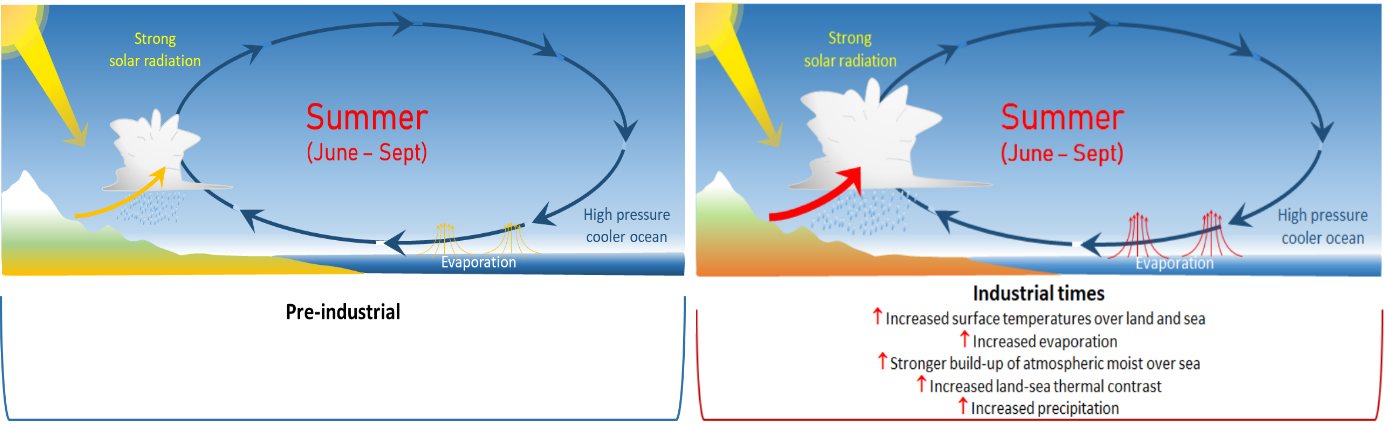
-
Solar heating: As the sun moves north toward the Tropic of Cancer (April-June), the Asian landmass heats up rapidly. Intense low pressure develops over Central Asia, the Tibetan Plateau, and northwest India.
-
Ocean stays cool: Meanwhile, the Indian Ocean, Arabian Sea, and Bay of Bengal remain relatively cooler, maintaining high pressure.
-
Pressure gradient: The pressure difference between the cool ocean (high pressure) and the hot land (low pressure) drives moist oceanic winds toward the continent.
-
Moisture inflow: These moisture-laden winds blow onshore - in India they arrive from the southwest, hence the name Southwest Monsoon (active June-September).
-
Orographic lifting: When these winds hit barriers like the Western Ghats or Himalayas, they are forced to rise rapidly.
-
Condensation and rainfall: Rising air cools at the dry adiabatic lapse rate, then at the saturated lapse rate once condensation begins. Clouds form and heavy rain falls.
-
Latent heat feedback: Condensation releases enormous latent heat, which warms the air further, intensifies the low pressure over land, and sustains the system for months - unlike a regular thunderstorm that lasts only hours.
The Role of the ITCZ
The Intertropical Convergence Zone (ITCZ) - the belt where trade winds from both hemispheres meet - migrates seasonally:
- In summer, the ITCZ shifts northward over the Asian continent (sometimes called the monsoon trough).
- This draws Southern Hemisphere trade winds across the equator; the Coriolis effect deflects them to the right, turning them into the southwest winds that define the Indian monsoon.
- In winter, the ITCZ retreats south of the equator, reversing the whole pattern.
Jet Stream Theory
Two jet streams play a key role in the Indian monsoon:
- Subtropical Westerly Jet (STJ): Flows along the southern slopes of the Himalayas in winter, keeping cold air locked over the subcontinent. In summer, it shifts north to the Tibetan Plateau, removing the "lid" and allowing the low pressure over India to intensify.
- Somali Jet / Low-Level Jet: A strong, narrow current of air that flows northeastward along the East African coast and then curves into the Indian subcontinent, delivering massive amounts of moisture.
Winter Monsoon (Dry Phase)
- In winter, the sun moves south toward the Tropic of Capricorn.
- Land cools rapidly; high pressure builds over the Tibetan Plateau and Siberian Plateau.
- Cold, dry continental air flows outward from these high-pressure cells toward the relatively warmer ocean.
- In India, these are the Northeast Monsoon winds - dry for most of the country, but they pick up moisture over the Bay of Bengal and bring rain to the southeastern coast (Tamil Nadu, Seemandhra).
Factors That Intensify the Asian Monsoon
Several geographic features amplify the monsoon, as illustrated in the diagram above:
- The Tibetan Plateau acts as an elevated heat source, intensifying the low pressure system over Asia and acting as a barrier to cold northern air.
- The Himalayas block cold continental winds from penetrating southward and force incoming moist air upward, triggering heavy orographic rainfall.
- Warm ocean temperatures (SST): Higher sea surface temperatures increase evaporation, loading the atmosphere with more moisture.
In industrial times (right panel in the diagram), increased land-sea thermal contrast, stronger evaporation, and more atmospheric moisture all act to intensify monsoon precipitation.
Classical Theory vs. Modern Understanding
| Theory | Key Idea |
|---|---|
| Classical Theory | Monsoon = large-scale land-sea breeze; summer low over land draws ocean winds |
| Jet Stream Theory | Northward shift of Subtropical Westerly Jet triggers onset; Somali Jet delivers moisture |
| ITCZ Theory | Seasonal migration of ITCZ drives wind reversal across the equator |
| Modern View | All three mechanisms interact; Tibetan Plateau heating is central |
Types of Monsoon
- South Asian Monsoon - the strongest and most studied; affects India, Bangladesh, Pakistan, Myanmar
- West African Monsoon - brings rain to the Sahel and West Africa
- East Asian Monsoon - brings the meiyu/baiu (plum rain) season to China, Korea, Japan
- North American Monsoon - summer rains over the southwestern US and northwest Mexico
- Australian Monsoon - wet-season rains over northern Australia (Nov-April)
Summary
The monsoon is fundamentally a thermally driven, seasonally reversing atmospheric circulation. Differential land-ocean heating creates pressure gradients; moisture-laden ocean air flows onto the heated continent, rises, condenses, and releases both rainfall and latent heat that sustains the system for months. The Tibetan Plateau, ITCZ migration, and jet stream shifts all amplify and time this process. For more than a quarter of humanity, the monsoon's arrival and strength each year determines food security, water supply, and economic well-being. The Climate Change Academy overview and Wikipedia's monsoon article provide good supplementary reading.
Mechanism of Nor'Wester
A Nor'Wester (called Kalbaishakhi in Bengali) is a violent pre-monsoon thunderstorm that strikes West Bengal, Bangladesh, and northeast India during March-May. It forms when hot, dry air from the northwest collides with warm, moist air from the Bay of Bengal, triggering intense convective activity - producing sudden squalls, thunder, lightning, and hail.
Searching sources...
Searching the Web
Nor'Wester Kalbaishakhi mechanism formation thunderstorm West Bengal meteorology
Reading Web Page
https://en.wikipedia.org/wiki/Nor%27westers
Loading Image
Loading Image
Loading Image
Here is a detailed explanation of the Mechanism of Nor'Wester (Kalbaishakhi):
What is a Nor'Wester?
A Nor'wester (Bengali: Kalbaishakhi - "fateful event of Baishakh") is a violent, localized pre-monsoon thunderstorm that strikes West Bengal, Bangladesh, Odisha, Assam, Bihar, Jharkhand, Tripura, and parts of Nepal during March to May, typically in the afternoon or just before sunset. The name comes from the fact that these storms travel from the northwest toward the southeast.
In Assamese it is called Bordoisila, and it is classified meteorologically as a progressive derecho - a long-lived, wind-driven convective system.
Geographical Setting

Two contrasting air masses collide over the Bengal region:
- Hot, dry air mass from northwest India (Rajasthan, Gangetic plains)
- Warm, moist air mass from the Bay of Bengal (from the south/southeast)
A low pressure zone develops over eastern India / Bangladesh as the meeting point of these two air masses.
Core Mechanism: Air Mass Conflict
The Nor'wester is fundamentally produced by the collision (convergence) of two contrasting air masses - this is what makes it different from a simple sea breeze thunderstorm.
| Air Mass | Origin | Properties |
|---|---|---|
| Dry continental air | NW India (Rajasthan, Punjab) | Hot, dry, unstable |
| Moist maritime air | Bay of Bengal | Warm, humid, buoyant |
When these two air masses meet over the Chhotanagpur Plateau (Bihar-Jharkhand border), the lighter moist air is forcibly lifted over the denser dry air, triggering explosive convection.
Phases of Formation
Phase 1 - Pre-storm / Cumulus Stage
- In the pre-monsoon season (March-May), the land heats up intensely under a high sun.
- The Chhotanagpur Plateau and Gangetic plains build up severe surface heat, creating a surface low pressure.
- Hot, dry air from the northwest flows southeast toward this low.
- Simultaneously, warm, moist southerly winds from the Bay of Bengal flow northward into the same zone.
- Where these air masses converge, intense convective uplift begins - warm moist air rises sharply.
- A large cumulonimbus (Cb) cloud starts building vertically, sometimes reaching heights of 12 km (40,000 ft).
Phase 2 - Mature Stage

- As the cloud builds, strong updrafts carry moisture to great heights.
- Above the freezing level (~6 km), water droplets freeze into ice crystals and hail embryos.
- Downdrafts form alongside updrafts - cold, rain-cooled air rushes downward to the surface.
- The downdraft hitting the surface spreads out as a cold outflow (gust front), which undercuts warm air ahead, forcing more uplift and sustaining the storm.
- This mature stage produces the characteristic features:
- Gale-force winds often exceeding 100 km/h
- Torrential rain within a short time window
- Hailstones (from frozen supercooled water droplets)
- Intense lightning and thunder
- Occasional tornadoes in the moisture-rich Ganges-Brahmaputra Delta
Phase 3 - Dissipating Stage
- The downdraft eventually cuts off the supply of warm moist air feeding the updraft.
- The storm loses its energy source and rapidly weakens.
- Rain decreases, winds ease, sky clears - often within 30-60 minutes of onset.
- This is why Nor'westers are described as intense but brief.
Direction of Movement
The storm system originates over the Chhotanagpur Plateau and tracks consistently from northwest to southeast, which explains both names:
- "Nor'wester" - comes from the northwest
- "Kalbaishakhi" - strikes during the month of Baishakh (mid-April to mid-May)
Key Triggering Factors
| Factor | Role |
|---|---|
| Intense surface heating | Creates convective instability and surface low pressure |
| Moisture from Bay of Bengal | Provides the latent heat fuel for thunderstorm development |
| Dry NW air intrusion | Acts as a trigger by undercutting and lifting the moist air |
| Chhotanagpur Plateau | Elevated terrain enhances convergence and initial uplift |
| Afternoon timing | Peak surface heating at 3-6 PM maximizes convective energy |
| Pre-monsoon instability | Atmospheric lapse rates are steepest in spring, favoring explosive convection |
Nor'wester vs. Regular Thunderstorm
| Feature | Regular Thunderstorm | Nor'wester |
|---|---|---|
| Cause | Local convection | Convergence of two contrasting air masses |
| Duration | 30 min - 2 hrs | Short but extremely intense (30-90 min) |
| Wind speed | Moderate | Often exceeds 100 km/h |
| Hail | Occasional | Common and large |
| Spatial scale | Local | Regional (tracks hundreds of km) |
| Classification | Ordinary cell | Progressive derecho |
Effects
Destructive:
- Uproots trees, damages crops (especially mango, litchi)
- Waterlogging, flooding of roads
- Loss of life from lightning, hail, tornadoes
- Infrastructure damage
Beneficial:
- Provides critical pre-monsoon moisture to kharif crops (jute, paddy)
- Breaks oppressive pre-monsoon heat
- Replenishes dry soils before the monsoon arrives
Climate Change Impact
According to the Wikipedia article on Nor'westers and recent research, due to global warming, these storms are becoming less frequent but more intense - producing greater destruction when they do occur. The MDPI atmospheric sciences study on diurnal analysis of Nor'westers confirms changes in their timing and frequency over Gangetic West Bengal in recent decades.
Summary
A Nor'wester forms when hot dry continental air from the northwest collides with warm moist maritime air from the Bay of Bengal over eastern India. The forced uplift of the moist air triggers explosive cumulonimbus development, releasing enormous latent heat that powers violent updrafts, downdrafts, hail, and gale-force winds. The storm tracks northwest to southeast, typically lasts under an hour, and dissipates once the warm moist air supply is cut off by its own downdraft. It is essentially a large-scale, self-organizing convective storm system - the product of two air masses in conflict over a thermally unstable landscape.
This is a shared conversation. Sign in to Orris to start your own chat.