
Cerebellum cortex has 3 layers
The cerebellar cortex has 3 layers: the molecular layer (outermost), the Purkinje cell layer (middle), and the granular layer (innermost). Each has distinct cell types and functions in cerebellar signal processing.
Searching sources...
Reading File
Finding Sources
Finding Sources
Reading File
Reading File
Reading File
Loading Image
Yes, the cerebellar cortex has exactly 3 layers. Here is a detailed breakdown from multiple authoritative neuroscience and physiology textbooks:
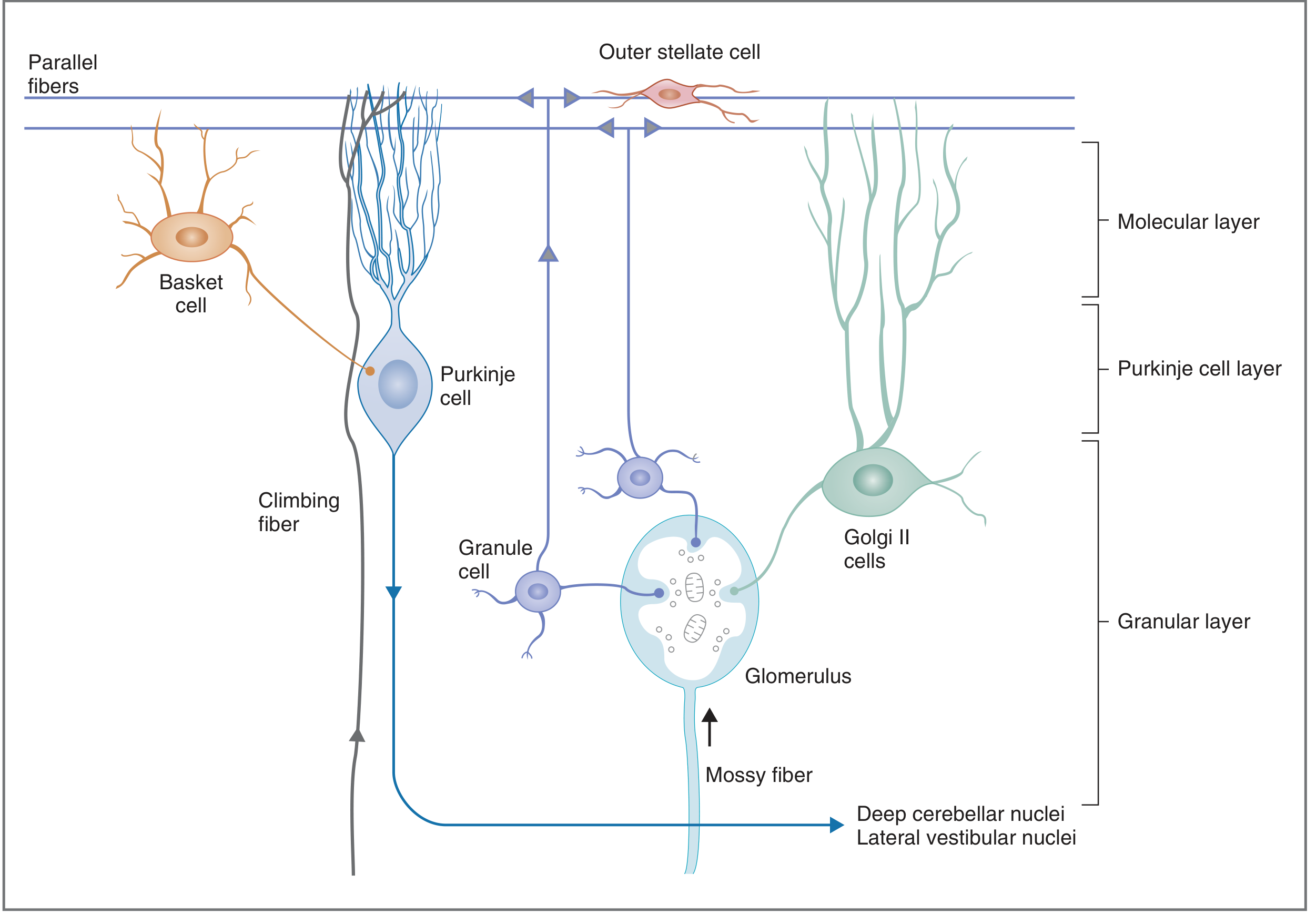
The Three Layers of the Cerebellar Cortex
1. Granular Layer (Innermost - "Input Layer")
- Contains granule cells (~100 billion - the most numerous neurons in the brain), Golgi II cells, and glomeruli
- Mossy fibers (from spinocerebellar and pontocerebellar tracts) terminate here, synapsing on granule and Golgi type II cell dendrites within the glomeruli
- Golgi cells provide inhibitory feedback onto granule cells
- The granular layer is functionally the input layer of the cerebellar cortex
- Also contains smaller populations of cells of Lugaro, unipolar brush cells, and chandelier cells
2. Purkinje Cell Layer (Middle - "Output Layer")
- Consists of a single sheet of Purkinje cell bodies (each 50-80 µm in diameter)
- Purkinje cells are among the largest neurons in the CNS, with extensive dendritic arbors extending up into the molecular layer
- Their axons carry the sole output of the cerebellar cortex, projecting to:
- Deep cerebellar nuclei (especially the dentate nucleus)
- Vestibular nuclei in the brain stem
- Output is always inhibitory (via GABA)
- Each Purkinje cell dendrite can receive input from up to 250,000 parallel fibers
- Each Purkinje cell receives input from only one climbing fiber, which produces powerful "complex spikes"
3. Molecular Layer (Outermost)
- Contains outer stellate cells and basket cells - both inhibitory interneurons that inhibit Purkinje cells
- Contains the fan-like dendrites of Purkinje cells and dendrites of Golgi II cells
- Contains parallel fibers - the T-shaped bifurcating axons of granule cells that run parallel to the long axis of the cerebellar folia and synapse perpendicularly across the Purkinje cell dendritic trees
The 5 Cell Types of the Cerebellar Cortex (Summary)
| Cell | Layer | Function |
|---|---|---|
| Granule cells | Granular | Excitatory interneurons; relay mossy fiber input via parallel fibers |
| Golgi II cells | Granular (body) / Molecular (dendrites) | Inhibitory feedback onto granule cells |
| Purkinje cells | Purkinje cell layer | Sole output of cortex; inhibitory (GABA) |
| Basket cells | Molecular | Inhibit Purkinje cells |
| Stellate cells | Molecular (outer) | Inhibit Purkinje cells |
Two Afferent Input Systems
| Fiber | Origin | Terminates On | Effect on Purkinje cell |
|---|---|---|---|
| Mossy fibers | Vestibular, spinal, pontine nuclei | Granule cells (via glomeruli) | Indirect via parallel fibers → simple spikes |
| Climbing fibers | Inferior olivary nucleus (medulla) | Purkinje cell proximal dendrites directly | Direct, powerful → complex spikes (1 climbing fiber per Purkinje cell) |
Both systems also send collateral branches directly to the deep cerebellar nuclei, bypassing the cortex.
Sources: Costanzo Physiology 7th Ed., p. 114 | Kandel Principles of Neural Science 6th Ed. | Ganong's Review of Medical Physiology 26th Ed. | Localization in Clinical Neurology 8th Ed.
This is a shared conversation. Sign in to Orris to start your own chat.