
Ackerman tumor
Ackerman tumor verrucous carcinoma oral cavity pathology features
Ackerman Tumor (Verrucous Carcinoma)
Definition
Epidemiology
- Predominantly affects men over 55 years of age
- Oral verrucous carcinoma accounts for 0.57-16% of oral SCC
- The larynx is the second most common head and neck site; most laryngeal cases involve the true vocal cords
Sites of Involvement
| Site | Synonyms/Notes |
|---|---|
| Oral cavity (most common) | Oral florid papillomatosis / Ackerman tumor |
| Larynx | Second most common H&N site |
| Plantar foot | Epithelioma cuniculatum / carcinoma cuniculatum |
| Anogenital region | Buschke-Lowenstein tumor (giant condyloma acuminatum) |
| Sinonasal, esophagus, temporal bone | Less common |
Etiology / Risk Factors
- Tobacco use (chewing tobacco, snuff, areca nut chewing) - the most well-established risk factor for oral VC
- HPV (types 6, 11, 16, 18) - detected in some cases, but the precise etiologic role remains controversial; several studies show HPV is not etiopathogenetically linked to head and neck VC
- Pressure and other chronic irritants (plantar variant)
- Not UV-related
Clinical Features
- Slowly growing, exophytic, papillomatous/warty proliferation with well-demarcated margins
- Surface most often white (due to hyperkeratosis); color varies with associated inflammation
- Plantar variant: bulbous mass with multiple sinuses ("rabbit burrows") opening to the surface
- If untreated: local destruction of underlying bone, muscle, and salivary glands
- Metastases are rare in pure VC; reactive lymphadenopathy may occur from peritumoral inflammation
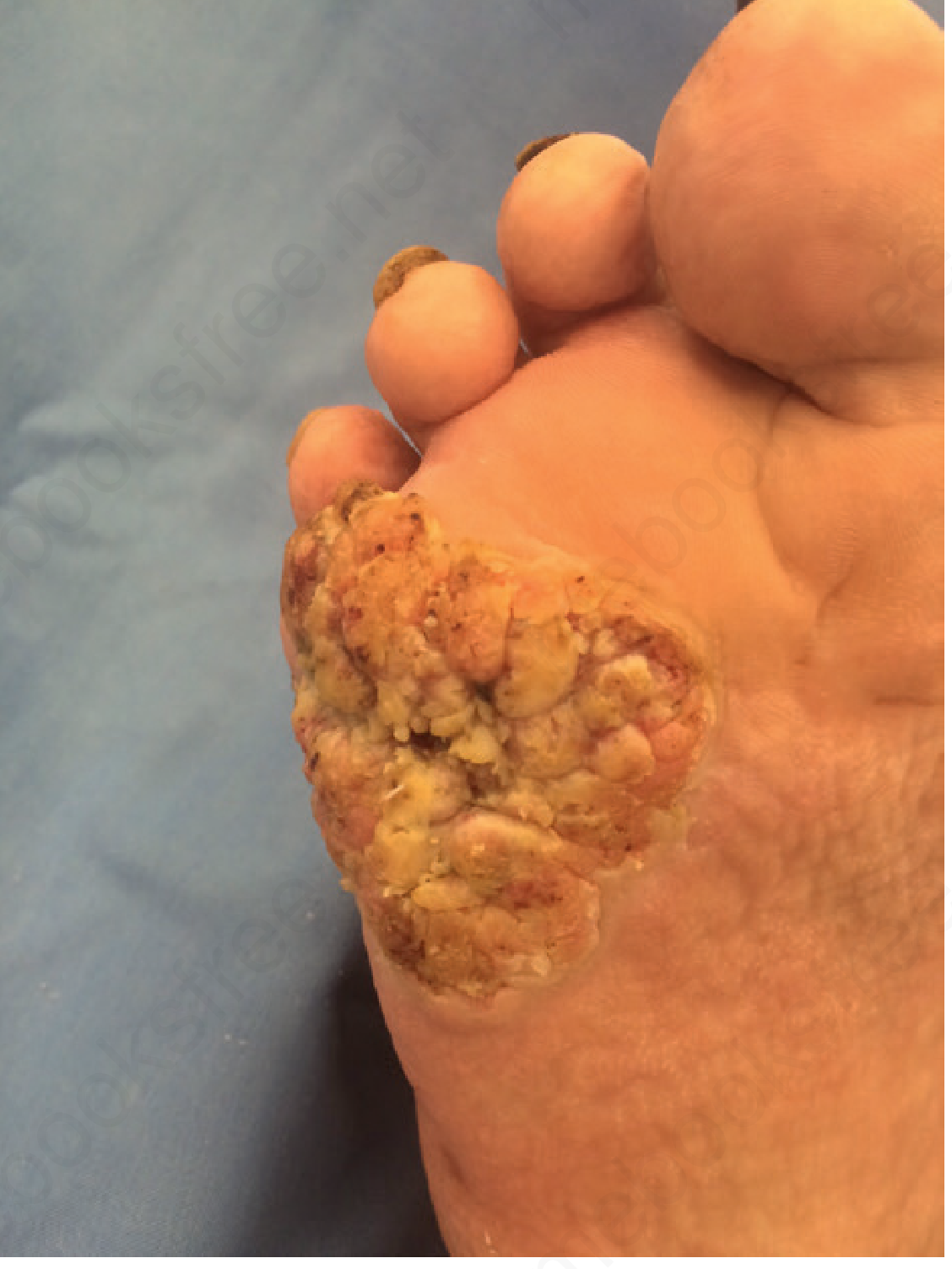
Histopathology
- Hyperkeratosis and acanthosis with an undulating, papillary/verrucous surface
- Well-differentiated squamous epithelium - cytologic atypia is minimal; rare mitotic figures
- Bulbous rete ridges - broad, pushing (not infiltrating/spiky) deep margin
- Bulbous invaginations with parakeratotic centers; fibrovascular cores
- Cytoplasm is often "apple-pink" with a glassy appearance
- Dense chronic inflammatory infiltrate in the superficial connective tissue
Critical diagnostic note: Superficial biopsies frequently miss the diagnostic features - the characteristic pushing-base pattern is deep. Multiple and deeper biopsies are often required.
Hybrid Carcinoma
- Up to 20% of verrucous carcinomas show foci of conventional SCC within them - this is called a hybrid carcinoma
- Hybrid VC can metastasize to cervical lymph nodes and must be managed like conventional SCC
- Superficial biopsies may misdiagnose hybrid tumors as pure VC
Differential Diagnosis
- Conventional SCC (hybrid VC vs pure VC distinction)
- Verruca vulgaris (wart)
- Condyloma acuminatum
- Squamous papilloma
- Proliferative verrucous leukoplakia (oral cavity)
Treatment
| Approach | Details |
|---|---|
| Surgery (treatment of choice) | Conservative surgical excision; Mohs microsurgery useful for cutaneous lesions |
| Radiotherapy | Less preferred - VC is less radiosensitive than conventional SCC; higher risk of residual/recurrent disease; historically linked to anaplastic transformation (likely reflecting misdiagnosed hybrid tumors) |
| Neck dissection | Not indicated in pure VC (does not metastasize); indicated for hybrid VC |
| Other (cutaneous) | CO2 laser, intralesional IFN-alfa, imiquimod, PDT, topical/systemic chemotherapy (bleomycin, 5-FU, cisplatin) - all with variable success |
Prognosis
- Excellent overall
- 5-year survival: 85-90% (oral); approaches 90% (laryngeal)
- Surgical salvage is highly successful even for recurrence
- Worse prognosis if hybrid carcinoma is present and not recognized
Make a note on Ackerman tumor of oral cavity on poster
Medical educational poster titled "Ackerman Tumor (Oral Verrucous Carcinoma)" with clean clinical layout. Include the following sections with icons and colored boxes: HEADER: "Ackerman Tumor" large bold title, subtitle "Oral Verrucous Carcinoma | Oral Florid Papillomatosis" DEFINITION box: Low-grade, well-differentiated variant of SCC. Exophytic, slow-growing, locally destructive. Rarely metastasizes. EPIDEMIOLOGY box: Males >55 years. Accounts for 0.57–16% of oral SCC. Most common in buccal mucosa, gingiva, tongue, floor of mouth. ETIOLOGY box with icons: Tobacco chewing / snuff (primary risk). Areca nut chewing. HPV types 6, 11, 16, 18 (controversial role). Chronic mucosal irritation. CLINICAL FEATURES box: Exophytic warty/papillomatous white mass. Well-demarcated margins. Slow persistent growth. Local destruction of bone, muscle, salivary glands if untreated. Reactive lymphadenopathy (peritumoral inflammation — NOT metastasis). HISTOPATHOLOGY box: Hyperkeratosis + acanthosis. Well-differentiated squamous epithelium — MINIMAL atypia. Bulbous pushing (non-infiltrating) deep margin. Apple-pink glassy cytoplasm. Dense chronic inflammatory infiltrate. Note: Superficial biopsy may miss diagnosis — deep/multiple biopsies needed. HYBRID CARCINOMA box (highlighted in red/orange): 20% cases have foci of conventional SCC → Hybrid carcinoma. CAN metastasize. Must treat as conventional SCC. TREATMENT box: Surgery = Treatment of choice. Mohs microsurgery for cutaneous variant. Radiotherapy avoided (less effective, risk of anaplastic transformation). Neck dissection NOT needed for pure VC. PROGNOSIS box: 5-year survival 85–90%. Excellent with complete excision. Poor if hybrid carcinoma missed. Use a professional medical poster design with teal/dark blue header, white background, colored section boxes, clear readable fonts, and organized grid layout.
mkdir -p /tmp/workspace/ackerman-poster && ls /tmp/workspace/
~/ackerman-poster/create_poster.py
from reportlab.lib.pagesizes import A3, landscape
from reportlab.lib import colors
from reportlab.lib.units import cm, mm
from reportlab.platypus import (
SimpleDocTemplate, Paragraph, Spacer, Table, TableStyle, HRFlowable
)
from reportlab.lib.styles import getSampleStyleSheet, ParagraphStyle
from reportlab.lib.enums import TA_CENTER, TA_LEFT, TA_JUSTIFY
from reportlab.platypus import KeepTogether
from reportlab.lib.colors import HexColor
# ── Colour palette ──────────────────────────────────────────────────────────
TEAL_DARK = HexColor("#0A3D62") # header bg
TEAL_MID = HexColor("#1A6A8A") # section header bg
TEAL_LIGHT = HexColor("#D6EAF8") # section bg tint
GOLD = HexColor("#F39C12") # accent / highlight
RED_BOX = HexColor("#C0392B") # hybrid warning header
RED_LIGHT = HexColor("#FADBD8") # hybrid warning bg
GREEN_DARK = HexColor("#1E8449") # prognosis header
GREEN_LIGHT = HexColor("#D5F5E3") # prognosis bg
ORANGE = HexColor("#E67E22") # etiology header
ORANGE_LIGHT= HexColor("#FDEBD0") # etiology bg
PURPLE_DARK = HexColor("#6C3483") # histo header
PURPLE_LIGHT= HexColor("#F5EEF8") # histo bg
WHITE = colors.white
GREY_LIGHT = HexColor("#F2F3F4")
TEXT_DARK = HexColor("#1C1C1C")
BULLET = "•"
OUTPUT = "/tmp/workspace/ackerman-poster/Ackerman_Tumor_Oral_Cavity_Poster.pdf"
doc = SimpleDocTemplate(
OUTPUT,
pagesize=landscape(A3),
rightMargin=1.2*cm, leftMargin=1.2*cm,
topMargin=0.8*cm, bottomMargin=0.8*cm,
title="Ackerman Tumor – Oral Verrucous Carcinoma"
)
W = landscape(A3)[0] - 2.4*cm # usable width
# ── Styles ──────────────────────────────────────────────────────────────────
base = getSampleStyleSheet()
def S(name, parent="Normal", **kw):
s = ParagraphStyle(name, parent=base[parent], **kw)
return s
header_title = S("HdrTitle", fontSize=28, textColor=WHITE,
leading=34, alignment=TA_CENTER, fontName="Helvetica-Bold")
header_sub = S("HdrSub", fontSize=13, textColor=HexColor("#D6EAF8"),
leading=18, alignment=TA_CENTER, fontName="Helvetica")
sec_heading = S("SecHdr", fontSize=11, textColor=WHITE,
leading=14, fontName="Helvetica-Bold", alignment=TA_CENTER)
body = S("Body", fontSize=9, textColor=TEXT_DARK,
leading=13, fontName="Helvetica", spaceAfter=1)
body_b = S("BodyB", fontSize=9, textColor=TEXT_DARK,
leading=13, fontName="Helvetica-Bold", spaceAfter=1)
bullet_style = S("Bullet", fontSize=9, textColor=TEXT_DARK,
leading=13, fontName="Helvetica",
leftIndent=10, firstLineIndent=-10, spaceAfter=2)
warn_head = S("WarnHdr", fontSize=11, textColor=WHITE,
leading=14, fontName="Helvetica-Bold", alignment=TA_CENTER)
note_style = S("Note", fontSize=8, textColor=HexColor("#7B241C"),
leading=11, fontName="Helvetica-BoldOblique", spaceAfter=2)
def bp(text, style=bullet_style):
return Paragraph(f"<b>{BULLET}</b> {text}", style)
def cell_content(heading, items, hdr_color, bg_color, note=None, style=bullet_style):
"""Returns a list of Paragraph/Spacer for one coloured info cell."""
hdr_s = ParagraphStyle("ch", parent=sec_heading, backColor=hdr_color,
borderPad=4)
content = [Paragraph(heading, hdr_s), Spacer(1, 3)]
for item in items:
content.append(bp(item, style))
if note:
content.append(Spacer(1, 4))
content.append(Paragraph(note, note_style))
return content
# ── Build story ─────────────────────────────────────────────────────────────
story = []
# ── HEADER ───────────────────────────────────────────────────────────────────
hdr_table = Table(
[[Paragraph("ACKERMAN TUMOR", header_title)],
[Paragraph("Oral Verrucous Carcinoma | Oral Florid Papillomatosis | Low-Grade SCC Variant", header_sub)]],
colWidths=[W]
)
hdr_table.setStyle(TableStyle([
("BACKGROUND", (0,0), (-1,-1), TEAL_DARK),
("ROWBACKGROUNDS", (0,0), (-1,-1), [TEAL_DARK, TEAL_DARK]),
("TOPPADDING", (0,0), (-1,-1), 10),
("BOTTOMPADDING", (0,0), (-1,-1), 8),
("LEFTPADDING", (0,0), (-1,-1), 10),
("RIGHTPADDING", (0,0), (-1,-1), 10),
("ROUNDEDCORNERS",(0,0), (-1,-1), [6,6,6,6]),
]))
story.append(hdr_table)
story.append(Spacer(1, 8))
# helper: make a styled section box
def make_box(heading, bullets, hdr_color, bg_color, note=None):
inner = cell_content(heading, bullets, hdr_color, bg_color, note)
t = Table([[inner]], colWidths=["100%"])
t.setStyle(TableStyle([
("BACKGROUND", (0,0), (-1,-1), bg_color),
("TOPPADDING", (0,0), (-1,-1), 6),
("BOTTOMPADDING", (0,0), (-1,-1), 6),
("LEFTPADDING", (0,0), (-1,-1), 8),
("RIGHTPADDING", (0,0), (-1,-1), 8),
("BOX", (0,0), (-1,-1), 0.8, hdr_color),
("ROUNDEDCORNERS",(0,0), (-1,-1), [4,4,4,4]),
]))
return t
# ── ROW 1: Definition | Epidemiology | Etiology ──────────────────────────────
def_box = make_box(
"DEFINITION",
["Low-grade, well-differentiated <b>variant of SCC</b>",
"Predominantly <b>exophytic</b>, papillomatous growth",
"Slow, persistent growth with <b>pushing margins</b>",
"Local destruction possible; <b>metastasis rare</b>",
"First described by <b>Lauren Ackerman (1948)</b>"],
TEAL_MID, TEAL_LIGHT
)
epi_box = make_box(
"EPIDEMIOLOGY",
["Predominantly <b>males > 55 years</b>",
"Accounts for <b>0.57–16%</b> of oral SCC",
"Most common site: <b>buccal mucosa</b>",
"Followed by: gingiva, tongue, floor of mouth, hard palate",
"Larynx = 2nd most common head & neck site"],
TEAL_MID, TEAL_LIGHT
)
etio_box = make_box(
"ETIOLOGY / RISK FACTORS",
["<b>Tobacco chewing / snuff</b> — primary risk factor",
"Site of tumor corresponds to <b>tobacco placement site</b>",
"<b>Areca nut chewing</b> (betel quid)",
"HPV types 6, 11, 16, 18 — detected but <b>role controversial</b>",
"Alcohol consumption, oral microbiota",
"<b>NOT UV-related</b>"],
ORANGE, ORANGE_LIGHT
)
row1 = Table([[def_box, epi_box, etio_box]],
colWidths=[W*0.32, W*0.33, W*0.35])
row1.setStyle(TableStyle([
("VALIGN", (0,0), (-1,-1), "TOP"),
("LEFTPADDING", (0,0), (-1,-1), 3),
("RIGHTPADDING", (0,0), (-1,-1), 3),
]))
story.append(row1)
story.append(Spacer(1, 6))
# ── ROW 2: Clinical | Histopathology | Hybrid + Treatment + Prognosis ────────
clin_box = make_box(
"CLINICAL FEATURES",
["<b>Slow-growing</b>, exophytic, warty/papillomatous white mass",
"<b>Well-demarcated</b> margins",
"Color: usually <b>white</b> (hyperkeratosis); varies with inflammation",
"If untreated: destroys <b>bone, muscle, salivary glands</b>",
"<b>Reactive lymphadenopathy</b> from peritumoral inflammation",
"Pure VC: <b>does NOT metastasize</b>",
"Plantar variant: 'rabbit burrow' sinuses (carcinoma cuniculatum)"],
TEAL_MID, TEAL_LIGHT
)
histo_bullets = [
"<b>Hyperkeratosis + acanthosis</b>, verrucous surface",
"Well-differentiated squamous epithelium — <b>minimal atypia</b>",
"Rare mitotic figures",
"<b>Bulbous rete ridges</b> — broad, pushing deep margin",
"Cytoplasm: <b>apple-pink, glassy</b> appearance",
"Dense <b>chronic inflammatory infiltrate</b> in superficial CT",
"Fibrovascular cores in papillary projections",
]
histo_note = "⚠ Superficial biopsy often MISSES diagnosis. Deep / multiple biopsies are mandatory."
histo_box = make_box(
"HISTOPATHOLOGY",
histo_bullets,
PURPLE_DARK, PURPLE_LIGHT,
note=histo_note
)
# right column: stacked Hybrid + Treatment + Prognosis
hybrid_box = make_box(
"⚠ HYBRID CARCINOMA ⚠",
["<b>~20%</b> of VC have foci of conventional SCC",
"Hybrid VC <b>CAN metastasize</b> to cervical nodes",
"Treat hybrid VC as <b>conventional SCC</b>",
"Superficial biopsies may <b>miss</b> this — always deep biopsy"],
RED_BOX, RED_LIGHT
)
tx_box = make_box(
"TREATMENT",
["<b>Surgery</b> = treatment of choice (conservative excision)",
"Mohs microsurgery for cutaneous variant",
"<b>Radiotherapy:</b> less effective; risk of anaplastic transformation → <b>avoid if possible</b>",
"RT indicated only if surgery would require total laryngectomy or patient unfit",
"<b>Neck dissection:</b> NOT indicated for pure VC",
"Hybrid VC: treat as conventional SCC (with neck dissection)"],
TEAL_MID, TEAL_LIGHT
)
prog_box = make_box(
"PROGNOSIS",
["5-year survival: <b>85–90%</b>",
"Excellent with <b>complete excision</b>",
"Surgical salvage: <b>universally successful</b>",
"Worse prognosis if <b>hybrid carcinoma missed</b>"],
GREEN_DARK, GREEN_LIGHT
)
right_col = [hybrid_box, Spacer(1, 4), tx_box, Spacer(1, 4), prog_box]
row2 = Table([[clin_box, histo_box, right_col]],
colWidths=[W*0.30, W*0.36, W*0.34])
row2.setStyle(TableStyle([
("VALIGN", (0,0), (-1,-1), "TOP"),
("LEFTPADDING", (0,0), (-1,-1), 3),
("RIGHTPADDING", (0,0), (-1,-1), 3),
]))
story.append(row2)
story.append(Spacer(1, 6))
# ── FOOTER ───────────────────────────────────────────────────────────────────
footer_style = S("Footer", fontSize=7.5, textColor=HexColor("#707070"),
alignment=TA_CENTER, fontName="Helvetica-Oblique")
story.append(HRFlowable(width="100%", thickness=0.5, color=TEAL_DARK))
story.append(Spacer(1, 3))
story.append(Paragraph(
"Sources: Dermatology 2-Volume Set 5e • Cummings Otolaryngology Head & Neck Surgery • "
"Andrews' Diseases of the Skin • Fitzpatrick's Dermatology | For educational use only",
footer_style
))
# ── Build ────────────────────────────────────────────────────────────────────
doc.build(story)
print(f"Poster saved to: {OUTPUT}")
cd /tmp/workspace/ackerman-poster && python create_poster.py
Ackerman Tumor Oral Cavity Poster
PDF Document · PDF
| Section | Colour |
|---|---|
| Definition, Epidemiology, Clinical, Treatment | Teal |
| Etiology / Risk Factors | Orange |
| Histopathology | Purple |
| Hybrid Carcinoma warning | Red |
| Prognosis | Green |
- Definition - low-grade SCC variant, Ackerman (1948)
- Epidemiology - males >55, buccal mucosa most common
- Etiology - tobacco, areca nut, HPV (controversial), NOT UV
- Clinical Features - warty white exophytic mass, pushing margins, rare metastasis
- Histopathology - minimal atypia, bulbous ridges, apple-pink cytoplasm, with the biopsy warning note
- Hybrid Carcinoma - highlighted warning box (20%, can metastasize)
- Treatment - surgery first choice, avoid radiotherapy, no neck dissection for pure VC
- Prognosis - 5-year survival 85-90%
- Footer - source references