
Partial tkr or meniscus replacement or meniscus surgery
Reading File
Finding Sources
Finding Sources
The best sources are Miller's Review of Orthopaedics and Family Medicine. Let me read those sections in parallel.
Reading File
Reading File
I have the Miller's content truncated. Let me read the rest of the Miller's section covering partial meniscectomy, repair, transplant, and also search for partial/unicompartmental TKR.
Reading File
Finding Sources
Reading File
Reading File
I now have comprehensive information from the textbooks. Let me also read the Miller's section on meniscal transplant indications and the UKA section from Miller's for the partial knee replacement details.
Reading File
I now have enough information to write a comprehensive answer. Let me compose it.
Here is a comprehensive overview of partial knee replacement (unicompartmental knee arthroplasty), meniscus surgery, and meniscal transplantation, drawn from authoritative orthopaedic and medicine textbooks.
Meniscal Anatomy & Biomechanics
The menisci are C-shaped fibrocartilaginous structures on the tibial plateau that play a critical load-bearing role:
- The menisci transmit 50–75% of axial loads at full extension and 85% at 90° of flexion
- The medial meniscus bears 30–40% of tibiofemoral load; the lateral bears ~70%
- They decrease peak contact stresses at the articular surface by 100–200%
- Resecting just 75% of radial meniscal width increases contact stress as much as total meniscectomy
- Only the peripheral third receives blood supply — this "red zone" has the highest healing potential
— Miller's Review of Orthopaedics, 9th Edition
Meniscal Tears
Types
- Traumatic tears: common in younger patients; sports-related twisting/rotational forces
- Degenerative tears: older patients; insidious onset; complex/horizontal pattern
- Meniscal root tears: radial tear or avulsion from tibial plateau; completely disrupts circumferential fibers; biomechanically equivalent to total meniscectomy
The medial meniscus tears ~3× more often than the lateral, but lateral tears are more common with ACL injuries.
Diagnosis
- Joint line tenderness, effusion, mechanical symptoms (locking, catching, popping)
- McMurray test: hyperflexion with varus/valgus stress and rotation — positive if pain + palpable click
- MRI is the gold standard for confirmation
Meniscal Surgery Options
1. Conservative (Non-operative)
In the absence of intermittent swelling, catching, or locking — especially for degenerative tears — conservative management is appropriate and should be exhausted before surgery. — Miller's Review of Orthopaedics
2. Partial Meniscectomy (Arthroscopic)
- Best for: Tears not amenable to repair (complex, degenerative, central/radial tears)
- Resect the minimum amount of meniscal tissue necessary to achieve a stable rim
- Partial meniscectomy increases peak stresses in the affected compartment → raises long-term arthritis risk
- Evidence from randomized controlled trials (including sham-surgery controls) shows partial meniscectomy for degenerative tears offers limited benefit over placebo surgery at 2-year follow-up
3. Meniscal Repair
Indications:
- Tear length 1–4 cm
- Vertical (longitudinal) tear pattern
- Peripheral "red-red" zone tear (vascularized)
- Meniscal root tear
- Patient age < 40 years
- Concurrent ACL reconstruction extends indications (better healing environment)
Techniques (four main approaches):
| Technique | Notes |
|---|---|
| Open | Rarely used |
| Outside-in | Good for anterior horn tears |
| Inside-out | Gold standard; vertical mattress sutures |
| All-inside | Popular; latest devices allow construct tensioning |
Success rates:
- ~90% when done with ACL reconstruction
- ~60% with intact ACL
- ~30% with ACL-deficient knee
Rehabilitation: avoid knee flexion > 90°; weight-bearing protocols vary.
4. Meniscal Allograft Transplantation
Controversial — all non-operative options should be exhausted first.
Indications:
- Prior total or near-total meniscectomy (especially lateral)
- Pain in the involved compartment
- BMI < 30
- Age < 50 years
- Normal alignment; ligamentous stability
- Addressable (but not diffuse grade III–IV) chondral lesions
Contraindications:
- Diffuse grade III–IV chondral changes
- Kissing lesions (opposing femoral + tibial chondral defects)
- Advanced age, inflammatory arthritis, uncorrected malalignment
Key technical points:
- Graft sizing must be within 5% of native meniscus (done by X-ray or MRI)
- Undersized grafts → poor congruity; oversized → meniscal extrusion
- Bone plug technique (individual plugs for anterior and posterior horns) or bone bridge (preferred laterally)
- Pain relief is the most consistent benefit; chondroprotective effect not yet confirmed clinically
- Collagen meniscal implants show early promise vs. partial meniscectomy for medial tears
— Miller's Review of Orthopaedics, 9th Edition
Partial Knee Replacement (Unicompartmental Knee Arthroplasty / UKA)
This is a bone-preserving alternative to total knee replacement (TKR) for patients with arthritis limited to a single compartment.
How it compares to Total Knee Replacement
| Feature | Partial (UKA) | Total (TKA) |
|---|---|---|
| Compartments replaced | 1 of 3 | All 3 |
| Native ligaments preserved | ✅ Yes | ❌ No |
| Recovery pain | Less | More |
| Recovery speed | Faster | Slower |
| Range of motion | Greater | Less |
| Patient satisfaction | Higher (85–90%) | ~70–85% |
| Implant survival (15 yr) | Lower (higher failure risk) | ~90–95% |
| Failure mode | Progression of arthritis in other compartments | Wear/loosening |
Why patients pursue UKA
Total knee replacement satisfies only 70–85% of patients — the difficulty in reproducing native ligamentous kinematics with metal and plastic components is a major limitation. UKA preserves the ACL, PCL, and collateral ligaments, resulting in more natural knee feel and motion.
Candidate criteria for UKA
- Symptomatic arthritis confined to one compartment (most commonly medial)
- Intact cruciate ligaments
- Appropriate alignment (not severe varus/valgus deformity)
- Reasonable BMI and activity demands
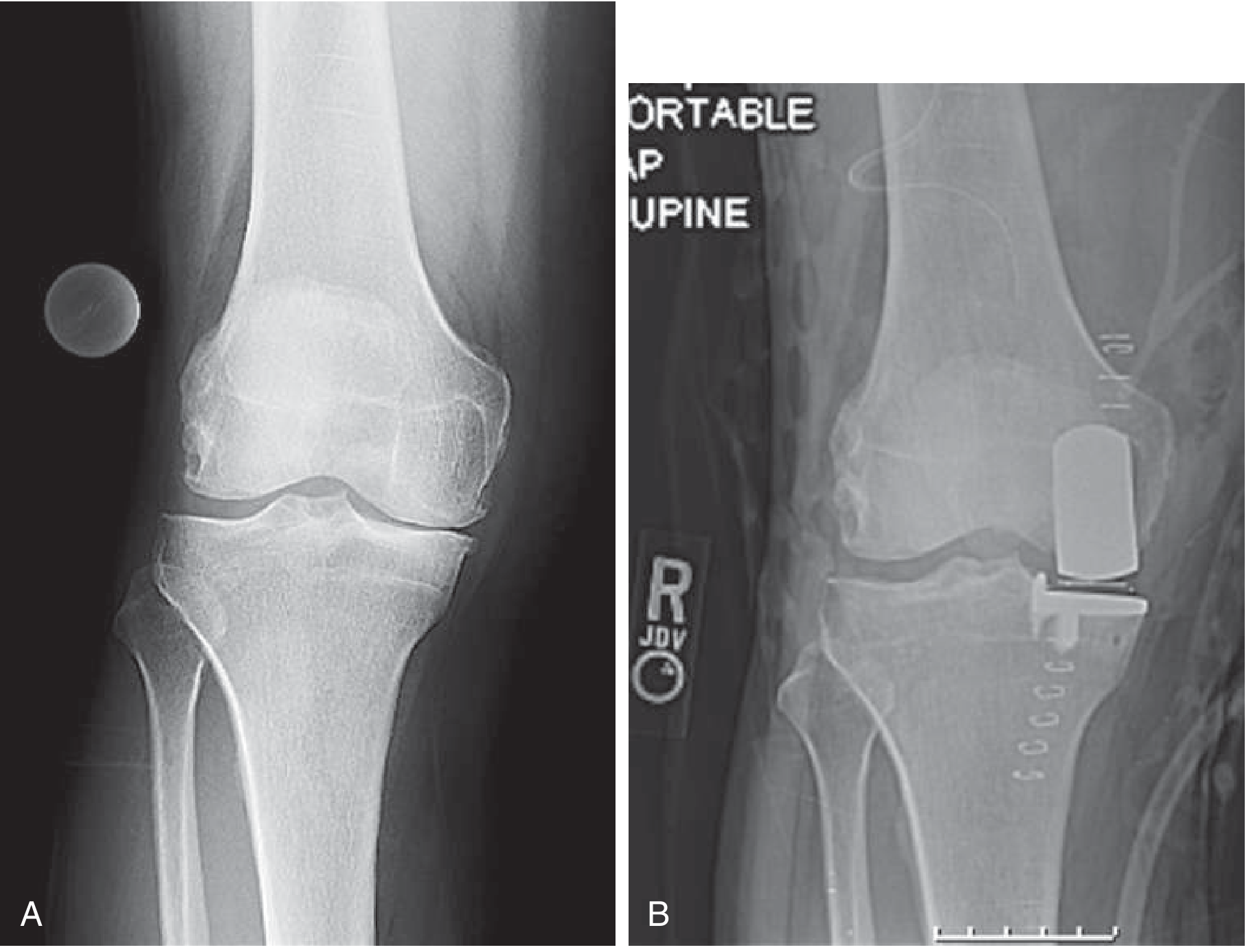
Limitations
The 10–15 year failure rate is higher for UKA than TKA because arthritis may develop in the preserved compartments over time, potentially requiring conversion to total knee replacement.
— Goldman-Cecil Medicine; Miller's Review of Orthopaedics, 9th Edition; Morgan & Mikhail's Clinical Anesthesiology
Summary: Which Option for Whom?
| Clinical Situation | Preferred Option |
|---|---|
| Acute peripheral tear, young patient | Meniscal repair |
| Degenerative tear, older patient, no mechanical symptoms | Conservative management |
| Non-repairable tear, any age | Partial meniscectomy |
| Post-meniscectomy pain, young patient (<50), single compartment | Meniscal allograft transplant |
| Single-compartment OA, preserved ligaments | Unicompartmental knee arthroplasty (partial TKR) |
| Multi-compartment OA, failed UKA or repair | Total knee replacement |
Both are same
Could you clarify what you mean by "both are same"? I want to make sure I understand correctly before responding.
Asking for Preferences
What are you referring to as 'both are same'?
These are actually not the same procedure — they are quite different in what is operated on, how invasive they are, and who they are for. Here's a clear breakdown:
Partial TKR vs. Meniscus Surgery — Key Differences
| Feature | Partial TKR (UKA) | Meniscus Surgery |
|---|---|---|
| What is treated | Bone/cartilage arthritic degeneration (osteoarthritis) | Torn or damaged meniscal fibrocartilage |
| What is removed/replaced | Arthritic bone and cartilage — replaced with a metal/plastic implant permanently | Torn meniscal tissue — either trimmed, repaired with sutures, or replaced with a donor graft |
| Reversibility | Permanent — bone is cut away and implant fixed | Repair/trim is permanent; transplant uses allograft tissue |
| Implant involved | Yes — a prosthetic device is implanted | No implant (except in allograft transplant, which uses donor meniscus tissue) |
| Target patient | Older patients with single-compartment arthritis | Younger to middle-aged patients with a meniscal tear |
| Invasiveness | Major joint surgery (arthroplasty) | Typically arthroscopic (minimally invasive) |
| Recovery | Weeks to months | Days to weeks (repair takes longer than trim) |
| Goal | Replace a worn-out joint surface | Restore or remove a torn shock-absorbing structure |
The Conceptual Confusion
The overlap that might make them seem similar:
- Both involve the knee joint
- Both can address pain and mechanical symptoms
- A severely torn or absent meniscus accelerates arthritis — meniscus surgery is often done to prevent the arthritis that eventually leads to needing a partial TKR
- In some patients with early single-compartment disease, a meniscal allograft transplant is done specifically to delay or avoid partial or total knee replacement
So in a sense, meniscus surgery is a precursor or alternative to partial TKR — not the same procedure. They address different stages and different structures of the same joint.
This is a shared conversation. Sign in to Orris to start your own chat.