
Histology of skin
Reading File
The skin (integument) is composed of the epidermis, dermis, and hypodermis. The epidermis is a stratified squamous epithelium with four main cell types and five distinct layers in thick skin. The dermis contains collagen, elastic fibers, and adnexal structures. Let me pull the full textbook content and images now.
Searching sources...
Finding Sources
Finding Sources
Finding Sources
Finding Sources
Excellent - I found a dedicated Histology textbook. Let me read it along with Bailey & Love's surgery section and Robbins for pathology context.
Reading File
Reading File
Finding Sources
Reading File
Reading File
Reading File
Reading File
Now let me fetch the key histology images to include in the answer.
Loading Image
Reading File
Loading Image
Loading Image
Reading File
I now have extensive content. Let me fetch one more key image - the full skin layers diagram and Langerhans/Merkel cell content.
Reading File
Finding Sources
Reading File
Reading File
Loading Image
Reading File
I now have comprehensive content from authoritative histology textbooks. Let me compile the full detailed answer.
Histology of Skin
The skin (cutis/integument) is the largest organ of the body, covering ~1.8 m² and constituting 15-20% of total body mass. It consists of three main layers: the epidermis, the dermis, and the hypodermis (subcutaneous layer).
Layers Overview
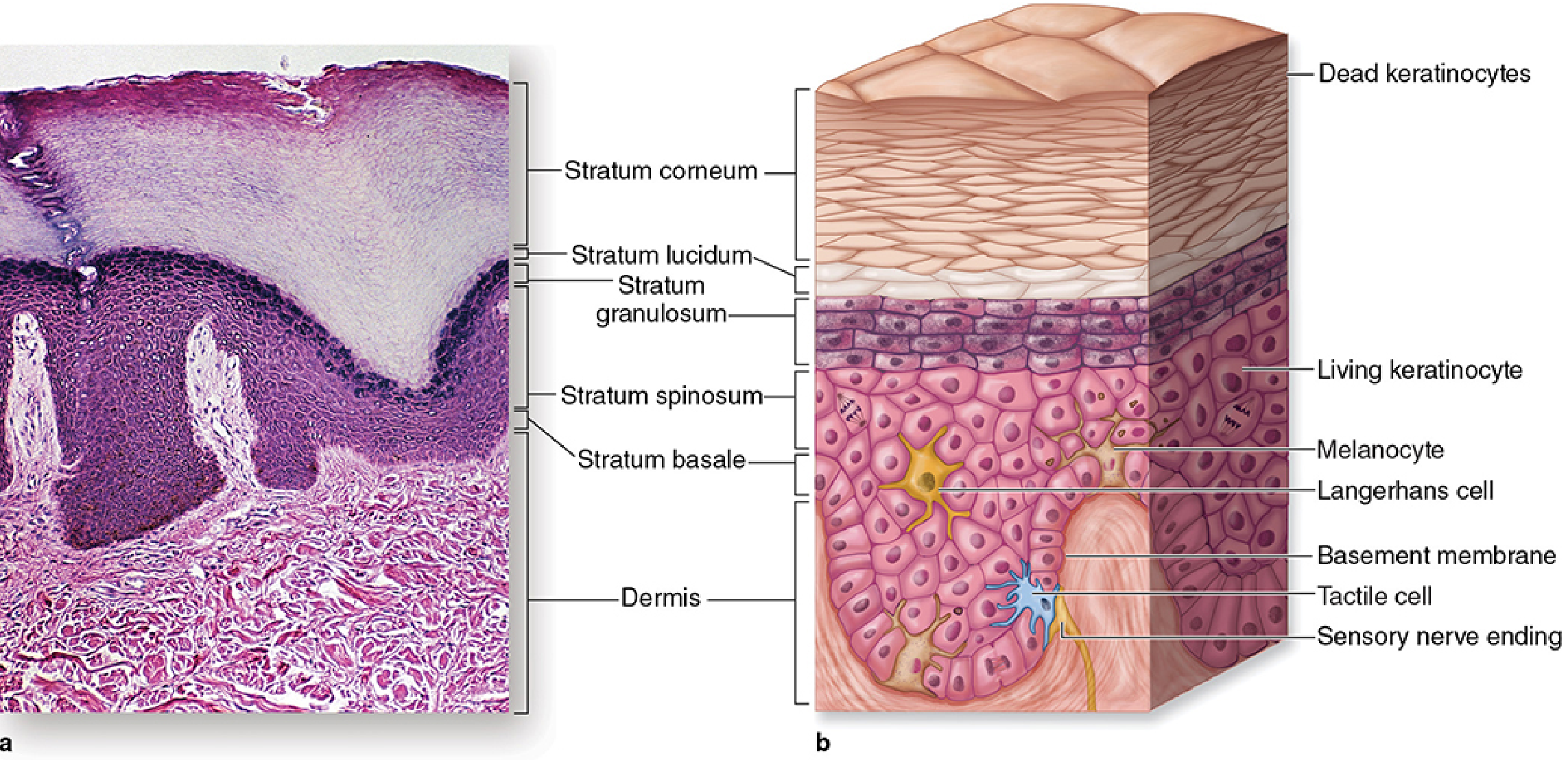
Thick skin showing all five epidermal strata and the underlying dermis (Junqueira's Basic Histology, 17e)
1. EPIDERMIS
The epidermis is a keratinized stratified squamous epithelium derived from ectoderm. It constitutes about 5% of skin thickness and has no blood vessels - cells receive nutrition by diffusion from the dermis.
Layers of the Epidermis (deep to superficial)
In thick skin (palms, soles), five layers are present. In thin skin (most body surfaces), the stratum lucidum is absent.
| Layer | Key Features |
|---|---|
| Stratum basale | Single layer; stem cells; active mitosis |
| Stratum spinosum | Several cells thick; prickle cells; tonofibrils |
| Stratum granulosum | Keratohyalin granules; lamellar bodies |
| Stratum lucidum | Thick skin only; translucent, anucleate |
| Stratum corneum | Fully keratinized; dead, flattened squames |
Stratum Basale (Stratum Germinativum)
A single layer of small, cuboidal to low-columnar cells resting on the basal lamina. These are the epidermal stem cells that give rise to all keratinocytes by mitotic division. Key features:
- Basophilic cytoplasm (closely spaced nuclei impart a deep blue stain)
- Connected to each other and overlying spinous cells by desmosomes
- Attached to the basal lamina by hemidesmosomes
- Contains scattered melanin granules transferred from neighboring melanocytes
- New keratinocytes generated here migrate upward, beginning their terminal differentiation journey
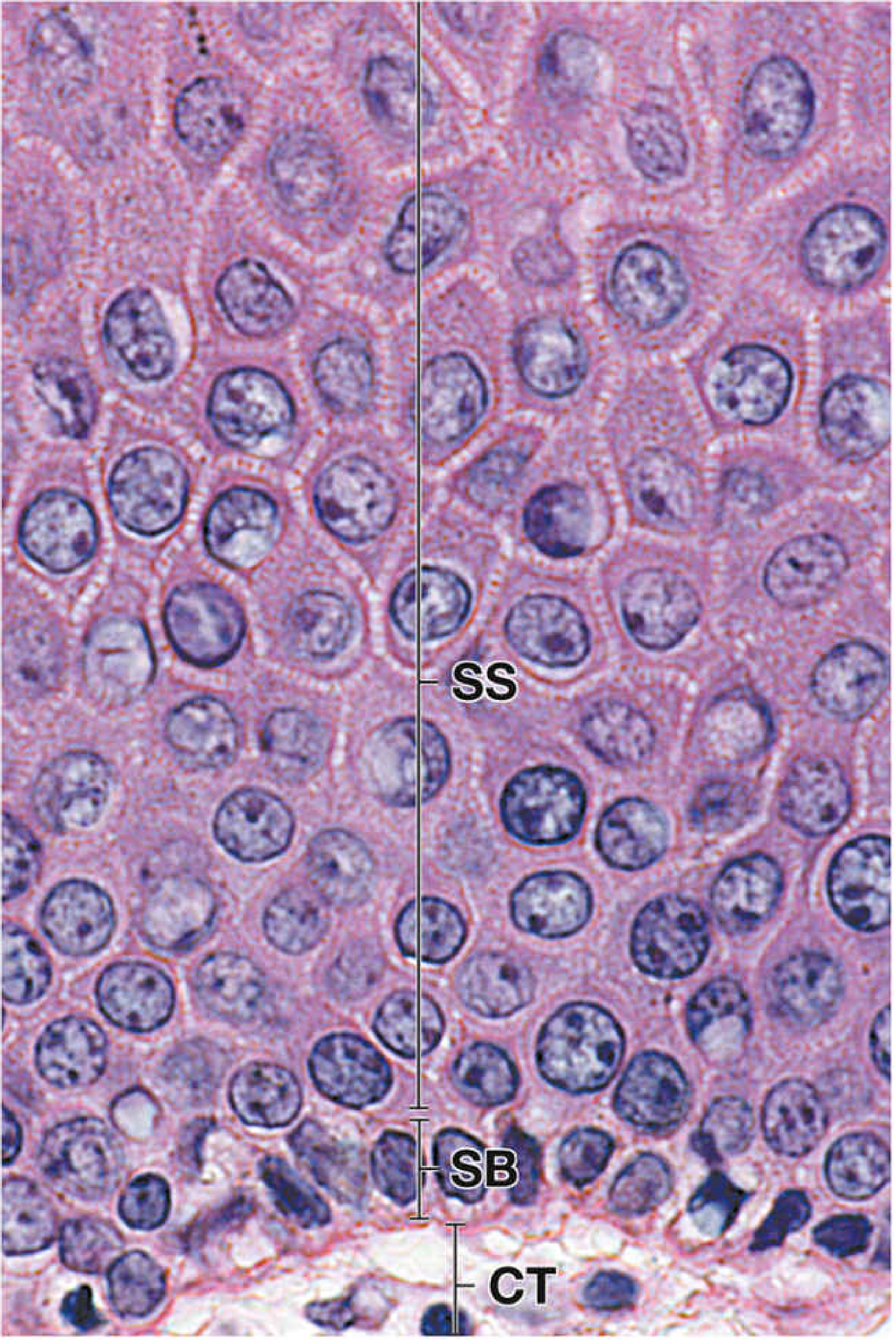
High-power H&E of the basal epidermis: SB = stratum basale, SS = stratum spinosum, CT = connective tissue (Histology: A Text and Atlas, 8e)
Stratum Spinosum (Prickle Cell Layer)
At least several cells thick. Keratinocytes here are larger than basal cells and characteristically show:
- Cytoplasmic spines (processes) linked to adjacent cells by desmosomes - visible as the "node of Bizzozero" (slight thickenings at desmosomal sites)
- Called "prickle cells" because cells shrink during histological processing, leaving expanded intercellular spaces between the spines
- Keratin intermediate filaments (tonofibrils) assemble here and converge at desmosomes
- Cells become progressively more flattened toward the surface
Stratum Granulosum
2-5 layers of flattened cells containing two distinctive features:
- Keratohyalin granules - basophilic, irregular granules containing loricrin and profilaggrin, which cross-link keratin filaments
- Lamellar bodies (membrane-coating granules / Odland bodies) - secreted at the interface with stratum corneum to form the epidermal water barrier (lipid-rich secretion). The turnover time through stratum spinosum + granulosum is ~31 days.
Cells in this layer show apoptotic nuclear morphology (DNA fragmentation) but do not undergo cellular fragmentation - instead they fill with keratin filaments.
Stratum Lucidum
Found only in thick skin. A pale, translucent band of 2-3 layers of anucleate, eosinophilic, densely packed cells. Considered a subdivision of the stratum corneum.
Stratum Corneum
The outermost layer of fully keratinized, dead, flattened squames (cornified cells):
- Cells (corneocytes) lack nuclei and organelles
- Packed with keratin filaments within a cornified envelope
- Cells are eventually shed (desquamation) from the surface
- Average thickness: 16-20 cell layers; turnover ~14 days in this layer
- The total epidermal turnover time is ~15-30 days
Non-Keratinocyte Cells of the Epidermis
Four cell types inhabit the epidermis:
1. Keratinocytes (~80%)
The structural cell; undergoes terminal differentiation (a form of specialized apoptosis) as it migrates from basale to corneum.
2. Melanocytes
- Dendritic cells of neural crest origin, located mainly in the stratum basale (1 per 4-40 basal keratinocytes - constant ratio across all skin types)
- Produce melanin in lysosome-related organelles called melanosomes (derived from Golgi)
- Synthesis pathway: L-tyrosine → L-DOPA → L-DOPAquinone → eumelanin (black-brown, when cysteine insufficient) or pheomelanin (yellow-red, when cysteine abundant), via the enzyme tyrosinase
- Mature melanosomes (Stage IV) travel to the tips of dendritic processes and are transferred to adjacent keratinocytes by a process called pigment donation - keratinocytes phagocytose the tips of melanocyte processes
- Melanosomes accumulate above and around keratinocyte nuclei, forming a "melanosome microparasol" that shields nuclear DNA from UV radiation
- Skin color differences arise from the number, size, and distribution of melanosomes - not the number of melanocytes
- Regulated by MSH (via MC1R receptor), ACTH, sex steroids, and UV exposure
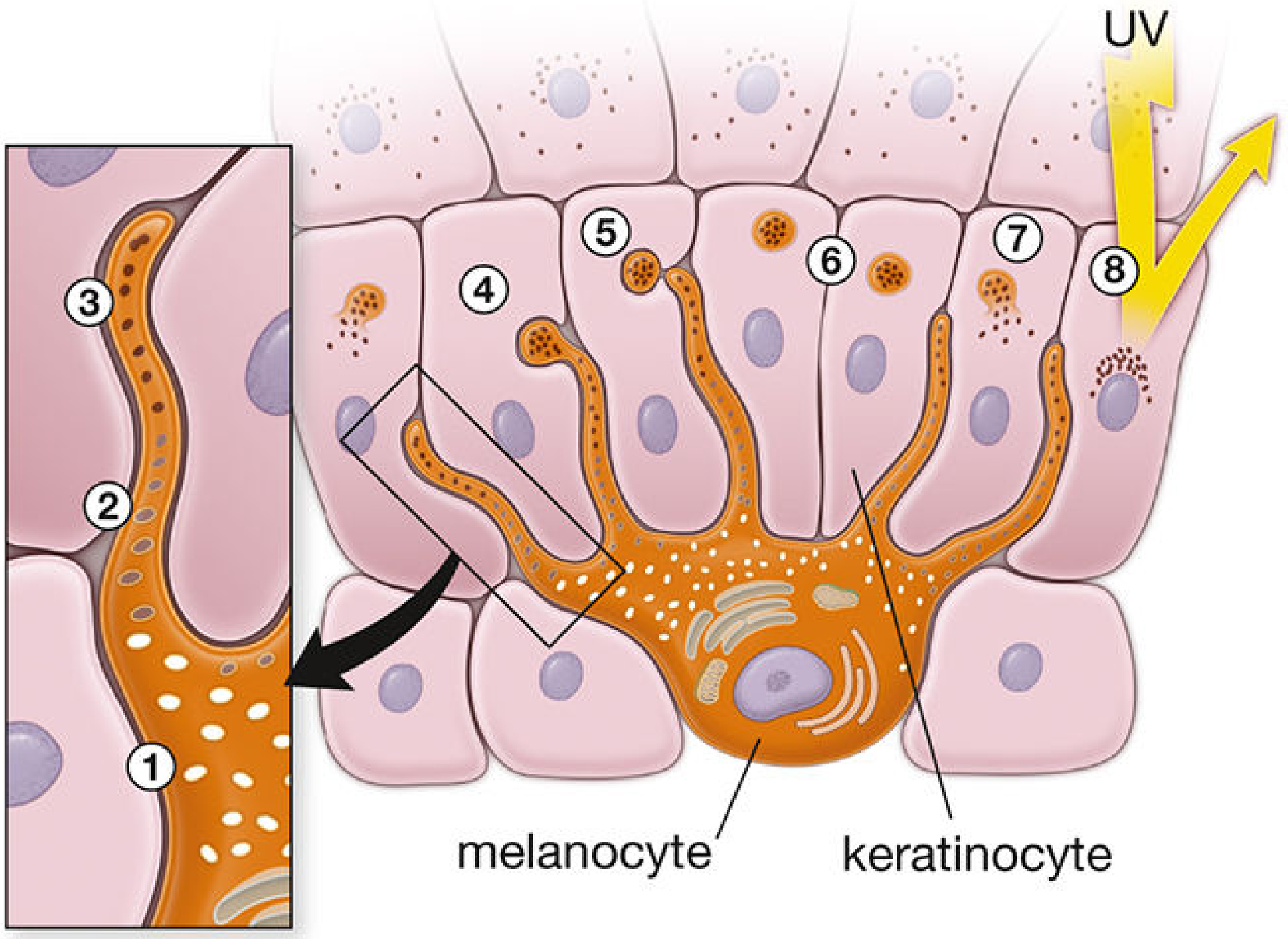
Melanin formation and pigment donation to keratinocytes (Histology: A Text and Atlas, 8e)
3. Langerhans Cells
- Dendritic antigen-presenting cells (resident macrophages) of the epidermis
- Derived from erythro-myeloid progenitor cells of the yolk sac - self-renewing, cannot be replenished by bone marrow monocytes
- Located primarily in the stratum spinosum
- In H&E sections appear as clear cells (like melanocytes, they do not pick up conventional stains well)
- Identified by CD1a, CD207 (langerin), and Birbeck granules (racket-shaped, visible only on electron microscopy - pathognomonic)
- Function: immunosurveillance - extend processes through tight junctions to sample the epidermal microenvironment; process antigens and migrate to lymph nodes as immunostimulatory cells
- Respond to pathogens and contact sensitizers (relevant in allergic contact dermatitis)
4. Merkel Cells
- Located in the stratum basale, especially in touch-sensitive areas (fingertips, lips)
- Modified epithelial cells acting as mechanoreceptors for light touch
- Contain dense-core granules with neuropeptides
- Associated with disc-shaped terminals of myelinated sensory (Type II) nerve fibers
- The Merkel corpuscle = Merkel cell + associated disc receptor
- Clinically relevant: Merkel cell carcinoma is an aggressive neuroendocrine skin tumor
2. DERMIS
The dermis constitutes 95% of skin thickness and is derived from mesoderm. It is composed of dense irregular connective tissue providing mechanical support, strength, and thickness.
Two Layers
Papillary Layer (superficial)
- Loose connective tissue immediately beneath the epidermis
- Thin collagen fibers: predominantly type I and type III collagen (ratio of type III:I increases with age)
- Thread-like elastic fibers forming an irregular network
- Contains dermal papillae and dermal ridges that interdigitate with the epidermis (increasing surface area of dermal-epidermal junction)
- Rich in blood vessels (capillary loops supplying but not entering the epidermis), lymphatics, and nerve processes
- Sensory nerve endings and receptors are concentrated here (Meissner corpuscles in dermal papillae)
Reticular Layer (deep)
- Always thicker and less cellular than the papillary layer
- Thick, irregular bundles of predominantly type I collagen and coarser elastic fibers
- Collagen = tensile strength; Elastic fibers = elasticity and resiliency
- Collagen/elastic bundles run in regular Langer's lines (cleavage lines) - surgical incisions parallel to these lines heal with minimal scarring
- Contains adnexal structures (hair follicles, sweat glands, sebaceous glands), smooth muscle (arrector pili), blood vessels, and nerves
Cells of the Dermis
- Fibroblasts - dominant structural cells; secrete collagen (types I, II, III, V, VII), proteoglycans, glycosaminoglycans, and multiadhesive glycoproteins; also have immune defense roles (express toll-like receptors)
- Dermal dendritic cells and resident macrophages (mononuclear phagocyte system)
- Mast cells - scattered throughout
- Lymphocytes - CD4+, CD8+, γ/δ T cells, regulatory T cells, NK cells, skin-resident memory T cells (Trm)
- Note: neutrophils are normally absent but infiltrate with injury or UV exposure
3. HYPODERMIS (Subcutaneous Layer)
- Equivalent to the subcutaneous fascia of gross anatomy
- Contains variable amounts of adipose tissue arranged in lobules separated by connective tissue septa
- Provides thermal insulation and energy reserve
- Contains the lower portions of hair follicles and sweat glands, larger blood vessels, and nerves
- The thin, largely vestigial panniculus carnosus (striated muscle) lies deep to the hypodermis; remnants persist as platysma and facial expression muscles in humans
4. SKIN APPENDAGES (Adnexal Structures)
All are downgrowths of the epidermis:
| Structure | Type | Key Features |
|---|---|---|
| Hair follicles | Invagination of epidermis | Arrector pili muscle attached; surrounds hair shaft |
| Eccrine sweat glands | Simple coiled tubular | Merocrine secretion; thermoregulation; present everywhere |
| Apocrine sweat glands | Modified sweat glands | In axilla, groin, areola; open into hair follicles; activated at puberty |
| Sebaceous glands | Holocrine | Open into hair follicles; secrete sebum; lubrication and antimicrobial |
| Nails | Plate of hard keratin | From nail matrix |
| Mammary glands | Modified apocrine | Produce milk |
Arrector pili muscles - smooth muscle bundles running from deep hair follicle to superficial dermis; contraction causes hair erection and "goose flesh" (cutis anserina)
5. SENSORY RECEPTORS OF THE SKIN
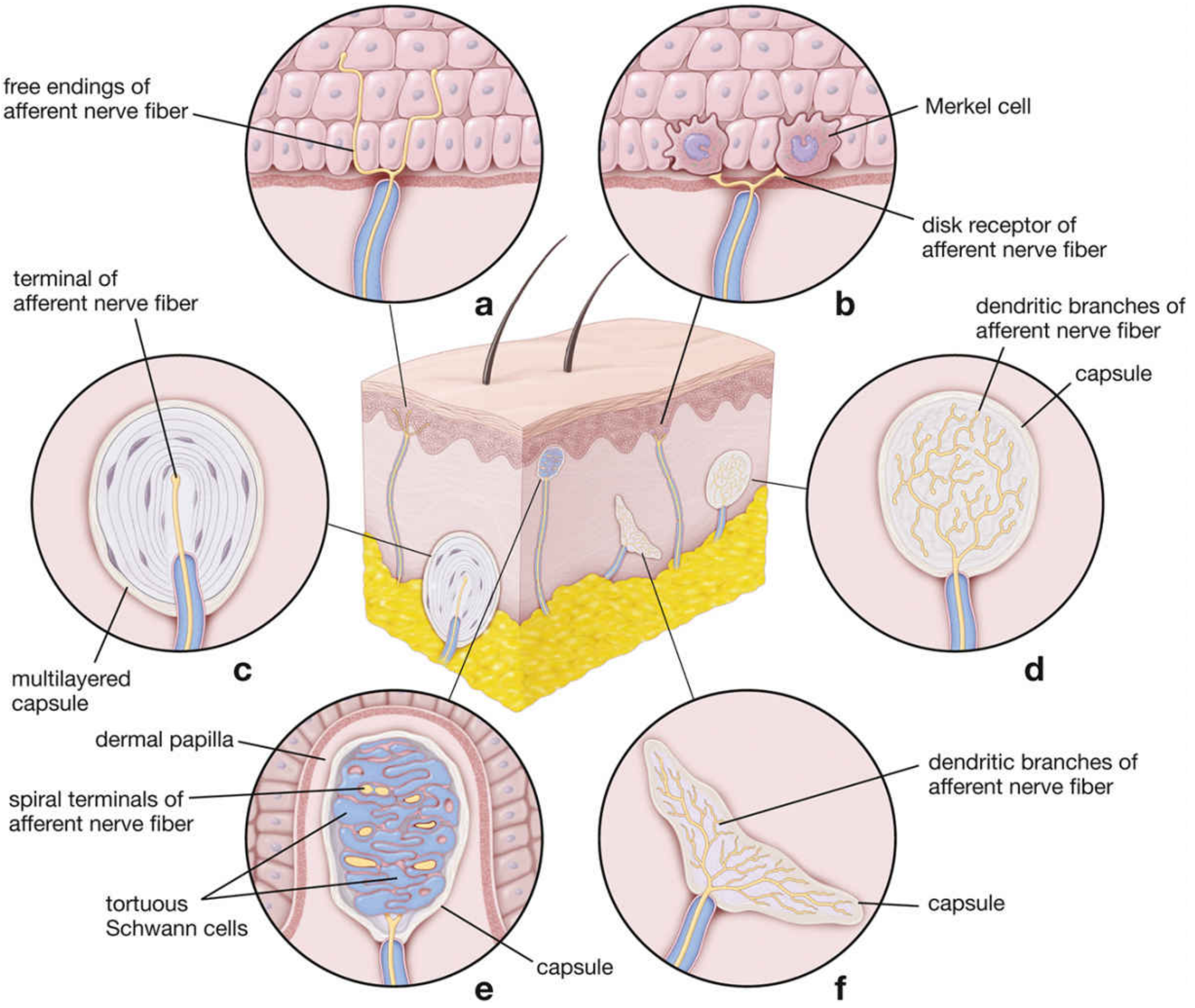
Types of cutaneous sensory receptors (Histology: A Text and Atlas, 8e)
| Receptor | Location | Modality |
|---|---|---|
| Free nerve endings | Epidermis (to stratum granulosum) | Pain, temperature, crude touch |
| Merkel corpuscles | Stratum basale | Light touch, sustained pressure |
| Meissner corpuscles | Dermal papillae | Fine/discriminative touch, vibration (low freq) |
| Pacinian corpuscles | Deep dermis/hypodermis | Deep pressure, high-frequency vibration |
| Ruffini corpuscles | Deep dermis | Skin stretch, joint position |
| Krause end bulbs | Dermis | Cold sensation |
6. THICK SKIN vs. THIN SKIN
| Feature | Thick Skin | Thin Skin |
|---|---|---|
| Location | Palms, soles | Most of body |
| Stratum lucidum | Present | Absent |
| Hair follicles | Absent | Present |
| Stratum corneum | Much thicker | Thinner |
| Eccrine sweat glands | Abundant | Present but fewer |
7. VASCULAR SUPPLY
The epidermis contains no blood vessels - all epidermal cells are nourished by diffusion from dermal capillaries. Blood anastomoses form five plexi: subfascial, fascial, subdermal, dermal, and subepidermal.
Clinical Correlations
- Vitiligo: selective loss of melanocytes → depigmentation
- Albinism: normal melanocyte count but defective melanin synthesis pathway
- Psoriasis: keratinocyte hyperproliferation → loss of granular layer, parakeratosis
- Langerhans cell histiocytosis: clonal proliferation of Langerhans cells; diagnosed by Birbeck granules on EM or CD1a/CD207 on immunohistochemistry
- Merkel cell carcinoma: aggressive neuroendocrine tumour of skin
- Langer's lines: incisions parallel to these heal with minimal scarring - important in surgery
- Friction blisters: space formed between epidermis and dermis of thick skin; calluses represent protective hyperkeratosis
Sources: Histology: A Text and Atlas with Correlated Cell and Molecular Biology (Pawlina & Ross), 8e; Junqueira's Basic Histology, Text and Atlas, 17e; Bailey & Love's Short Practice of Surgery, 28e
Cerebrospinal fluid renoria
Reading File
The term "renoria" doesn't correspond to a standard medical term - you likely mean rhinorrhea (CSF rhinorrhea), which is leakage of cerebrospinal fluid through the nose. Let me look this up properly.
Searching sources...
Finding Sources
Finding Sources
Searching the Web
CSF rhinorrhea cerebrospinal fluid nasal leak diagnosis treatment
I have a dedicated chapter in Cummings Otolaryngology. Let me read both sections fully.
Reading File
Reading File
Reading File
Reading File
Reading File
I now have all the essential content. Let me compile a comprehensive answer.
Note: "Renoria" appears to be a spelling variant or typo for rhinorrhea. This answer covers CSF rhinorrhea (cerebrospinal fluid leaking through the nose).
Cerebrospinal Fluid (CSF) Rhinorrhea
CSF rhinorrhea occurs when a skull base defect permits drainage of CSF from the intracranial subarachnoid space into the nose and paranasal sinuses. It requires a breach in the arachnoid/dura, skull base bone, and sinonasal mucosa - plus a pressure gradient to drive fluid flow.
CSF Physiology (Background)
- CSF is produced by the choroid plexus in the ventricles at a rate of ~20 mL/hour in adults
- Total CSF volume = 140 mL: 20 mL in ventricles, 50 mL in intracranial subarachnoid space, 70 mL in paraspinal subarachnoid space
- Normal CSF pressure: 4 cm H₂O (infants) to 14 cm H₂O (adults)
- Pressure fluctuates with respiration, arterial pulsation, and head position
- CSF resorption by arachnoid villi plays the major role in maintaining ICP - disruption leads to elevated ICP
Classification (Ommaya et al.)
I. TRAUMATIC
A. Accidental
- Immediate (within 48 hrs)
- Delayed (days to weeks after injury)
B. Surgical (Iatrogenic)
- Neurosurgical procedures - transsphenoidal hypophysectomy, frontal craniotomy, other skull base procedures
- Rhinologic procedures - endoscopic sinus surgery (ESS), septoplasty, combined skull base procedures
II. NONTRAUMATIC
A. Elevated Intracranial Pressure (ICP)
- Hydrocephalus
- Intracranial masses
- Empty sella syndrome (ESS) - pulsatile CSF pressure transmitted through arachnoid herniation into sella
B. Normal ICP
- Neoplasm (direct erosion of skull base)
- Infection (e.g., osteomyelitis)
- Granulomatous disease (granulomatosis with polyangiitis)
C. Idiopathic ("Spontaneous")
- Actually, most "idiopathic" cases have occult elevated ICP (mean 26-32 cm H₂O on lumbar puncture) - the CSF leak may serve as a pressure release valve
Epidemiology
- ~80% of CSF rhinorrhea results from accidental trauma (mostly closed head injury)
- CSF rhinorrhea occurs in only 2-3% of serious head trauma cases
- Skull base fracture is associated with a CSF fistula in 12-30% of cases
- More than 50% of traumatic CSF fistulas are at the anterior cranial base, mostly at the cribriform plate
- Only 4% of all CSF leaks are truly nontraumatic
- 16% result from intracranial/extracranial procedures
- Iatrogenic leaks are increasingly common: ~0.5% rate during endoscopic sinus surgery
- Most traumatic CSF leaks manifest within 2 days and almost all within 3 months of injury
Common Sites of Skull Base Defects
| Site | Common Cause |
|---|---|
| Cribriform plate | Head trauma, ESS |
| Ethmoid roof (fovea ethmoidalis) | Iatrogenic (sinus surgery) |
| Sphenoid sinus (lateral recess) | Idiopathic/elevated ICP |
| Frontal sinus | Anterior fossa fracture |
| Sella/parasellar | Transsphenoidal surgery |
The cribriform plate is the thinnest part of the skull base and is the most frequently involved site.
Clinical Features
Symptoms
- Watery, clear, unilateral nasal discharge - the hallmark; often described as salty tasting
- Volume increases with head-down position (Valsalva, straining, coughing, bending forward)
- Bilateral rhinorrhea suggests bilateral skull base defects
- Headache - positional, often relieved when lying flat (from intracranial hypotension when actively leaking)
- History of head trauma, prior skull base surgery, or trans-sphenoidal procedure is key
"Halo" or "Ring" Sign
- When CSF-containing nasal discharge drips onto a pillow or gauze, the CSF migrates further than blood/mucus, forming a pale outer ring around a darker central spot
- Not a specific test but raises suspicion
Diagnosis
The diagnostic process has two goals:
- Confirm the presence of CSF in the nasal secretion
- Localize the skull base defect
Step 1 - Confirm CSF
Beta-2 Transferrin (β-2 transferrin)
- Gold standard chemical marker
- A isoform of transferrin found almost exclusively in CSF (also in perilymph and aqueous humor - not in nasal secretions, serum, or saliva)
- Highly specific and sensitive
- Method: fluid is collected, sent for protein electrophoresis
- Limitations: requires ~0.5 mL of fluid; result may take days
Beta-trace Protein (β-TP / prostaglandin D2 synthase)
- Another highly specific CSF marker
- Faster turnaround than β-2 transferrin
- Both tests have significantly replaced older, less specific cisternography tests
Glucose Testing
- A nasal secretion glucose >30 mg/dL suggests CSF, but this is non-specific (glucose is also elevated in hyperglycemia, secretory rhinitis) - not reliable
Intrathecal Fluorescein
- Fluorescein dye injected intrathecally (into CSF)
- Used intraoperatively (and sometimes preoperatively) for precise localization of the leak
- Nasal endoscopy reveals a greenish hue at the defect site
- Confirms active leak and guides repair
- Not FDA-approved for intrathecal use but widely employed off-label
Step 2 - Localize the Defect
High-Resolution CT (HRCT) of the Skull Base
- First-line imaging after chemical confirmation
- 1 mm direct coronal images (or reformatted from 1 mm axial data)
- Identifies bony skull base dehiscences, fracture lines
- Provides excellent bony anatomical detail
- A bony defect on CT alone (without positive β-2 transferrin) is insufficient to diagnose active CSF leak
MRI of the Skull Base
- Complementary to CT
- Superior soft tissue detail
- Identifies meningoceles and meningoencephaloceles herniating through defects
- Detects empty sella (suggesting elevated ICP as etiology)
- MR with gadolinium or MR angiography helps identify vessels within encephaloceles (to avoid stroke during repair)
CT/MR Fusion
- Hybrid technique combining CT bony detail with MR soft tissue signal
- Emerging tool for complex defects
Cisternography (Radionuclide or CT)
- Now relegated to selected cases only due to high specificity of β-2 transferrin and β-TP
- CT cisternography: intrathecal iodinated contrast + CT; useful for large defects or when multiple potential sites are present
Management
Conservative (Non-Surgical)
Indicated first-line for most traumatic/accidental CSF leaks:
- Bed rest with head of bed elevation (30°)
- Avoidance of nose-blowing, Valsalva, straining
- Lumbar drainage (CSF diversion) - reduces ICP and flow through the defect
- Most traumatic leaks resolve spontaneously within 1 week with conservative measures
- Prolonged CSF leak > 7-10 days increases meningitis risk - earlier surgical intervention warranted
Surgical Management
Indicated for:
- All spontaneous/idiopathic leaks (will not resolve without repair)
- All iatrogenic leaks
- Traumatic leaks that fail conservative management (>7-10 days)
- Leaks with pneumocephalus
- Prevention of ascending meningitis
Endoscopic Repair (Primary Surgical Approach)
Since the 1980s, transnasal endoscopic repair has become the gold standard - it has supplanted open (intracranial) approaches for the vast majority of anterior skull base defects.
Steps:
- Standard endoscopic dissection for exposure of defect
- Intrathecal fluorescein administered to identify the defect
- Preparation of defect margins: mucosa within 5 mm of the defect removed (to allow graft adherence)
- Fulguration of any herniated meningocele/meningoencephalocele (never push it intracranially - risk of CSF gush and pneumocephalus)
- Graft placement
Grafting materials:
- Temporalis fascia, fascia lata
- Pedicled middle turbinate flaps
- Free cartilage/bone grafts (nasal septum, calvarium)
- Autogenous fat ("bath-plug" technique for small defects)
- Acellular dermal allograft
- Xenogeneic collagen dural substitutes (Durepair, Dura-Gen) for larger defects
- Meta-analysis (Hegazy et al., 289 fistulae): graft material choice does not significantly alter outcome
Graft placement technique:
- Underlay technique: graft placed on the intracranial side of the defect - ambient ICP holds it in place
- Bath-plug technique (Wormald): intracranial fat graft anchored by ICP
- Free grafts generally preferred over pedicled grafts (lower failure rate)
Success rate: Endoscopic repair achieves >90% success for most anterior skull base defects.
Intracranial (Open) Repair
- Reserved for complex, large, or posterior defects not accessible endoscopically
- Involves frontal craniotomy with direct dural repair
- Higher morbidity; anosmia risk (if cribriform plate dissected)
- Transglabellar subcranial approach allows direct access to anterior fossa floor with less frontal lobe retraction
Management of Elevated ICP
- All nontraumatic/idiopathic CSF rhinorrhea should be evaluated for occult raised ICP (even after successful repair)
- Lumbar puncture opening pressure measurement is essential post-repair
- If elevated ICP confirmed: treat with acetazolamide, weight loss (if obese), or CSF diversion (ventriculoperitoneal shunt, lumboperitoneal shunt)
- Failure to address elevated ICP leads to recurrence of the CSF leak after repair
Complications of Untreated CSF Rhinorrhea
| Complication | Notes |
|---|---|
| Bacterial meningitis | Most feared - risk increases with duration of leak; recurrent meningitis is the usual presentation of missed/delayed CSF rhinorrhea |
| Pneumocephalus | Air entering the subarachnoid space through the defect; tension pneumocephalus is life-threatening |
| Brain abscess | Rare |
| Encephalitis | Ascending infection |
The longer the CSF leak persists, the greater the risk of meningitis - early intervention is therefore preferred.
Antibiotic Prophylaxis
The routine use of prophylactic antibiotics for CSF rhinorrhea is controversial and not recommended by most guidelines. Evidence does not support reduced meningitis rates, and antibiotic use may select for resistant organisms.
Sources: Cummings Otolaryngology: Head and Neck Surgery, 7e (Chapter 48 - CSF Rhinorrhea and Anterior Skull Base)
Hiatus semilunaries
Reading File
The hiatus semilunaris is a crescent-shaped groove in the lateral nasal wall (middle meatus) into which the maxillary sinus, anterior ethmoid cells, and frontal sinus drain. It is a key landmark in sinonasal anatomy and ENT surgery. Let me pull the authoritative textbook content and images.
Searching sources...
Finding Sources
Finding Sources
Excellent - multiple authoritative ENT textbooks. Let me read them in parallel.
Reading File
Reading File
Reading File
Reading File
Reading File
Reading File
Now let me fetch the key anatomical images.
Loading Image
Loading Image
Reading File
I have comprehensive content and key images. Let me now compile the full answer.
Hiatus Semilunaris
Definition
The hiatus semilunaris (Latin: "semilunar gap/cleft") is a two-dimensional, crescent-shaped (sickle-shaped) slit located in the lateral wall of the middle meatus of the nasal cavity. It is the gap through which the middle meatus communicates with the ethmoidal infundibulum - and is therefore the critical drainage passage for the anterior group of paranasal sinuses.
Location
It lies in the middle meatus - the air space lateral to the middle turbinate - and is only visible after the middle turbinate is medialized or removed.
Boundaries
| Border | Structure |
|---|---|
| Anterior/inferior | Posterior free margin of the uncinate process |
| Posterior/superior | Anterior wall of the ethmoid bulla (bulla ethmoidalis) |
- Medially: opens into the middle meatus
- Laterally: opens into the ethmoidal infundibulum (a 3D funnel-shaped space)
The hiatus semilunaris is purely a 2D slit or window - it is a cleft, not a space itself. The 3D space behind/lateral to it is the ethmoidal infundibulum.
Relationship to the Ethmoidal Infundibulum
The infundibulum is the 3D funnel-shaped corridor that lies lateral to the hiatus semilunaris. Its boundaries are:
| Wall | Structure |
|---|---|
| Medial | Uncinate process |
| Lateral | Lamina papyracea (medial orbital wall) |
| Posterior | Anterior wall of ethmoid bulla |
| Anterior/superior | Frontal process of maxilla |
| Superior/lateral | Lacrimal bone |
The infundibulum opens inferiorly at the maxillary sinus ostium and receives drainage from the anterior ethmoid cells and - variably - from the frontal sinus. The hiatus semilunaris is the gateway from the nose into this infundibulum; surgically, a probe passed through the hiatus semilunaris enters the infundibulum.
Endoscopic and CT Anatomy
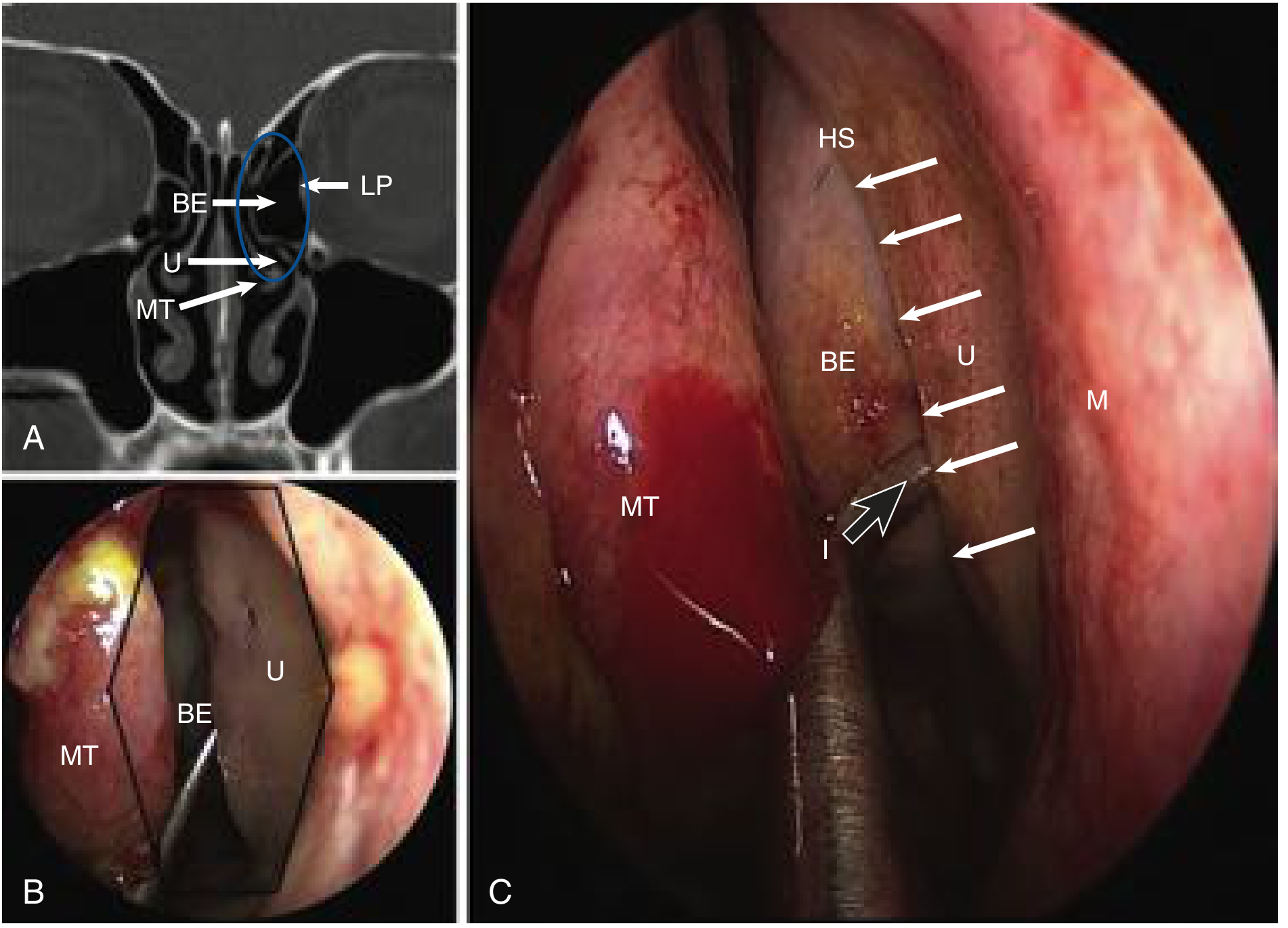
Ostiomeatal complex: (A) Coronal CT with ostiomeatal complex outlined in blue - BE = bulla ethmoidalis, U = uncinate process, LP = lamina papyracea, MT = middle turbinate. (C) Endoscopic view: HS = hiatus semilunaris (white arrows), a 2D cleft between U and BE; I = infundibulum (ball probe entering through hiatus). (Cummings Otolaryngology, 7e)
Structures that Drain through / near the Hiatus Semilunaris
| Sinus | Drainage Route |
|---|---|
| Maxillary sinus | Natural ostium → ethmoidal infundibulum → hiatus semilunaris → middle meatus |
| Anterior ethmoid cells | Via infundibulum → hiatus semilunaris → middle meatus |
| Frontal sinus | Frontal recess → above the hiatus semilunaris (superiorly, or into superior infundibulum, depending on uncinate attachment) |
The posterior ethmoid cells and sphenoid sinus drain separately into the sphenoethmoidal recess and superior meatus - they do NOT pass through the hiatus semilunaris.
The Osteomeatal Complex (OMC)
The hiatus semilunaris is a key component of the osteomeatal complex (OMC) - a functional (not anatomical) concept representing the final common drainage pathway for the anterior sinuses. The OMC comprises:
- Maxillary ostium - main drainage channel of maxillary sinus
- Ethmoidal infundibulum - 3D corridor draining maxillary and anterior ethmoid sinuses
- Hiatus semilunaris - the 2D slit connecting infundibulum to middle meatus
- Uncinate process - sickle-shaped bone forming the anterior border of the hiatus
- Bulla ethmoidalis - the largest anterior ethmoid air cell, forming the posterior border
- Anterior ethmoid cells
- Ostia of frontal, maxillary, and anterior ethmoid sinuses
The OMC is bounded laterally by the lamina papyracea and medially by the middle turbinate; superiorly by the fovea ethmoidalis; posteriorly by the basal lamella of the middle turbinate.
The Uncinate Process - Key Relationship
The uncinate process is a thin, sickle-shaped bone running anterosuperior to posteroinferior along the lateral nasal wall. It forms the medial wall of the infundibulum and the anterior border of the hiatus semilunaris.
Its superior attachment determines frontal sinus drainage:
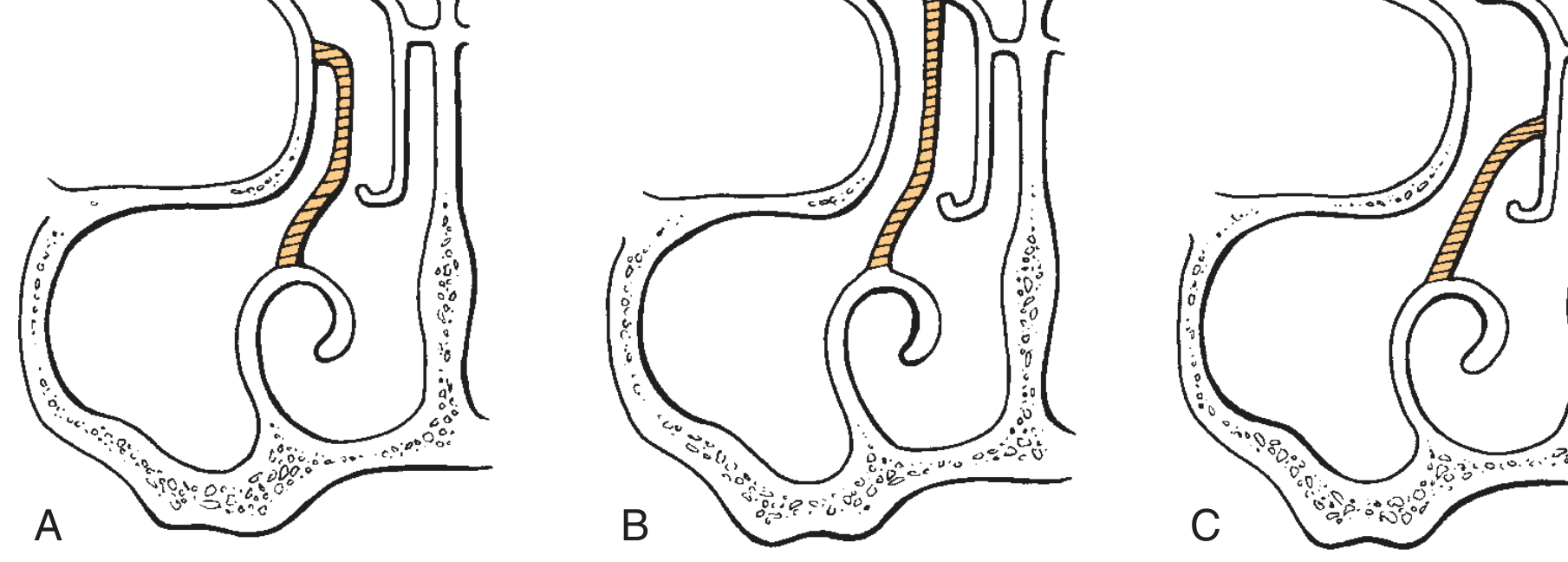
Superior attachment variants of the uncinate process (Cummings Otolaryngology, 7e)
| Uncinate Attachment | Frontal Sinus Drainage |
|---|---|
| Lamina papyracea (most common) | Frontal sinus drains medially, next to middle turbinate - NOT into infundibulum (forms a terminal recess) |
| Skull base or ethmoid roof | Frontal sinus drains into superior infundibulum |
| Middle turbinate | Frontal sinus drains into superior infundibulum |
This variation is surgically important: the surgeon must know where the frontal sinus drains before uncinectomy.
Embryological Origin
The hiatus semilunaris develops from the first furrow (between the first and second ethmoturbinals):
- The descending aspect of the first furrow forms the ethmoidal infundibulum, hiatus semilunaris, and middle meatus
- The maxillary sinus develops from the inferior aspect of the infundibulum
Clinical Significance
1. Chronic Rhinosinusitis (CRS)
Obstruction of the OMC - especially at the hiatus semilunaris and infundibulum - is considered the key initiating event in most cases of CRS. Mechanisms:
- Mucosal inflammation → edema of uncinate/bulla → narrowing of hiatus → obstructed drainage
- Retained secretions → reduced aeration → mucosal hypoxia → ciliary dysfunction → mucus stasis → secondary infection → perpetuating cycle
2. Functional Endoscopic Sinus Surgery (FESS)
The hiatus semilunaris is the primary target and entry point in FESS:
- Uncinectomy (removal of uncinate process) opens the hiatus and exposes the infundibulum
- This provides access to the maxillary sinus ostium, anterior ethmoid cells, and frontal recess
- Middle meatal antrostomy (widening of maxillary ostium) is performed after entering through the infundibulum
Order of FESS dissection (Messerklinger technique):
- Uncinectomy → opens hiatus semilunaris
- Anterior ethmoidectomy (bulla removal)
- Posterior ethmoidectomy
- Sphenoidotomy / frontal sinusotomy as required
3. Nasal Polyps
Polyps most commonly arise in the region of the middle meatus and hiatus semilunaris, arising from the inflamed mucosa of the infundibulum and ethmoid cells - because this area is the most vulnerable to inflammatory obstruction.
4. Accessory Maxillary Ostia (Nasal Fontanelles)
The lateral nasal wall has areas of bony dehiscence (fontanelles) near the maxillary sinus ostium region - accessory ostia occur in up to 30% of people (mostly in the posterior fontanelle, posterior to the uncinate). These can cause mucus recirculation if they communicate with the natural ostium.
5. Imaging
On coronal CT scans of the paranasal sinuses, the OMC is best evaluated:
- Look for infundibular width, uncinate position, and air-filled ethmoidal infundibulum
- Opacification of the infundibulum/hiatus region on CT is the hallmark of OMC obstruction
- OMC disease is a contraindication to non-surgical management in recurrent CRS
Summary Table
| Feature | Detail |
|---|---|
| Shape | Crescent/semilunar (2D slit) |
| Location | Lateral wall, middle meatus |
| Anterior border | Free edge of uncinate process |
| Posterior border | Anterior wall of ethmoid bulla |
| Lateral continuation | Ethmoidal infundibulum (3D) |
| Medial opening | Middle meatus |
| Sinuses draining through it | Maxillary, anterior ethmoid, (frontal - variably) |
| NOT draining through it | Posterior ethmoid, sphenoid |
| Part of | Osteomeatal complex (OMC) |
| Surgical relevance | Entry point for FESS (uncinectomy opens it) |
Sources: Cummings Otolaryngology: Head and Neck Surgery, 7e; KJ Lee's Essential Otolaryngology, 11e; Scott-Brown's Otorhinolaryngology Head & Neck Surgery, Vol 1 & 2; Color Atlas of Human Anatomy, Vol 2
External carotid artery and it's branches
Reading File
The external carotid artery (ECA) arises from the common carotid bifurcation at the level of C3/C4 and gives off 8 branches supplying the face, scalp, and neck. This is a visual anatomy topic - image retrieval will be important.
Searching sources...
Finding Sources
Finding Sources
Gray's Anatomy for Students has a dedicated section. Let me read it alongside Fischer's Surgery and the Color Atlas in parallel.
Reading File
Reading File
Reading File
Reading File
Reading File
Reading File
Loading Image
Loading Image
Excellent - I have two excellent anatomical illustrations and comprehensive textbook content. Now let me fetch one more image - the detailed branches illustration - and get the maxillary artery sub-branches.
Finding Sources
Loading Image
Reading File
I have all the content I need. Let me now compile the comprehensive answer.
External Carotid Artery and Its Branches
Overview
The external carotid artery (ECA) is one of the two terminal branches of the common carotid artery, arising at the level of the upper border of the thyroid cartilage (C3-C4 vertebral level) - the carotid bifurcation.
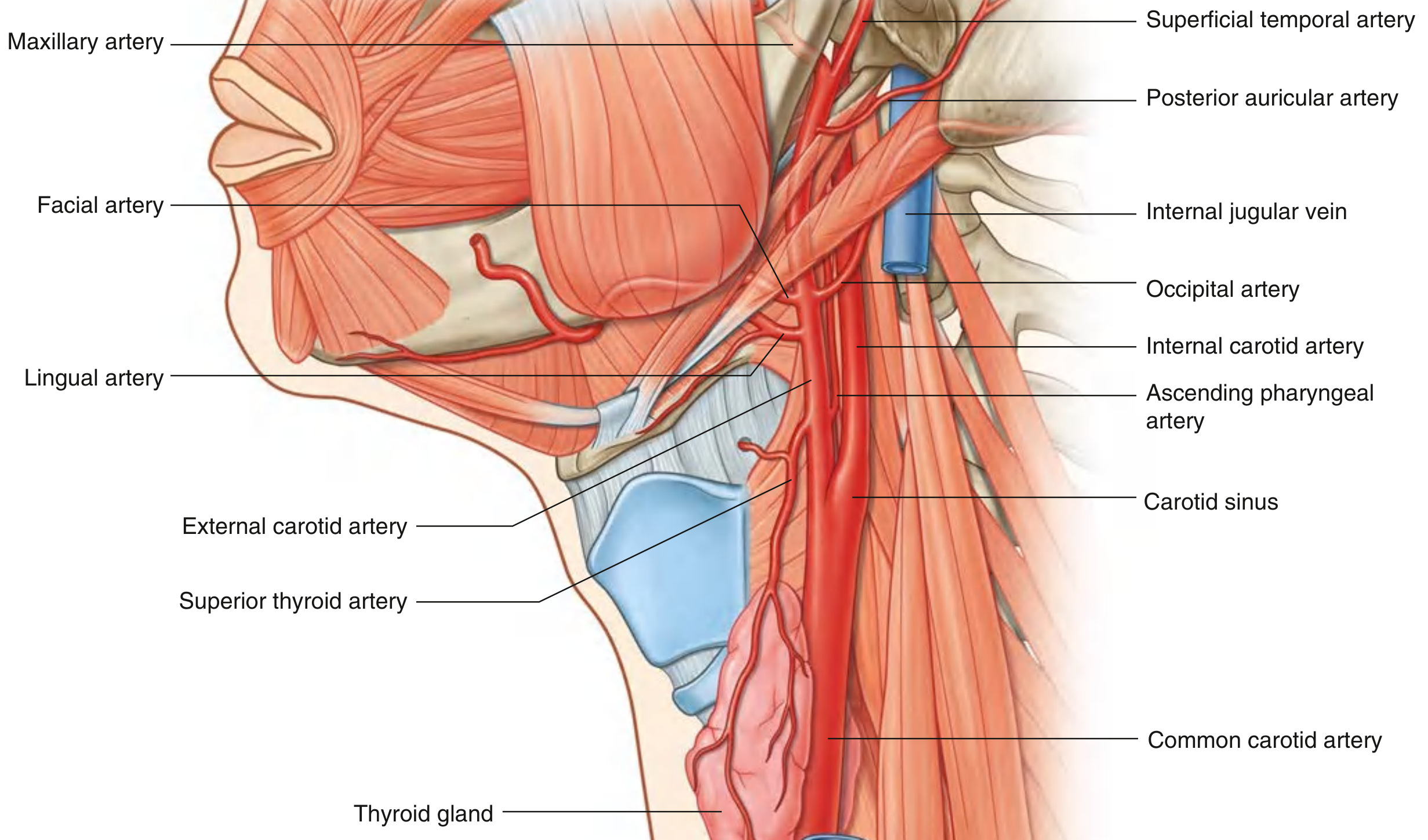
External carotid artery and its branches (Gray's Anatomy for Students)
Origin and Course
- Arises from the common carotid artery at the carotid bifurcation at the superior margin of the thyroid cartilage
- Initially lies anteromedial to the internal carotid artery; higher up it lies anterolateral to it
- Exits the carotid sheath and travels upward between the superior border of the thyroid cartilage and the neck of the mandible
- In the carotid triangle, it is crossed by the hypoglossal nerve (CN XII) and the facial and lingual veins
- Superior to the carotid triangle, it is crossed by the posterior belly of digastric and stylohyoid muscles
- Within the parotid gland, it is crossed by the facial nerve (CN VII)
- Divides into its two terminal branches (superficial temporal + maxillary arteries) at the neck of the mandible within the parotid gland
Key distinguishing feature from internal carotid: The internal carotid artery gives no branches in the neck. The external carotid gives 8 branches - this is the main distinguishing feature when identifying the two vessels surgically.
The Eight Branches - Grouped
The branches are classically grouped into three groups + two terminal branches:
| Group | Branches |
|---|---|
| Anterior (3) | Superior thyroid, Lingual, Facial |
| Posterior (2) | Occipital, Posterior auricular |
| Medial (1) | Ascending pharyngeal |
| Terminal (2) | Superficial temporal, Maxillary |
Mnemonic: "Some Anatomists Like Freaking Out Poor Medical Students" = Superior thyroid, Ascending pharyngeal, Lingual, Facial, Occipital, Posterior auricular, Maxillary, Superficial temporal
Detailed Branches
ANTERIOR BRANCHES
1. Superior Thyroid Artery
- First and most inferior branch of the ECA (occasionally arises from the common carotid - an important anatomical variant)
- Origin: at or just below the level of the superior margin of the thyroid cartilage, close to the bifurcation
- Course: runs anteroinferiorly, deep to the infrahyoid muscles, to the superior pole of the thyroid gland
- The external branch of the superior laryngeal nerve runs in close proximity - at risk during thyroid surgery
Branches:
- Infrahyoid artery - along the lower border of the hyoid
- Superior laryngeal artery - pierces the thyrohyoid membrane with the internal laryngeal nerve; supplies the interior of the larynx
- Sternocleidomastoid branch
- Cricothyroid artery - supplies cricothyroid muscle; anastomoses across the midline (clinically relevant in emergency cricothyrotomy)
- Glandular branches to the superior pole of the thyroid
Supply: Thyrohyoid muscle, larynx (internal structures), sternocleidomastoid and cricothyroid muscles, superior pole of thyroid gland
2. Lingual Artery
- Second anterior branch
- Origin: from the anterior surface of the ECA at the level of the tip of the greater horn of the hyoid bone, just above the superior thyroid artery
- Course: loops superoanteriorly on the middle constrictor, runs deep to the hypoglossal nerve (CN XII), stylohyoid, and posterior belly of digastric; then passes deep to the hyoglossus muscle to reach the sublingual region and tongue
- The Pirogoff's triangle (or lingual triangle) - bounded by the hyoglossus, posterior belly of digastric, and hypoglossal nerve - is the surgical landmark for locating the lingual artery in the neck
Branches:
- Suprahyoid artery - along upper border of hyoid
- Dorsal lingual branches - to dorsum of tongue and tonsil
- Sublingual artery - to sublingual gland and floor of mouth
- Deep lingual artery - terminal branch; runs to tip of tongue on its inferior surface
Supply: Tongue muscles, palatine tonsil, soft palate, epiglottis, floor of mouth, sublingual gland
3. Facial Artery
- Third anterior branch (arises just above the lingual artery - may share a common trunk with it: "linguofacial trunk")
- Origin: in the carotid triangle, just above the lingual artery
- Cervical course: passes deep to the stylohyoid and posterior belly of digastric, then deep between the submandibular gland and mandible, loops through a groove on the posterior surface of the submandibular gland
- Enters the face by hooking over the inferior border of the mandible just anterior to the masseter muscle (palpable pulse point)
- Facial course: ascends tortuously toward the medial angle (canthus) of the eye as the angular artery
Cervical branches:
- Ascending palatine artery
- Tonsillar artery (major blood supply to palatine tonsil)
- Glandular branches to submandibular gland
- Submental artery
Facial branches:
- Inferior labial artery
- Superior labial artery (gives off septal branches to nasal septum/Kiesselbach's area)
- Lateral nasal artery
- Angular artery (terminal branch) - anastomoses with the ophthalmic artery (a branch of the internal carotid) at the medial canthus
Supply: All structures in the face from the inferior border of mandible to the medial corner of the eye; soft palate, palatine tonsil, pharyngotympanic tube, submandibular gland
POSTERIOR BRANCHES
4. Occipital Artery
- Origin: from the posterior surface of the ECA, near the level of origin of the facial artery
- Course: passes superoposteriorly, deep to the posterior belly of digastric (a key surgical landmark - the occipital artery is a guide to the posterior belly); crosses the internal carotid artery, glossopharyngeal, vagus, and spinal accessory nerves, and deep cervical muscles
- Emerges on the posterior scalp by piercing the attachment of trapezius/sternocleidomastoid to the occipital bone
- Terminal branches: medial and lateral branches to the posterior scalp
Branches:
- Sternocleidomastoid branches (2)
- Auricular branch
- Mastoid branch - enters skull via mastoid foramen; supplies mastoid cells and meninges
- Descending branches - to deep muscles of the neck and back
- Meningeal branch - to posterior cranial fossa
- Terminal scalp branches
Supply: Sternocleidomastoid muscle, meninges of posterior cranial fossa, mastoid cells, deep muscles of the back, posterior scalp
5. Posterior Auricular Artery
- Small branch from the posterior surface of the ECA
- Origin: at the level of the superior border of the posterior belly of digastric; arises just above the digastric/stylohyoid
- Course: passes superiorly between the external acoustic meatus and mastoid process
Branches:
- Stylomastoid artery - enters the stylomastoid foramen; supplies the facial nerve canal, middle ear, mastoid air cells
- Auricular branch - to the posterior surface of the auricle (pinna)
- Occipital branch - to the scalp posterior to the ear
Supply: Parotid gland and nearby muscles, external ear and scalp posterior to the ear, middle and inner ear structures, facial nerve in its canal
MEDIAL BRANCH
6. Ascending Pharyngeal Artery
- The smallest and most medial branch; often the second branch given off (between the superior thyroid and lingual)
- Origin: from the posterior (medial) surface of the ECA, just above the superior thyroid artery
- Course: a long, narrow vessel that ascends along the lateral wall of the pharynx, medial to the internal carotid artery, to the base of the skull
Branches:
- Pharyngeal branches (3-4) - to pharyngeal constrictors, stylopharyngeus, soft palate
- Prevertebral branches - to prevertebral muscles
- Inferior tympanic artery - enters the tympanic canaliculus; supplies the middle ear (anastomoses with other tympanic branches)
- Posterior meningeal branches - pass through jugular foramen and hypoglossal canal to supply meninges of the posterior cranial fossa
Supply: Pharyngeal constrictors and stylopharyngeus, palate, palatine tonsil, pharyngotympanic tube, prevertebral muscles, meninges of posterior cranial fossa
TERMINAL BRANCHES
7. Superficial Temporal Artery
- One of the two terminal branches of the ECA; appears as a direct upward continuation
- Origin: behind the neck of the mandible within the parotid gland
- Course: emerges from the superior border of the parotid gland, passes anterior to the ear, crosses the zygomatic process of the temporal bone (palpable as a pulse just in front of the tragus)
- Divides above the zygomatic arch into anterior (frontal) and posterior (parietal) branches
- Gives off the transverse facial artery as it exits the parotid gland
Branches:
- Transverse facial artery - runs horizontally across the face between the parotid duct and zygomatic arch; supplies the parotid, masseter, and overlying facial skin
- Anterior auricular branches - to the auricle and external acoustic meatus
- Middle temporal artery - pierces the temporal fascia; supplies the temporalis muscle
- Zygomatico-orbital artery - to the orbicularis oculi
- Frontal (anterior) branch - to the forehead and scalp
- Parietal (posterior) branch - to the temporal and parietal scalp regions
Supply: Parotid gland and duct, masseter, lateral face, anterior part of external ear, temporalis muscle, parietal and temporal scalp
Clinical note: The superficial temporal artery is the site most often used for temporal artery biopsy in suspected giant cell (temporal) arteritis. It is also used for scalp flaps and free flap anastomosis in reconstructive surgery.
8. Maxillary Artery
- The larger of the two terminal branches of the ECA
- Origin: posterior to the neck of the mandible, within the parotid gland
- Course: passes horizontally and deep to the neck of the mandible (or sometimes superficial to the lateral pterygoid), through the infratemporal fossa, and continues through the pterygomaxillary fissure into the pterygopalatine fossa
- Divided into three parts by the lateral pterygoid muscle:
Part 1 - Mandibular (Retrocondylar) Part:
- Middle meningeal artery - enters skull via foramen spinosum; supplies dura (main supply) - torn in extradural haematoma
- Accessory meningeal artery - via foramen ovale
- Deep auricular artery - to external acoustic meatus and lateral surface of tympanic membrane
- Anterior tympanic artery - to medial surface of tympanic membrane
- Inferior alveolar artery - enters mandibular foramen; gives off mental branch (exits mental foramen); supplies mandibular teeth, chin skin
Part 2 - Pterygoid (Muscular) Part:
- Masseteric artery
- Pterygoid branches (medial and lateral)
- Deep temporal arteries (anterior and posterior) - to temporalis
- Buccal artery - to buccinator and buccal mucosa
Part 3 - Pterygopalatine (3rd) Part (in pterygopalatine fossa):
- Posterior superior alveolar artery - to upper molar teeth and maxillary sinus
- Infraorbital artery - enters orbit via inferior orbital fissure; exits via infraorbital foramen; supplies infraorbital skin, lower eyelid, upper lip, and upper incisor/canine teeth
- Greater palatine artery - descends via greater palatine foramen; supplies hard palate
- Lesser palatine arteries - via lesser palatine foramina; to soft palate and tonsil
- Pharyngeal artery - to roof of pharynx and sphenoidal sinus
- Sphenopalatine artery (the largest terminal branch) - enters nasal cavity via the sphenopalatine foramen; the main blood supply to the nasal cavity; supplies nasal lateral wall and septum; a major source of posterior epistaxis - can be catheterized from the femoral route for embolization
Supply: External acoustic meatus, tympanic membranes, TMJ, dura mater, trigeminal ganglion, mandibular teeth, chin, temporalis, infratemporal fossa, maxillary sinus, upper teeth, infraorbital skin, palate, roof of pharynx, nasal cavity
Relationships of the ECA - Surgical Importance
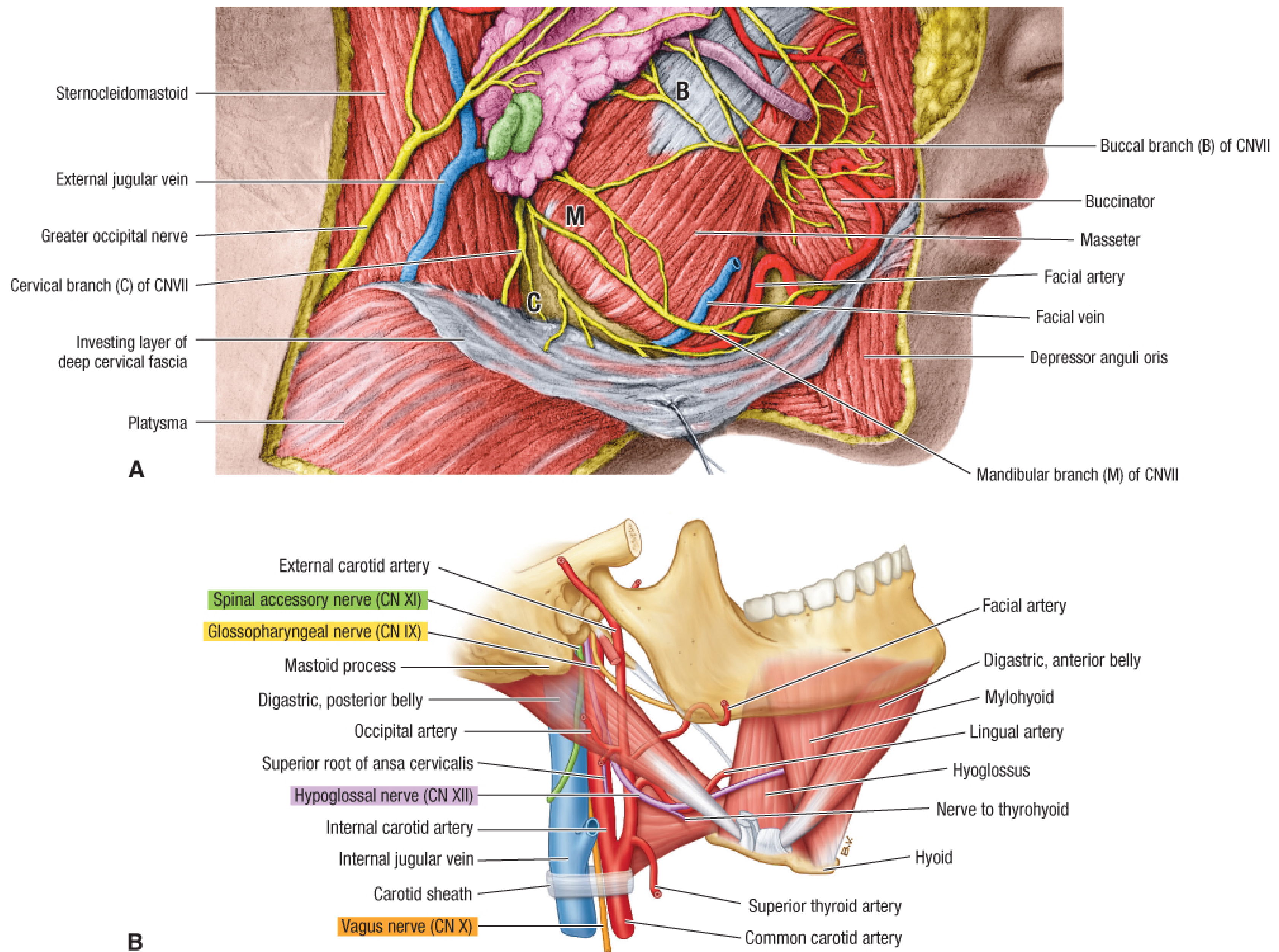
Relationships of the external carotid artery to cranial nerves and neck muscles (Fischer's Mastery of Surgery, 8e)
| Structure | Relation |
|---|---|
| Hypoglossal nerve (CN XII) | Crosses the ECA anteriorly in the carotid triangle |
| Styloglossus / stylopharyngeus | Separate ECA from internal carotid artery |
| Posterior belly of digastric + stylohyoid | Cross anterior to ECA; important landmarks |
| Facial nerve (CN VII) | Crosses ECA within parotid gland |
| Retromandibular vein | Formed within parotid by confluence of superficial temporal and maxillary veins |
Distinguishing ECA from Internal Carotid Artery
| Feature | External Carotid | Internal Carotid |
|---|---|---|
| Branches in neck | 8 branches | None |
| Initial position | Anteromedial | Posterolateral |
| Pulsation test | Temporal compression stops pulse | Does not stop with temporal compression |
| Carotid sinus | On proximal internal carotid | Not on ECA |
Anatomical Variants (Clinically Important)
- Superior thyroid artery may arise from the common carotid artery
- Lingual and facial arteries may arise from a common trunk (linguofacial trunk) - present in ~20%
- Posterior auricular artery may arise from the occipital artery
- Ascending pharyngeal artery may originate more superiorly than usual
- Middle meningeal artery occasionally arises from the ophthalmic artery (branch of internal carotid)
Summary Table
| # | Branch | Group | Key Supply |
|---|---|---|---|
| 1 | Superior thyroid | Anterior | Thyroid gland, larynx |
| 2 | Ascending pharyngeal | Medial | Pharynx, meninges, middle ear |
| 3 | Lingual | Anterior | Tongue, floor of mouth, sublingual gland |
| 4 | Facial | Anterior | Face, tonsil, submandibular gland, lips |
| 5 | Occipital | Posterior | Posterior scalp, sternocleidomastoid, meninges |
| 6 | Posterior auricular | Posterior | Ear, scalp behind ear, facial nerve canal |
| 7 | Superficial temporal | Terminal | Scalp (temporal/parietal), parotid, lateral face |
| 8 | Maxillary | Terminal | Dura, mandible/teeth, maxilla/teeth, nasal cavity, palate, infratemporal fossa |
Sources: Gray's Anatomy for Students, 4e; Fischer's Mastery of Surgery, 8e; KJ Lee's Essential Otolaryngology, 11e; Scott-Brown's Otorhinolaryngology Head & Neck Surgery, Vol 3
Cavernous sinus
Reading File
The cavernous sinus is a paired dural venous sinus on either side of the sella turcica, containing the internal carotid artery and multiple cranial nerves - a critically important anatomical region. This is a visual anatomy topic requiring images.
Searching sources...
Finding Sources
Finding Sources
Excellent - I have dedicated cavernous sinus sections in neurology and anatomy textbooks. Let me read them in parallel.
Reading File
Reading File
Reading File
Reading File
Reading File
Loading Image
Loading Image
Finding Sources
Excellent - I have the two key diagrams (base of skull view and coronal cross-section) plus comprehensive content. Let me read the Harrison's content for CST and get the Gray's anatomy content.
Reading File
Finding Sources
Reading File
Loading Image
I now have three excellent diagrams and comprehensive content from neurology and anatomy textbooks. Let me compile the complete answer.
Cavernous Sinus
Definition
The cavernous sinus is a paired dural venous sinus - one on each side of the sella turcica at the base of the skull. It is not a simple channel but a complex, trabeculated venous plexus enclosed between two layers of dura mater. Its importance lies in the extraordinary number of vital neurovascular structures that either pass through or are embedded in its walls.
Location and Extent
- Lies in the middle cranial fossa, on either side of the body and greater wing of the sphenoid bone
- Extends from the apex of the orbit anteriorly to the apex of the petrous temporal bone posteriorly
- Medial wall is grooved into the body of the sphenoid (housing the sella and pituitary gland)
- Inferior wall grooves the base of the greater wing of the sphenoid
- The medial, upper, and lateral walls are formed by a fold of the inner layer of dura mater, which is medially continuous with the diaphragma sellae
- Posterolaterally, the wall is medial to the anterior part of Meckel's cave (which contains the trigeminal ganglion)
Contents
This is the most clinically important feature of the cavernous sinus. The contents differ between the lateral wall (where most cranial nerves run) and the interior (where the ICA and CN VI run).
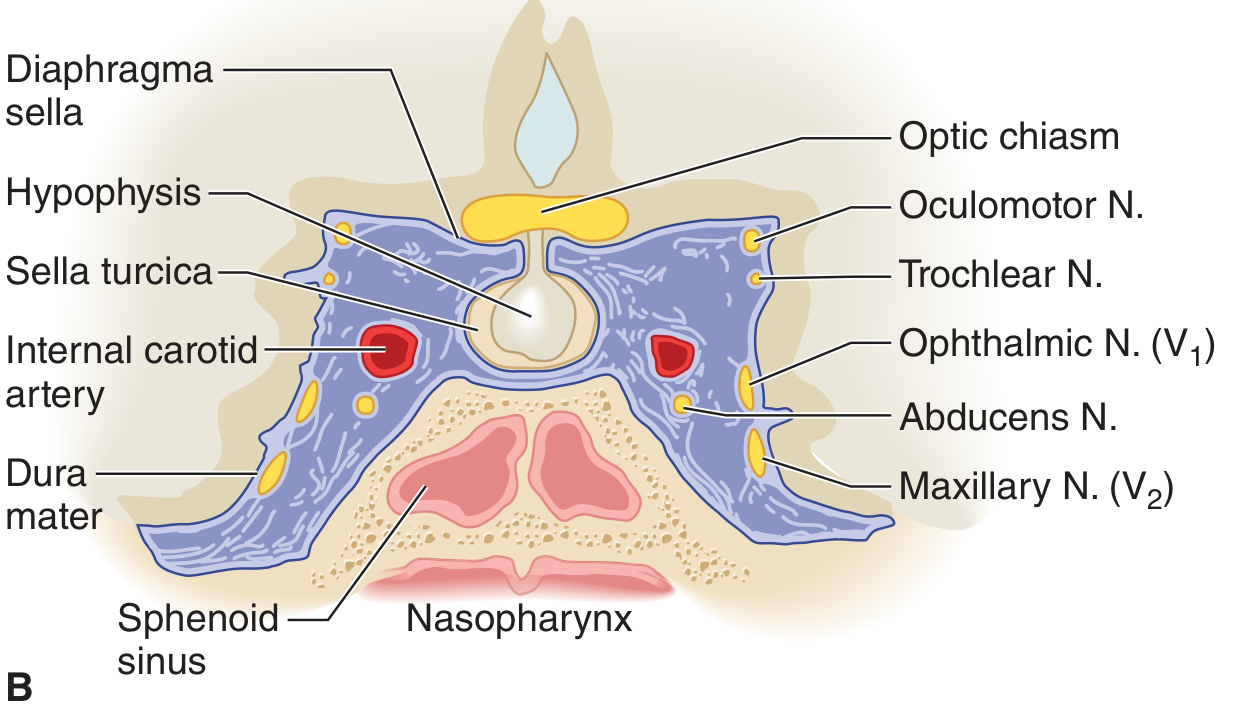
Coronal section through the cavernous sinus showing all contents and relations (Adams & Victor's Principles of Neurology, 12e)
Within the Lateral Wall (from superior to inferior):
- Oculomotor nerve (CN III) - most superior, in the upper lateral wall
- Trochlear nerve (CN IV) - below CN III in the lateral wall
- Ophthalmic nerve (V₁) - below CN IV
- Maxillary nerve (V₂) - lowest in the lateral wall
Within the Sinus Itself (free in the venous blood):
- Internal carotid artery (ICA) - runs an S-shaped course (the "carotid siphon") through the sinus
- Abducens nerve (CN VI) - runs within the sinus (not in the lateral wall), directly lateral to the ICA - therefore most susceptible to raised ICP and most commonly affected in cavernous sinus pathology
Key memory aid: "O TOM CAT" - Oculomotor, Trochlear, Ophthalmic, Maxillary in the wall; Carotid Artery (and abducens nerve) Traversing the interior. Or: the structures in the lateral wall (III, IV, V1, V2) are embedded in dura and relatively protected; the ICA and CN VI are free in the venous blood and maximally exposed.
Also within or passing through:
- Sympathetic plexus around the ICA (postganglionic sympathetic fibers from the superior cervical ganglion)
- Branches of the meningohypophyseal trunk (first branch of the cavernous ICA)
Walls and Bony Relations
| Wall | Structure |
|---|---|
| Medial | Body of sphenoid bone (grooved); adjacent to pituitary gland/sella turcica |
| Inferior | Greater wing of sphenoid |
| Lateral | Dural fold (contains CN III, IV, V1, V2) |
| Roof | Dural fold; adjacent to optic chiasm and CN II above |
| Anterior | Superior orbital fissure |
| Posterior | Petroclival junction; connects to superior and inferior petrosal sinuses |
Arterial Relations
The internal carotid artery enters the cavernous sinus by emerging from the petrous apex through the superior aspect of the foramen lacerum, then projects upward, forward, and medially to the anterior clinoid process. Just posterior to the optic canals, it perforates the dura to enter the subarachnoid space of the middle cranial fossa and immediately divides into its terminal branches.
Within the cavernous sinus, the ICA gives off:
- Meningohypophyseal trunk - supplies meninges, posterior pituitary, and tentorium
- Inferolateral trunk - supplies cranial nerves within the sinus
Venous Connections (Tributaries and Drainage)
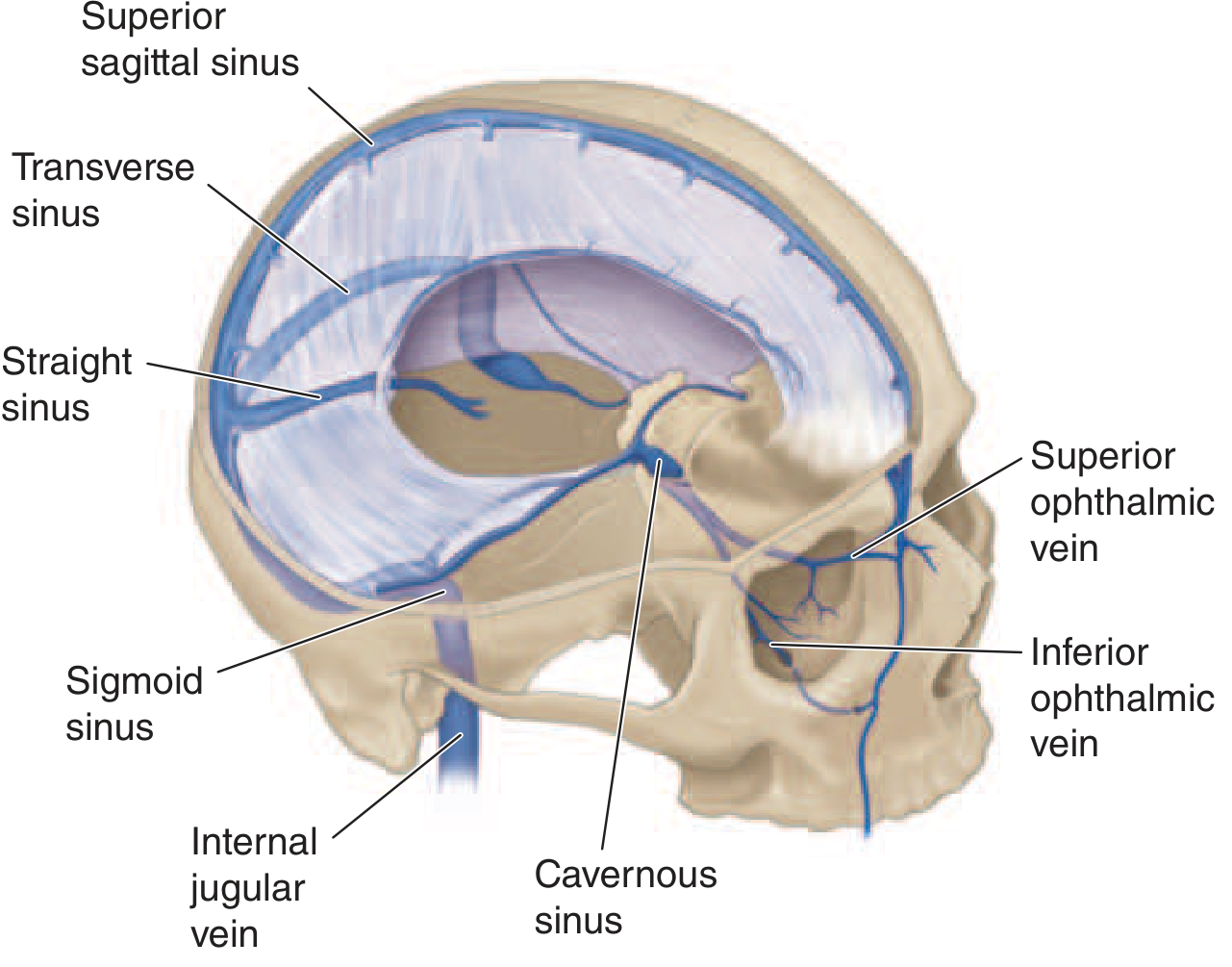
Anatomy of the cerebral venous sinuses showing the cavernous sinus and its connections (Harrison's Principles of Internal Medicine, 22e)
Tributaries (Inflow):
| Source | Vein |
|---|---|
| Orbit | Superior and inferior ophthalmic veins (main route for spread of facial/orbital infection) |
| Middle cerebral vein (superficial) | Sphenoparietal sinus |
| Cerebral hemispheres | Cerebral veins |
| Sphenoid sinus | Small emissary veins |
| Ethmoid sinus | Small emissary veins |
| Pterygoid plexus | Via foramen ovale / foramen of Vesalius |
| Contralateral cavernous sinus | Intercavernous sinuses (anterior and posterior, encircling the sella = circular sinus) |
Drainage (Outflow):
| Route | Destination |
|---|---|
| Superior petrosal sinus | → Transverse sinus (at junction with sigmoid sinus) |
| Inferior petrosal sinus | → Internal jugular vein (via jugular foramen) |
| Emissary veins via foramen ovale | → Pterygoid plexus |
The two cavernous sinuses communicate freely with each other via the anterior intercavernous sinus (in front of the pituitary stalk) and the posterior intercavernous sinus (behind it), forming the circular sinus (of Ridley) that encircles the pituitary gland.
Important: Cerebral veins and venous sinuses have no valves - blood can flow in either direction. This bidirectional flow allows facial/sinus infections to spread retrogradely into the cavernous sinus.
Routes of Infection to the Cavernous Sinus
The cavernous sinus receives blood from the facial veins via the superior and inferior ophthalmic veins. This creates three main routes for septic thrombosis:
- Facial/orbital route: Facial/periorbital infection → angular vein → superior ophthalmic vein → cavernous sinus (the "danger area of the face" - central face, upper lip, nose)
- Sinonasal route: Sphenoid or ethmoid sinusitis → small emissary veins → cavernous sinus (most common cause of septic CST)
- Pterygoid plexus route: Dental infection / infratemporal fossa → pterygoid plexus → via foramen ovale to cavernous sinus
Cavernous Sinus Syndrome
Definition: A constellation of signs and symptoms resulting from damage to the structures within or immediately adjacent to the cavernous sinus.
Clinical Features
| Sign/Symptom | Mechanism |
|---|---|
| Ophthalmoplegia (CN III, IV, VI palsy) | Involvement of CN III, IV, VI → all extraocular movements affected |
| Ptosis | CN III palsy (levator palpebrae) |
| Proptosis / exophthalmos | Impaired venous drainage from orbit |
| Chemosis (conjunctival oedema) | Impaired venous/lymphatic drainage from orbit |
| Facial pain/hyperesthesia | V1 (ophthalmic) and V2 (maxillary) involvement |
| Decreased corneal reflex | V1 involvement |
| Horner's syndrome | Sympathetic plexus around the ICA affected → ptosis, miosis, anhidrosis |
| Pupillary changes | CN III (mydriasis) or sympathetic (miosis) depending on which is involved |
| Dilated tortuous retinal veins / papilledema | Impaired orbital venous drainage |
Key distinguishing feature: CN VI (abducens) palsy is often the earliest and most common finding because the abducens nerve runs free within the sinus (not in the protected lateral wall), making it the most vulnerable nerve.
CN V3 (mandibular) is not involved in cavernous sinus syndrome because V3 exits the skull via foramen ovale and does not pass through the cavernous sinus.
Causes of Cavernous Sinus Syndrome
Septic / Infectious
- Cavernous sinus thrombosis (CST) - bacterial: sphenoid/ethmoid sinusitis, dental abscess, facial cellulitis; fungal: mucormycosis (angioinvasive, particularly in diabetics/immunocompromised)
- Herpes zoster
Vascular
- Carotid-cavernous fistula (CCF) - direct (traumatic, high-flow) or indirect (dural, spontaneous)
- Internal carotid artery aneurysm
- ICA dissection, dolichoectasia
- Superior ophthalmic vein thrombosis
Neoplastic
- Pituitary adenoma (with lateral extension)
- Meningioma
- Nasopharyngeal carcinoma (direct extension)
- Lymphoma, plasmacytoma
- Skull base metastases
- Sphenoid sinus tumours
Inflammatory
- Tolosa-Hunt syndrome - painful idiopathic granulomatous inflammation; responds to corticosteroids; diagnosis of exclusion
- Granulomatosis with polyangiitis (Wegener's)
- Sarcoidosis
Other
- Pituitary apoplexy (sudden haemorrhage into pituitary tumour → bilateral CN palsies + visual loss)
Cavernous Sinus Thrombosis (CST)
Septic CST
- Most common sources: sphenoid and ethmoid sinusitis
- Also: orbital cellulitis, facial/dental infections
- Organisms: Staphylococcus aureus (most common), Streptococci, Gram-negatives, anaerobes; mucormycosis in immunocompromised
Clinical features:
- Fever (often high, spiking), severe headache
- Frontal and retroorbital pain
- Diplopia (early - CN VI palsy commonest)
- Ptosis, proptosis, chemosis
- Extraocular dysmotility (CN III, IV, VI)
- Hyperesthesia of V1 and V2; decreased corneal reflex
- Dilated, tortuous retinal veins; papilledema
- If bilateral → bilateral proptosis/ophthalmoplegia (pathognomonic for CST)
- May progress to meningitis, brain abscess, septicaemia
Aseptic (Non-infectious) CST
- Hypercoagulable states (antiphospholipid antibodies, malignancy, pregnancy, OCP)
- Dehydration
- Inflammatory conditions
Diagnosis
- MRI brain with gadolinium + MR venography (MRV) - absent flow void in the cavernous sinus; enhancement of sinus walls
- CT venography - filling defect; also shows paranasal sinus disease
- Cerebral angiography (venous phase) - definitive but invasive
Treatment
- IV antibiotics (6 weeks minimum) - directed at causative organism; empirically: broad-spectrum including MRSA cover
- Drainage of source of infection (e.g., sphenoidectomy for sphenoid sinusitis)
- Anticoagulation - heparin (controversial in septic CST but recommended for progressive neurological deterioration or aseptic CST)
- For mucormycosis: amphotericin B + surgical debridement
- Corticosteroids for Tolosa-Hunt syndrome
Carotid-Cavernous Fistula (CCF)
An abnormal communication between the ICA (or its branches) and the cavernous sinus:
| Type | Cause | Features |
|---|---|---|
| Direct (Type A) | Trauma (most common), rupture of intracavernous ICA aneurysm | High-flow; pulsatile proptosis, bruit, severe chemosis |
| Indirect (dural) | Spontaneous (post-menopausal women); arteriovenous shunting from dural branches | Low-flow; gradual onset; "red eye" the main feature |
Classic triad of direct CCF: pulsatile proptosis + chemosis + orbital bruit
Treatment: endovascular embolisation (coil or balloon occlusion via transarterial or transvenous approach).
Summary of Contents (Memory Aid)
LATERAL WALL (superior → inferior): | WITHIN SINUS:
──────────────────────────────────── | ──────────────
CN III (Oculomotor) | Internal Carotid Artery (ICA)
CN IV (Trochlear) | CN VI (Abducens) - lateral to ICA
CN V1 (Ophthalmic) | Sympathetic plexus (on ICA)
CN V2 (Maxillary) |
CN V3 (Mandibular) does NOT pass through the cavernous sinus - it exits through foramen ovale directly.
Sources: Adams & Victor's Principles of Neurology, 12e; Harrison's Principles of Internal Medicine, 22e; Bradley & Daroff's Neurology in Clinical Practice, 8e; Scott-Brown's Otorhinolaryngology Head & Neck Surgery, Vol 2; Localization in Clinical Neurology, 8e
Middle meningeal artery
Reading File
The middle meningeal artery is the largest branch of the maxillary artery, enters the skull through foramen spinosum, and is the key artery involved in extradural (epidural) haematoma when ruptured. This is a critical surgical anatomy topic with visual importance.
Searching sources...
Finding Sources
Finding Sources
Reading File
Reading File
Finding Sources
Loading Image
Loading Image
Reading File
Finding Sources
Finding Sources
Reading File
Reading File
Loading Image
Loading Image
I now have all four key images and comprehensive textbook content. Let me compile the complete answer.
Middle Meningeal Artery
Definition
The middle meningeal artery (MMA) is the largest of all the meningeal arteries, supplying the greatest part of the dura mater. It is the first branch of the mandibular part (Part 1) of the maxillary artery, given off in the infratemporal fossa. Its surgical importance is paramount - it is the artery most commonly torn in extradural (epidural) haematoma.
Origin
- Branch of the maxillary artery (first part / mandibular part), given off in the infratemporal fossa
- The maxillary artery is itself a terminal branch of the external carotid artery
- MMA is thus ultimately a branch of: External carotid → Maxillary → Middle meningeal artery
Variant: The MMA occasionally arises from the ophthalmic artery (a branch of the internal carotid artery) rather than the maxillary artery.
Course
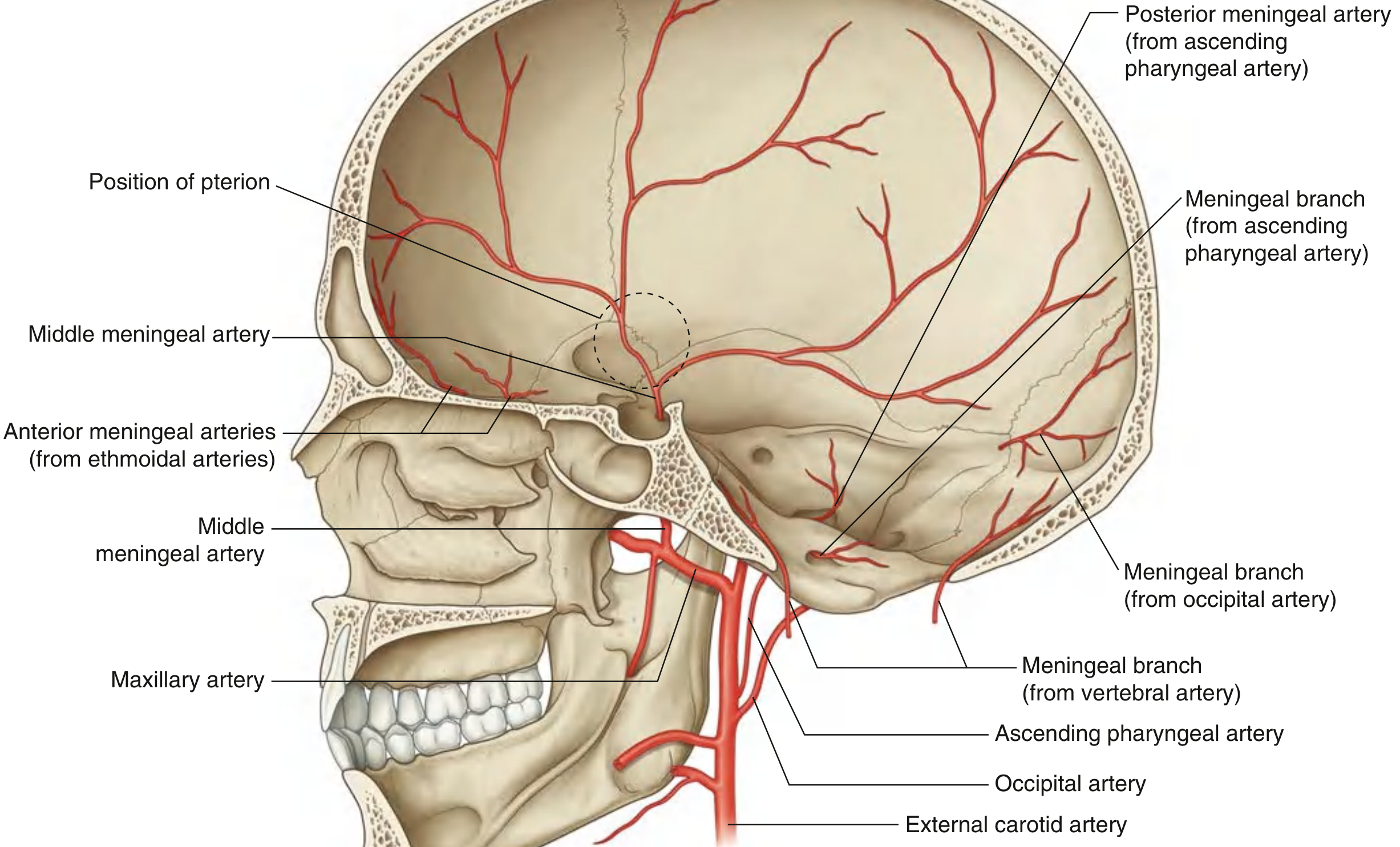
Dural arterial supply showing the MMA and all meningeal arteries (Gray's Anatomy for Students, 4e)
Step-by-step course:
- Infratemporal fossa: Arises from the first part of the maxillary artery, in the infratemporal fossa deep to the lateral pterygoid muscle
- Foramen spinosum: Enters the middle cranial fossa through the foramen spinosum (in the greater wing of the sphenoid) - the only artery to enter through this foramen
- Extradural space: Runs in the outer (periosteal/endosteal) layer of the dura mater, tightly adherent to the inner surface of the skull in the middle cranial fossa
- Division: Divides into anterior (frontal) and posterior (parietal) branches at a variable point
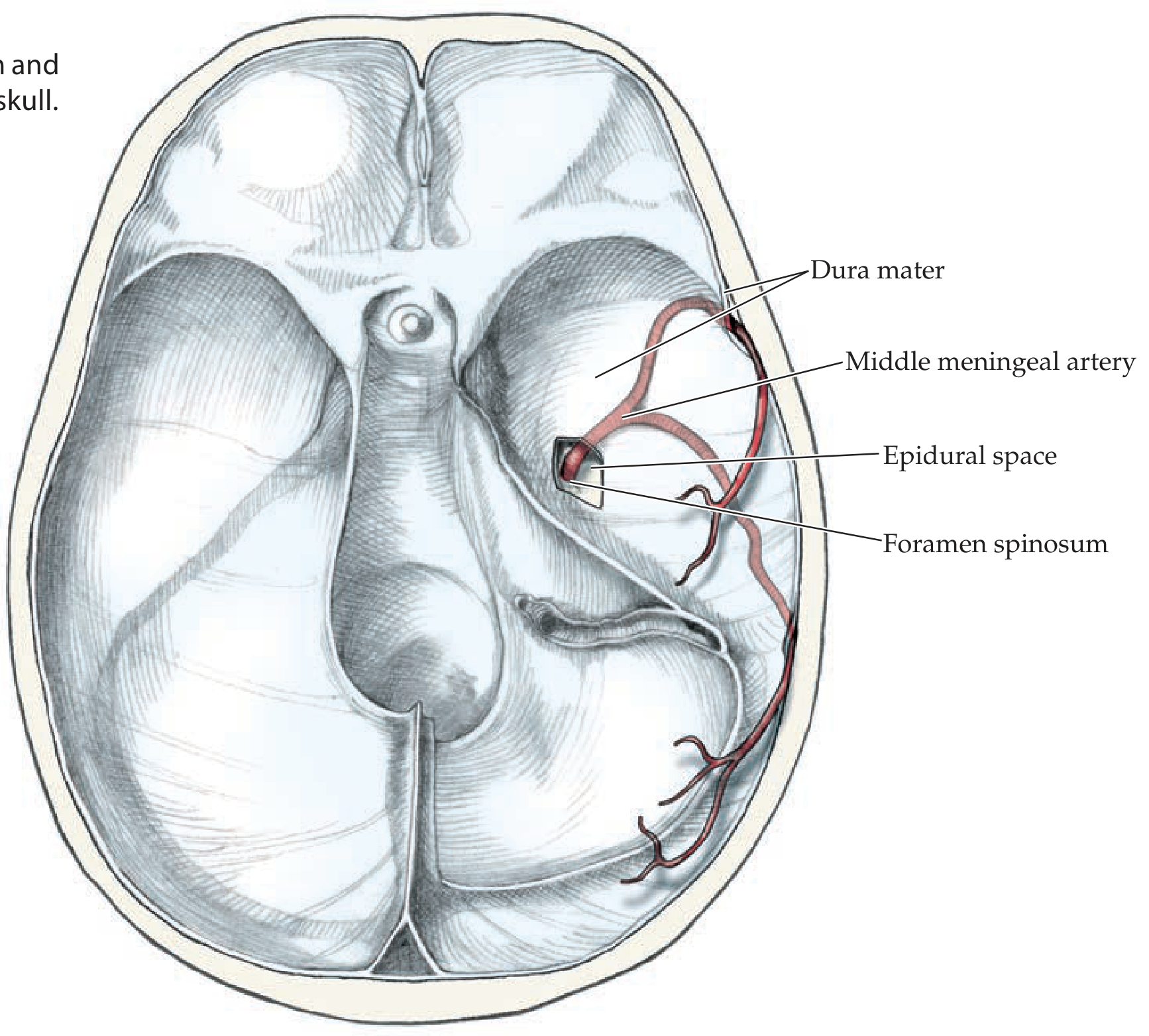
The MMA emerging from the foramen spinosum and running in the epidural space (Neuroanatomy through Clinical Cases, 3e)
Branches
1. Anterior (Frontal) Branch
- The larger and more important branch clinically
- Passes almost vertically upward toward the vertex of the skull
- Crosses the pterion during its course - the thinnest part of the skull (H-shaped junction of the frontal, parietal, temporal, and greater wing of sphenoid)
- Lies in a groove on the inner surface of the temporal/parietal bone - often runs in a bony canal in adults (especially after age 40), making it more vulnerable to tearing with skull fracture
- Supplies the dura of the anterior and lateral parts of the middle cranial fossa and the inferolateral convexity
2. Posterior (Parietal) Branch
- Passes posterosuperiorly toward the parietal and occipital regions
- Supplies the dura of the posterior part of the middle cranial fossa
Other branches from the MMA within the skull:
- Superior tympanic artery - to the tensor tympani muscle and mucosa of the tympanic cavity
- Orbital branch - passes through the superior orbital fissure (or a small canal) to supply the dura of the anterior cranial fossa and anastomose with the lacrimal artery
- Petrosal branch - travels with the greater petrosal nerve through the hiatus of the facial nerve canal; supplies the tegmen tympani and geniculate ganglion
- Temporal branches - to the overlying temporalis muscle (after piercing the dura)
Surface Marking / Position of the Anterior Branch
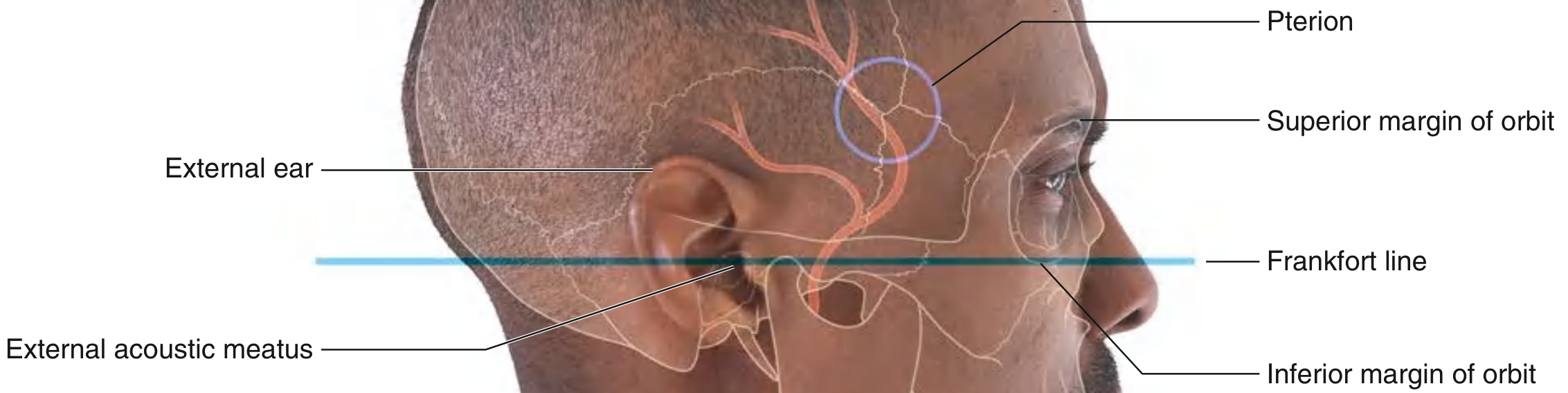
Surface marking of the middle meningeal artery showing the pterion region (Gray's Anatomy for Students, 4e)
The anterior branch of the MMA is located approximately:
- Midway between the superior margin of the orbit and the upper part of the external ear
- At the pterion - a small circular area in the temporal fossa where the sphenoid, frontal, parietal, and temporal bones of the skull come together
- This corresponds roughly to 2.5 cm above the midpoint of the zygomatic arch and 4 cm posterior to the frontozygomatic suture
The pterion is the weakest point of the skull - the four bones that meet here produce a thin, H-shaped suture region where the inner table can be fractured with relatively modest force.
The Pterion - Key Concept
| Feature | Detail |
|---|---|
| Location | Temple region, lateral skull |
| Bones meeting | Frontal + Parietal + Temporal (squamous) + Greater wing of sphenoid |
| Clinical importance | Thinnest part of skull; overlies MMA anterior branch |
| Surface marking | ~2.5 cm above the midpoint of the zygomatic arch |
| Significance | Fracture here → tears MMA → extradural haematoma |
Supply
The MMA supplies the greatest part of the dura mater in the middle cranial fossa and the convexity of the brain over the frontal, temporal, and parietal lobes. Importantly:
- It supplies the dura mater, periosteum of the inner skull, and the bone itself (diploic supply)
- It does not primarily supply the brain parenchyma - the brain is supplied by the internal carotid and vertebral arterial systems
Comparison of Meningeal Arteries
| Artery | Cranial Fossa | Origin | Entry Foramen |
|---|---|---|---|
| Anterior meningeal | Anterior | Ethmoidal arteries (ophthalmic) | Cribriform plate / anterior ethmoidal foramen |
| Middle meningeal | Middle (mainly) | Maxillary artery (1st part) | Foramen spinosum |
| Accessory meningeal | Middle (medial) | Maxillary artery | Foramen ovale |
| Posterior meningeal | Posterior | Ascending pharyngeal artery | Jugular foramen |
| Meningeal branch | Posterior | Occipital artery | Jugular foramen / mastoid foramen |
| Meningeal branch | Posterior | Vertebral artery | Foramen magnum |
Clinical Significance: Extradural (Epidural) Haematoma
Mechanism
- A lateral blow to the temporal/pterion region fractures the thin inner table of the squamous temporal bone
- This tears the anterior branch of the MMA (most commonly) running in the outer dural layer
- Blood escapes under pulsatile arterial pressure and gradually strips the dura away from the bone, forming an expanding extradural haematoma
- The process is progressive because: (a) the source is arterial and high-pressure; (b) the dura initially resists stripping, requiring time and pressure to accumulate
Classic Clinical Presentation ("Talk and Die")
- Initial loss of consciousness - from the primary brain injury (concussion)
- Lucid interval - patient recovers and appears neurologically normal; headache may be present
- Rapid deterioration - as haematoma expands and ICP rises beyond compensatory capacity:
- Severe headache
- Vomiting
- Decreasing conscious level
- Contralateral hemiparesis (corticospinal tract compression)
- Ipsilateral fixed dilated pupil (CN III compression from uncal herniation - Hutchinson pupil)
- Bradycardia + hypertension + irregular breathing (Cushing's response = late sign of severe ICP)
This "talk and die" pattern occurs in only one-third of cases. Many patients never have a clear lucid interval, and EDH can also occur with prolonged primary loss of consciousness.
CT Appearance
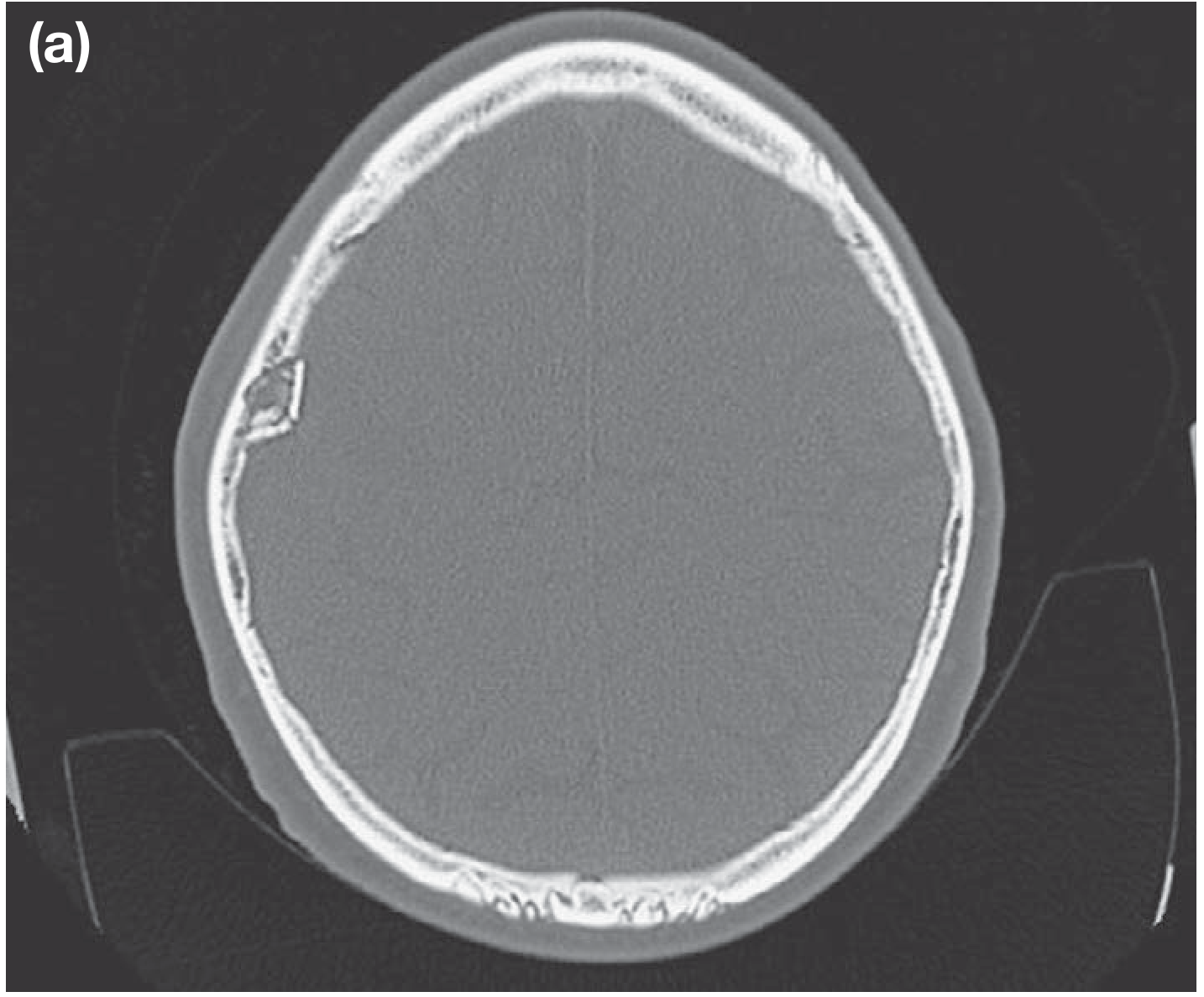
CT head showing the biconvex (lens-shaped) hyperdense extradural haematoma (Bailey & Love's Surgery, 28e)
- Biconvex (lenticular/lens-shaped) hyperdense collection between skull and brain
- Constrained by the dural attachment to suture lines (dura firmly adheres at sutures - the haematoma cannot cross sutures)
- Mass effect: midline shift, brain compression
- Associated skull fracture usually visible on bone windows
- Areas of mixed density within the haematoma indicate active/ongoing bleeding
Management
- Urgent neurosurgical evacuation (craniotomy/burr hole) for deteriorating/comatose patients or large haematomas
- Prognosis is excellent if evacuated promptly before herniation occurs
- Close observation with serial imaging for small haematomas in neurologically intact patients
Persistent Stapedial Artery - Important Variant
In the embryo, the stapedial artery (arising from the internal carotid via the stapes) normally forms the MMA. This artery usually regresses and the MMA then takes its origin from the external carotid/maxillary artery. In a persistent stapedial artery (PSA), this regression fails:
- The foramen spinosum is typically absent (a useful radiological sign)
- The MMA instead arises from the internal carotid artery via the persistent stapedial artery
- Clinically important in middle ear surgery (risk of massive haemorrhage) and skull base surgery
- PSA appears as an anomalous vessel on the promontory in the middle ear
Summary
| Feature | Detail |
|---|---|
| Origin | First part of maxillary artery (infratemporal fossa) |
| Entry foramen | Foramen spinosum (in greater wing of sphenoid) |
| Location in skull | Outer (periosteal) layer of dura mater |
| Main branches | Anterior (frontal) + posterior (parietal) |
| Main supply | Dura mater, periosteum, inner skull (middle & lateral cranial fossa) |
| Vulnerable point | Anterior branch at pterion (thinnest skull) |
| Clinical emergency | Extradural haematoma (biconvex on CT) |
| Classic presentation | Lucid interval → rapid deterioration → CN III palsy + contralateral hemiplegia |
| Key variant | Persistent stapedial artery → absent foramen spinosum |
Sources: Gray's Anatomy for Students, 4e; Neuroanatomy through Clinical Cases, 3e; Bailey & Love's Short Practice of Surgery, 28e; Scott-Brown's Otorhinolaryngology Head & Neck Surgery, Vol 2
Lingual artery and it's branches
Reading File
The lingual artery is the second anterior branch of the external carotid artery, supplies the tongue and floor of mouth, and is an important surgical landmark in neck dissections and tongue surgeries.
Searching sources...
Finding Sources
Finding Sources
Reading File
Reading File
Finding Sources
Finding Sources
Finding Sources
Finding Sources
Finding Sources
Finding Sources
Reading File
Reading File
Reading File
Loading Image
Loading Image
I have two excellent anatomical diagrams and comprehensive content. Let me now compile the complete answer.
Lingual Artery and Its Branches
Overview
The lingual artery is the second anterior branch of the external carotid artery (ECA). It is the principal blood supply to the tongue, floor of the mouth, and sublingual gland, and is a key landmark in both neck dissection and tongue base surgery.
Origin
- Arises from the anterior surface of the external carotid artery, just above the superior thyroid artery
- Origin is at the level of the tip of the greater horn (cornu) of the hyoid bone (C3 vertebral level)
- May share a common trunk with the facial artery (linguofacial trunk) in ~20% of cases - an important surgical variant
Course
The lingual artery has a distinctive looped course, divided into four segments (Shangkuan classification):
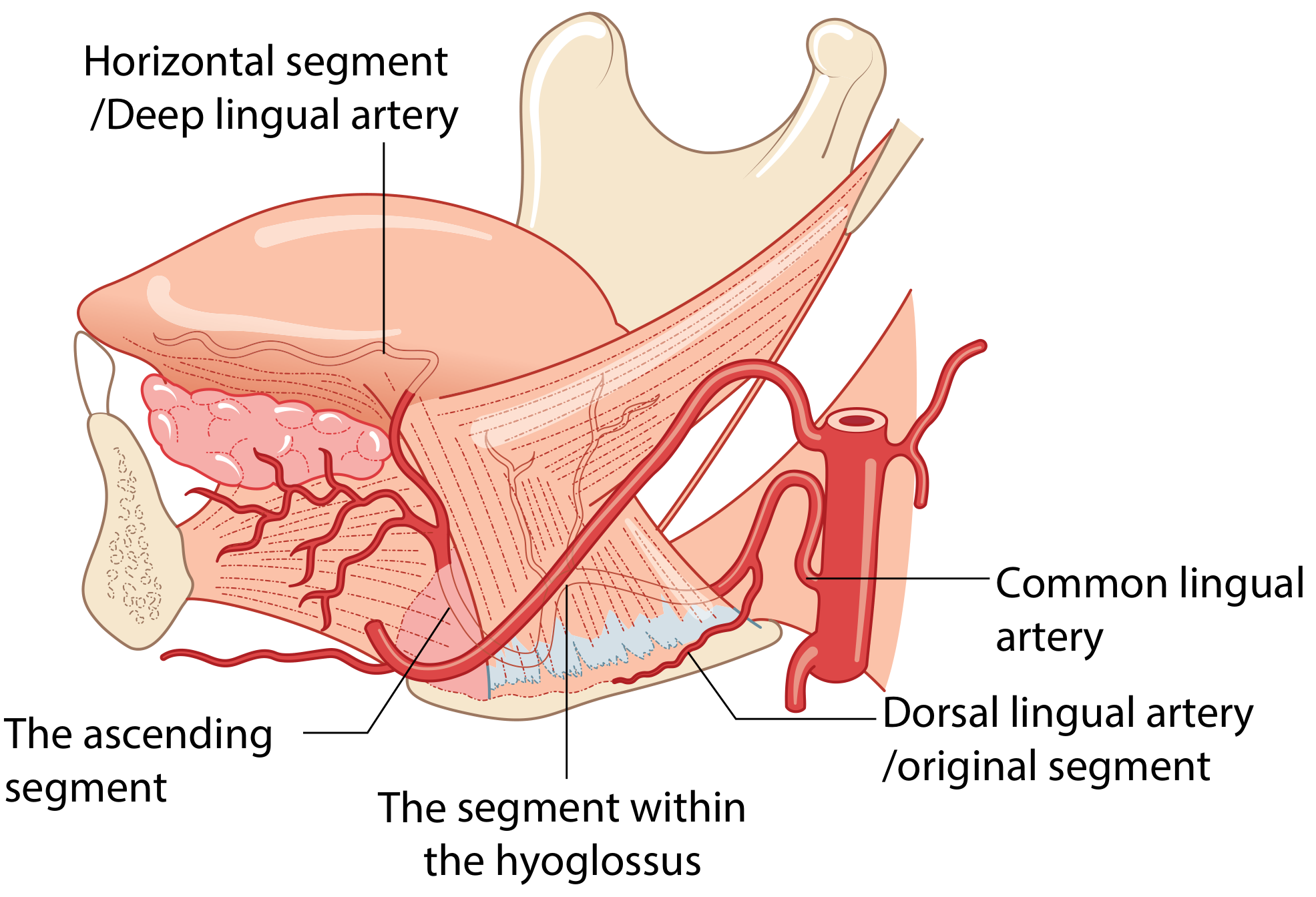
Four segments of the lingual artery (Scott-Brown's Otorhinolaryngology Head & Neck Surgery, Vol 3)
Segment 1: Original (Root) Segment
- Arises from the ECA and forms a characteristic upward loop (the "lingual loop") then turns downward and forward
- Lies consistently 3-4 mm superolateral to the greater horn of the hyoid bone
- Encountered when skeletonizing the greater horn of the hyoid deep to the hyoglossus muscle during neck dissection
Segment 2: Within the Hyoglossus
- Passes deep to (beneath) the hyoglossus muscle - this is the KEY anatomical relationship
- Passes obliquely from posterosuperior to anteroinferior under the posterior border of hyoglossus
- Lies medial to the hypoglossal nerve (CN XII) - the hypoglossal nerve and lingual vein run on the outer (lateral/superficial) surface of hyoglossus, while the lingual artery runs on its deep surface
- Also runs deep to the stylohyoid muscle and posterior belly of digastric
- Passes between the middle constrictor of the pharynx and hyoglossus to enter the floor of the oral cavity via the oropharyngeal triangle (bounded by mylohyoid, superior constrictor, and middle constrictor)
Segment 3: Ascending Segment
- Ascends in a tortuous manner along the anterior border of hyoglossus
- The sublingual artery arises here (~0.8 cm above the hyoid bone)
Segment 4: Horizontal Segment (Deep Lingual Artery)
- Continues forward between hyoglossus and genioglossus muscles toward the apex of the tongue
- Runs with many upward and downward tortuosities between the longitudinal tongue muscles
- Becomes the deep lingual artery as the terminal segment
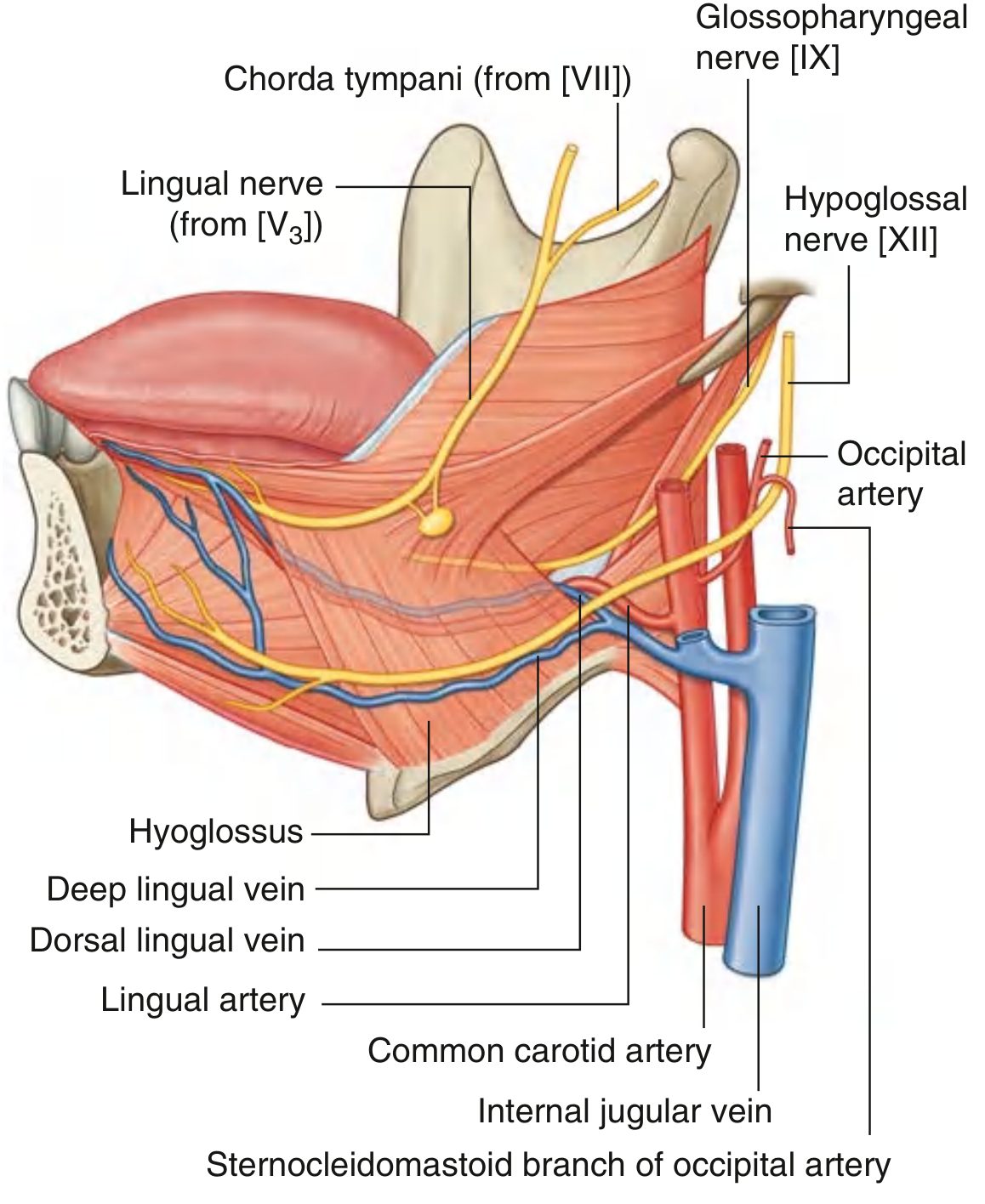
Arteries, veins, and nerves of the tongue (Gray's Anatomy for Students, 4e)
Key Relationship: The Hyoglossus Muscle
The hyoglossus muscle is the critical landmark for the lingual artery:
| Structure | Relation to Hyoglossus |
|---|---|
| Lingual artery | Deep (medial surface) |
| Lingual vein | Superficial (lateral surface) |
| Hypoglossal nerve (CN XII) | Superficial (lateral surface) |
| Lingual nerve (V3) | Superficial (enters floor of mouth above hyoglossus) |
This relationship is critical in surgery: to find and ligate the lingual artery, the surgeon must go deep to the hyoglossus muscle. The hypoglossal nerve on the surface serves as a guide.
Branches
1. Suprahyoid Branch
- Arises from the initial (root) segment
- Small branch running along the upper border of the hyoid bone
- Anastomoses with the contralateral suprahyoid branch
- Supplies hyoid bone, suprahyoid muscles
2. Dorsal Lingual Arteries (Rami dorsales linguae)
- Usually 2-3 small branches
- Arise medial to the hyoglossus muscle (from the segment within hyoglossus)
- First branch of the lingual artery arises ~0.7 cm from the anterior border of hyoglossus
- Ascend to the posterior part of the dorsum of the tongue
- Vascular territory: root of tongue (5 mm behind the terminal sulcus), glossoepiglottic folds, palatoglossal arch (anterior pillar of fauces), soft palate, palatine tonsil, and epiglottis
- In the region of the valleculae, anastomose with epiglottic branches of the superior laryngeal artery
3. Sublingual Artery (Arteria sublingualis)
- Arises from the ascending segment at the anterior margin of hyoglossus (~0.8 cm above the hyoid bone)
- Passes forward between the genioglossus and mylohyoid muscles to reach the sublingual gland
- Vascular territory:
- Ventral (undersurface) of the tongue
- Anterior and lateral floor of the mouth
- Vestibular and lingual gum (gingiva)
- Sublingual gland
- Overlying oral mucosa
- One branch enters the lingual foramen - a small opening on the posterior aspect of the mandibular symphysis immediately above the genial tubercles - to supply the anterior mandible and lower incisors (clinically relevant in implant surgery)
- Anastomoses with its contralateral fellow and with the submental artery (branch of facial artery)
4. Deep Lingual Artery (Arteria profunda linguae / Ranine artery)
- The terminal branch of the lingual artery
- The horizontal segment of the course
- Runs forward with many tortuosities in the plane between hyoglossus and genioglossus, then between the inferior longitudinal muscle and genioglossus
- Reaches the apex (tip) of the tongue on its inferior surface, near the lingual frenulum
- Visible through the thin mucosa of the undersurface of the tongue as the ranine veins are also visible alongside it
- At the tip, anastomoses with the contralateral deep lingual artery
- Supplies the intrinsic muscles and mucosa of the body and tip of the tongue
Summary of Branches
| Branch | Origin | Supply |
|---|---|---|
| Suprahyoid | Root segment | Hyoid bone, suprahyoid muscles |
| Dorsal lingual (2-3 branches) | Within hyoglossus (medial to it) | Tongue dorsum (posterior), tonsil, soft palate, epiglottis, palatoglossal arch |
| Sublingual | Ascending segment (anterior border of hyoglossus) | Sublingual gland, floor of mouth, gingiva, mandible (via lingual foramen) |
| Deep lingual (terminal) | Horizontal segment | Intrinsic tongue muscles, tongue body and tip mucosa |
Important Relations - Summary
| Structure | Relation |
|---|---|
| Hyoglossus | Lingual artery runs on its deep (medial) surface |
| Hypoglossal nerve (CN XII) | Runs on the superficial surface of hyoglossus (above the artery) |
| Lingual nerve (V3) | Enters floor of mouth crossing superficial to hyoglossus; initially lies lateral then loops under the submandibular duct |
| Middle constrictor of pharynx | Lingual artery passes between middle constrictor and hyoglossus |
| Mylohyoid | Lingual artery passes deep to, entering floor of mouth through the oropharyngeal triangle |
| Submandibular duct | Crosses above lingual nerve in the floor of mouth; lingual artery is deeper |
The Pirogoff (Lingual) Triangle
The Pirogoff triangle (also called the lingual triangle or Beclard's triangle) is the surgical landmark used to identify and ligate the lingual artery in the neck:
| Border | Structure |
|---|---|
| Anterosuperior | Posterior border of mylohyoid muscle |
| Posterosuperior | Posterior belly of digastric muscle |
| Inferior | Greater horn (cornu) of the hyoid bone |
| Floor | Hyoglossus muscle (with lingual artery deep to it) |
By dissecting through the floor of this triangle (i.e., through/deep to hyoglossus), the lingual artery is exposed in the neck. This approach is used for ligation of the lingual artery in:
- Control of haemorrhage from tongue tumours
- Tongue base surgery
- Preparation before partial/total glossectomy
Venous Drainage (Companion Veins)
- Deep lingual vein: runs alongside the deep lingual artery anteriorly in the tongue; posteriorly separates from the artery and travels on the superficial (lateral) surface of hyoglossus alongside CN XII → drains to internal jugular vein
- Dorsal lingual vein: follows the lingual artery between hyoglossus and genioglossus → internal jugular vein
- The deep lingual veins are visible through the thin mucosa of the undersurface of the tongue as ranine veins
Nerve Relations (Clinically Important)
Three major nerves are closely related to the lingual artery in the floor of the mouth and tongue base:
| Nerve | Relation | Function |
|---|---|---|
| Lingual nerve (V3) | Crosses superficial to hyoglossus; lies lateral to lingual artery | General sensation (anterior 2/3 tongue), taste via chorda tympani (VII) |
| Hypoglossal nerve (CN XII) | Superficial to hyoglossus, lies above lingual artery | Motor to all intrinsic and extrinsic tongue muscles (except palatoglossus) |
| Glossopharyngeal nerve (CN IX) | Supplies the root of tongue | Taste and general sensation (posterior 1/3 tongue) |
Clinical Significance
1. Tongue Cancer Surgery
- Before partial/total glossectomy, the lingual artery is ligated in the neck (at the Pirogoff triangle) to reduce intraoperative bleeding
- Langenbeck (1819) first described ligation of the lingual artery before tongue surgery
2. Haemorrhage Control
- Posterior tongue bleeding (from the dorsal lingual artery territory) can be life-threatening
- The dorsal lingual artery is the principal vessel encountered during transoral tongue base surgery (e.g., for obstructive sleep apnoea, tongue base tumours)
- Endovascular embolisation of the lingual artery is used for uncontrolled tongue haemorrhage
3. Neck Dissection
- The lingual artery is identified at the Pirogoff triangle and must be preserved or controlled during neck dissections
- The greater horn of the hyoid is used as a surgical landmark: the lingual artery lies 3-4 mm superolateral to it
4. Dental / Implant Surgery
- The sublingual artery sends a branch through the lingual foramen of the mandible
- During anterior mandibular implant placement, this branch can be injured, causing floor-of-mouth haematoma → airway compromise (life-threatening)
5. Anastomoses
- The lingual arteries are not end-arteries - they anastomose with contralateral fellow vessels at the tongue tip (deep lingual arteries) and at the hyoid (suprahyoid branches)
- This means bilateral ligation is required to fully devascularise the tongue
Sources: Gray's Anatomy for Students, 4e; Scott-Brown's Otorhinolaryngology Head & Neck Surgery, Vol 3; Color Atlas of Human Anatomy Vol 2; Fischer's Mastery of Surgery, 8e
Lateral wall of nose
Your credits are exhausted. You can purchase a top-up or subscribe to a plan to continue using Orris. If you're already subscribed, your daily credits will reset tomorrow.
This is a shared conversation. Sign in to Orris to start your own chat.