
Vulval intraepithelial neoplasia - short note for dnb answer - reference novak gynae and latest updatw
Reading File
Now let me search the library for VIN content from Novak's Gynecology, while simultaneously searching PubMed for the latest updates.
Finding Sources
Searching PubMed
"vulvar intraepithelial neoplasia" AND management
Finding Sources
Searching PubMed
"vulvar intraepithelial neoplasia" VIN treatment
Found the Berek & Novak's sections. Let me read both blocks simultaneously.
Reading File
Reading File
Reading Article
PMID: 38262367
Good content from the block4. Let me read more of the block4 which was truncated and also get the Robbins pathology content.
Reading File
Reading File
Excellent - I now have comprehensive content from both Berek & Novak's Gynecology and Robbins Pathology. Let me also fetch the VIN image and get the abstract of the latest 2026 review for current updates.
Loading Image
Reading Article
PMID: 41928602
I now have all the material needed for a comprehensive DNB short note. Let me compile the answer.
Vulval Intraepithelial Neoplasia (VIN)
References: Berek & Novak's Gynecology; Robbins & Cotran Pathologic Basis of Disease; Gupta et al., Obstet Gynecol Sci 2024 [PMID 38262367]; Swaminathan et al., Clin Obstet Gynecol 2026 [PMID 41928602]
Definition
VIN is a noninvasive squamous intraepithelial precursor lesion of the vulva with malignant potential. The ISSVD (International Society for the Study of Vulvar Disease) introduced the term in 1986, replacing older terms such as Bowen disease, erythroplasia of Queyrat, and carcinoma in situ simplex - all of which represented gross variants of the same disease process.
Classification
ISSVD 1986 / WHO (Classic Grading - Novak)
| Grade | Atypia extent |
|---|---|
| VIN 1 | Lower 1/3 of epithelium |
| VIN 2 | Lower 2/3 of epithelium |
| VIN 3 (CIS) | Full-thickness involvement |
Current ISSVD 2015 / WHO 2014 Classification (Updated)
The current classification replaces the three-tier system with two major types:
1. uVIN (usual type VIN) / High-grade VIN
- HPV-associated (mainly HPV-16)
- Younger women (reproductive age)
- Subtypes: warty, basaloid, mixed
- p16 positive on immunostaining
- 10-15% risk of progression to invasive SCC if untreated
2. dVIN (differentiated VIN)
- HPV-independent
- Older women (postmenopausal)
- Associated with lichen sclerosis and lichen simplex chronicus
- TP53 mutations common
- Higher malignant potential - faster progression to invasive SCC (~30%)
- p16 negative; p53 aberrant expression
Note: VIN 1 is no longer considered a precancerous lesion per ACOG guidelines. It is most often an HPV effect and does not require treatment.
Epidemiology
- Incidence increasing, especially in young women
- HPV-associated SCC: 30% of all vulvar cancers, younger women (avg 30 years)
- HPV-independent SCC: 70% of cases, older women (avg 75 years)
- 10-30% of VIN patients have concurrent cervical or vaginal HPV lesions (multicentric disease)
Etiology and Risk Factors
For uVIN:
- High-risk HPV infection (especially HPV-16)
- Early sexual debut, multiple sexual partners
- Immunosuppression (HIV, transplant)
- Smoking
- History of CIN or VaIN
For dVIN:
- Chronic lichen sclerosis
- Lichen simplex chronicus
- Older age
- TP53 somatic mutations (and other: PIK3CA, NOTCH1, HRAS)
Clinical Features
- Symptoms: Pruritus (most common), burning, pain, dysuria; may be asymptomatic
- Appearance: Variable - white hyperkeratotic plaques, erythematous areas, pigmented/raised lesions, warty or papular lesions
- Location: Labia majora most common; may involve labia minora, perineum, perianal skin, clitoris
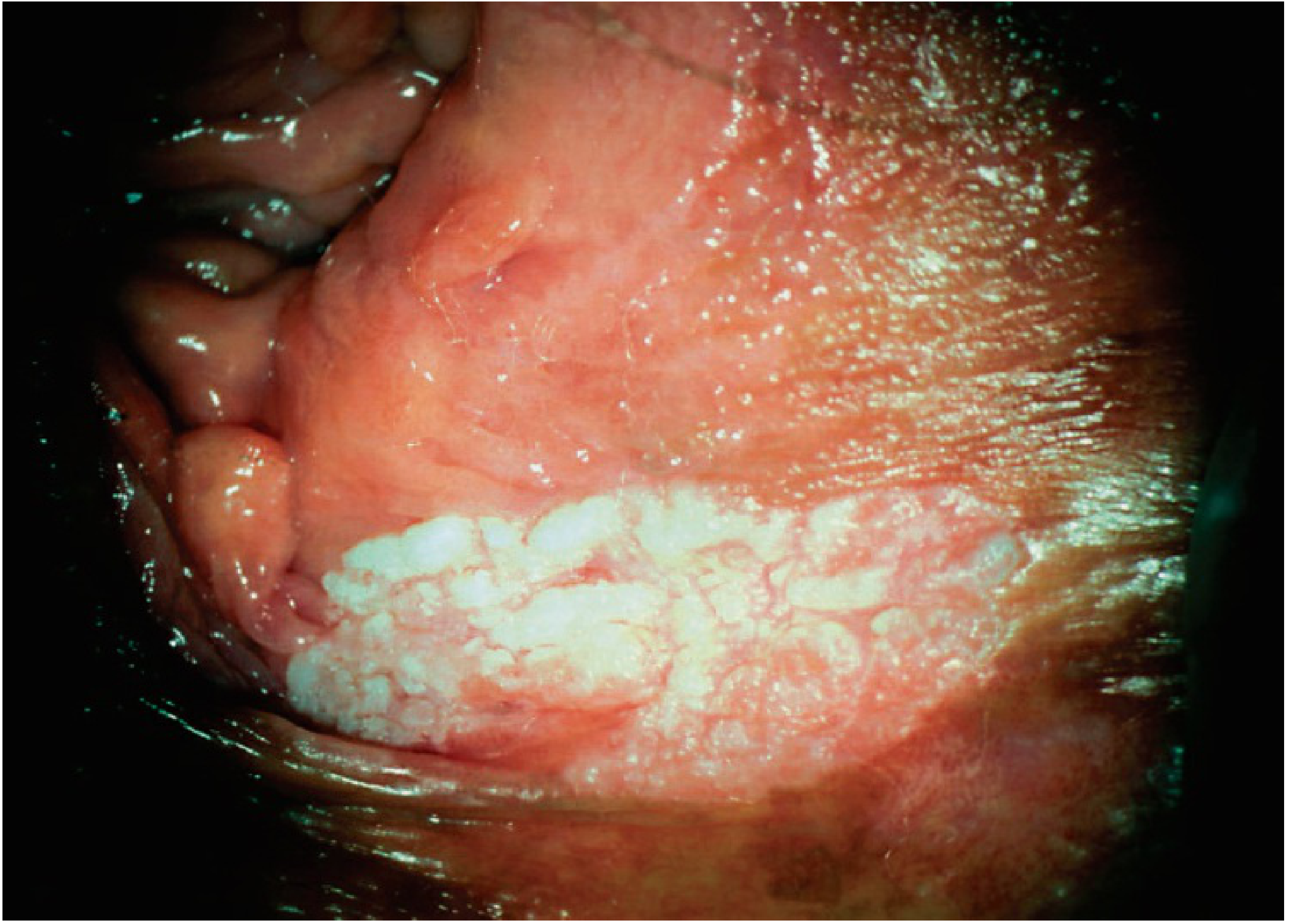
- Multifocal VIN 3 - multiple small hyperpigmented lesions on labia majora
- Bowenoid papulosis - multiple small pigmented papules (<5 mm), young women, may regress postpartum (term no longer recommended by ISSVD)
Clinical appearance of VIN 3 (Berek & Novak):
Histopathology
uVIN / High-grade VIN:
- Epidermal thickening, nuclear atypia, increased mitoses
- Lack of cellular maturation
- Koilocytes (HPV cytopathic effect) - perinuclear halos, binucleation, multinucleation
- Dyskeratotic cells in superficial layers
- VIN 3: immature cells with scanty cytoplasm and severe chromatin changes occupying most of epithelium
dVIN:
- Keratinizing, well-differentiated cells
- Basal layer atypia, elongated rete ridges
- Less obvious nuclear atypia - easily missed
- TP53 mutations
Diagnosis
- Clinical inspection - bright light, magnifying glass; careful vulvar exam at annual check
- Colposcopy with acetic acid - acetowhite lesions
- Biopsy - MANDATORY for all suspicious lesions; directed biopsy of darkest/raised areas
- Immunohistochemistry: p16 (positive in uVIN), p53 (aberrant in dVIN)
- Concurrent cervical and vaginal examination (multicentric disease)
Indications for biopsy: Any pigmented, discolored, raised, ulcerated or persistently symptomatic vulvar lesion.
Progression Risk
| Type | Progression to Invasion |
|---|---|
| uVIN (treated) | 5-10% |
| uVIN (untreated) | 10-15% |
| dVIN | ~30% (higher, faster) |
| uVIN in immunosuppressed | Higher |
| Spontaneous regression | Can occur in young women with uVIN |
Risk of progression higher in women >45 years or immunosuppressed (Robbins).
Management
VIN 1
- No treatment required (not a precancerous lesion per ACOG)
- Observation; address underlying HPV
VIN 2
- p16 positive: Treat as VIN 3
- p16 negative: Can be observed
VIN 3 / High-grade VIN - Treatment Options
Surgical:
- Wide local excision - preferred for unifocal disease; provides histology; repeat excision often needed but usually avoids vulvectomy
- Superficial (skinning) vulvectomy - for extensive/recurrent/multifocal VIN 3; goal is to preserve normal anatomy, clitoris, and anterior vulva
- Split-thickness skin grafting - when primary closure not possible (harvest from thigh or buttock)
Ablative:
4. CO2 laser ablation - suitable for multifocal disease; disadvantage: no specimen for histology; costly and painful
Medical (current/emerging):
5. Imiquimod 5% cream - topical immunomodulator; first-line medical option; effective for uVIN, especially multifocal
6. Cidofovir - topical antiviral
7. Sinecatechins - topical catechins (investigational)
8. Photodynamic therapy (PDT)
Principle: Extensive surgery is not warranted given 5-10% progression rate; cosmesis and function preservation are priorities, especially in premenopausal women.
Surveillance / Follow-up
- Regular vulvar inspection every 6-12 months (lifelong)
- Recurrence is common after all modalities
- Annual cervical smears (multicentric HPV disease)
- Screen sexual partners
Prevention
- HPV vaccination (9-valent vaccine - Gardasil 9) - prevents HPV-16/18 related uVIN
- Smoking cessation
- Safe sexual practices
Key Points for DNB Exam
| Feature | uVIN | dVIN |
|---|---|---|
| HPV status | Positive (HPV-16) | Negative |
| Age | Young/reproductive | Postmenopausal |
| Associated with | CIN, VaIN, immunosuppression | Lichen sclerosis |
| p16 IHC | Positive | Negative |
| p53 | Wild-type | Aberrant/mutant |
| Progression risk | 10-15% | ~30% |
| Morphology | Warty/basaloid | Keratinizing/differentiated |
Latest Updates (2024-2026)
- The ISSVD 2015 binary classification (uVIN vs dVIN) is now standard - the three-tier VIN 1/2/3 system is largely replaced in current practice, though VIN 3 language persists in older literature
- dVIN is now recognized as a high-risk lesion - its lack of florid atypia makes it frequently under-diagnosed; p53 IHC is recommended when dVIN is suspected
- New molecular subtypes of HPV-independent VIN lacking TP53 mutations have been described (PIK3CA, NOTCH1, HRAS mutations) - ongoing reclassification expected (Robbins 10th ed.)
- Imiquimod is increasingly used as first-line for multifocal uVIN, with remission rates of 35-81% in trials
- Vaccination of all eligible individuals emphasized as a preventive strategy (Swaminathan et al., Clin Obstet Gynecol 2026, PMID 41928602)
- Formal screening guidelines for vulvar disease remain limited - major gap identified in current literature
Sources: Berek & Novak's Gynecology (p. 872-874); Robbins & Cotran Pathologic Basis of Disease (p. 917); Gupta S et al. Obstet Gynecol Sci 2024 [PMID 38262367]; Swaminathan S et al. Clin Obstet Gynecol 2026 [PMID 41928602]

01fc8b3d-f614-4dfe-b002-bffe6ea3608f.jpeg
Answer this question for 10 marks acc to NBEMS dnb theory exam
Reading File
The question is a clinical scenario: 22-year-old pregnant woman with PIH, presents with abdominal pain, fetal distress, planned for emergency LSCS. The question asks [3+4+3] = assessment (3 marks), anaesthesia (4 marks), analgesia (3 marks) for perioperative plan. This is an obstetric anaesthesia/high-risk obstetrics question. Let me search all three components simultaneously.
Finding Sources
Finding Sources
Finding Sources
Finding Sources
Finding Sources
Finding Sources
Good - found key anesthesia textbook sections. Let me read all three simultaneously.
Finding Sources
Reading File
Reading File
Finding Sources
Finding Sources
Finding Sources
Excellent - found highly specific sections. Let me read the three most relevant ones simultaneously.
Reading File
Reading File
Reading File
Excellent content. Now let me get the preoperative assessment and postoperative analgesia sections.
Finding Sources
Finding Sources
Reading File
Finding Sources
Finding Sources
Finding Sources
Finding Sources
Finding Sources
Reading File
Reading File
I now have comprehensive material from the major anesthesia textbooks. Let me now also get the Barash section on anesthetic management for preeclampsia/cesarean delivery to complete the picture.
Reading File
I now have all the material needed. Let me compose the structured 10-mark DNB answer.
Emergency LSCS in a 22-year-old with PIH and Fetal Distress - Perioperative Plan
[3 + 4 + 3 marks = 10 marks]
References: Morgan & Mikhail's Clinical Anesthesiology 7e; Barash, Cullen & Stoelting's Clinical Anesthesia 9e; Creasy & Resnik's Maternal-Fetal Medicine
PART A: PREOPERATIVE ASSESSMENT [3 marks]
Rapid Structured Assessment (Emergency Setting)
1. Clinical history (targeted)
- Duration and severity of PIH: BP readings, proteinuria (preeclampsia with severe features vs mild)
- Symptoms of severe preeclampsia: headache, visual disturbance, epigastric pain, oliguria
- Fetal distress pattern: type of CTG abnormality (late decelerations, loss of variability, bradycardia)
- Last oral intake (aspiration risk - full stomach assumed in emergency)
- Drug history: antihypertensives (labetalol, nifedipine), MgSO4 infusion (affects muscle relaxants), steroids
2. Airway assessment - CRITICAL in preeclampsia
- Mallampati grading, mouth opening, neck mobility
- Preeclampsia causes edema of tongue, epiglottis and pharynx - significantly increases risk of difficult/failed intubation
- Higher-grade airways mandate preparation for awake fiberoptic or video laryngoscopy (Barash 9e)
3. Investigations - essential panel
| Investigation | Relevance |
|---|---|
| Full blood count (especially platelet count) | Thrombocytopenia in HELLP - safe neuraxial if platelets >70,000-100,000/mm³ (stable, not falling) |
| Coagulation screen (PT, aPTT, fibrinogen) | Exclude DIC/HELLP |
| LFT | HELLP syndrome (elevated transaminases) |
| RFT + urine protein | Renal involvement, proteinuria |
| Serum electrolytes | Especially in patients on MgSO4 |
| Fetal heart rate monitoring | Ongoing in OT to avoid unnecessary GA |
| Group & cross-match | Anticipate PPH |
4. Fetal distress signs (Table 41-5, Morgan & Mikhail)
- Repetitive late decelerations
- Loss of fetal beat-to-beat variability with late/deep decelerations
- Sustained FHR < 80 beats/min
- Fetal scalp pH < 7.20
- Meconium-stained liquor
5. Classify urgency: True "crash" (immediate delivery within minutes - general anesthesia likely) vs urgent-but-not-immediate (allows time for spinal/epidural)
6. Optimize before induction:
- Control BP: IV labetalol 5-10 mg increments or IV hydralazine or IV nicardipine (target BP <160/110 mmHg)
- MgSO4: loading dose 4-6 g IV over 20-30 minutes if not already given; maintenance 1-2 g/hr (seizure prophylaxis)
- Antacid prophylaxis: sodium citrate 30 mL orally + IV ranitidine/metoclopramide (aspiration prophylaxis - full stomach)
- Left lateral tilt / uterine displacement (aortocaval decompression)
- Establish large-bore IV access x2; arterial line if severe hypertension
- Consent (usually verbal/implied in emergency)
- Paediatric/neonatal team alert (neonatal resuscitation standby)
PART B: ANAESTHESIA [4 marks]
Choice of Anaesthesia
Regional anaesthesia is preferred (Morgan & Mikhail, Barash, Creasy & Resnik):
- Avoids the major risk of failed/difficult intubation (leading cause of maternal death in obstetric anaesthesia)
- Avoids aspiration risk
- Reduces circulating catecholamines, attenuates hypertensive response to pain
- Improves uteroplacental perfusion by up to 75% (Barash 9e)
- Allows mother to be awake at delivery
General anaesthesia reserved for:
- Contraindication to neuraxial (thrombocytopenia <70,000, coagulopathy, patient refusal)
- True emergency ("crash") with inadequate time for regional
- Failed regional block
Option 1: Spinal Anaesthesia (preferred for emergency LSCS)
Advantages: Rapid onset, reliable dense block, no risk of inadvertent intravascular injection
Technique:
- Position: sitting or left lateral
- Level: L3-L4 or L2-L3 interspace
- Drug: Hyperbaric bupivacaine 0.5% - 10 to 12.5 mg (2-2.5 mL) + fentanyl 15-25 mcg + intrathecal morphine 100 mcg (for postoperative analgesia)
- Target sensory block: T4-T6 (nipple line)
- Note on preeclampsia: Contrary to older concerns, spinal anaesthesia does NOT cause more severe hypotension in preeclampsia compared to normotensive women; current evidence supports its safety (Barash 9e; Creasy & Resnik)
Hypotension management:
- Phenylephrine is preferred vasopressor (over ephedrine) - less fetal acidosis
- IV fluid co-load with crystalloid at time of spinal insertion
- Avoid excessive preload (risk of pulmonary oedema in preeclampsia)
- Left uterine displacement maintained throughout
- Monitor BP every 2-3 minutes after spinal
Option 2: Epidural Anaesthesia (if epidural already in situ from labour)
- Top up with 3% chloroprocaine (fastest onset - 5-10 min) or 2% lignocaine with adrenaline and bicarbonate (alkalinised for speed)
- Combined spinal-epidural (CSE) also an option
Option 3: General Anaesthesia (when regional not possible)
Pre-oxygenation: 4 maximal breaths of 100% O2 (rapid denitrogenation)
Rapid Sequence Induction (RSI - mandatory due to full stomach):
- Induction: Thiopentone 4-5 mg/kg IV or Propofol 2 mg/kg (use ketamine 1 mg/kg if hypotensive)
- Note: Ketamine and ergot alkaloids should be AVOIDED in uncontrolled hypertension (worsens BP)
- Muscle relaxant: Suxamethonium 1.5 mg/kg IV (Sellick's maneuver/cricoid pressure simultaneously)
- If MgSO4 on board: reduce dose of non-depolarizing relaxants (MgSO4 potentiates neuromuscular blockade - monitor with nerve stimulator)
- Video laryngoscope immediately available; difficult airway trolley at bedside
- Intubate with cuffed ETT; confirm with capnography
Maintenance:
- Isoflurane/sevoflurane + 50% N2O in O2
- Avoid high-dose volatile agents before delivery (uterine relaxation, neonatal depression)
- After delivery: convert to opioid-based analgesia (fentanyl), reduce volatile agent
Controlling hypertensive response to intubation:
- IV labetalol 5-10 mg before laryngoscopy
- IV nicardipine or clevidipine for intraoperative hypertension
- Intra-arterial BP monitoring (arterial line) recommended in severe hypertension
Extubation: Only when fully awake, airway reflexes intact (oedematous airway - extubate with extreme caution)
Intraoperative monitoring (all cases)
- Continuous pulse oximetry, capnography (if GA), ECG
- Non-invasive BP every 2-3 minutes (invasive arterial line in severe disease)
- Urine output monitoring (catheter - target >25 mL/hr)
- Temperature, peripheral nerve stimulator (if MgSO4 + non-depolarising relaxants)
- Continuous FHR monitoring in OT until delivery
PART C: POSTOPERATIVE ANALGESIA [3 marks]
Multimodal Analgesia - Gold Standard (Barash 9e)
Combining analgesic drugs with different mechanisms reduces opioid requirements and side effects.
1. Neuraxial opioids (most effective for post-LSCS analgesia)
| Route | Drug | Dose | Duration |
|---|---|---|---|
| Intrathecal (given at time of spinal) | Morphine | 100 mcg | 12-24 hours |
| Epidural | Morphine | 1-3 mg | 12-24 hours |
- Provides prolonged (12-24 hr) visceral and somatic pain relief
- Side effects: nausea/vomiting, pruritus, urinary retention
- Delayed respiratory depression - rare but potentially devastating; mandatory monitoring (respiratory rate, sedation score) for 24 hours after neuraxial morphine
2. Systemic non-opioid analgesics (regular scheduled)
- Paracetamol (acetaminophen) 1g IV/oral every 6 hours (safe, reduces opioid requirement)
- NSAIDs - Ibuprofen 400-600 mg oral 8 hourly or ketorolac 15-30 mg IV (use with caution in preeclampsia - monitor BP and renal function; avoid if significant proteinuria/renal impairment or oliguria)
3. Breakthrough/rescue analgesia
- Oral oxycodone or IV morphine PCA as required
- Avoid codeine and tramadol (unsafe in breastfeeding mothers - codeine: risk of neonatal respiratory depression via CYP2D6 ultrametabolisers; tramadol similarly)
4. Regional/nerve block techniques (if neuraxial morphine not given)
- Transversus abdominis plane (TAP) block - bilateral; covers somatic anterior abdominal wall pain (T8-L1); gives 8-12 hours analgesia
- Quadratus lumborum (QL) block - provides broader coverage including visceral pain
- Wound infiltration with long-acting local anaesthetic (levobupivacaine/ropivacaine) if TAP not feasible
5. Non-pharmacological
- Early mobilisation
- Ice packs to wound
- Supportive positioning
Monitoring in the Postoperative Period
- BP monitoring every 15 minutes for 1 hour, then hourly (PIH may worsen 24-48 hours postpartum)
- Continue MgSO4 for 24 hours postdelivery (eclampsia risk highest in first 24 hours postpartum)
- Urine output, deep tendon reflexes (MgSO4 toxicity: hyporeflexia, respiratory depression - antidote: calcium gluconate 1g IV over 10 min)
- Respiratory monitoring hourly if neuraxial morphine given
- Watch for HELLP syndrome (platelet count, LFTs at 24-48 hours)
- Breastfeeding: most standard analgesics safe; avoid codeine/tramadol
Summary Table
| Component | Key Points |
|---|---|
| Assessment [3] | Airway (edema risk), platelet/coagulation screen, BP control, MgSO4, antacid, urgency classification |
| Anaesthesia [4] | Spinal preferred (hyperbaric bupivacaine + fentanyl); GA if contraindicated (RSI, video laryngoscope, avoid ketamine if severe HTN, reduce NMB doses with MgSO4) |
| Analgesia [3] | Intrathecal morphine 100 mcg + paracetamol + NSAIDs (multimodal); TAP block if neuraxial morphine not given; avoid codeine/tramadol in breastfeeding |
References: Morgan & Mikhail's Clinical Anesthesiology 7e (Chapter 41); Barash, Cullen & Stoelting's Clinical Anesthesia 9e (Chapter 41); Creasy & Resnik's Maternal-Fetal Medicine (Chapter on Preeclampsia/Eclampsia)
Q1 Periop plan including assessment,anesthesia and analgesia for ecclamptic patient posted for c section? for 10 marks. Q2 Discuss Labour analgesia and pain pathway involved in labour analgesia. Q3. RECENT PPH MANGEMENT IN FLOW CHART FORM?
Searching all three topics simultaneously from the medical library.
Finding Sources
Finding Sources
Finding Sources
Finding Sources
Finding Sources
Finding Sources
Finding Sources
Finding Sources
Finding Sources
Reading File
Reading File
Finding Sources
Your credits are exhausted. Your daily credits reset tomorrow, or you can purchase a top-up for more.
This is a shared conversation. Sign in to Orris to start your own chat.