
Cardiovascular system
I need to clarify what you're looking for before diving in.
Asking for Preferences
What do you need on the cardiovascular system? · What level of detail?
Reading File
Finding Sources
Searching Images
cardiovascular system heart anatomy overview diagram
Finding Sources
Finding Sources
Finding Sources
Reading File
Reading File
Reading File
Loading Image
Here is a concise overview of the cardiovascular system — its anatomy and physiology.
The Cardiovascular System: Overview
What It Does
The cardiovascular system is a closed-loop transport network that delivers oxygen, nutrients, hormones, and immune cells to tissues while removing carbon dioxide and metabolic waste. It consists of the heart, blood vessels (arteries, veins, capillaries), and blood.
The Heart — Anatomy
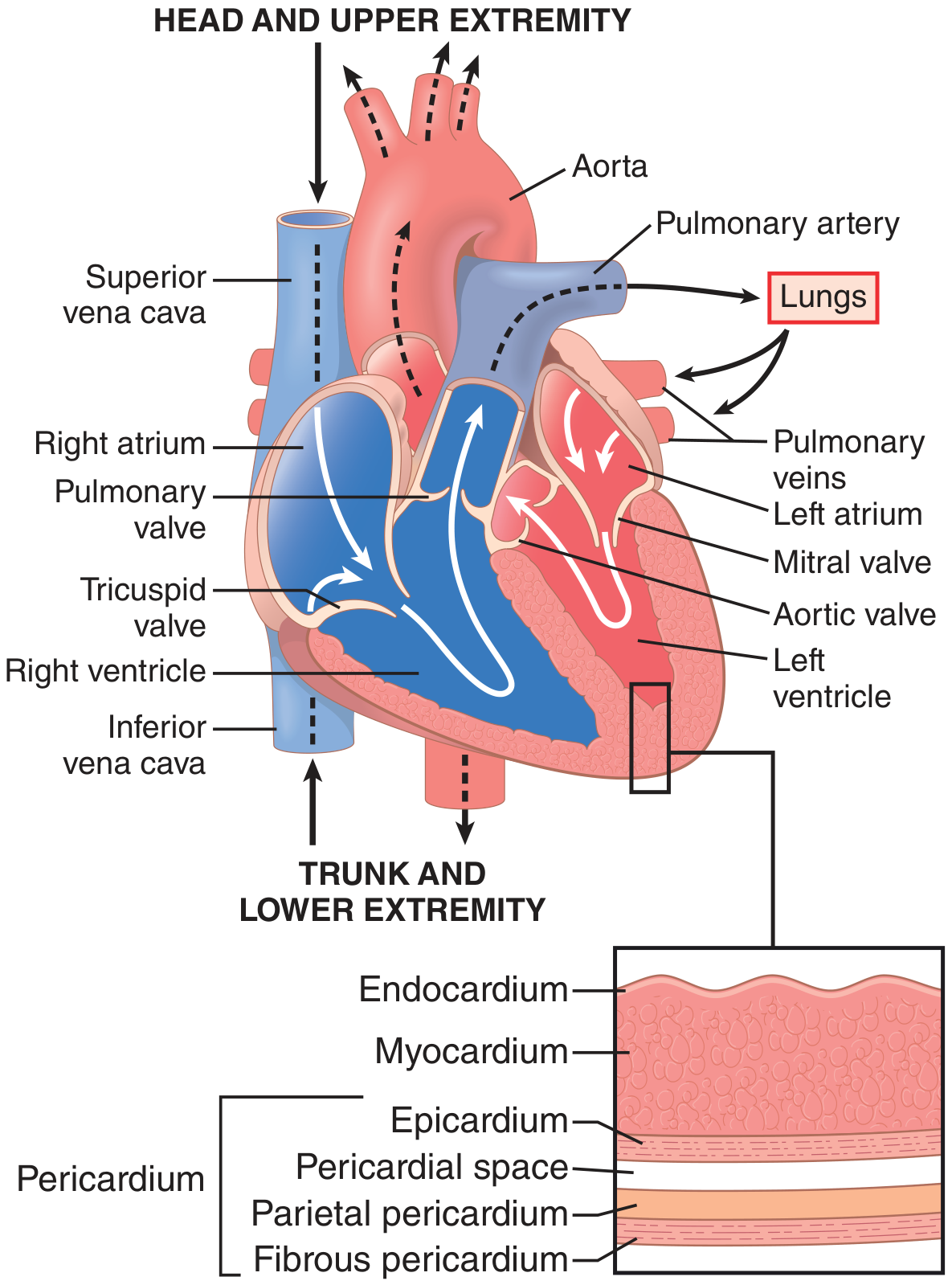
The heart is a four-chambered muscular pump divided into two parallel circuits:
| Chamber | Role |
|---|---|
| Right atrium | Receives deoxygenated blood from superior & inferior vena cavae |
| Right ventricle | Pumps blood to the lungs via the pulmonary artery |
| Left atrium | Receives oxygenated blood from pulmonary veins |
| Left ventricle | Pumps oxygenated blood to the body via the aorta (thick-walled, high-pressure) |
Four valves prevent backflow:
- AV valves (between atria and ventricles): Tricuspid (right), Mitral (left)
- Semilunar valves (at outflow): Pulmonary, Aortic
Wall layers (inner → outer): Endocardium → Myocardium → Epicardium → Pericardial space → Fibrous pericardium
The ventricular wall is mostly cardiomyocytes but 60–70% of cardiac cells are actually fibroblasts, which produce collagen to maintain structural integrity. — Goldman-Cecil Medicine
Cardiac Muscle — Special Features
Cardiac muscle is striated like skeletal muscle but unique in that:
- Cells are connected by intercalated discs containing gap junctions → ions flow freely → the heart acts as an electrical syncytium (one cell depolarizes, all depolarize)
- It has automaticity — specialized pacemaker cells (SA node) generate rhythmic action potentials without external input
- The left ventricle has a double-helix fiber arrangement that creates a wringing/twisting motion during systole, aiding ejection. At end-systole, the ventricle recoils like a spring during diastole to rapidly fill. — Guyton & Hall Medical Physiology
Two Circuits of Circulation
Body tissues → [Veins] → Right heart → Pulmonary artery → Lungs (gas exchange)
     ↑                                                              ↓
  [Arteries] ← Left heart ← Pulmonary veins ←←←←←←←←←←←←←←←←←←←←
- Pulmonary circuit (right heart → lungs → left heart): low pressure; CO₂ out, O₂ in
- Systemic circuit (left heart → body → right heart): high pressure; delivers O₂ and nutrients
Coronary Circulation
The heart itself is supplied by coronary arteries arising from the aorta just above the aortic valve. Key features:
- Coronary flow to the epicardium occurs during both systole and diastole
- Flow to the endocardium occurs predominantly during diastole (compressed during systole by high LV pressures) — Goldman-Cecil Medicine
Regulation of Cardiovascular Function
| System | Effect |
|---|---|
| Sympathetic (SNS) | ↑ Heart rate, ↑ contractility, vasoconstriction (via norepinephrine/epinephrine) |
| Parasympathetic (vagus) | ↓ Heart rate, slows AV conduction (via acetylcholine at SA/AV nodes) |
| Renin-angiotensin system | ↑ Blood pressure via angiotensin II (vasoconstriction) + aldosterone (Na⁺/water retention) |
| Local metabolites | Nitric oxide, adenosine, CO₂ → coronary vasodilation (up to 6-fold) |
Cardiac Energetics
The heart relies almost entirely on aerobic metabolism — primarily oxidizing fatty acids and glucose. It has virtually no capacity for anaerobic metabolism, making it exquisitely sensitive to hypoxia and ischemia. — Goldman-Cecil Medicine
Sources: Goldman-Cecil Medicine (International Ed.) | Guyton & Hall Textbook of Medical Physiology
This is a shared conversation. Sign in to Orris to start your own chat.