
Mechanism of nonepinephrine and indications side effects normal' dose how to give how much to dilute
I'll look up norepinephrine (also spelled noradrenaline) from the medical library right away.
Searching sources...
Reading File
Now let me search the medical library for norepinephrine in parallel:
Finding Sources
Finding Sources
Excellent results. Now let me read the most pharmacologically rich sections in parallel:
Reading File
Reading File
Reading File
Reading File
I now have rich data from multiple authoritative textbooks. Let me read more of the Lippincott pharmacology section for side effects and dilution, and also grab the Goodman & Gilman section:
Reading File
Reading File
I now have comprehensive data from multiple authoritative sources. Let me also fetch the cardiovascular effects image from Lippincott:
Loading Image
I now have everything needed for a complete, well-sourced answer. Here it is:
Norepinephrine (Noradrenaline) - Complete Clinical Reference
1. Mechanism of Action
Norepinephrine is an endogenous catecholamine and the primary neurotransmitter of postganglionic sympathetic fibers. It acts on adrenergic receptors with the following receptor profile:
| Receptor | Effect | Clinical Result |
|---|---|---|
| α1 (dominant at therapeutic doses) | Smooth muscle contraction | Intense vasoconstriction of arteries AND veins |
| β1 | Increases heart rate & contractility | Positive inotropy; tachycardia (often masked) |
| β2 (very weak) | Minimal vasodilation in skeletal muscle | Negligible - this is why it causes MORE vasoconstriction than epinephrine |
Molecular pathway: α1 receptors couple to Gq → PLC → IP3/DAG → Ca²⁺ → PKC, causing vascular smooth muscle contraction. β1 receptors couple to Gs → adenylyl cyclase → cAMP → PKA, increasing myocardial contractility.
Net cardiovascular effect:
- Systolic BP ↑ (vasoconstriction + inotropy)
- Diastolic BP ↑ (vasoconstriction)
- Pulse pressure narrows
- Reflex bradycardia - the rise in BP stimulates baroreceptors → increased vagal tone → HR falls (this masks the β1 tachycardia). If you pre-treat with atropine, tachycardia becomes evident.
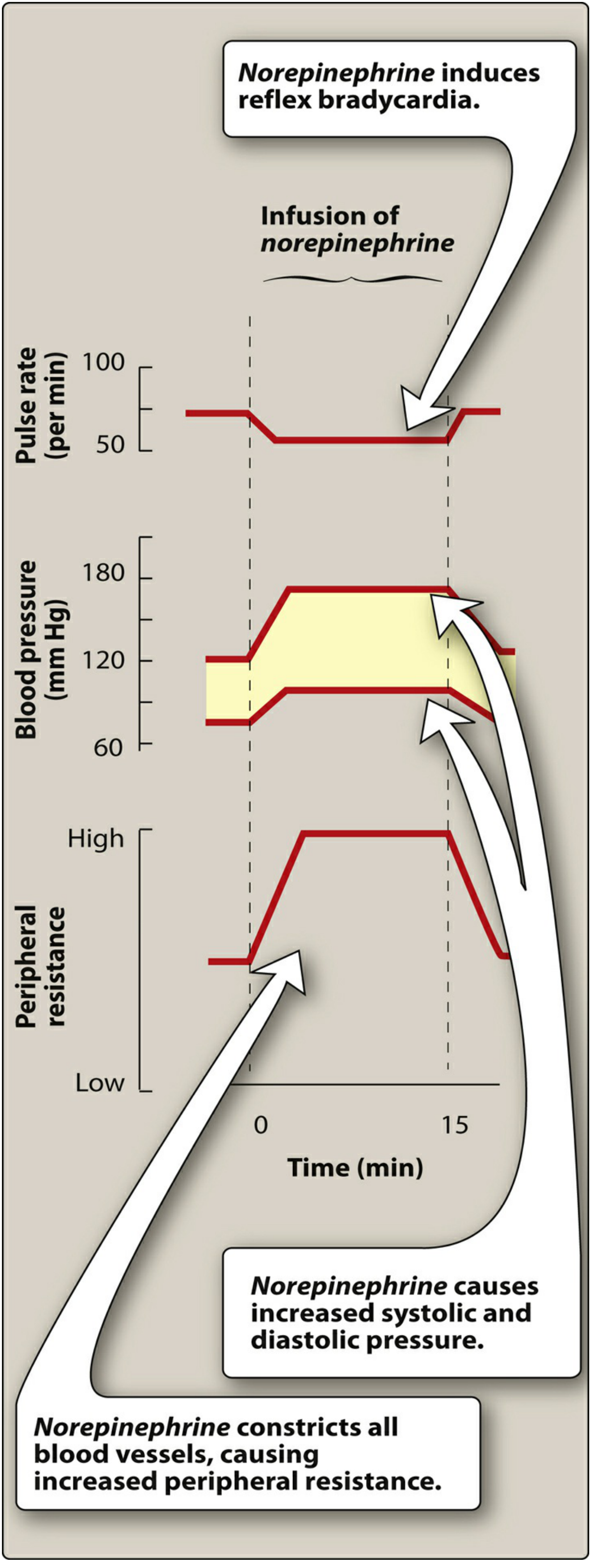
Fig: During NE infusion - peripheral resistance rises, both systolic and diastolic BP rise, and reflex bradycardia occurs. - Lippincott Illustrated Reviews: Pharmacology
2. Indications
- Septic shock - first-line vasopressor of choice (Surviving Sepsis guidelines) when refractory to adequate fluid resuscitation
- Vasodilatory / vasoplegic shock (e.g., post-cardiac surgery vasoplegia, distributive shock)
- Cardiogenic shock - associated with improved outcomes vs. dopamine, especially in cardiogenic shock
- Acute hypotension refractory to fluid resuscitation
- Intraoperative hypotension - has largely replaced phenylephrine as primary intraoperative vasoconstrictor in many centers
It does NOT have a role in bronchospasm or anaphylaxis because of its weak β2 activity. Epinephrine is used for those. - Lippincott Illustrated Reviews: Pharmacology
3. Dosing
| Source | Dose Range |
|---|---|
| Morgan & Mikhail's Clinical Anesthesiology | 2 to 20 mcg/min (= 30-300 ng/kg/min) |
| Current Surgical Therapy | 0.01 to 0.4 mcg/kg/min |
| Tintinalli's Emergency Medicine | Titrated to MAP target |
Practical dosing:
- Starting dose: 0.01-0.1 mcg/kg/min (or 2-4 mcg/min in adults)
- Usual maintenance: 0.1-0.5 mcg/kg/min
- High-dose / refractory shock: up to 1-3 mcg/kg/min (though at these levels, consider adding vasopressin)
- Always titrate to effect - target MAP ≥ 65 mmHg
It must be given as a continuous IV infusion because the half-life is very short (~1-2 minutes); the drug is rapidly metabolized by MAO (monoamine oxidase) and COMT (catechol-O-methyltransferase), with inactive metabolites excreted in urine.
4. How to Give (Administration)
Route
- Central venous access is strongly preferred - extravasation from a peripheral line can cause severe tissue necrosis and gangrene (due to intense local vasoconstriction)
- Peripheral line is a temporizing measure only; switch to CVC as soon as possible
Preparation / Dilution
Standard preparation (most common in ICU/OR):
| Method | How to prepare | Concentration |
|---|---|---|
| Standard concentration | Add 4 mg (1 ampoule of 4 mg/4 mL) to 250 mL NS or D5W | 16 mcg/mL |
| Double concentration | Add 8 mg to 250 mL NS or D5W | 32 mcg/mL |
| High concentration (fluid-restricted patients) | Add 4 mg to 100 mL NS or D5W | 40 mcg/mL |
Ampoules typically contain 4 mg norepinephrine in 4 mL of solution. - Morgan & Mikhail's Clinical Anesthesiology
Dilution example (standard 16 mcg/mL):
- Patient weight 70 kg, starting dose 0.1 mcg/kg/min = 7 mcg/min
- Rate = 7 mcg/min ÷ 16 mcg/mL = ~26 mL/hr
Compatible diluents: Normal saline (NS), Dextrose 5% in water (D5W)
Do NOT mix with alkaline solutions (bicarbonate) - causes degradation
5. Side Effects / Adverse Effects
Cardiovascular
- Reflex bradycardia (most common, from baroreceptor reflex)
- Hypertension (if overdosed)
- Decreased cardiac output - vasoconstriction increases afterload; if LV function is compromised, CO may fall
- Arrhythmias
- Increased myocardial oxygen demand
- Cardiac arrest (with severe overdose)
Tissue Ischemia (serious)
- Peripheral ischemia - fingers, toes (intense vasoconstriction)
- Renal ischemia - reduces renal and splanchnic blood flow (major concern in prolonged use)
- Mesenteric ischemia - gut hypoperfusion
- Tissue necrosis at injection site if extravasation occurs
Treatment of extravasation:
- Phentolamine (α-blocker) - inject intradermally into affected area
- Alternatives: intradermal terbutaline or topical nitroglycerin
Other
- Nausea, vomiting
- Headache
- Anxiety / tremors
6. Key Pharmacokinetic Points
| Property | Value |
|---|---|
| Onset | Almost immediate (IV) |
| Duration of action | 1-2 minutes after infusion stopped |
| Metabolism | MAO + COMT (liver, sympathetic nerve endings) |
| Excretion | Urine (as inactive metabolites) |
| Route | IV infusion ONLY (not IM/SC - causes local necrosis) |
7. Quick Clinical Memory Aid
NE = α1 >>> β1 >> β2 (negligible)

Effect:  ↑BP (systolic + diastolic)
         ↑SVR (vasoconstriction ALL beds)
         ↓HR (reflex bradycardia)
         ↑Inotropy (β1)

1st line: Septic shock
Dose: 0.01-0.5 mcg/kg/min IV infusion
Dilute: 4 mg in 250 mL NS = 16 mcg/mL
Danger: Extravasation → necrosis → use CVC
Antidote for extravasation: Phentolamine
Sources: Lippincott Illustrated Reviews: Pharmacology | Morgan & Mikhail's Clinical Anesthesiology 7e | Tintinalli's Emergency Medicine | Current Surgical Therapy 14e | Goodman & Gilman's Pharmacological Basis of Therapeutics
Drug administration of atropine
Reading File
Searching sources...
Finding Sources
Finding Sources
Great results. Now let me read the most comprehensive sections in parallel - Harriet Lane (pediatric doses), Lippincott (pharmacology), Tintinalli (emergency doses), and Morgan & Mikhail (anesthesia):
Reading File
Reading File
Reading File
Reading File
Now let me read the rest of the Harriet Lane pediatric doses and Lippincott adverse effects section:
Reading File
Reading File
I have comprehensive data. Let me also fetch the dose-effect diagram:
Loading Image
How to dilute atropine how to give
I have the textbook data from the previous search already in context. Let me pull a bit more detail on dilution specifics and ET tube administration.
Searching sources...
Finding Sources
Finding Sources
Finding Sources
Finding Sources
I have all the data needed from the previous session. Here is the complete, practical guide:
Atropine - How to Dilute and How to Give
Available Formulations
| Form | Concentration |
|---|---|
| Vials (injection) | 0.4 mg/mL and 1 mg/mL |
| Prefilled syringe | 0.25 mg/5 mL, 0.5 mg/5 mL, 1 mg/10 mL |
| AtroPen autoinjector (IM) | 0.25 mg, 0.5 mg, 1 mg, 2 mg |
Routes of Administration
| Route | When Used | Notes |
|---|---|---|
| IV push (bolus) | Symptomatic bradycardia, cardiac arrest, organophosphate poisoning | Most common in emergency/ICU settings |
| IM | Pre-medication, organophosphate poisoning (AtroPen), field use | Use 1 mg/mL concentration for IM |
| Endotracheal (ET tube) | When IV/IO access not yet available in arrest | Dilute with NS before giving |
| IO (intraosseous) | Pediatric arrest when no IV access | Same dose as IV |
| Ophthalmic drops | Eye procedures, uveitis | 1% solution (adults), 0.5% solution (children) |
| Nebulized | Bronchospasm (rarely) | Use injectable solution in nebulizer |
How to Dilute
IV Push (most common use)
Atropine is typically given undiluted (ready to use) for IV bolus in emergency settings.
| Preparation | How |
|---|---|
| Standard | Draw up from 0.4 mg/mL or 1 mg/mL vial directly - no dilution needed for IV push |
| If using 1 mg/mL vial for a small dose | Draw up the required volume (e.g., 0.5 mg = 0.5 mL from 1 mg/mL vial) - give undiluted |
| Pediatric IV push | Can dilute with NS to a total of 5-10 mL so the small volume is easier to inject accurately |
IV doses < 0.5 mg and slow injection have been associated with paradoxical bradycardia - always give IV push rapidly (over ~1 minute or as a fast push in arrest). - Tintinalli's Emergency Medicine
Endotracheal (ET Tube) Route
When IV access is unavailable (usually in pediatric or field resuscitation):
- Draw up the dose
- Dilute with Normal Saline to a volume of 1-2 mL
- Instill down the ET tube
- Follow immediately with 1 mL NS flush
- Give several positive pressure breaths to distribute drug into lungs
ET dose = 0.04-0.06 mg/kg (2-3x the IV dose to compensate for less reliable absorption). - Harriet Lane Handbook
Nebulized (for bronchospasm)
- Use the injectable solution directly in the nebulizer
- Dose: 0.025-0.05 mg/kg (max 2.5 mg) in 2.5 mL NS
- Can be mixed with albuterol for simultaneous nebulization
IM (AtroPen autoinjector)
- No dilution needed - inject as-is into the outer thigh
- Can be given through clothing in emergencies (organophosphate poisoning)
How to Give - Dose Summary
Adults
| Indication | Dose | Route | Repeat |
|---|---|---|---|
| Symptomatic bradycardia | 0.5-1 mg IV fast push | IV | Every 5 min PRN; max total 3 mg |
| Pre-medication (before intubation/surgery) | 0.4-0.6 mg (0.01-0.02 mg/kg) | IV or IM | Single dose |
| Organophosphate poisoning | 2-4 mg IV | IV | Repeat every 5-10 min until secretions dry; no maximum in poisoning |
| Bradycardia in arrest | 1 mg IV push | IV | Every 3-5 min; max 3 mg |
Children (Pediatric Doses - Harriet Lane)
| Indication | Dose | Max Single Dose |
|---|---|---|
| Pre-intubation | 0.02 mg/kg IV/IM | 0.5 mg |
| Bradycardia/CPR | 0.02 mg/kg IV/IO Q5 min x 2-3 doses | 0.5 mg (child); 1 mg (adolescent) |
| ET tube route | 0.04-0.06 mg/kg diluted to 1-2 mL NS | - |
| Max total CPR dose | - | 1 mg (child); 2 mg (adolescent) |
| Neonates | 0.01-0.02 mg/kg IV | - |
Note: Atropine is no longer recommended for neonatal bradycardia or for asystole/PEA cardiac arrest. - Harriet Lane Handbook, Tintinalli's
Step-by-Step: Giving Atropine for Bradycardia (Adult)
1. Confirm symptomatic bradycardia (HR < 60 + hypotension/altered LOC/chest pain)
2. Draw up 0.5-1 mg from vial (undiluted)
3. Give IV FAST PUSH (over ~1 minute - do NOT give slowly)
   → Slow push or dose < 0.5 mg can worsen bradycardia (paradoxical effect)
4. Flush line with NS
5. Monitor HR and BP continuously
6. Repeat 0.5-1 mg every 5 min if needed
7. Maximum total dose = 3 mg (full vagal blockade)
8. If no response after 3 mg → consider transcutaneous pacing or dopamine/epinephrine
Key Points to Remember
| Point | Detail |
|---|---|
| Speed of injection | Always fast IV push - slow push causes paradoxical bradycardia |
| Minimum dose | 0.5 mg in adults to avoid paradoxical effect |
| Max adult total | 3 mg (except in organophosphate poisoning - no ceiling) |
| Compatible diluents | Normal saline (NS), D5W |
| Half-life | ~4 hours |
| Onset IV | ~1 minute |
| Duration | 30-60 minutes (cardiovascular effects) |
| Do NOT use in | Glaucoma (angle-closure), obstructive uropathy, tachycardia, thyrotoxicosis |
Dose-Effect by Amount (Adults)
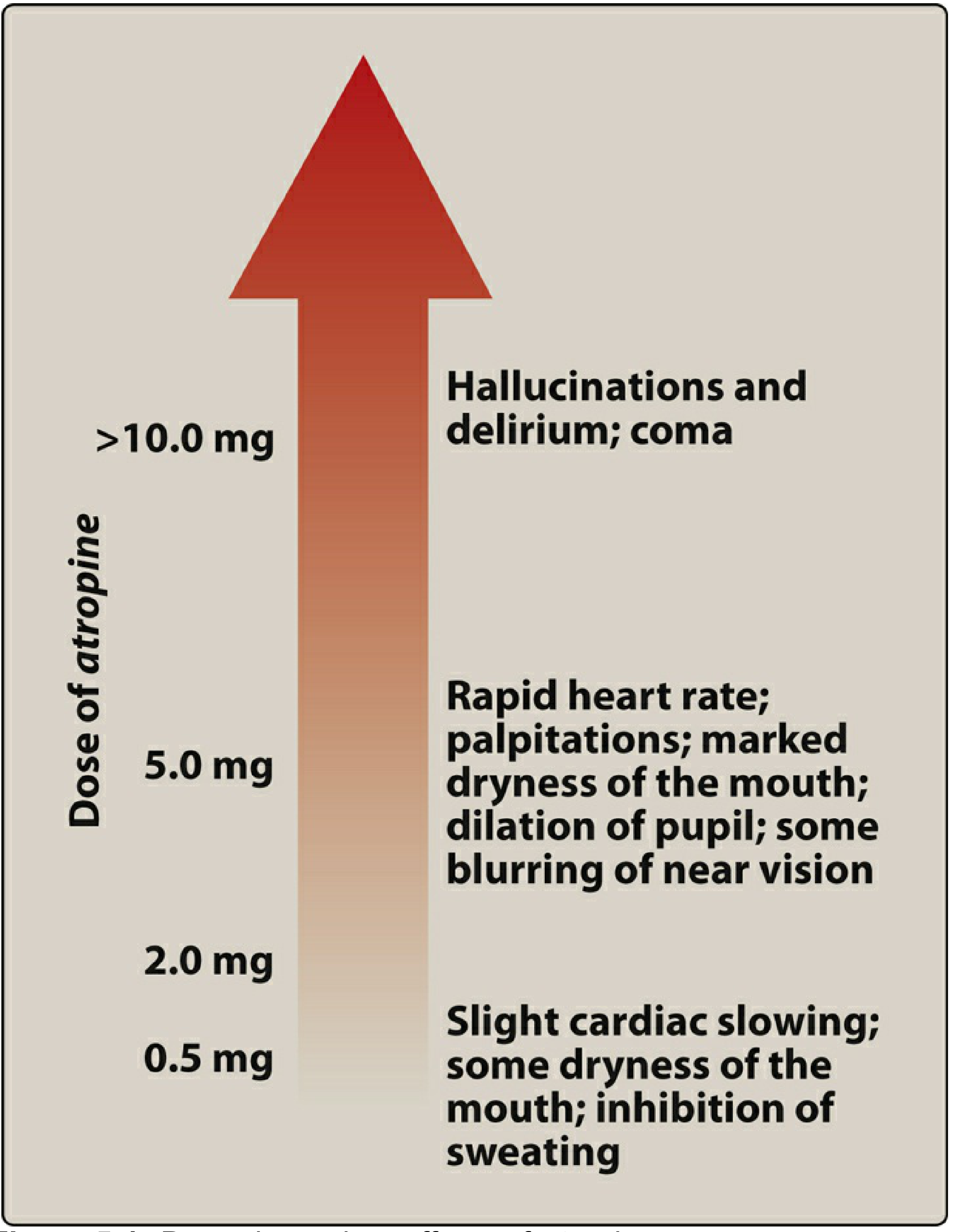
Dose-dependent effects of atropine - Lippincott Illustrated Reviews: Pharmacology
Sources: Harriet Lane Handbook 23rd Ed | Morgan & Mikhail's Clinical Anesthesiology 7e | Tintinalli's Emergency Medicine | Lippincott Illustrated Reviews: Pharmacology | Barash's Clinical Anesthesia 9e
This is a shared conversation. Sign in to Orris to start your own chat.