
Vericose vein classification
Reading File
Now let me search the medical library and web in parallel.
Finding Sources
Searching the Web
varicose vein classification CEAP grading system clinical
Finding Sources
Searching the Web
varicose veins classification types Sapheno femoral Trendelenburg Homan grading surgical
Finding Sources
Reading Web Page
https://thewhiteleyclinic.co.uk/news-articles/ceap-classific…
Finding Sources
Reading File
Reading File
Reading File
Reading File
Reading File
Finding Sources
I now have comprehensive information from multiple authoritative sources. Let me compile the full answer.
Loading Image
Here is a comprehensive overview of varicose vein classification.
Varicose Vein Classification
Varicose veins are subcutaneous, dilated, tortuous veins ≥3 mm in diameter, involving the saphenous veins, their tributaries, or non-saphenous superficial leg veins. The gold standard for classifying the full spectrum of chronic venous disease (CVD) is the CEAP system, modeled after the TNM staging system for cancer.
1. CEAP Classification (Primary System)
CEAP stands for Clinical, Etiology, Anatomy, Pathophysiology. It was introduced in 1994, revised in 2004, and updated again in 2020 (Lurie et al., J Vasc Surg Venous Lymphat Disord).
C - Clinical Classification
This is the most widely used component in everyday practice:
| Class | Description |
|---|---|
| C0 | No visible or palpable signs of venous disease |
| C1 | Telangiectasias or reticular veins |
| C2 | Varicose veins (the classic "varicose vein" grade) |
| C2r | Recurrent varicose veins (added in 2020 revision) |
| C3 | Edema (venous origin) |
| C4 | Changes in skin and subcutaneous tissue secondary to CVD |
| C4a | Pigmentation or eczema |
| C4b | Lipodermatosclerosis or atrophie blanche |
| C4c | Corona phlebectatica (added in 2020 revision) |
| C5 | Healed venous ulcer |
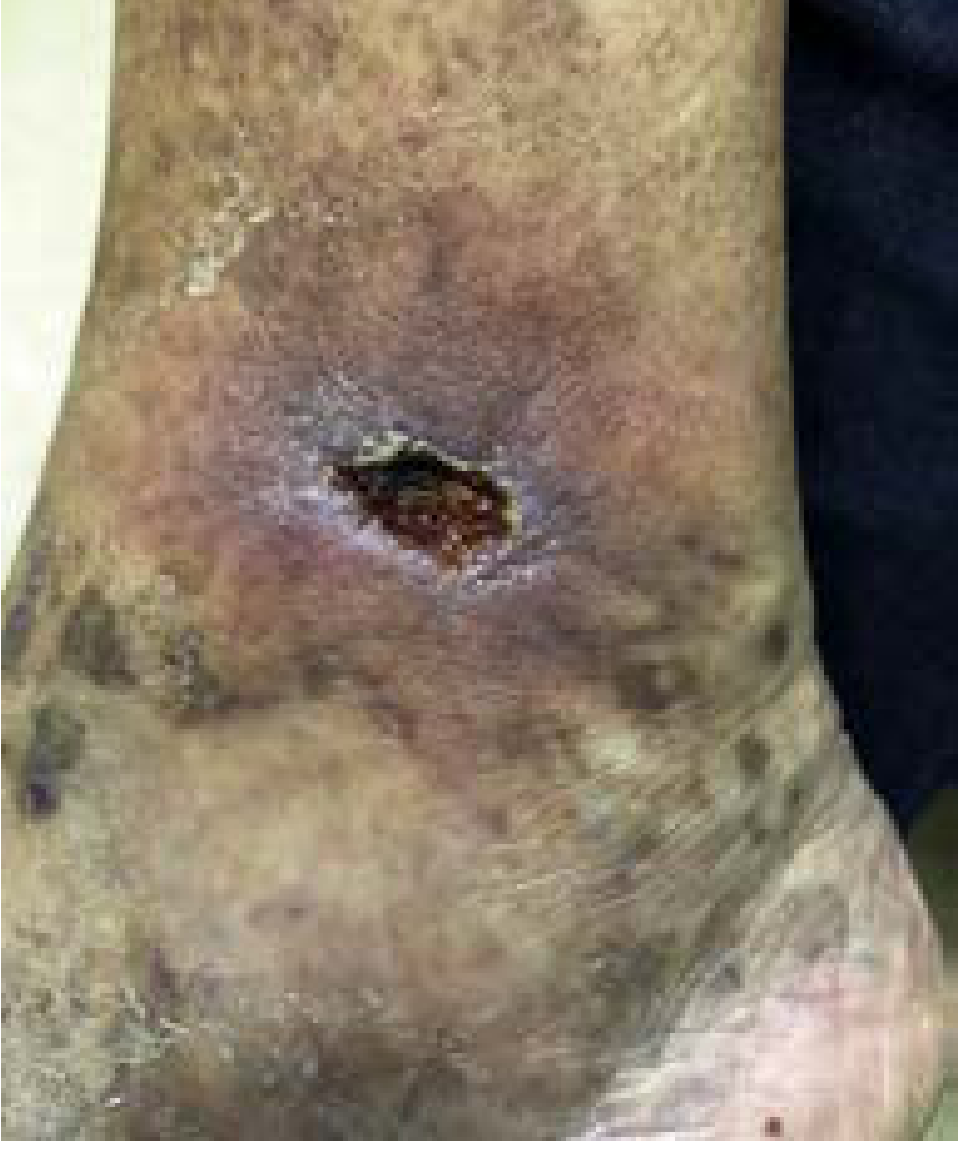
| C6 | Active venous ulcer |
| C6r | Recurrent active venous ulcer (added in 2020 revision) |
- A suffix "s" (symptomatic) or "a" (asymptomatic) is added, e.g., C2s or C2a.
- Varicose veins proper = C2. Skin changes begin at C4. Ulceration is C5-C6.
C6 Active Venous Ulcer (CEAP C6):
E - Etiologic Classification
| Code | Meaning |
|---|---|
| Ep | Primary (degenerative valve dysfunction, most common) |
| Es | Secondary (post-thrombotic, post-traumatic) |
| Es-i | Secondary - intravenous cause |
| Es-e | Secondary - extravenous cause (e.g., May-Thurner, Nutcracker syndrome) |
| Ec | Congenital (e.g., Klippel-Trenaunay syndrome, Ehlers-Danlos) |
| En | No cause identified |
A - Anatomic Classification
| Code | Location |
|---|---|
| As | Superficial veins (great saphenous, small saphenous, tributaries) |
| Ap | Perforator veins |
| Ad | Deep veins |
| An | No venous anatomic location identified |
P - Pathophysiologic Classification
| Code | Mechanism |
|---|---|
| Pr | Reflux (most common - valve incompetence) |
| Po | Obstruction |
| Pr,o | Both reflux and obstruction |
| Pn | No pathophysiology identified |
Pathologic reflux is defined as reversal of flow for:
-
500 ms in perforator veins
-
500 ms in truncal superficial veins
-
1000 ms in deep veins
2. Clinical Types by Morphology (Descriptive Classification)
Before or alongside CEAP, clinicians describe venous disease morphologically:
| Type | Size | Appearance |
|---|---|---|
| Telangiectasias (spider veins) | <1 mm | Intradermal, red/purple, flat |
| Reticular veins | 1-3 mm | Subdermal, bluish-green, non-palpable |
| Varicose veins | ≥3 mm | Subcutaneous, tortuous, palpable, blue/green |
| Truncal varicosities | Often >5 mm | Along great/small saphenous trunk |
| Branch varicosities | Variable | Tributaries of the main trunks |
3. Etiological Classification (Clinical Context)
| Type | Cause |
|---|---|
| Primary | Intrinsic valve weakness/degeneration; no underlying cause |
| Secondary | Post-DVT (post-thrombotic syndrome), trauma |
| Congenital | Arteriovenous malformations, Klippel-Trenaunay syndrome |
4. Anatomical Classification by Vessel Involved
| System | Vessels |
|---|---|
| Great Saphenous System | GSV and tributaries (medial thigh/calf) |
| Small Saphenous System | SSV and tributaries (posterior calf) |
| Perforating veins | Cockett's, Boyd's, Dodd's perforators |
| Deep veins | Femoral, popliteal, tibial (when involved) |
5. Venous Clinical Severity Score (VCSS / r-VCSS)
A complementary scoring tool (not a standalone classification) that grades 10 attributes (pain, varicose veins, edema, skin pigmentation, inflammation, induration, ulcer number/size/duration, compression use) on a 0-3 scale. It is used for outcome measurement and tracking treatment response rather than initial classification.
Key Points for Exams / Clinical Practice
- CEAP C2 = true varicose veins (the clinically significant threshold for treatment decisions)
- CEAP C3-C6 = advanced CVI warranting graded compression (30-40 mmHg) and often intervention
- Skin manifestations are uncommon with ambulatory venous pressure (AVP) <35 mmHg but near-universal with AVP >90 mmHg
- The 2020 revision added C2r (recurrent VV), C4c (corona phlebectatica), and C6r (recurrent active ulcer)
- Duplex ultrasonography (standing position) is the essential diagnostic test - determines CEAP A and P components
Sources: Current Surgical Therapy 14e (Table 1, Revised 2020 CEAP); Harrison's Principles of Internal Medicine 22E (Table 293-1); Dermatology 2-Volume Set 5e (Table 155.1); Lurie et al. 2020 CEAP update
This is a shared conversation. Sign in to Orris to start your own chat.