
Bed sore
Reading File
Now let me search the medical library and PubMed in parallel for comprehensive coverage of bed sores (pressure ulcers/injuries).
Finding Sources
Searching PubMed
"pressure ulcer" OR "pressure injury" prevention treatment
Good results. Let me read the most clinically relevant sources in parallel - the Andrews' Dermatology section, the Goldman-Cecil Medicine section, and the Forensic Pathology section (for staging detail).
Reading File
Reading File
Reading File
Excellent - the Forensic Pathology book has detailed staging content. Let me read more of it to get the full staging system and images.
Reading File
Finding Sources
I have images of the staging. Let me fetch them and also read more of the forensic text for the remaining staging details and complications.
Loading Image
Reading File
I now have comprehensive content. Let me also fetch the Stage 4 images quickly.
Loading Image
I now have comprehensive information to provide a thorough answer. Here is the complete overview:
Bed Sores (Decubitus Ulcers / Pressure Injuries)
A bed sore - also called a pressure ulcer, pressure sore, or decubitus ulcer - is the breakdown of skin and underlying tissue caused by prolonged mechanical pressure leading to ischemia.
Pathophysiology
Tissue damage begins when pressure on soft tissue exceeds 32 mmHg, closing both capillary blood flow and lymphatic drainage. This cuts off oxygen delivery and allows metabolic waste to accumulate. If sustained for more than 2 hours, irreversible tissue damage occurs.
Three main mechanical forces contribute:
| Force | Mechanism |
|---|---|
| Pressure | Direct compression over bony prominences; most common cause |
| Shearing | Sliding of tissue layers over each other, stretching/thrombosing blood vessels (e.g., when bed head is raised and patient slides down) |
| Friction + Moisture | Incontinence (urine/feces) reduces skin resistance fivefold; moisture from perspiration fixes superficial skin while deeper layers shear |
- DiMaio's Forensic Pathology, 3rd Ed.
Risk Factors
Over 100 risk factors have been identified. The major ones are:
- Depressed sensory or motor function (spinal cord injury, stroke, coma)
- Altered consciousness
- Malnutrition - causes muscle atrophy and loss of subcutaneous padding; obesity also increases risk due to poor vascularization of adipose tissue
- Moisture (urinary/fecal incontinence) - multiplies risk 5x
- Pressure over bony prominences
- Shearing forces
- Diabetes mellitus, peripheral vascular disease, cerebrovascular disease, sepsis, hypotension
Common Sites
- ~95% develop on the lower body
- 65% in the pelvic area (sacrum and coccyx most common, especially for stages 3-4)
- 30% on the legs (greater trochanters, heels)
- Ischial tuberosities in wheelchair-bound patients
Staging (4-Stage System)
| Stage | Description |
|---|---|
| Stage 1 | Non-blanching erythema lasting >24h; skin intact; edema/induration present. Treatable; does not imply neglect. |
| Stage 2 | Partial-thickness skin loss - ranges from blister to shallow ulcer involving epidermis ± dermis; does NOT penetrate into subcutaneous fat. Readily treatable. |
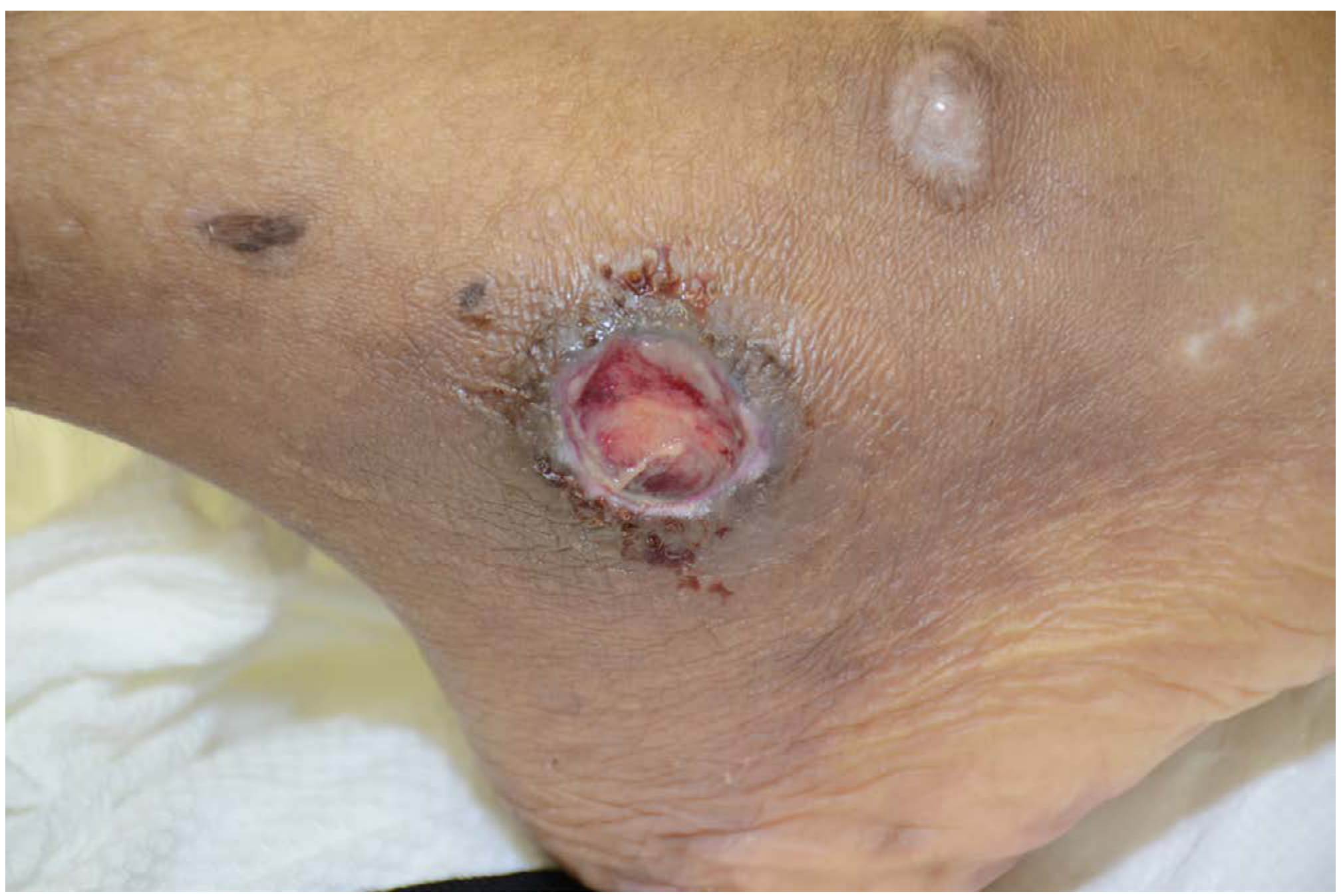
| Stage 3 | Full-thickness ulcer through skin and subcutaneous fat down to fascia; usually necrotic, foul-smelling, infected; undermining common. |
| Stage 4 | Full-thickness ulcer extending through fascia into muscle, bone, tendon, or joint capsule; osteomyelitis may develop. |
Stages 3 and 4 can be indicative of poor nursing care/neglect, depending on patient factors and circumstances. They develop principally on the sacrum (69.6% of stages 3-4 cases).
Stage 3 Decubitus Ulcer:
Stage 4 Decubitus Ulcer:
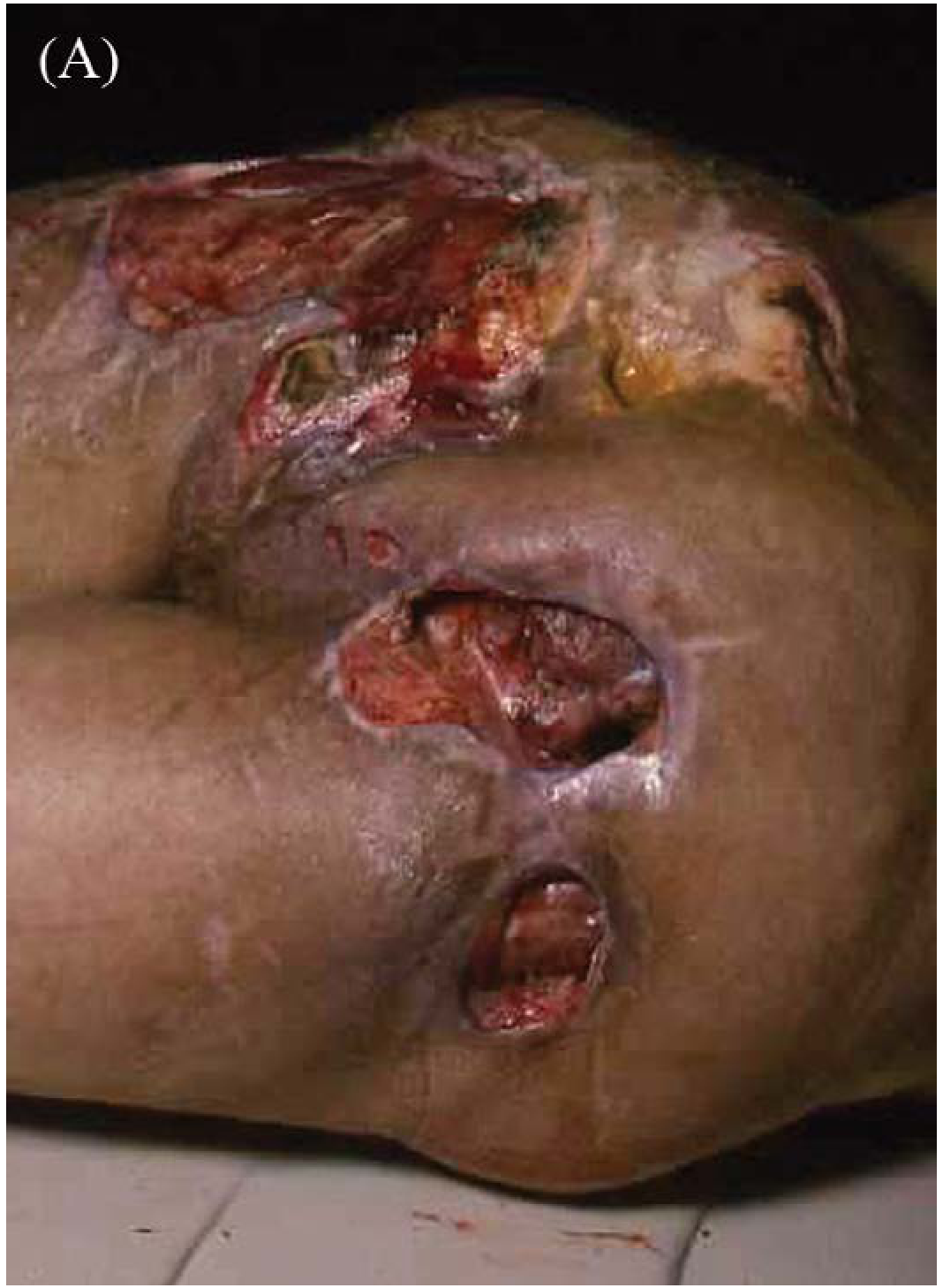
(Images: DiMaio's Forensic Pathology, 3rd Ed., Figures 18.3 and 18.4)
Complications
- Septicemia (most serious; often underreported)
- Local infection and bacteremia
- Osteomyelitis (especially stage 4)
- Fistulas
- Squamous cell carcinoma (SCC) arising in chronic wounds (Marjolin ulcer)
- Fluid and protein loss - stages 2-4 all lose fluids and proteins; severity correlates with stage
- Andrews' Diseases of the Skin; DiMaio's Forensic Pathology
Prevention
The cornerstone is pressure redistribution:
- Reposition in bed at minimum every 2 hours; in wheelchair every 1 hour
- Maintain adequate nutrition and hydration
- Keep skin dry - prevent lying in urine/feces
- Do not raise the bed head too high (promotes shearing)
- Provide extra padding over bony prominences
- Use air-filled products, liquid-filled flotation devices, or foam mattresses
- Identify and monitor at-risk patients early
Recent evidence supports care bundles (structured multi-component interventions) as more effective than single-component approaches (Chaboyer et al., 2024, PMID: 38642429).
Treatment
| Component | Details |
|---|---|
| Pressure relief | Frequent repositioning; pressure-redistributing mattresses/cushions |
| Wound debridement | Sharp, mechanical, enzymatic, or autolytic - at least weekly. Exception: stable dry heel eschar - do not debride |
| Wound cleaning | Normal saline preferred over peroxide or povidone-iodine |
| Dressings | Keep wound tissue moist, surrounding skin dry |
| Dressing types | Films (stage II only) - Alginates, foams, hydrogels, hydrofibers, hydrocolloid (stage III-IV for hydrofibers) |
| Infection control | Topical metronidazole eliminates anaerobic odor within 36 hours |
| Nutrition | Adequate protein/caloric intake is essential for healing |
| Surgical repair | Flaps and reconstructive procedures for advanced wounds |
| Adjuvant therapies | Ultrasound, hyperbaric oxygen, electrical stimulation, growth factors, skin substitutes (under investigation) |
- Andrews' Diseases of the Skin, p. 53
Epidemiology
- Incidence in nursing homes: ~7-8% (some studies up to 11.2%)
- 73% of all stage 4 sores occur in patients aged 80 years and older
- Pressure sores are frequently underreported and underdiagnosed on admission
Recent evidence (2024-2026): A meta-analysis (PMID 38642429) confirms that pressure injury prevention care bundles significantly reduce hospital-acquired pressure injuries, supporting multi-component over single-intervention strategies.
This is a shared conversation. Sign in to Orris to start your own chat.