
Relation of retina and diabetes
Reading File
Now let me search the library in parallel across headings and paragraphs for diabetic retinopathy content.
Finding Sources
Finding Sources
Good. Now let me read the most comprehensive sources in parallel — the Kanski ophthalmology section and the Goldman-Cecil section on classification/management, plus Harrison's:
Reading File
Reading File
Reading File
The Goldman-Cecil file has very rich content. Let me read the Kanski ophthalmology section for detailed clinical signs and pathogenesis, and also search for relevant images:
Reading File
Searching Images
diabetic retinopathy fundus classification stages
Now let me read more from the detailed Kanski ophthalmology section on pathogenesis, classification, and signs:
Reading File
The Kanski block ends at line 7566, so I need to read the next block for the full pathogenesis/classification/signs/treatment content:
Reading File
I now have comprehensive content from multiple authoritative sources. Let me compile a thorough answer.
Diabetic Retinopathy: Relation of the Retina and Diabetes
Overview
Diabetic retinopathy (DR) is the most common cause of new blindness in industrialised countries among working-age adults. It is a pathognomonic microvascular complication that eventually affects more than 50% of people with long-standing diabetes. With effective screening and treatment (ETDRS, anti-VEGF trials), the risk of severe visual loss can be reduced to less than 5%.
— Kanski's Clinical Ophthalmology, 10th Ed.
Pathogenesis
DR is predominantly a microangiopathy — small retinal blood vessels are particularly vulnerable to damage from sustained hyperglycaemia. Key mechanisms include:
| Mechanism | Details |
|---|---|
| Pericyte loss | Supporting cells of retinal capillaries are lost early |
| Basement membrane thickening | Structural weakening of vessel walls |
| Altered retinal blood flow | Leads to areas of ischaemia |
| Capillary leak | Protein, red blood cells, and lipids leak → retinal oedema |
| Capillary occlusion | Causes chronic retinal hypoxia |
| Neovascularisation | VEGF-driven; new vessels are fragile and rupture-prone |
VEGF (Vascular Endothelial Growth Factor) is the principal angiogenic mediator driving neovascularisation.
— Goldman-Cecil Medicine; Kanski's Clinical Ophthalmology
Ophthalmic Complications of Diabetes
Common:
- Diabetic maculopathy — diabetic macular oedema (DMO) and macular ischaemia
- Retinopathy — neovascularisation of disc/retina, vitreous haemorrhage
- Unstable refraction (osmotic refractive changes — common at diagnosis or with high glucose)
Uncommon/Rare:
- Accelerated age-related cataract
- Tractional retinal detachment
- Neovascular glaucoma (NVG)
- Ocular motor nerve palsies (CN III or VI — due to diabetic mononeuropathy)
- Neovascularisation of the iris (rubeosis iridis)
- Reduced corneal sensitivity
- Diabetic papillopathy
Classification (ETDRS / International Classification)
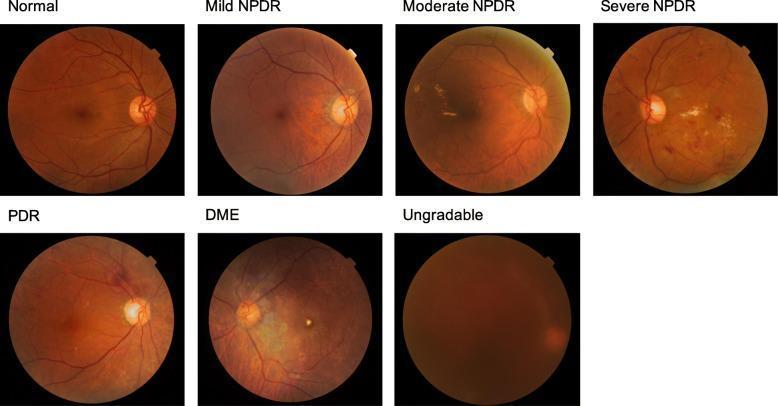
Non-Proliferative Diabetic Retinopathy (NPDR)
| Stage | Key Features | Follow-up |
|---|---|---|
| No DR | Normal | 12 months |
| Very Mild NPDR | Microaneurysms only | 12 months |
| Mild NPDR | Microaneurysms, dot/blot haemorrhages, exudates, cotton-wool spots | 6–12 months |
| Moderate NPDR | Severe haemorrhages, soft exudates, venous beading, IRMA | ~6 months |
| Severe NPDR | >20 intraretinal haemorrhages in all 4 quadrants, OR venous beading in ≥2 quadrants, OR prominent IRMA (4-2-1 rule) | Refer to retinal specialist |
Proliferative Diabetic Retinopathy (PDR)
- Neovascularisation of the disc (NVD) and/or new vessels elsewhere (NVE)
- High-risk PDR: vitreous/pre-retinal haemorrhage, NVD >1/3 disc area, or NVE >1/2 disc area
Advanced Diabetic Eye Disease
- Tractional retinal detachment
- Persistent vitreous haemorrhage
- Neovascular glaucoma
Clinically Significant Macular Oedema (CSMO)
- Retinal thickening or hard exudates at or approaching the centre of the macula — can occur at any stage
— Kanski's Clinical Ophthalmology; Goldman-Cecil Medicine
Clinical Signs (Fundoscopic Findings)
| Sign | Significance |
|---|---|
| Microaneurysms | Earliest sign; tiny red dots from capillary wall outpouchings |
| Dot and blot haemorrhages | Intraretinal blood from ruptured capillaries |
| Hard exudates | Lipid/protein leakage — yellow waxy deposits |
| Cotton-wool spots | Nerve fibre layer infarcts from capillary occlusion |
| Venous beading | Irregular venous calibre — sign of significant ischaemia |
| IRMA | Intraretinal microvascular anomalies — shunts bypassing ischaemic areas |
| Neovascularisation | Hallmark of PDR — frond-like new vessels |
| Vitreous/preretinal haemorrhage | Ruptured new vessels |
| Traction retinal detachment | Fibrovascular membrane contraction |
Risk Factors for Diabetic Retinopathy
- Duration of diabetes — most important predictor; DR rarely develops within 5 years of onset
- Poor glycaemic control (high HbA1c) — DCCT and UKPDS confirmed tight control prevents/delays DR
- Hypertension — accelerates progression
- Dyslipidaemia — elevated triglycerides worsen macular exudates
- Nephropathy — co-prevalence especially in type 1 DM
- Pregnancy — can accelerate retinopathy; screening required before and during
- Puberty — DR rare before puberty
- Type of diabetes — more common in type 1 than type 2, but type 2 has larger absolute numbers
Paradoxical Worsening with Glycaemic Improvement
A sudden improvement in blood glucose control can cause transient worsening of retinopathy in the first 6–12 months. Long-term, improved control is beneficial. GLP-1 receptor agonists (when associated with marked glycaemic improvement) have been associated with increased risk of worsening DR — this should be factored into choice of therapy. Patients may be candidates for prophylactic laser photocoagulation before rapid normalisation (e.g., prior to pancreas/islet transplantation).
— Harrison's Principles of Internal Medicine, 22nd Ed.
Screening Recommendations
| Diabetes Type | Start Screening |
|---|---|
| Type 2 DM | At diagnosis (hyperglycaemia may have been present years before clinical recognition) |
| Type 1 DM | 5 years after diagnosis |
| Pregnancy | Before and during pregnancy |
- Routine non-dilated exams are inadequate — requires dilated fundus exam or retinal photography with remote reading
- Significant retinopathy can be present with no symptoms — Harrison's; Goldman-Cecil Medicine
Treatment
| Modality | Indication |
|---|---|
| Glycaemic control | Primary prevention and slowing progression |
| Blood pressure control | Reduces progression |
| Panretinal laser photocoagulation (PRP) | Severe NPDR and PDR; ablates ischaemic retina to reduce VEGF drive |
| Anti-VEGF agents (ranibizumab, aflibercept, bevacizumab — intravitreal injection) | Diabetic macular oedema; proliferative DR; equally successful as laser |
| Focal/grid laser | Clinically significant macular oedema |
| Vitrectomy | Vitreous haemorrhage, traction retinal detachment involving macula |
| Fenofibrate | May reduce DR progression (lowers triglycerides) |
| Aspirin | Does NOT influence natural history; antiplatelet agents can be continued with intravitreal injections |
— Harrison's Principles of Internal Medicine; Goldman-Cecil Medicine; Kanski's Clinical Ophthalmology
Key Takeaways
- DR is a microvascular complication driven by chronic hyperglycaemia and mediated largely by VEGF
- It progresses through well-defined stages: No DR → Mild NPDR → Moderate NPDR → Severe NPDR → PDR → Advanced disease
- Macular oedema is the leading cause of visual impairment; proliferative disease causes blindness via haemorrhage and traction
- DR is largely asymptomatic until late stages — screening is essential
- Treatment is highly effective when started early; most blindness from DR is preventable
This is a shared conversation. Sign in to Orris to start your own chat.