
Write short note mc burning point
Reading File
The query is about "burning point" which could be a chemistry/physics concept (ignition/flash/burning point of substances) or a medical topic. Let me search the library and web simultaneously.
Finding Sources
Searching the Web
burning point definition chemistry fire point flash point difference
The query "mc burning point" likely refers to the fire point (also called burning point) in the context of chemistry/petroleum/fire science - a common short-note topic in competitive exams. Here is a well-structured short note:
Short Note: Burning Point (Fire Point)
Definition
The burning point (also called the fire point) is the lowest temperature at which a liquid produces sufficient vapour to sustain continuous combustion after the ignition source is removed. It is slightly higher than the flash point.
Key Concepts
1. Flash Point vs. Burning Point vs. Auto-ignition Temperature
| Property | Definition | Ignition Source Needed? | Sustained Burning? |
|---|---|---|---|
| Flash Point | Lowest temp at which vapour momentarily ignites | Yes | No (flash only) |
| Burning Point (Fire Point) | Lowest temp at which vapour burns continuously | Yes | Yes |
| Auto-ignition Temperature | Temp at which substance ignites spontaneously | No | Yes |
- Burning Point > Flash Point (usually by 5-10°C)
- Auto-ignition Temperature > Burning Point
2. Mechanism
- As a flammable liquid is heated, it produces vapour above its surface.
- At the flash point, vapour briefly ignites but the rate of vapour production is too low to sustain the flame.
- At the burning point, enough vapour is produced continuously to keep the flame alive even after the ignition source is removed.
3. Significance
- Used in fire hazard classification of liquids (petroleum, solvents, oils).
- Important in petroleum refining, storage, and transport safety.
- Helps determine safe handling temperatures for flammable chemicals.
- Regulatory standards (ASTM, IS codes) use fire point data for labelling dangerous goods.
4. Measurement
- Measured using the Cleveland Open Cup (COC) apparatus.
- The liquid is placed in an open cup, heated gradually, and a small flame is passed over it at regular intervals.
- The temperature at which the liquid continues to burn for at least 5 seconds after the flame is removed is recorded as the burning/fire point.
5. Examples
| Substance | Flash Point (°C) | Burning/Fire Point (°C) |
|---|---|---|
| Diesel | 52 | ~57 |
| Lubricating oil | ~200 | ~215 |
| Kerosene | 38 | ~43 |
Summary
The burning point is a key safety parameter indicating the temperature at which a flammable liquid will sustain combustion. It is always higher than the flash point and is measured using open-cup methods. It is widely used in petroleum, chemical, and fire safety industries to classify and manage fire risks.
In abdomen
The user is asking about "burning point in abdomen" - this is a medical question about a burning sensation/pain in the abdomen. Let me search the medical library.
Finding Sources
Finding Sources
The user seems to be asking about burning/fire-related injuries or effects in the abdomen - likely in the context of burns involving the abdomen or possibly intra-abdominal effects of burning. Let me clarify the context and also search more specifically.
Finding Sources
Finding Sources
Searching the Web
burning point abdomen forensic medicine short note
The web search returned McBurney's point - that is almost certainly what the user means! "mc burning point" = McBurney's point in abdomen. Let me now do a proper search on McBurney's point.
Finding Sources
Excellent! Now I have rich content. Let me read the most detailed sections from multiple textbooks.
Reading File
Reading File
Reading File
I now have excellent content. Let me also fetch the anatomical illustration of McBurney's point.
Loading Image
Now I have everything needed. Here is a complete short note on McBurney's Point in the abdomen:
Short Note: McBurney's Point
Definition
McBurney's point is a surface anatomical landmark on the anterior abdominal wall that marks the point of maximum tenderness in acute appendicitis. It is located at the junction of the lateral one-third and medial two-thirds of a line drawn from the right anterior superior iliac spine (ASIS) to the umbilicus - in other words, one-third of the distance from the ASIS to the navel.
- Rosen's Emergency Medicine: "The McBurney point classically represents the point of maximal tenderness in appendicitis."
Historical Background
- First described by Charles McBurney in 1889, when he published his recommendation for early laparotomy in appendicitis.
- He defined it as the point of "maximum tenderness, one half to 2 inches inside the right anterior spinous process of the ilium on a line drawn from the umbilicus."
- It corresponds roughly to the base of the appendix where it attaches to the cecum.
(Sleisenger and Fordtran's Gastrointestinal and Liver Disease)
Anatomical Location
| Line | Right ASIS to umbilicus |
| Position | 1/3 from the ASIS (or 2/3 from the umbilicus) |
| Quadrant | Right iliac fossa / Right Lower Quadrant (RLQ) |
Note: The origin of the appendix can vary as much as 10 cm from the McBurney point, which limits its diagnostic reliability in atypical positions.
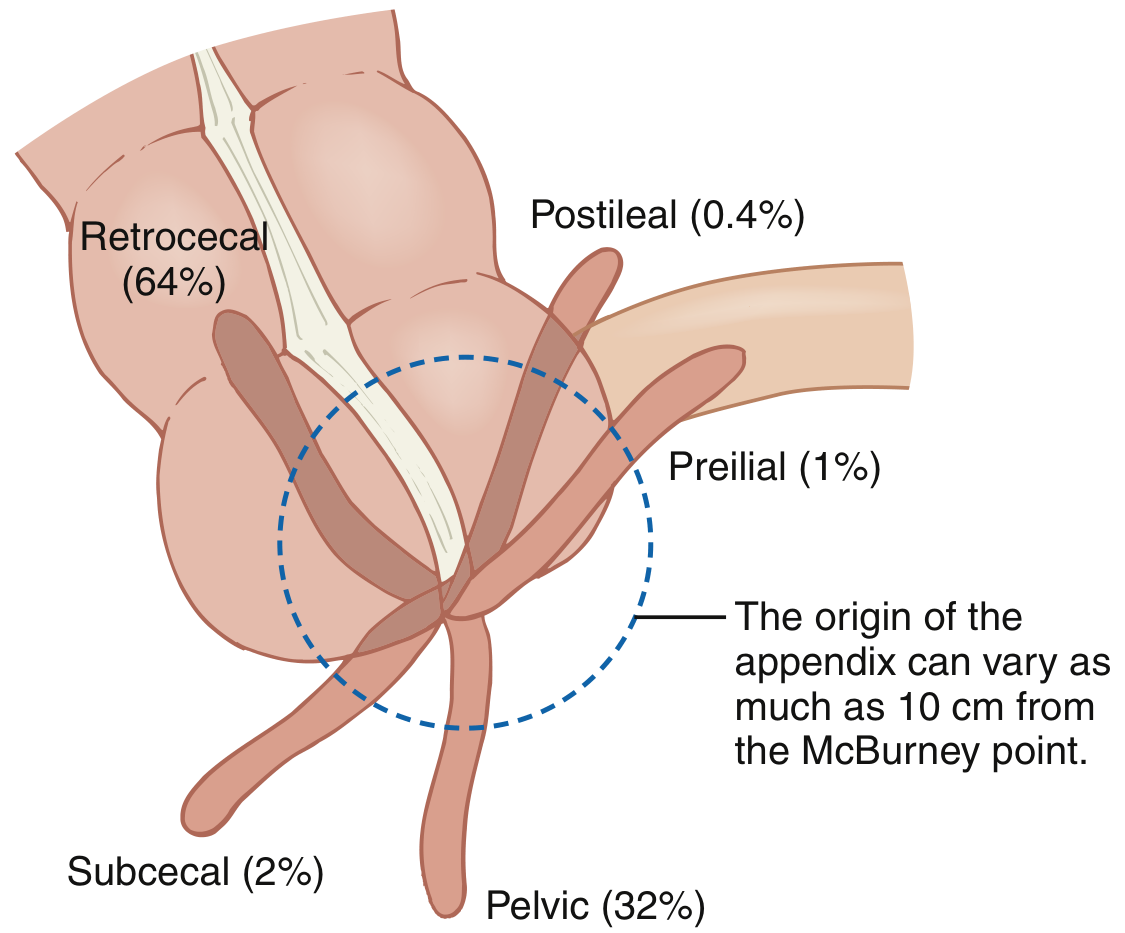
McBurney's Sign
McBurney's sign = deep tenderness elicited by firm palpation at McBurney's point.
- This is a classic physical finding in acute appendicitis.
- It indicates parietal peritoneal irritation when the inflamed appendix lies in its typical location.
- As described in Robbins Pathology: "Deep tenderness located two-thirds of the distance from the umbilicus to the right anterior superior iliac spine (McBurney point)."
Clinical Significance in Appendicitis
Pain Progression
- Early stage: Periumbilical, diffuse, colicky pain (T10 visceral nerve stimulation from luminal distension)
- Later stage: Pain migrates and localizes to McBurney's point as somatic parietal peritoneum becomes involved
- Perforation: Pain becomes diffuse (peritonitis)
Why Pain Localizes Here
- As appendiceal wall pressure exceeds capillary pressure, ischemia and transmural inflammation extend to the adjacent parietal peritoneum
- Parietal peritoneum is somatically innervated - pain becomes sharp and well localized at McBurney's point
Limitations
- Not reliable when the appendix is in an atypical position:
- Retrocecal (64%): may cause right flank or back pain
- Pelvic (32%): may cause pelvic, testicular, or adnexal pain
- Retrocecal: may show psoas sign or obturator sign instead
- Tenderness at McBurney's point has only modest predictive value due to variable appendix position
- Less reliable in women (may mimic ovarian torsion or cystic disease), young children, and the elderly
McBurney's Incision
The McBurney's point also gives the name to the McBurney's incision (also called gridiron incision):
- A muscle-splitting incision made perpendicular to the line from ASIS to umbilicus, centered at McBurney's point
- Used for open appendectomy
- Advantages: minimal muscle damage, strong wound due to opposing muscle fiber directions
Summary Table
| Feature | Details |
|---|---|
| Named after | Charles McBurney (1889) |
| Location | 1/3 from ASIS on line to umbilicus |
| Clinical sign | McBurney's sign - deep tenderness |
| Disease | Acute appendicitis |
| Limitation | Variable appendix position (up to 10 cm shift) |
| Incision | Gridiron/McBurney's incision for appendectomy |
This is a shared conversation. Sign in to Orris to start your own chat.