
What is the cource of sciatic nerve
The sciatic nerve is the largest nerve in the body. It arises from the sacral plexus, formed by the anterior rami of L4, L5, S1, S2, and S3 nerve roots. It exits the pelvis through the greater sciatic foramen, below the piriformis muscle, and runs down the posterior thigh before dividing into the tibial and common peroneal (fibular) nerves, usually at the popliteal fossa.
Searching sources...
Reading File
Finding Sources
Searching the Web
sciatic nerve course anatomy origin
Reading File
Reading File
Reading File
Reading File
Now let me fetch the anatomical diagram of the sciatic nerve to include in the answer:
Loading Image
Here is a complete account of the course of the sciatic nerve, drawn from Gray's Anatomy for Students and supplemented with web sources:
Course of the Sciatic Nerve
Origin
The sciatic nerve is the largest nerve in the body (~2 cm wide). It arises from the sacral plexus, formed by the anterior (ventral) rami of L4, L5, S1, S2, and S3.
It is structurally two nerves in one sheath:
- Tibial nerve component - from anterior divisions of L4-S3
- Common fibular (peroneal) nerve component - from posterior divisions of L4-S2
Step-by-Step Course
1. Pelvis
The nerve forms within the pelvis from the sacral plexus on the anterior surface of the piriformis muscle.
2. Exit from the Pelvis
It leaves the pelvis through the greater sciatic foramen, passing inferior to the piriformis muscle (in ~88% of people). It lies between the superficial (gluteus maximus) and deep group of gluteal muscles.
3. Gluteal Region
- It crosses the posterior surfaces of the obturator internus + gemelli muscles, then the quadratus femoris muscle
- At the midpoint between the ischial tuberosity and the greater trochanter, it lies just deep to gluteus maximus
- At the lower border of quadratus femoris, it enters the posterior thigh
4. Posterior Thigh
The sciatic nerve descends in the posterior compartment of the thigh, supplying all the hamstring muscles:
- Biceps femoris (long and short heads)
- Semitendinosus
- Semimembranosus
- Ischial part of adductor magnus
5. Terminal Division
The nerve divides into its two terminal branches - usually at the apex of the popliteal fossa (lower third of thigh), though in ~10% of individuals the division occurs higher, even at the greater sciatic foramen:
- Tibial nerve - continues down the posterior leg, supplying calf muscles and sole of the foot
- Common fibular (peroneal) nerve - winds around the neck of the fibula to supply the anterior and lateral compartments of the leg
Anatomical Diagram (Gluteal Region - Posterior View)
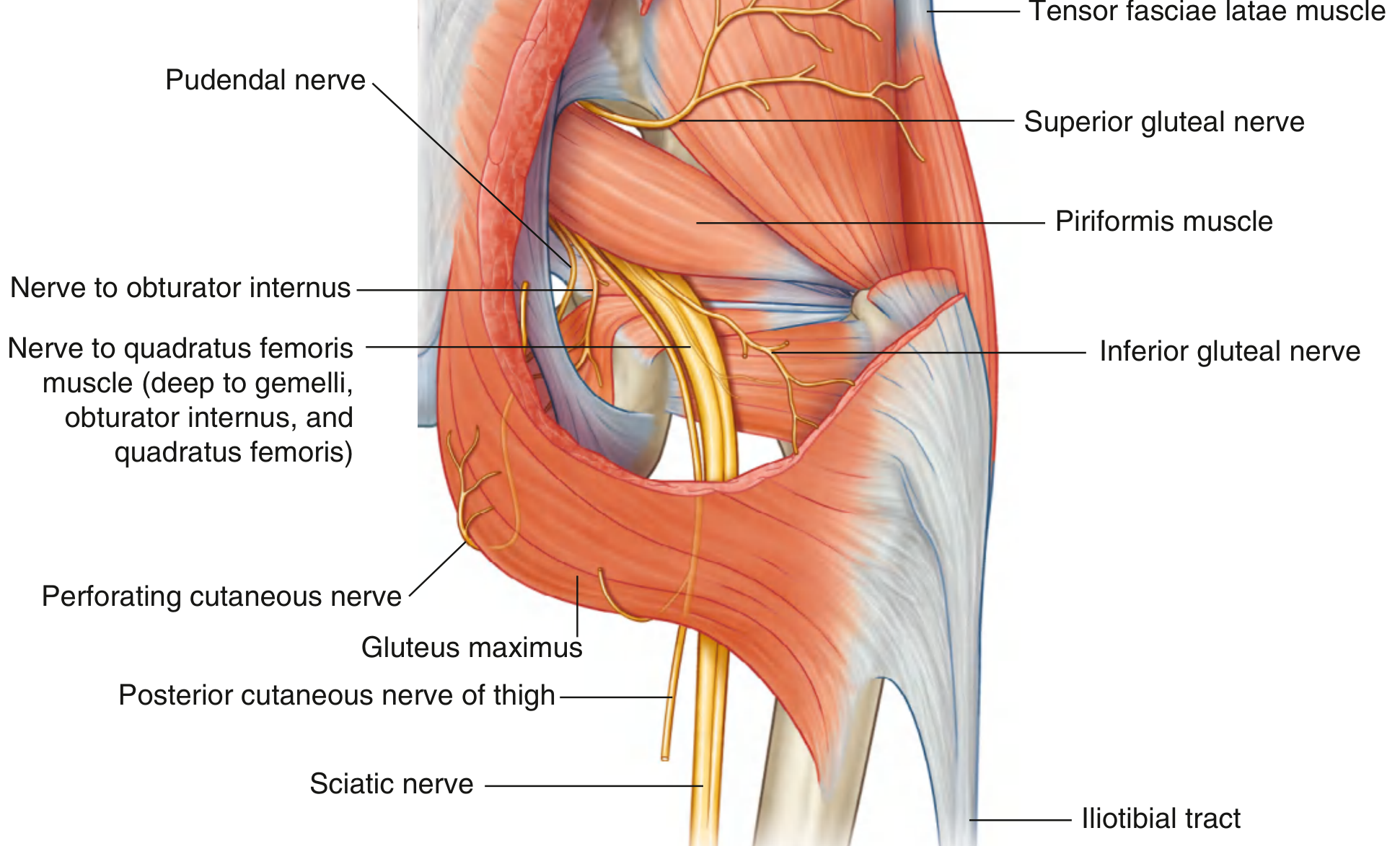
Fig. 6.48 - Nerves of the Gluteal Region, Posterior View (Gray's Anatomy for Students)
Piriformis Variations (Clinically Important)
| Variation | Frequency |
|---|---|
| Nerve passes below piriformis (normal) | ~88% |
| Common peroneal part passes through divided piriformis | ~11% |
| Entire nerve passes through piriformis | ~0.13% |
This is why the common peroneal division is more vulnerable in piriformis syndrome and sciatic nerve injuries.
Motor Supply Summary
| Region | Muscles Supplied |
|---|---|
| Posterior thigh | Hamstrings + ischial adductor magnus (direct branches) |
| Leg and foot | Via tibial nerve (posterior compartment) and common fibular nerve (anterior + lateral) |
Sensory Supply
Skin on the lateral side of the leg, the lateral side of the foot, and the sole (through its terminal branches).
Sources:
- Gray's Anatomy for Students, pp. 668, 682
- Bradley and Daroff's Neurology in Clinical Practice
This is a shared conversation. Sign in to Orris to start your own chat.