
Explain in detail disability in cbr
I'll start by reading the medical library skill, then search for CBR (Community-Based Rehabilitation) disability content.
Quick Answer: CBR stands for Community-Based Rehabilitation - a strategy within community development for the rehabilitation, equalization of opportunities, and social inclusion of people with disabilities. The concept of "disability" in CBR follows the biopsychosocial model, viewing disability not just as a medical condition but as the result of the interaction between a person's health condition and their environment/social context.
Searching sources...
Reading File
Now let me search the library database and web simultaneously for CBR disability content.
Finding Sources
Finding Sources
Searching the Web
disability in CBR community based rehabilitation WHO ICF model detailed explanation
Let me now search the library with broader terms and also extract detailed content from the NCBI page on CBR guidelines.
Finding Sources
Reading Web Page
https://www.ncbi.nlm.nih.gov/books/NBK310968
I found the Park's Textbook content on CBR. Let me now read that section in detail alongside the Preventive Medicine content.
Reading File
Reading File
Good - the first result found the CBR section in Park's. Let me read more of block5 specifically around the CBR section:
Reading File
Now let me search for the broader CBR/disability section in Park's:
Finding Sources
Finding Sources
Excellent! Park's has the disability definitions and ICF section. Let me read that comprehensively:
Reading File
Reading File
Reading File
Reading File
Reading File
Reading File
I now have comprehensive material to compose a thorough answer. Let me also fetch the ICF diagram:
Loading Image
I now have all the information needed to write a comprehensive answer. Here is the detailed explanation:
Disability in CBR (Community-Based Rehabilitation)
1. What is CBR?
Community-Based Rehabilitation (CBR) is defined by WHO and major NGOs as:
"A strategy within general community development for the rehabilitation, equalization of opportunities and social inclusion of all people with disabilities. CBR is implemented through the combined efforts of the people with disabilities themselves, their families, organizations and communities, and the relevant governmental and non-governmental health, education, vocational, social and other services."
CBR was first initiated by WHO following the Declaration of Alma-Ata (1978) and has since expanded from a purely medical model into a broad, multisectoral approach covering health, education, livelihood, social participation, and empowerment. It is now implemented in over 100 countries. (- Park's Textbook of Preventive and Social Medicine, p. 376; WHO CBR Guidelines, NCBI Bookshelf)
2. Understanding "Disability" - The Conceptual Framework
CBR's concept of disability is built on two interrelated classification systems:
A. ICIDH (1980) - The Original WHO Model
The International Classification of Impairments, Disabilities and Handicaps (ICIDH), first published by WHO in 1980, introduced a systematic taxonomy of the consequences of disease and injury. It defined three distinct levels:
| Term | Definition | Level |
|---|---|---|
| Impairment | "Any loss or abnormality of psychological, physiological, or anatomical structure or function." Disturbances at the level of the organ - defects/loss of limb, organ, body structure, or mental function. | Organ level |
| Disability | "Any restriction or lack (resulting from an impairment) of ability to perform an activity in the manner or within the range considered normal for a human being." Reflects consequences in terms of functional performance and activity by the individual. | Person level |
| Handicap | "A disadvantage for a given individual, resulting from an impairment or a disability, that limits or prevents the fulfilment of a role that is normal (depending on age, sex, and social and cultural practice) for that individual." Reflects interaction with and adaptation to the individual's surroundings. | Social level |
(- Park's Textbook of Preventive and Social Medicine, p. 674)
Handicap may be:
- Intrinsic - arising from within the person (e.g., blindness)
- Extrinsic - arising from the social environment (e.g., loss of parents)
- Primary - the direct handicap (e.g., blindness)
- Secondary - arising from the primary handicap (e.g., poverty resulting from blindness)
B. ICF (2001) - The Current Biopsychosocial Model Used in CBR
The ICIDH was replaced by the International Classification of Functioning, Disability and Health (ICF, WHO 2001). This is the primary framework underpinning CBR today. The key shift: ICIDH focused on the consequences of disease, while ICF focuses on components of health. ICF is a classification of health and health-related domains describing body function and structure, activities and participation - recognizing that disability occurs in a social and environmental context.
ICF Model Diagram:
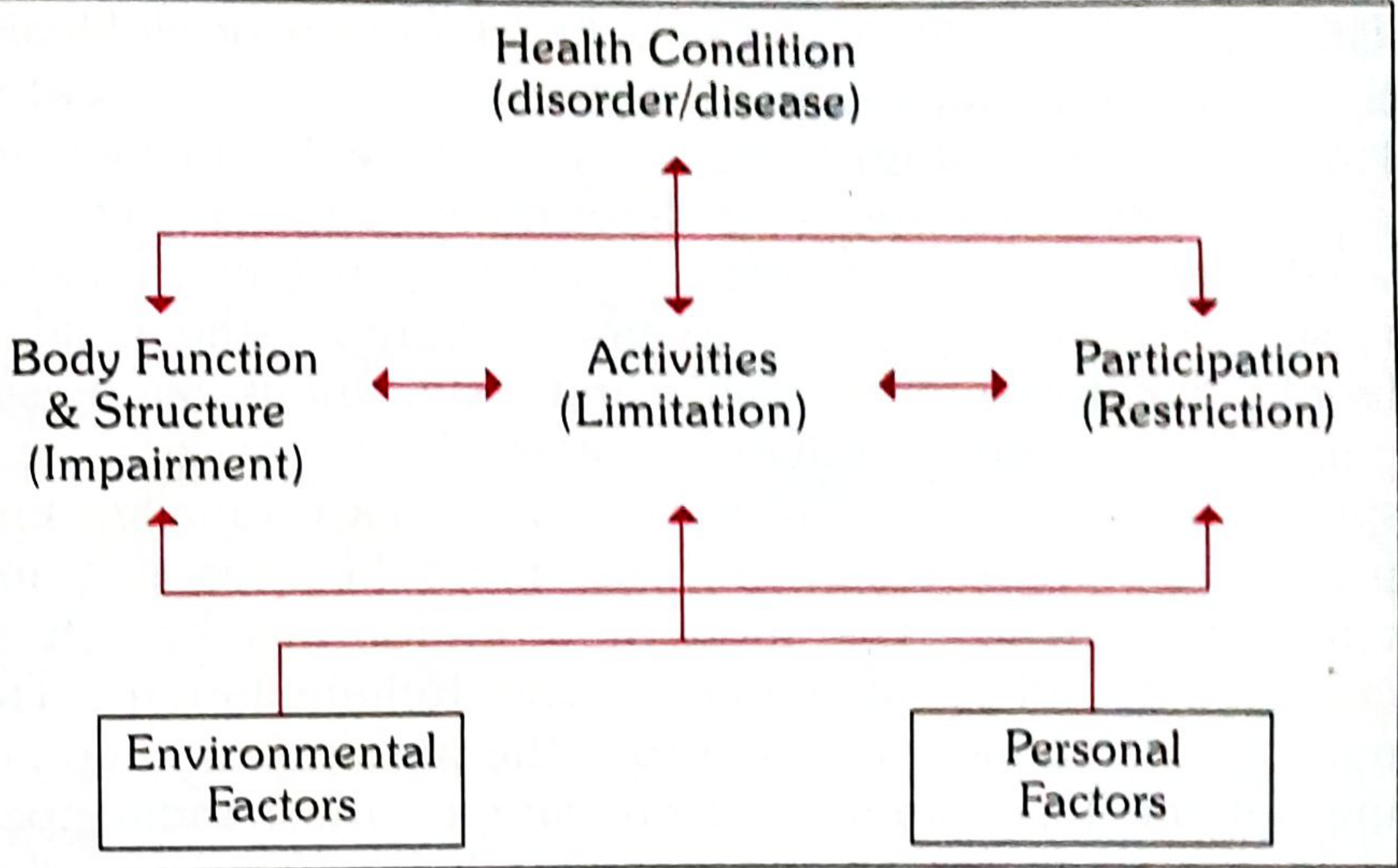
(Source: Park's Textbook of Preventive and Social Medicine, p. 675)
Two Parts of the ICF Framework
Part 1: Functioning and Disability
- Body Function and Structure - Describes actual anatomy, physiology, and psychology of the human body. Problems here are called impairments.
- Activity and Participation - Describes the person's functional status: communication, mobility, interpersonal interactions, self-care, learning, applying knowledge, etc. Problems here are called activity limitations and participation restrictions.
Part 2: Contextual Factors
- Environmental Factors - Factors NOT within the person's control: family, workplace, government agencies, laws, cultural beliefs. These can be facilitators (help the person function) or barriers (restrict functioning).
- Personal Factors - Race, gender, age, educational level, coping styles, etc.
The ICF model is bidirectional - all components interact with each other and with the underlying health condition. This is why CBR takes a multisectoral approach.
3. Two Models of Disability Underlying CBR Philosophy
CBR recognizes two competing views that are synthesized in the ICF:
| Model | View of Disability | Intervention |
|---|---|---|
| Medical Model | A feature of the person, directly caused by disease, trauma, or other health conditions | Medical care by individual professionals |
| Social Model | A socially-created problem, NOT an attribute of the individual; caused by an unaccommodating physical and social environment | Political response, environmental modification, attitude change |
CBR adopts a biopsychosocial synthesis - disability arises from the interaction of health conditions WITH environmental and personal factors. This explains why CBR addresses not just medical rehabilitation but also education, livelihood, social inclusion, and empowerment.
(- Park's Textbook of Preventive and Social Medicine, p. 675; Linking CBR, Disability and Rehabilitation - Afri-CAN)
4. Classification of Disability in CBR
CBR classifies disability into three main groups, each requiring different rehabilitation approaches:
A. Physical Disability (Physically Handicapped)
Includes children and adults who are:
- Blind or visually impaired
- Deaf and/or mute
- Those with congenital deformities (hare-lip, cleft palate, talipes)
- "Crippled" due to: poliomyelitis, cerebral palsy, congenital heart disease, road accidents, burns, injuries
Three broad causative groups:
- Birth defects - preventable through adequate prenatal/natal/postnatal services and genetic counselling
- Infections - e.g., polio (preventable by immunization), rubella
- Accidents - preventable through safety education
B. Mental Disability (Mentally Handicapped)
Mental handicap is a condition of sub-average intellectual function combined with deficits in adaptive behaviour.
Causes:
- Genetic: Down's syndrome, Klinefelter syndrome, PKU, Tay-Sachs disease, galactosaemia, microcephaly, congenital hypothyroidism
- Antenatal: neural tube defects, Rh incompatibility, rubella, CMV, toxoplasmosis, syphilis, drugs, irradiation
- Perinatal: birth injuries, hypoxia, cerebral palsy
- Postnatal: head injuries, encephalitis, lead/mercury poisoning
- Miscellaneous: maternal malnutrition, iodine deficiency, consanguineous marriages, late-age pregnancy
WHO Classification by IQ:
| Category | IQ Range |
|---|---|
| Mild mental retardation | 50-70 |
| Moderate mental retardation | 35-49 |
| Severe mental retardation | 20-34 |
| Profound mental retardation | Under 20 |
Among 100 mentally handicapped persons: approximately 70 mild, 20 moderate, and 5 severe cases.
C. Social Disability (Socially Handicapped)
A child or person whose opportunities for healthy personality development are hampered by:
- Parental inadequacy
- Environmental deprivation (lack of stimulation/learning)
- Emotional disturbances
- Orphaned, neglected, or destitute status
- Exploitation or delinquency
Children with physical or mental disabilities also face social handicaps due to social rejection or misunderstanding.
(- Park's Textbook of Preventive and Social Medicine, pp. 674-675)
5. Magnitude of Disability - Global and Indian Context
- At least 10% of the world's population lives with a disability, the majority in developing countries in conditions of poverty
- Nearly 83 million people globally are estimated to be mentally retarded
- 42 million people have hearing loss (41 dB and above) - 3rd leading cause of disability
- Disability from poliomyelitis has affected about 10 million globally
- In India: approximately 16.15 million persons (1.9% of population) have physical disability; about 3% of 1-14 year age group has developmental delays
6. Prevention of Disability in CBR - Three Levels
CBR operates at all three levels of prevention:
Primary Prevention (Prevent the handicap from occurring)
- Genetic counselling (optimal maternal age 20-30 years; avoid consanguineous marriages)
- At-risk approach (identify those at risk of transmitting inherited diseases)
- Immunization - polio is the main cause of disability in India; prevent with OPV
- Proper maternal nutrition to reduce prematurity
- Prenatal care, avoiding teratogenic drugs/X-rays/smoking
- Medical Termination of Pregnancy Act (1971) allows abortion of severely handicapped foetuses
Secondary Prevention (Early diagnosis + treatment)
- Early diagnosis through MCH and School Health Services
- Treatment: physiotherapy, occupational therapy, speech therapy, prosthetics
- "Physical Medicine and Rehabilitation" - the modern term
- Vocational guidance: train the handicapped to "work with what is left"
Tertiary Prevention (Rehabilitation)
- CBR aims to restore the person to the highest possible level of functioning
- Measures are medical, surgical, social, educational, and vocational
- Requires coordinated efforts by Health, Education, Social Welfare departments, and voluntary organizations
7. The CBR Matrix - Five Key Domains Addressing Disability
The CBR Guidelines present a matrix of five interconnected components, each essential for addressing disability comprehensively:
| Domain | Key Activities |
|---|---|
| Health | Promotion, prevention, medical care, rehabilitation, assistive devices |
| Education | Inclusive education, non-formal education, lifelong learning |
| Livelihood | Skills development, self-employment, financial services, social protection |
| Social | Personal assistance, marriage/family support, cultural/religious participation, sports/recreation |
| Empowerment | Advocacy, self-help groups, disabled people's organizations, political participation |
8. ICF as a Tool in CBR Planning
The ICF is used in CBR in four key ways (Schneider & Hartley, 2006):
- Planning individual intervention programmes - identifying each component of a person's disability to tailor a rehabilitation plan
- Looking at whole community issues - not just individual impairments but environmental and participation barriers
- Monitoring and evaluation of CBR generally - standardized language for measuring outcomes
- Motivating policies that promote inclusion of disabled people
The ICF, UNCRPD (UN Convention on the Rights of Persons with Disabilities), and CBR Guidelines all share a common view of disability as a human rights issue requiring equalization of opportunities and full community participation.
9. Rehabilitation in CBR - A Practical Summary
Rehabilitation measures include planned and systematic actions - medical, surgical, social, educational, and vocational - consistently over years with sustained counselling and health education to restore individuals to the highest possible level of functional ability.
The guiding principle stated in Park's: "The cheapest and surest rehabilitation is to prevent physical deformities and social and vocational disruption by early diagnosis and adequate treatment. We should never allow dehabilitation to take place and afterwards take up the uphill task of rehabilitation." (p. 375)
In India, key national institutes supporting CBR for persons with disability include:
- National Institute for Mentally Handicapped (NIMH), Secunderabad (1984)
- Ali Yavar Jung National Institute for the Hearing Handicapped, Mumbai
- National Institute for the Visually Handicapped, Dehradun
- National Institute for the Orthopaedically Handicapped, Kolkata
Key References:
- Park's Textbook of Preventive and Social Medicine - WHO definition of CBR (p. 376), disability classification and ICF (pp. 674-675)
- WHO CBR Guidelines - NCBI Bookshelf
- Linking CBR, Disability and Rehabilitation (ICF Framework)
Properly explain only disability handicap and imapirment
These three terms form the foundation of disability classification in CBR and rehabilitation. Let me pull the exact textbook content.
Searching sources...
Finding Sources
Finding Sources
Reading File
Reading File
Reading File
I have all the authoritative content needed. Here is a clean, detailed explanation of all three terms:
Impairment, Disability, and Handicap in CBR
These three terms were formally defined by WHO in the International Classification of Impairments, Disabilities and Handicaps (ICIDH, 1980) - the foundational framework for CBR. They represent three distinct but linked levels of the consequences of disease or injury.
The ICIDH Sequence
The ICIDH describes a progression:
Disease/Injury → IMPAIRMENT → DISABILITY → HANDICAP
                  (Organ)       (Person)     (Society)
Each term operates at a different level and has a precise meaning. They are not interchangeable.
1. IMPAIRMENT
Definition (WHO - ICIDH)
"Any loss or abnormality of psychological, physiological, or anatomical structure or function."
Level: ORGAN level
Impairment is the most basic level - it is a problem at the level of a body part, organ, or organ system. It is the direct result of a disease, injury, or congenital defect.
Key Points:
- Includes defects or loss of a limb, organ, or other body structure
- Includes defects or loss of mental function
- It is a deviation from a biomedical standard - something is structurally or functionally wrong with the body
- Impairment can be permanent or temporary
Additional Impairment Categories:
| Type | Meaning |
|---|---|
| Temporary impairment | Exists only for a limited period after injury or illness |
| Permanent impairment | Assessed once Maximum Medical Improvement (MMI) is reached - no further treatment can improve it |
| Whole-person impairment | Alteration in functioning of the body as a whole; ranges from 0% (none) to 100% (cessation of all body functions) |
| Permanent partial impairment | Numeric percentage of loss of body functioning due to an affected organ system |
Examples:
- Loss of a limb (arm, leg)
- Damage to the visual cortex or the eye itself → blindness
- Loss of cochlear function → deafness
- Paralysis of leg muscles after polio
- Loss of mental function after brain injury
2. DISABILITY
Definition (WHO - ICIDH)
"Any restriction or lack (resulting from an impairment) of ability to perform an activity in the manner or within the range considered normal for a human being."
Level: PERSON level
Disability is a step beyond impairment - it is what the impairment does to the person's ability to function. It reflects the consequences of impairment in terms of functional performance and activity by the individual.
Key Points:
- Disability arises from an impairment (it is its functional consequence)
- It is assessed by comparing the person's performance to what is considered normal for a human being
- The same impairment does NOT always cause the same degree of disability - context matters
- Disability represents disturbances at the level of the person
Critical Distinction - Impairment ≠ Disability:
The degree of impairment frequently correlates with the degree of disability, but this is not always the case. A classic example from Murray & Nadel's Respiratory Medicine:
Loss of the fifth finger of the non-dominant hand:
- For an average person - small impairment = small disability
- For a concert pianist - same small impairment = significant disability in work activities
This shows that disability is contextual and person-specific, not purely biological.
| Type | Meaning |
|---|---|
| Permanent total disability | A medicolegal determination that a person's impairment precludes future gainful employment entirely |
Examples:
- Paralysis of the legs → inability to walk (disability in mobility)
- Deafness → inability to communicate through speech in normal settings
- Blindness → inability to read standard print or navigate independently
- Cognitive impairment → inability to perform activities of daily living
3. HANDICAP
Definition (WHO - ICIDH)
"A disadvantage for a given individual, resulting from an impairment or a disability, that limits or prevents the fulfilment of a role that is normal (depending on age, sex, and social and cultural practice) for that individual."
Level: SOCIETY/SOCIAL ROLE level
Handicap is the broadest level. It reflects the social consequences - how disability affects the person's ability to fulfil their expected roles in society. The term handicap reflects interaction with and adaptation to the individual's surroundings.
Key Points:
- Handicap is defined by social norms - what is "normal" varies by age, sex, and cultural context
- The same disability can cause different handicaps in different societies
- It is not inherent to the person - it arises from the gap between the person's capacity and society's expectations/accommodations
- Handicap connects CBR to the social model of disability
Types of Handicap:
| Type | Definition | Example |
|---|---|---|
| Intrinsic handicap | Arises from within the person | Blindness itself |
| Extrinsic handicap | Arises from the social environment | Loss of parents, lack of accessible infrastructure |
| Primary handicap | The direct/original handicap | Blindness |
| Secondary handicap | One that arises as a consequence of the primary handicap | Poverty resulting from blindness |
Examples:
- A person who is deaf (impairment) and cannot hear speech (disability) cannot get a job requiring telephone communication → handicap in the role of "worker"
- A person with paraplegia who cannot walk (disability) but lives in a city with no ramps or accessible transport → handicap in the role of "community member"
- A mentally retarded child who cannot study at a normal school → handicap in the role of "student"
Summary Comparison Table
| Feature | Impairment | Disability | Handicap |
|---|---|---|---|
| Level | Organ/body | Person | Society/social role |
| What it is | Structural/functional loss | Restricted activity performance | Social role disadvantage |
| Caused by | Disease, injury, defect | Impairment | Impairment or disability |
| Measured against | Normal anatomical/physiological standard | Normal human activity range | Normal social roles for that individual |
| Example | Paralysed leg muscles | Cannot walk | Cannot fulfil role of independent worker/community member |
| CBR focus | Medical/therapeutic intervention | Functional rehabilitation | Social inclusion, equalization of opportunity |
Why the Distinction Matters in CBR
CBR must address all three levels simultaneously:
- Treating impairment alone (purely medical approach) is insufficient
- A person may have significant impairment but little disability if given the right training
- A person may have disability but face minimal handicap if society is inclusive and accessible
- Reducing handicap often requires changing the environment and social attitudes - not just treating the person
This is why the 2001 ICF replaced the ICIDH - it moved the focus from "what is wrong with the person" to "what factors in the person and environment together produce the disability experience," which aligns perfectly with CBR's holistic, community-based approach.
Sources:
- Park's Textbook of Preventive and Social Medicine, p. 674 - ICIDH definitions and handicap types
- Murray & Nadel's Textbook of Respiratory Medicine, p. 832 - impairment vs. disability distinction and clinical examples
Explain causes and consequences of all this in detail wtever their in park textbook everything
Reading Park's textbook thoroughly for all content on causes and consequences of impairment, disability, and handicap.
Searching sources...
Finding Sources
Finding Sources
Reading File
Finding Sources
Excellent - this is the core section. Let me read it in full and also get the handicapped children causes section:
Reading File
Reading File
Reading File
Reading File
Reading File
Finding Sources
Reading File
Finding Sources
Reading File
I now have all the material from Park's. Let me update todos and compile the full answer.Here is everything Park's Textbook of Preventive and Social Medicine covers on the causes and consequences of impairment, disability, and handicap - presented in full detail.
Causes and Consequences of Impairment, Disability, and Handicap
As per Park's Textbook of Preventive and Social Medicine
PART 1 - THE SEQUENCE (Concept of Disability)
Park's presents the WHO framework as a clear progression of consequences:
DISEASE/INJURY → IMPAIRMENT → DISABILITY → HANDICAP
Each stage has its own causes and its own consequences. The important principle stated by Park's is:
"While impairment, which is the earliest stage, has a large medical component, disability and handicap, which are later stages, have large social and environmental components in terms of dependence and social cost." (p. 55)
This is illustrated with a concrete accident example:
| Stage | What happens | Term |
|---|---|---|
| Accident | Disease or disorder | - |
| Loss of foot | Structural/functional loss | Impairment (extrinsic or intrinsic) |
| Cannot walk | Restricted functional activity | Disability (objectified) |
| Unemployed | Social role disadvantage | Handicap (socialized) |
(Park's p. 55 - Concept of Disability diagram)
PART 2 - IMPAIRMENT
Definition
"Any loss or abnormality of psychological, physiological or anatomical structure or function."
- Example: loss of foot, defective vision, mental retardation
Key Properties of Impairment (Park's p. 55)
- May be visible or invisible
- May be temporary or permanent
- May be progressive or regressive
- One impairment may lead to secondary impairments - e.g., in leprosy, damage to nerves (primary impairment) → plantar ulcers (secondary impairment)
CAUSES OF IMPAIRMENT
Park's identifies the major causes of disabling impairments at different levels:
A. Major Causes in Developing Countries (p. 55)
The four main causes responsible for about 70% of all disability in developing countries:
- Communicable diseases (polio, leprosy, tuberculosis, measles, etc.)
- Malnutrition (protein-energy malnutrition, iodine deficiency, vitamin A deficiency)
- Low quality of perinatal care (birth injuries, hypoxia, prematurity)
- Accidents (road traffic, occupational, domestic)
B. Causes of Physical Disability/Impairment (p. 674)
Grouped into three broad causative categories:
| Causative Group | Examples |
|---|---|
| Birth defects | Hare-lip, cleft palate, talipes, congenital heart disease, neural tube defects |
| Infections | Poliomyelitis, rubella, cytomegalovirus, toxoplasmosis, syphilis, encephalitis |
| Accidents | Road traffic accidents, burns, injuries, industrial accidents |
Other causes of crippling: cerebral palsy, congenital heart disease
C. Causes of Mental Handicap/Impairment (p. 674-675)
Mental handicap has many causes - genetic, environmental, prenatal, and postnatal:
(a) Genetic conditions:
- Down's syndrome
- Klinefelter syndrome
- Phenylketonuria (PKU)
- Tay-Sachs disease
- Galactosaemia
- Microcephaly
- Congenital hypothyroidism
- Chromosomal abnormalities (single and multiple gene action)
(b) Antenatal factors:
- Neural tube defects
- Rh incompatibility
- Infections: rubella, cytomegalovirus, toxoplasmosis, syphilis
- Drugs (teratogenic)
- Irradiation (X-rays)
(c) Perinatal factors:
- Birth injuries
- Hypoxia (oxygen deprivation during delivery)
- Cerebral palsy
(d) Postnatal factors:
- Head injuries and accidents
- Encephalitis (brain inflammation)
- Physical and chemical agents: lead poisoning, mercury poisoning
(e) Miscellaneous:
- Maternal malnutrition
- Protein-energy malnutrition (PEM)
- Iodine deficiency (endemic goitre - a major preventable cause)
- Consanguineous marriages (increases risk of recessive genetic disorders)
- Pregnancy after age 40 (late marriages) - associated with Down's syndrome and other chromosomal defects
CONSEQUENCES OF IMPAIRMENT
- Leads directly to disability - restricts the person's ability to perform activities
- Secondary impairments - one impairment generates further impairments (e.g., leprosy nerve damage → plantar ulcers → further tissue loss)
- Progression - impairment can be progressive, leading to worsening disability over time
- Need for medical intervention - impairment stage has the largest medical component and is the most amenable to medical treatment
PART 3 - DISABILITY
Definition
"Any restriction or lack of ability to perform an activity in the manner or within the range considered normal for a human being."
Because of an impairment, the affected person may be unable to carry out certain activities considered normal for their age, sex, etc. This inability is "disability."
CAUSES OF DISABILITY
Disability results from impairment. The causes are therefore the same underlying conditions that cause impairment, but Park's specifically emphasizes:
- Late presentation - when a patient reports late in the pathogenesis phase, the mode of intervention is disability limitation. If disease is not treated early, impairment progresses into disability.
- Inadequate or no treatment - disability is the consequence of untreated or inadequately treated impairment
- The four major causes (communicable diseases, malnutrition, poor perinatal care, accidents) - responsible for ~70% of disability in developing countries
Types of Disability (Rights of Persons with Disabilities Bill 2016 - Park's p. 677)
The number of recognized disability types was increased from 7 to 21 under Indian law:
- Blindness
- Low-vision
- Leprosy cured persons
- Hearing impairment (deaf and hard of hearing)
- Locomotor disability
- Dwarfism
- Intellectual disability
- Mental illness
- Autism spectrum disorder
- Cerebral palsy
- Muscular dystrophy
- Chronic neurological conditions
- Specific learning disabilities (added for the first time)
- Multiple sclerosis
- Speech and language disability (added for the first time)
- Thalassemia
- Haemophilia
- Sickle cell disease
- Multiple disabilities including deaf-blindness
- Acid attack victim (newly included)
- Parkinson's disease
The Central Government is authorized to notify additional categories of specified disability.
CONSEQUENCES OF DISABILITY
- Leads to handicap - disability produces social role disadvantage if not addressed
- Dependence - disabled persons may become dependent on family and society
- Social cost - disability has large social and environmental components; the burden falls on family, community, and state
- Loss of livelihood - inability to work leads to poverty
- Need for rehabilitation - requires physiotherapy, occupational therapy, speech therapy, prosthetics, vocational guidance
Consequences Requiring Rehabilitation (Park's p. 676):
Treatment facilities needed as a consequence of disability:
- Physiotherapy - corrects deformities, exercises weakened muscles (as in polio); uses infrared rays, diathermy
- Occupational therapy - teaches skills (music, painting, weaving, woodwork, pottery, basket making) according to ability and taste
- Speech therapy - trains the person to communicate normally
- Prosthetics - provision of artificial limbs, hearing aids, other equipment
PART 4 - HANDICAP
Definition
"A disadvantage for a given individual, resulting from an impairment or a disability, that limits or prevents the fulfilment of a role that is normal (depending on age, sex, and social and cultural factors) for that individual."
TYPES OF HANDICAP (Park's p. 674)
| Type | Description | Example |
|---|---|---|
| Intrinsic handicap | Arises from within the person | Blindness |
| Extrinsic handicap | Arises from the social/external environment | Loss of parents |
| Primary handicap | The original, direct handicap | Blindness |
| Secondary handicap | Arises as a consequence of the primary handicap | Poverty resulting from blindness |
One handicap can give rise to further handicaps - primary leads to secondary.
CAUSES OF HANDICAP
Handicap results from disability interacting with social and environmental factors. Specific causes Park's identifies:
For Physically Handicapped:
- Blindness, deafness/mutism
- Hare-lip, cleft palate, talipes
- Polio, cerebral palsy, congenital heart disease
- Road accidents, burns, injuries
For Mentally Handicapped (p. 674-675):
All the genetic and environmental causes listed above under mental impairment.
- Mental handicap is a condition of sub-average intellectual function combined with deficits in adaptive behaviour
- Previously used terms (idiot, moron, imbecile) are now discarded
WHO Classification of Mental Retardation by IQ:
| Grade | IQ Range | Proportion (per 100 cases) |
|---|---|---|
| Mild | 50-70 | 70 cases |
| Moderate | 35-49 | 20 cases |
| Severe | 20-34 | 5 cases |
| Profound | Under 20 | Rare |
- Children scoring above 70 are no longer classified as mentally handicapped
- IQ level is not necessarily constant throughout the individual's lifespan
- Severe mental retardation - the great majority remain more or less dependent throughout life
- Mental retardation often involves psychiatric disturbances
For Socially Handicapped (p. 675):
A "socially handicapped child" is one whose opportunities for healthy personality development and full unfolding of potentialities are hampered by:
- Parental inadequacy
- Environmental deprivation (lack of stimulation of learning process)
- Emotional disturbances
Such children include:
- Those orphaned due to death or loss of parents
- Neglected and destitute children
- Those who are exploited or victimized
- Delinquent children
"A child who is physically or mentally handicapped also meets with social handicaps to the extent to which he is subject to social rejection or misunderstanding and cannot make use of the normal value of social fulfilment." (Park's p. 675)
CONSEQUENCES OF HANDICAP
Park's describes the consequences of handicap in terms of what it prevents the person from achieving:
- Unemployment - cannot fulfil the role of a productive worker in society
- Social exclusion - cannot participate in community life as a normal member
- Educational deprivation - cannot access mainstream education
- Poverty - a secondary handicap arising from inability to earn
- Psychological impact - loss of personal dignity, confidence, and self-worth
- Family burden - families bear enormous social, financial, and emotional costs
- Stigma and discrimination - especially severe in conditions like leprosy
Specific societal consequences Park's highlights:
- In India, 16.15 million persons (1.9% of population) suffer from physical disability
- ~3% of the 1-14 year age group is affected by developmental delays
- Disability resulting from polio has affected ~10 million people globally
- Hearing loss (41 dB and above) affects 42 million globally - the 3rd leading cause of disability
- Mental retardation affects ~83 million globally (4th leading cause)
PART 5 - DISABILITY PREVENTION (Park's Three-Level Framework, p. 55)
Since the consequences of impairment → disability → handicap form a chain, Park's describes prevention at all three levels:
| Level | Target | Example |
|---|---|---|
| Primary prevention | Prevent impairment from occurring | Immunization against polio |
| Secondary prevention (Disability limitation) | Prevent impairment from becoming disability | Appropriate treatment; early diagnosis |
| Tertiary prevention | Prevent disability from becoming handicap | Rehabilitation, social integration |
Primary prevention is stated to be the most effective way of dealing with the disability problem in developing countries.
PART 6 - REHABILITATION (Consequences Requiring Action, p. 55-56)
As a direct consequence of the impairment-disability-handicap chain, rehabilitation is required. Park's defines it as:
"The combined and coordinated use of medical, social, educational and vocational measures for training and retraining the individual to the highest possible level of functional ability."
Four areas of rehabilitation required as consequences of disability:
| Type | Goal |
|---|---|
| Medical rehabilitation | Restoration of function |
| Vocational rehabilitation | Restoration of the capacity to earn a livelihood |
| Social rehabilitation | Restoration of family and social relationships |
| Psychological rehabilitation | Restoration of personal dignity and confidence |
"The patient must be restored and retrained 'to live and work within the limits of his disability but to the hilt of his capacity'." (Park's p. 56)
All content sourced directly from Park's Textbook of Preventive and Social Medicine:
- p. 55 - Concept of disability, causes, disability prevention
- p. 674-675 - Definitions, classification, causes of mental handicap, types of handicap
- p. 675-677 - ICF, approaches to prevention, Rights of Persons with Disabilities Bill 2016
- p. 376 - CBR definition
This is a shared conversation. Sign in to Orris to start your own chat.