
Throat irritation plus dry cough management
I'll look up the medical library skill first, then research this topic thoroughly.
Quick answer: Throat irritation with dry cough is most commonly managed with hydration, humidification, honey-based lozenges, and saline gargles for symptomatic relief. If infectious, antihistamines or short-course decongestants help. If cough persists beyond 3 weeks, causes like GERD, post-nasal drip, or ACE inhibitor use should be ruled out.
Searching sources...
Reading File
Now I'll run parallel searches across the library and PubMed simultaneously.
Finding Sources
Finding Sources
Searching PubMed
"dry cough" AND "throat irritation" AND management
Good leads from the library. Let me read the key sections in parallel.
Reading File
Finding Sources
Finding Sources
Let me pull the chronic cough section and the throat dry cough content from Cummings and Murray & Nadel:
Reading File
Reading File
Reading File
Now let me get one more important section on acute cough management and treatment from Family Medicine / Respiratory texts:
Finding Sources
Finding Sources
Searching PubMed
"chronic cough" AND treatment AND "upper airway"
Let me now read the Tintinalli's section on cough management and do a web search for current guidelines:
Reading File
Reading File
Searching the Web
throat irritation dry cough management 2025 guidelines treatment options
I now have comprehensive information to deliver a thorough, well-structured answer. Let me also fetch the chronic cough management algorithm image:
Loading Image
I have everything I need. Here is the full, structured answer:
Throat Irritation + Dry Cough: Management
Understanding the Symptom
A dry (non-productive) cough with throat irritation arises from stimulation of cough receptors in the pharynx and larynx. Cough is classified by duration, which directly guides management:
| Duration | Category | Most Common Causes |
|---|---|---|
| < 3 weeks | Acute | URTI, allergic reaction, bronchitis |
| 3-8 weeks | Subacute | Post-infectious, post-viral airway inflammation |
| > 8 weeks | Chronic | Upper airway cough syndrome (UACS), asthma, GERD, ACE inhibitor use |
1. Non-Pharmacological (General Measures)
These apply to nearly all causes and should be the first step:
- Hydration - adequate oral fluid intake keeps mucous membranes moist and thins secretions
- Humidification - a cool-mist humidifier adds moisture to ambient air and reduces mucosal dryness
- Voice rest - minimising talking and whispering reduces laryngeal trauma when the throat is inflamed
- Steam inhalation - warm steam temporarily soothes airway inflammation
- Avoidance of irritants - smoke, dry air, dust, strong scents, and alcohol
- Honey - has well-established evidence as a soothing agent; 1-2 teaspoons in warm water is effective (not for children < 1 year due to botulism risk)
- Saline gargles - warm salt water gargles reduce pharyngeal inflammation
- Elevating the head of the bed - particularly helpful if GERD is a contributing factor
Note on topical anesthetics (e.g. benzocaine lozenges): These are initially soothing but can decrease oropharyngeal/supraglottic sensitivity, allowing overuse of an injured area and potentially worsening mucosal damage. They should generally be avoided. - Cummings Otolaryngology
2. Pharmacological Management by Cause
A. Acute Cough (URTI / Viral)
- Decongestants (e.g. pseudoephedrine, oxymetazoline nasal spray) - provide symptomatic relief in upper respiratory infections; combination antihistamine-decongestant preparations should be avoided due to excessive drying of mucous membranes
- First-generation antihistamines (e.g. chlorpheniramine) - reduce post-nasal drip and have mild antitussive effects, but cause sedation and mucosal drying
- Menthol preparations - initially soothing but paradoxically worsen drying and mucosal irritation with prolonged use; not recommended for ongoing therapy - Cummings Otolaryngology
- Guaifenesin (expectorant/mucolytic) - thins secretions and improves laryngeal lubrication; commonly used as an adjunct, though direct evidence is limited
- Dextromethorphan - centrally-acting cough suppressant for dry, non-productive cough
- Aspirin should be avoided in throat/laryngeal conditions - inhibits platelet function and can cause submucosal laryngeal haemorrhage
B. Allergic Rhinitis / Upper Airway Cough Syndrome (UACS)
UACS (previously "post-nasal drip syndrome") is one of the top 3 causes of chronic cough. Mucus drainage from the nose directly stimulates pharyngeal cough receptors, and the underlying inflammation also triggers cough independently.
- Intranasal corticosteroids (e.g. fluticasone, mometasone) - first-line; effective for allergic rhinitis without the mucosal drying of systemic antihistamines; may take up to 2 weeks for maximal effect
- Non-sedating antihistamines (e.g. cetirizine, loratadine) - useful adjuncts with fewer drying effects than older agents
- Allergen avoidance and, when appropriate, allergen immunotherapy for recurrent/refractory allergic disease - Cummings Otolaryngology
C. Gastroesophageal Reflux Disease (GERD)
GERD is the third most common cause of chronic cough (after UACS and asthma), accounting for ~21% of cases. Importantly, 43-75% of patients with GERD-related cough have no classic heartburn symptoms. The pharynx, larynx, and trachea have almost no protective mechanisms against acid and are highly susceptible to reflux-related irritation.
- Proton pump inhibitors (PPIs) twice daily - first-line; treatment must be maintained for at least 3 months as GERD cough can take this long to resolve
- Dietary modification - avoid fatty foods, caffeine, alcohol, late meals
- Head-of-bed elevation
- Nissen fundoplication is reserved for confirmed GERD with surgical indications - Cummings Otolaryngology; Murray & Nadel's
D. ACE Inhibitor-Induced Cough
ACE inhibitors (e.g. enalapril, lisinopril) cause a dry, persistent cough in up to 10-15% of patients by accumulating bradykinin in the airways. Management is straightforward:
- Stop the ACE inhibitor - cough typically resolves within 1-4 weeks
- Switch to an angiotensin II receptor blocker (ARB), which does not cause cough
E. Asthma / Cough-Variant Asthma
- Inhaled corticosteroids (ICS) - cornerstone of management
- Short-acting beta-2 agonists (SABA) - for relief of bronchospasm
- Avoid beta-blockers (can precipitate or worsen asthma cough)
F. Post-Infectious / Subacute Cough
Mechanisms include postviral airway inflammation, bronchial hyperresponsiveness, and mucus hypersecretion. Management:
- Usually self-limiting with supportive care
- Short course of inhaled ipratropium may reduce bronchial hyperresponsiveness
- If pertussis is suspected (cough > 2 weeks + paroxysms), treat with azithromycin or clarithromycin
3. Chronic Cough Algorithm
When cough lasts > 8 weeks, a systematic approach is needed:
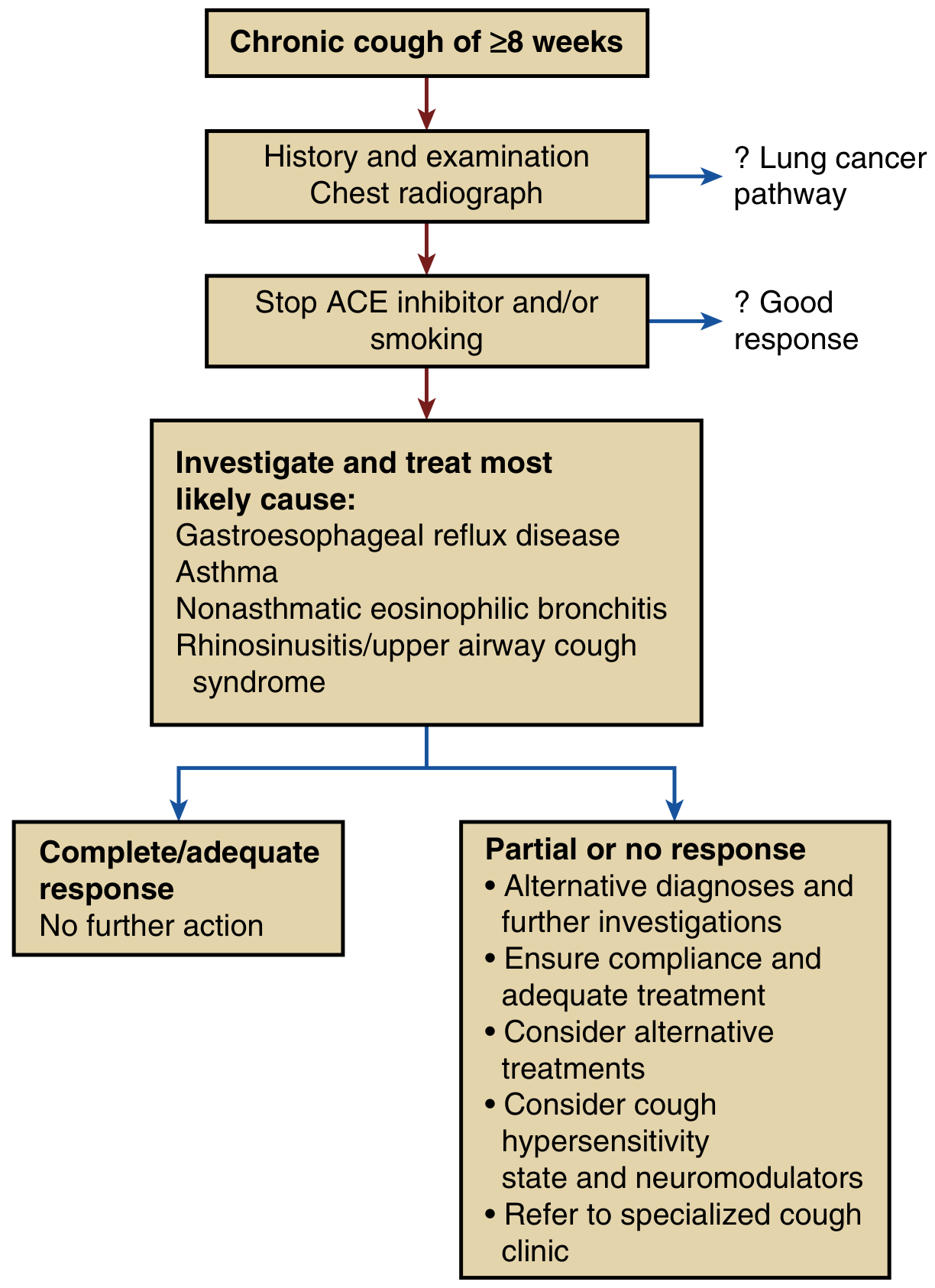
Key steps:
- History, examination, chest X-ray
- Stop ACE inhibitors / smoking
- Investigate and empirically treat the most likely cause (GERD, asthma, UACS, eosinophilic bronchitis)
- If partial/no response: consider cough hypersensitivity state, neuromodulators (gabapentin, pregabalin, amitriptyline), or referral to a specialist cough clinic
4. Special Consideration: Paradoxical Vocal Fold Motion Disorder (PVFMD)
When dry cough is accompanied by a foreign-body sensation in the throat, difficulty breathing, and does not respond to standard asthma therapy, PVFMD should be considered. This is inappropriate adduction of the vocal folds causing the "irritation + dry cough" complex. Diagnosis is via spirometry (flattened inspiratory limb) and laryngoscopy. Management is speech therapy / breathing retraining rather than inhalers. - Murray & Nadel's
5. Red Flags - When to Refer/Investigate Urgently
- Haemoptysis
- Unexplained weight loss
- Dysphagia
- Hoarseness > 3 weeks
- Chest pain
- Smoking history (especially age > 40) - these require chest imaging to exclude malignancy
Sources: Cummings Otolaryngology Head and Neck Surgery; Murray & Nadel's Textbook of Respiratory Medicine; Tintinalli's Emergency Medicine; Iowa Head and Neck Cough Protocols; StatPearls - Cough Evaluation and Management
This is a shared conversation. Sign in to Orris to start your own chat.