
Ectopic pregnancy
Reading File
Now let me search the library and PubMed in parallel.
Finding Sources
Searching PubMed
"ectopic pregnancy"[MeSH Terms] AND management
Excellent sources found. Let me read the most comprehensive ones in parallel.
Reading File
Reading File
Reading File
Let me read the Rosen's EM section and the Robbins pathology section more fully for clinical management and pathology details.
Reading File
Reading File
Finding Sources
Let me read the Berek & Novak's Gynecology section on ectopic pregnancy management and the Rosen's EM section on diagnosis/treatment in parallel.
Reading File
Reading File
I now have comprehensive information. Let me read the treatment section from Rosen's EM and the methotrexate dosing section from Berek & Novak.
Reading File
Reading File
I now have enough comprehensive information to compile a thorough answer. Let me also fetch the ultrasound image from Rosen's EM.
Loading Image
I now have all the information needed for a comprehensive, well-cited answer. Here it is:
Ectopic Pregnancy
Definition & Epidemiology
Ectopic pregnancy is implantation of the fertilized ovum outside the uterine corpus. It accounts for approximately 1-2% of all pregnancies and is the most common obstetric cause of maternal death in the first trimester, responsible for 4-10% of all maternal deaths. Among women presenting to the emergency department with first-trimester vaginal bleeding or pelvic pain, the incidence approaches 10-16%. The highest incidence is in women aged 25-34, though the highest rate is among older women and minority groups.
- Rosen's Emergency Medicine, p. 3350
- Roberts and Hedges' Clinical Procedures in Emergency Medicine, p. (block 12)
Sites of Implantation
| Site | Frequency |
|---|---|
| Fallopian tube (overall) | ~95% |
| - Ampullary | ~70% |
| - Isthmic | ~12% |
| - Fimbrial | ~11% |
| Interstitial/cornual | 2-4% |
| Ovarian | ~3% |
| Abdominal | ~1% |
| Cervical | <1% |
Cornual (interstitial) pregnancy is especially dangerous - the embryo can access the myometrial blood supply and grow to 10-14 weeks before rupturing, causing catastrophic hemorrhage.
Pathophysiology
Implantation occurs ~8-9 days after ovulation. Risk factors cause failure of the embryo to migrate properly to the endometrium. Once implanted in the tube, the pregnancy grows at a sub-normal rate, resulting in abnormally low or declining hCG. Blood leaks intermittently through the tubal wall or out the fimbrial ends into the peritoneum, producing intermittent symptoms.
Three natural outcomes are possible:
- Spontaneous involution (tubal abortion with resorption)
- Tubal abortion into the peritoneal cavity or vagina
- Rupture - with potentially life-threatening internal hemorrhage
Risk Factors
| Risk Factor | Notes |
|---|---|
| Prior tubal infection / PID | ~50% of ectopic cases; 3x increased risk from PID |
| Prior tubal surgery | Sterilization or prior ectopic surgery |
| IUD use | Risk from complicating PID, or IUD failure to prevent endometrial implantation |
| Smoking | Impairs tubal motility |
| Assisted reproduction (IVF) | Multiple embryo transfer; also raises risk of heterotopic pregnancy (normally 1:4000, much higher with ART) |
| History of infertility | |
| Prior spontaneous or induced abortion | |
| Advanced maternal age |
After one ectopic pregnancy, the risk of a subsequent ectopic can be as high as 22%, depending on treatment and location.
- Rosen's Emergency Medicine, p. 3350; Berek & Novak's Gynecology, block 9
Clinical Features
The classic triad is:
- Amenorrhea (missed period)
- Abdominal/pelvic pain
- Vaginal bleeding
However, this triad is neither sensitive nor specific. Key points:
- Risk factors are absent in nearly half of patients
- 15-20% have not missed a menstrual period
- Vaginal bleeding may be absent
- Pain varies: crampy, intermittent, severe, or absent
- Tachycardia is not always present even with significant hemoperitoneum
- Hemoglobin is usually normal
- Adnexal mass is palpable in only 10-20% of patients
- Bradycardia may occur paradoxically with significant intraperitoneal hemorrhage (vasovagal response)
Shoulder tip pain (diaphragmatic irritation from hemoperitoneum), syncope, and rectal or back pain may also occur. Blood in the peritoneal cavity does not consistently correlate with peritoneal signs or vital sign changes.
Diagnosis
Serum β-hCG
- A single measurement cannot exclude ectopic pregnancy, even at very low levels
- Serial measurements: in a normal IUP, β-hCG rises by at least 53-66% every 48 hours; a rise <53% or a plateau/decline in a hemodynamically stable patient with unknown location is suspicious
- Discriminatory zone: at hCG >1500-2000 mIU/L, transvaginal ultrasound should detect an IUP; absence of IUP above this threshold is highly suspicious for ectopic or failed IUP
Transvaginal Ultrasound (TVUS)
TVUS is the primary diagnostic tool - more sensitive than transabdominal US, identifies IUP earlier, and is diagnostic in up to 80% of stable first-trimester patients.
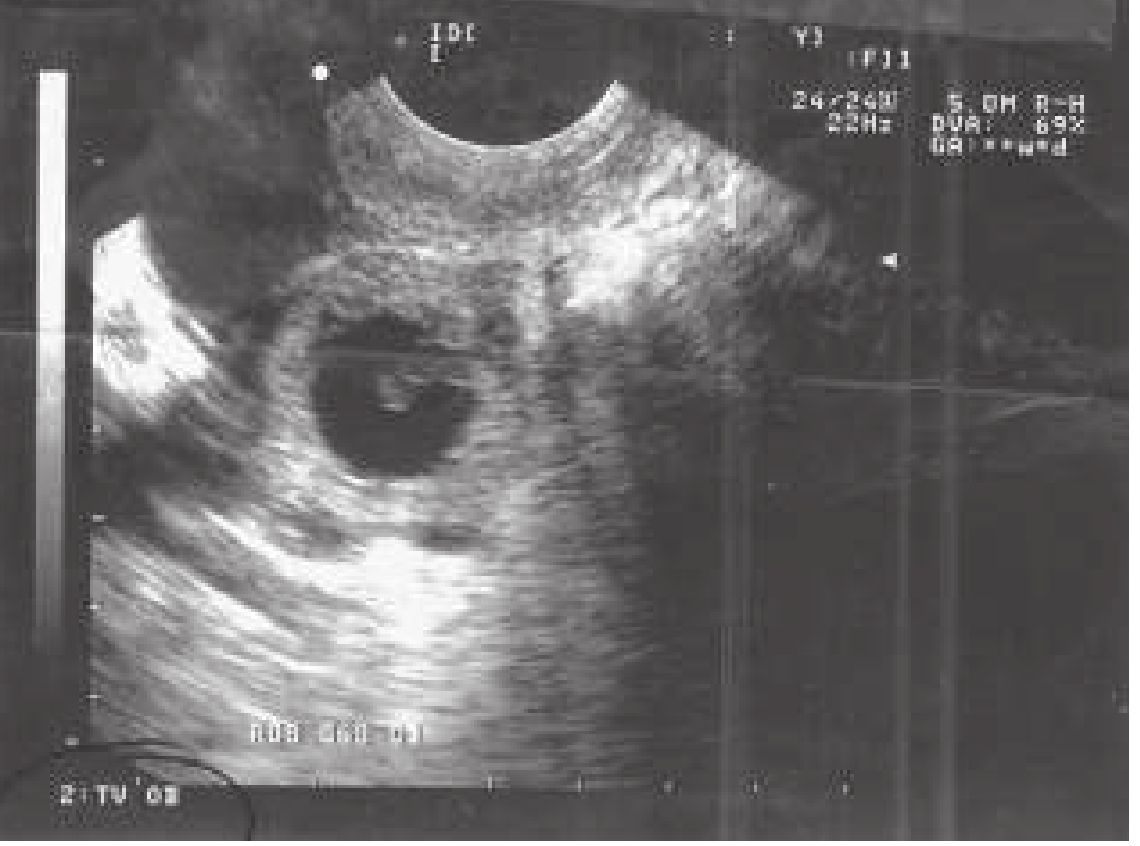
Ultrasound findings:
| Finding | Interpretation |
|---|---|
| Double decidual sac, intrauterine fetal pole/yolk sac, or fetal heart activity | Diagnostic of IUP |
| Pregnancy in fallopian tube, ectopic fetal heart activity, ectopic fetal pole | Diagnostic of ectopic |
| Moderate/large cul-de-sac fluid + empty uterus | Suggestive of ectopic |
| Adnexal mass + empty uterus | Suggestive of ectopic |
| Empty uterus alone | Indeterminate |
About 20% of ED evaluations yield an indeterminate ("pregnancy of unknown location") sonogram. In this group, if hCG <1000 mIU/mL with empty uterus, ectopic is more likely.
Serum Progesterone
-
20 ng/mL: likely viable IUP
- <5 ng/mL: excludes viable IUP (with rare exceptions); can be used alongside hCG ratios to triage low-risk patients
Other tests
-
D&C / uterine evacuation: identification of chorionic villi = IUP (miscarriage); no villi = likely ectopic
-
Laparoscopy: most efficient diagnostic tool in the hemodynamically unstable patient
-
Rosen's Emergency Medicine, p. 3351
Management
Management depends on hemodynamic stability, hCG level, ultrasound findings, and patient preference.
1. Surgical Management
Indications: Hemodynamically unstable, ruptured ectopic, failed medical therapy, contraindications to methotrexate, patient preference.
- Laparoscopy is the preferred surgical approach for most stable patients
- Salpingectomy (tube removal) vs. salpingostomy (tube-sparing): recurrent ectopic rates and IUP rates are similar between the two approaches (tubal patency variably affected by medical treatment)
- Laparotomy reserved for hemodynamically unstable patients or when laparoscopy is not feasible
- Cornual/interstitial ectopic: requires special surgical techniques due to proximity to uterine vasculature
2. Medical Management - Methotrexate
Methotrexate (MTX) is a folic acid analog that inhibits dihydrofolate reductase, preventing DNA synthesis, and kills actively dividing trophoblastic tissue. It is the first-line medical treatment for eligible patients. Approximately 35% of ectopic pregnancies are candidates for primary MTX therapy.
Absolute contraindications to MTX:
| Contraindication |
|---|
| Intrauterine pregnancy |
| Hemodynamic instability |
| Ruptured ectopic |
| Breastfeeding |
| Immunodeficiency |
| Moderate-severe anemia, leukopenia, or thrombocytopenia |
| Known sensitivity to methotrexate |
| Active pulmonary disease |
| Active peptic ulcer disease |
| Clinically significant hepatic or renal dysfunction |
Relative contraindications: ectopic >4 cm, embryonic cardiac motion on TVUS, β-hCG >5,000 mIU/mL, inability to comply with follow-up, refusal of blood transfusion.
Pre-treatment workup: CBC, blood type (Rh status), LFTs, electrolytes/creatinine, CXR if pulmonary disease history.
MTX Dosing Regimens
| Regimen | Protocol |
|---|---|
| Single-dose | MTX 50 mg/m² IM on day 0; check β-hCG on days 4 and 7; if drop <15%, repeat dose |
| Two-dose | MTX 50 mg/m² IM on days 0 and 4; check β-hCG on days 4 and 7; if drop <15%, give additional doses on days 7 and 11 |
| Multi-dose | MTX 1 mg/kg IM on days 1, 3, 5, 7 + leucovorin 0.1 mg/kg IM on days 2, 4, 6, 8; stop when β-hCG drops 15% between measurements |
- Success rate: ~90% for all regimens
- 15-25% of single-dose patients require a second dose (more likely with higher initial β-hCG)
- Patients with β-hCG >5,000 mIU/mL have higher failure rates with single-dose therapy
Important patient instructions while on MTX: Avoid folic acid supplements, NSAIDs, alcohol, sun exposure, and sexual intercourse. Warn about "separation pain" (transient abdominal pain on days 3-7 as the trophoblast separates) - this is normal but must be distinguished from tubal rupture.
- Berek & Novak's Gynecology, p. 1771-1773
3. Expectant Management
Reserved for a small subset of patients:
- Asymptomatic
- Very low or declining β-hCG (ideally <1000 mIU/mL and falling)
- No cardiac activity on TVUS
- Small ectopic mass
- Reliable follow-up
Requires close monitoring; risk of tubal rupture persists.
Special Types
| Type | Key Features |
|---|---|
| Heterotopic pregnancy | Simultaneous IUP + ectopic; historically 1:4,000, but much higher with ART; cannot rule out ectopic simply because an IUP is seen (unless no ART) |
| Interstitial/cornual | 2-4% of ectopics; late rupture (10-14 wks); catastrophic bleeding; hard to see on US |
| Cervical | Rare; heavy bleeding; US shows gestational sac in cervical canal |
| Abdominal | Rare; can grow to advanced gestational age; very high maternal mortality |
| Ovarian | Rare; must exclude corpus luteum cyst |
Complications
- Tubal rupture - surgical emergency; risk of exsanguination and death
- Rh sensitization (give anti-D immunoglobulin if Rh-negative)
- Recurrent ectopic pregnancy (up to 22% risk after first ectopic)
- Infertility
Key Teaching Points
- Always consider ectopic in any woman of reproductive age with abdominal pain or vaginal bleeding - even without classic risk factors
- 50% of patients with ectopic pregnancy receive medical evaluation at least twice before the correct diagnosis is made
- A positive pregnancy test + no IUP on TVUS = ectopic until proven otherwise
- Even normal vital signs and normal hemoglobin do not exclude a ruptured ectopic
- Laparoscopy is the most efficient diagnostic and therapeutic tool in the hemodynamically unstable patient
Sources: Rosen's Emergency Medicine (9780323757898); Berek & Novak's Gynecology (9781496380357); Roberts and Hedges' Clinical Procedures in Emergency Medicine (9780323354783); Robbins & Kumar Basic Pathology (9780323790185)
This is a shared conversation. Sign in to Orris to start your own chat.