
Management of breast carcinoma
"breast cancer"[MeSH Terms] AND "management"[MeSH Terms]
breast cancer management algorithm treatment
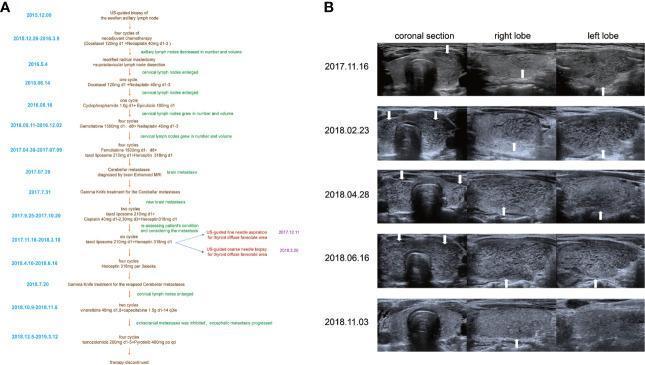
This medical figure consists of two primary components related to the management of occult breast cancer (OBC) with secondary thyroid involvement. Panel A is a detailed clinical timeline and treatment algorithm, documenting the patient's course from 2015 to 2019, including axillary node biopsy, modified radical mastectomy, multiple chemotherapy cycles (e.g., Docetaxel, Herceptin), and the emergence of cerebellar and thyroid metastases. Panel B is a longitudinal series of diagnostic ultrasound images of the thyroid gland, organized by date from November 2017 to November 2018. It displays coronal sections along with longitudinal views of the right and left lobes. White arrows highlight areas of metastasis characterized by a unique 'faveolate' (honeycomb-like) echo pattern and diffuse heterogeneity rather than discrete nodules. The series demonstrates the progression of these diffuse changes across both lobes by early 2018, followed by a partial reduction in the faveolate hypoechoic areas by November 2018 following systemic antitumor therapy. This illustrates a rare clinical presentation of metastatic breast carcinoma mimicking thyroiditis.
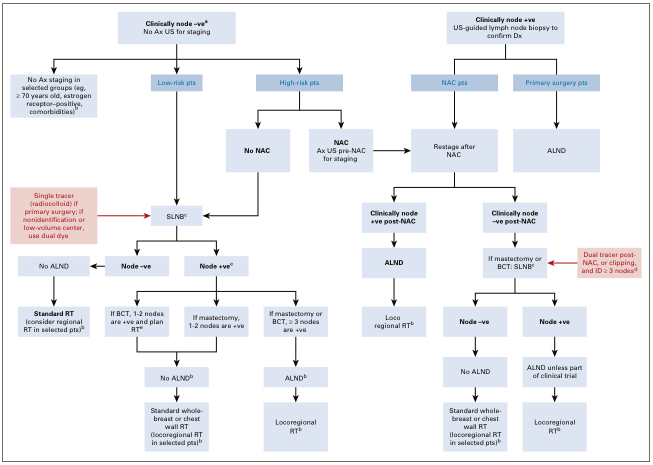
Summary : This flowchart outlines the axillary management algorithm for breast cancer patients, detailing the decision-making process for axillary staging and treatment based on clinical node status, risk stratification, and response to neoadjuvant chemotherapy (NAC).
Management of Breast Carcinoma
1. Initial Assessment & Staging
- Full history and physical examination
- Bilateral breast imaging (mammogram + ultrasound), MRI if indicated
- Core needle biopsy for histology, receptor status (ER, PR, HER2), and grade
- T - primary tumor size and local extension
- N - regional lymph node involvement
- M - distant metastases
- Sabiston Textbook of Surgery, p. 1392
2. Molecular Subtypes (Governs Systemic Therapy)
| Subtype | ER | PR | HER2 | Key Feature |
|---|---|---|---|---|
| Luminal A | + | + | - | Low grade, best prognosis |
| Luminal B | + | +/- | -/+ | Higher grade, more aggressive |
| HER2-enriched | - | - | + | Targeted therapy eligible |
| Triple-Negative (TNBC) | - | - | - | No targeted receptors, chemo +/- immunotherapy |
3. Surgical Management
Breast Surgery Options
- Six randomized trials showed equivalent survival to modified radical mastectomy for early-stage disease
- Must achieve negative margins
- Requires postoperative radiation in most cases
- Contraindications: multifocal disease, prior chest radiation, ongoing pregnancy, poor cosmesis, patient preference
- Indicated when BCS is contraindicated or patient preference
- Types include total (simple) mastectomy, modified radical mastectomy (breast + axillary nodes, sparing pectoralis), and skin/nipple-sparing variants
- Discuss immediate or delayed reconstruction (implant vs. autologous tissue)
- BRCA mutation carriers may opt for bilateral mastectomy given high contralateral risk
Historical note: Halsted radical mastectomy (1880s) removed breast + pectoralis muscles + axillary nodes and was standard until 1970s. NSABP B-04 showed no survival advantage of radical over total mastectomy at 25-year follow-up.
- Sabiston Textbook of Surgery, p. 1393
Axillary Management
- Clinically negative axilla: Sentinel lymph node biopsy (SLNB) - minimally invasive staging. Avoids full axillary dissection if sentinel nodes are negative
- Clinically positive axilla / significant sentinel node burden: Level I-II axillary lymph node dissection (ALND)
- De-escalation trends: Randomized data now support omitting SLNB in older women with small, biologically favorable, clinically node-negative tumors on adjuvant endocrine therapy; omitting ALND for low sentinel node burden + planned radiation
4. Radiation Therapy
After BCS
- Standard: whole breast radiation (WBR) daily x 4-6 weeks
- Hypofractionated schedules (3 weeks or 5-fraction) - equivalent outcomes, shorter duration
- Partial breast irradiation - not shown superior to WBR in trials
- Regional nodal irradiation extended to axillary/internal mammary nodes based on pathology
- Omission of RT is safe in women >65 years with low-risk ER+ tumors on endocrine therapy
Post-Mastectomy Radiation Therapy (PMRT)
-
Recommended for: tumor >5 cm, ≥4 positive axillary nodes (strong indication), 1-3 positive nodes or close margins (also considered)
-
Reduces locoregional recurrence and improves OS
-
Harrison's Principles of Internal Medicine, 22E, p. 680
5. Systemic Therapy
Neoadjuvant vs. Adjuvant
| Feature | Neoadjuvant | Adjuvant |
|---|---|---|
| Timing | Before surgery | After surgery |
| Goal | Downsize tumor, enable BCS, test in vivo response | Eliminate micrometastatic disease |
| Advantage | pCR predicts better outcome; allows de-escalation of surgery | Establishes pathologic stage first |
- Locally advanced disease (T3, T4 / N2, N3) - to downsize
- HER2+ tumors - chemotherapy + anti-HER2 agents
- Triple-negative breast cancer (TNBC) ≥2 cm or node-positive
- Desire to convert to BCS
- Premenopausal women with node-positive disease
- Bailey and Love's Short Practice of Surgery, 28th Edition
A. Endocrine (Hormonal) Therapy
| Agent | Class | Menopausal Status |
|---|---|---|
| Tamoxifen | Selective ER Modulator (SERM) | Any (pre or post) - 5-10 years |
| Toremifene | SERM | Any |
| Anastrozole, Letrozole, Exemestane | Aromatase Inhibitors (AIs) | Postmenopausal only (as monotherapy) |
| Goserelin, Leuprolide | LHRH agonists (ovarian suppression) | Premenopausal - combined with AI or tamoxifen |
| Abemaciclib, Ribociclib | CDK4/6 inhibitors | High-risk early ER+ disease (with endocrine therapy) |
- Harrison's Principles of Internal Medicine, 22E
B. Cytotoxic Chemotherapy
- Anthracyclines: Doxorubicin (Adriamycin), Epirubicin
- Taxanes: Paclitaxel (weekly or q3-weekly), Docetaxel
- Alkylating agents: Cyclophosphamide
- Antimetabolites: 5-Fluorouracil, Capecitabine, Methotrexate
- Platinum salts: Carboplatin, Cisplatin (especially TNBC/BRCA-mutated)
- AC-T: Doxorubicin + Cyclophosphamide → Paclitaxel
- TC: Docetaxel + Cyclophosphamide (lower-risk patients)
- CMF: Cyclophosphamide + Methotrexate + 5-FU (older regimen, less used now)
C. HER2-Targeted Therapy
| Agent | Type | Indication |
|---|---|---|
| Trastuzumab (Herceptin) | Monoclonal antibody | Early + metastatic; 1 year adjuvant |
| Pertuzumab | Monoclonal antibody | Neoadjuvant + adjuvant (with trastuzumab) |
| T-DM1 (Ado-trastuzumab emtansine) | Antibody-drug conjugate | Residual disease post-neoadjuvant |
| T-DXd (Trastuzumab deruxtecan) | Antibody-drug conjugate | Metastatic HER2+ / HER2-low |
| Neratinib | Tyrosine kinase inhibitor | Extended adjuvant after trastuzumab |
| Lapatinib | TKI | Metastatic; CNS disease |
- For small tumors (node-negative, <3 cm): weekly paclitaxel x12 weeks + trastuzumab ± pertuzumab (excellent outcomes)
- For larger/node-positive HER2+: neoadjuvant TCHP (Taxane + Carboplatin + Trastuzumab + Pertuzumab)
D. Immunotherapy
- Pembrolizumab (anti-PD-1): FDA-approved for early-stage and metastatic TNBC
- Neoadjuvant: added to chemotherapy for TNBC ≥2 cm or node-positive
- Post-surgery: continued to complete 1 year
- Patients achieving pCR: continue pembrolizumab alone
E. PARP Inhibitors (Targeted Therapy for BRCA-Mutated Disease)
- Olaparib: Oral PARP inhibitor for high-risk early HER2-negative breast cancer with germline BRCA1/2 mutation
- Talazoparib: Used in metastatic BRCA-mutated HER2-negative breast cancer
6. Special Situations
DCIS (Ductal Carcinoma In Situ)
- BCS + radiation is standard (reduces ipsilateral recurrence)
- Mastectomy for multifocal DCIS or patient preference
- SLNB: considered if mastectomy performed or if high-grade DCIS (risk of occult invasion)
- Adjuvant tamoxifen reduces contralateral breast events in ER+ DCIS
Locally Advanced Breast Cancer (LABC) - Stage III
- Neoadjuvant chemotherapy first, then surgery (usually mastectomy + ALND), then radiation
- Sequence: NACT → Surgery → RT → Adjuvant systemic therapy
Inflammatory Breast Cancer (IBC)
- Present with rapid onset, peau d'orange skin, warmth, erythema
- Always treated with neoadjuvant chemotherapy first (never primary surgery)
- Classified as T4d regardless of tumor size
- Remains classified as IBC even after complete response to NACT
Breast Cancer in Pregnancy
- Surgery (mastectomy preferred over BCS) can be performed in all trimesters
- Chemotherapy can be given in 2nd and 3rd trimesters
- Radiation and endocrine therapy deferred until after delivery
- HER2-targeted therapy (trastuzumab) - contraindicated during pregnancy (oligohydramnios)
BRCA Mutation Carriers
- Bilateral mastectomy reduces contralateral breast cancer risk
- Risk-reducing salpingo-oophorectomy for BRCA1/2 reduces ovarian cancer risk and helps with endocrine status
Male Breast Cancer
- Rare (~1% of all breast cancers); typically ER+
- Treatment mirrors female breast cancer; mastectomy typically preferred; tamoxifen is mainstay of endocrine therapy (AIs less effective without oophorectomy equivalent)
7. Metastatic Breast Cancer (Stage IV)
- ER+/HER2-: Endocrine therapy + CDK4/6 inhibitor (e.g., palbociclib, ribociclib, abemaciclib) as first-line; subsequent lines include fulvestrant, everolimus + exemestane, PI3K inhibitors (alpelisib for PIK3CA-mutated tumors)
- HER2+: Trastuzumab + pertuzumab + taxane (first-line); T-DXd (second-line); T-DM1, lapatinib-based regimens
- TNBC: Pembrolizumab (if PD-L1+) + chemotherapy; sacituzumab govitecan (TROP2 antibody-drug conjugate); platinum-based chemo for BRCA-mutated; olaparib/talazoparib
- Bone metastases: Zoledronate or denosumab for skeletal-related event prevention
- Oligometastatic disease: Select patients may benefit from local ablative therapy
8. Follow-Up of Survivors
-
History and physical examination: every 3-6 months for first 3 years, then annually
-
Annual mammography (ipsilateral and contralateral)
-
No routine CT/bone scans or blood tests unless symptomatic
-
Bone health: Bisphosphonate (zoledronate 6-monthly x3 years) for those on aromatase inhibitors or LHRH agonists
-
Symptom management on endocrine therapy:
- Hot flashes: venlafaxine, gabapentin
- Vaginal dryness: topical estrogen, lubricants
- AI-associated arthralgia: switching AI, NSAIDs, duloxetine, exercise
- Peripheral neuropathy (taxane-related): gabapentin
-
Harrison's Principles of Internal Medicine, 22E, p. 680
Summary Algorithm
| Stage | Primary Treatment | Systemic Therapy |
|---|---|---|
| DCIS (Stage 0) | BCS + RT or Mastectomy | Tamoxifen (ER+) |
| Early (Stage I-II) | BCS + RT or Mastectomy + SLNB | Adjuvant chemo ± targeted ± endocrine therapy based on subtype |
| Locally Advanced (Stage III) | NACT → Surgery → RT | Neoadjuvant then adjuvant systemic therapy |
| Inflammatory | NACT → Mastectomy → RT | As above |
| Metastatic (Stage IV) | Palliative intent | Systemic therapy (subtype-directed) ± local ablation |
Sources: Harrison's Principles of Internal Medicine 22E (2025) | Sabiston Textbook of Surgery | Bailey and Love's Short Practice of Surgery 28th Edition | Current Surgical Therapy 14e