
Hey orris get me a ready experience nursing interview questions and answer with complete details like picture and key points
What level of nursing experience are you targeting? · Which nursing specialty or setting? · What format do you want the output in?
ICU critical care nursing interview questions answers experienced nurse 2024
https://www.sunbeltstaffing.com/resources/nursing/icu-nurse-…
ls -la /home/daytona/workspace/ && mkdir -p /home/daytona/workspace/icu-nursing-interview && ls /home/daytona/skills/docx/scripts/office/ 2>/dev/null || echo "no scripts dir"
ICU critical care nursing interview preparation banner - professional nurse in ICU with monitors, ventilators in background, confident pose, text overlay says "ICU Nursing Interview Guide", clean professional look
cd /home/daytona/workspace/icu-nursing-interview && curl -s "https://cdn.orris.care/image-gen/8a5bf128d4b847dc8f7390b2e81446d5.png" -o banner.png && echo "Image downloaded: $(wc -c < banner.png) bytes"
~/icu-nursing-interview/generate.js
const {
  Document, Packer, Paragraph, TextRun, Table, TableRow, TableCell,
  ImageRun, Header, AlignmentType, HeadingLevel, LevelFormat, BorderStyle,
  WidthType, ShadingType, VerticalAlign, PageNumber, PageBreak
} = require('docx');
const fs = require('fs');
const path = require('path');

// ── Load banner image ─────────────────────────────────────────────────────────
const bannerPath = path.join(__dirname, 'banner.png');
const bannerBuffer = fs.readFileSync(bannerPath);

// ── Helpers ───────────────────────────────────────────────────────────────────
function h1(text) {
  return new Paragraph({
    heading: HeadingLevel.HEADING_1,
    children: [new TextRun({ text, bold: true, size: 34, color: '1B3A6B', font: 'Arial' })],
    spacing: { before: 320, after: 160 },
    border: { bottom: { color: '1B3A6B', style: BorderStyle.SINGLE, size: 12, space: 4 } }
  });
}

function h2(text) {
  return new Paragraph({
    heading: HeadingLevel.HEADING_2,
    children: [new TextRun({ text, bold: true, size: 28, color: '2C5F8A', font: 'Arial' })],
    spacing: { before: 260, after: 100 }
  });
}

function h3(text) {
  return new Paragraph({
    children: [new TextRun({ text, bold: true, size: 24, color: '1E5C40', font: 'Arial' })],
    spacing: { before: 200, after: 80 }
  });
}

function body(text, bold = false, color = '222222') {
  return new Paragraph({
    children: [new TextRun({ text, size: 22, font: 'Arial', bold, color })],
    spacing: { before: 60, after: 60 }
  });
}

function bullet(text, numbering) {
  return new Paragraph({
    numbering: { reference: numbering, level: 0 },
    children: [new TextRun({ text, size: 22, font: 'Arial', color: '222222' })],
    spacing: { before: 40, after: 40 }
  });
}

function keyPointBox(items) {
  // Shaded green box for key points
  const rows = items.map(item =>
    new TableRow({
      children: [
        new TableCell({
          children: [new Paragraph({
            numbering: { reference: 'bullets', level: 0 },
            children: [new TextRun({ text: item, size: 21, font: 'Arial', color: '1E3A2E' })],
            spacing: { before: 30, after: 30 }
          })],
          borders: { top: { style: BorderStyle.NONE }, bottom: { style: BorderStyle.NONE }, left: { style: BorderStyle.NONE }, right: { style: BorderStyle.NONE } },
          margins: { top: 60, bottom: 60, left: 120, right: 120 }
        })
      ]
    })
  );

  return new Table({
    width: { size: 100, type: WidthType.PERCENTAGE },
    borders: {
      top: { style: BorderStyle.SINGLE, size: 6, color: '2E7D52' },
      bottom: { style: BorderStyle.SINGLE, size: 6, color: '2E7D52' },
      left: { style: BorderStyle.THICK, size: 18, color: '2E7D52' },
      right: { style: BorderStyle.SINGLE, size: 6, color: '2E7D52' }
    },
    rows: [
      new TableRow({
        children: [new TableCell({
          children: [new Paragraph({
            children: [new TextRun({ text: '🔑 KEY POINTS', bold: true, size: 22, font: 'Arial', color: '1E5C40' })],
            spacing: { before: 60, after: 40 }
          })],
          shading: { fill: 'D6F5E3', type: ShadingType.CLEAR },
          borders: { top: { style: BorderStyle.NONE }, bottom: { style: BorderStyle.THIN, size: 4, color: '2E7D52' }, left: { style: BorderStyle.NONE }, right: { style: BorderStyle.NONE } },
          margins: { top: 60, bottom: 60, left: 120, right: 120 }
        })]
      }),
      ...rows
    ]
  });
}

function qBox(qNum, question) {
  return new Table({
    width: { size: 100, type: WidthType.PERCENTAGE },
    borders: {
      top: { style: BorderStyle.SINGLE, size: 6, color: '1B3A6B' },
      bottom: { style: BorderStyle.SINGLE, size: 6, color: '1B3A6B' },
      left: { style: BorderStyle.THICK, size: 18, color: '1B3A6B' },
      right: { style: BorderStyle.SINGLE, size: 6, color: '1B3A6B' }
    },
    rows: [
      new TableRow({
        children: [new TableCell({
          children: [new Paragraph({
            children: [
              new TextRun({ text: `Q${qNum}. `, bold: true, size: 24, font: 'Arial', color: 'FFFFFF' }),
              new TextRun({ text: question, bold: true, size: 24, font: 'Arial', color: 'FFFFFF' })
            ],
            spacing: { before: 80, after: 80 }
          })],
          shading: { fill: '1B3A6B', type: ShadingType.CLEAR },
          margins: { top: 80, bottom: 80, left: 140, right: 140 },
          borders: { top: { style: BorderStyle.NONE }, bottom: { style: BorderStyle.NONE }, left: { style: BorderStyle.NONE }, right: { style: BorderStyle.NONE } }
        })]
      })
    ]
  });
}

function pageBreak() {
  return new Paragraph({ children: [new PageBreak()] });
}

function sectionDivider(label, color = 'E8F0FA') {
  return new Table({
    width: { size: 100, type: WidthType.PERCENTAGE },
    borders: {
      top: { style: BorderStyle.NONE }, bottom: { style: BorderStyle.NONE },
      left: { style: BorderStyle.NONE }, right: { style: BorderStyle.NONE }
    },
    rows: [new TableRow({ children: [new TableCell({
      children: [new Paragraph({
        alignment: AlignmentType.CENTER,
        children: [new TextRun({ text: label, bold: true, size: 26, font: 'Arial', color: '1B3A6B' })],
        spacing: { before: 80, after: 80 }
      })],
      shading: { fill: color, type: ShadingType.CLEAR },
      margins: { top: 80, bottom: 80, left: 200, right: 200 },
      borders: { top: { style: BorderStyle.NONE }, bottom: { style: BorderStyle.NONE }, left: { style: BorderStyle.NONE }, right: { style: BorderStyle.NONE } }
    })] })]
  });
}

function spacer(pts = 120) {
  return new Paragraph({ children: [], spacing: { before: pts, after: pts } });
}

// ── Document children ─────────────────────────────────────────────────────────
const children = [];

// ── COVER ─────────────────────────────────────────────────────────────────────
children.push(
  new Paragraph({
    alignment: AlignmentType.CENTER,
    children: [new ImageRun({ data: bannerBuffer, transformation: { width: 600, height: 280 }, type: 'png' })],
    spacing: { before: 0, after: 200 }
  }),
  new Paragraph({
    alignment: AlignmentType.CENTER,
    children: [new TextRun({ text: 'ICU / CRITICAL CARE NURSING', bold: true, size: 44, font: 'Arial', color: '1B3A6B' })]
  }),
  new Paragraph({
    alignment: AlignmentType.CENTER,
    children: [new TextRun({ text: 'Interview Questions & Model Answers', bold: true, size: 34, font: 'Arial', color: '2C5F8A' })],
    spacing: { after: 120 }
  }),
  new Paragraph({
    alignment: AlignmentType.CENTER,
    children: [new TextRun({ text: 'For Nurses with 1-3 Years of Experience', size: 26, font: 'Arial', color: '555555', italics: true })]
  }),
  new Paragraph({
    alignment: AlignmentType.CENTER,
    children: [new TextRun({ text: 'Prepared: June 2026  |  Critical Care Specialty', size: 22, font: 'Arial', color: '888888' })],
    spacing: { before: 100, after: 400 }
  }),
  // Quick-reference legend
  sectionDivider('How to Use This Guide', 'E8F4FF'),
  spacer(80),
  body('This guide covers the 15 most common ICU interview question categories, each with:', false, '333333'),
  body('  • A model answer tailored to 1-3 years of ICU experience', false, '333333'),
  body('  • Key Points box summarizing what the interviewer is looking for', false, '333333'),
  body('  • Tips on using the STAR method (Situation · Task · Action · Result) where appropriate', false, '333333'),
  body('  • Clinical accuracy aligned with AACN and evidence-based practice standards', false, '333333'),
  spacer(80),
  pageBreak()
);

// ── SECTION 1: General & Motivation ──────────────────────────────────────────
children.push(
  sectionDivider('SECTION 1 — General & Motivation Questions', 'E8F0FA'),
  spacer(100),

  // Q1
  qBox(1, 'Tell me about yourself and your experience as an ICU nurse.'),
  spacer(60),
  h3('Model Answer'),
  body('I am a registered nurse with just over two years of experience in a medical-surgical ICU at a 300-bed community hospital. During that time I have managed up to two patients per shift, including post-operative cardiac surgery patients, multi-organ failure cases, and patients requiring mechanical ventilation. I hold my CCRN certification, which I completed in my second year, and I recently completed an ACLS instructor course. I thrive in environments that require rapid critical thinking, precise documentation, and close collaboration with physicians, respiratory therapists, and pharmacists. My goal in this role is to bring those skills here while continuing to grow — particularly in trauma critical care.'),
  spacer(80),
  keyPointBox([
    'Mention your setting, patient types, and nurse-to-patient ratio',
    'Lead with concrete skills: ventilator management, vasopressors, hemodynamic monitoring',
    'Name any certifications: CCRN, ACLS, PALS, BLS',
    'Show forward motion — mention a learning goal specific to the new role',
    'Keep it under 90 seconds when spoken aloud'
  ]),
  spacer(120),

  // Q2
  qBox(2, 'Why do you want to work in the ICU — and specifically at this facility?'),
  spacer(60),
  h3('Model Answer'),
  body('Critical care is where I do my best work. The complexity of managing patients whose physiology can shift minute to minute keeps me engaged and constantly learning. I chose to pursue ICU nursing deliberately — not as a stepping stone — and I have stayed because every shift deepens my clinical reasoning. I researched this facility specifically because of your Magnet designation and the fact that you recently expanded your cardiac ICU. I\'d like to develop expertise in IABP management and ECMO support, and I know this unit offers exposure to both. I also value your nurse residency model — mentorship at this level makes a measurable difference in outcomes for both patients and staff.'),
  spacer(80),
  keyPointBox([
    'Be specific to the hospital — mention Magnet status, unit type, programs, or recent news',
    'Show intrinsic motivation — passion for critical care, not just a pay raise',
    'Name a clinical skill you want to develop that the unit can offer',
    'Research the unit\'s patient population before your interview'
  ]),
  spacer(120),
  pageBreak()
);

// ── SECTION 2: Clinical & Technical ──────────────────────────────────────────
children.push(
  sectionDivider('SECTION 2 — Clinical & Technical Skills Questions', 'FFF5E6'),
  spacer(100),

  // Q3
  qBox(3, 'How do you perform a head-to-toe assessment on a critically ill patient?'),
  spacer(60),
  h3('Model Answer'),
  body('I follow a systematic ABCDE approach: Airway, Breathing, Circulation, Disability (neurological), and Exposure. I start by confirming airway patency — for intubated patients I verify ETT position, check for equal bilateral breath sounds, and confirm the ventilator settings match the order. For breathing I assess respiratory rate, SpO2, EtCO2, tidal volumes, and note any patient-ventilator dyssynchrony. For circulation I evaluate HR, arterial line waveform, MAP, skin color, temperature, and capillary refill; I then review any vasopressor infusions and their trends. Disability covers GCS, pupil reactivity, and sedation-agitation scale (RASS). Exposure means checking all lines, drains, wounds, and repositioning the patient to prevent pressure injuries. I document findings and immediately escalate any acute changes to the physician.'),
  spacer(80),
  keyPointBox([
    'ABCDE framework is the expected structure — do not skip to random systems',
    'Show familiarity with invasive monitoring: arterial lines, CVP, PAC if applicable',
    'Mention ventilator parameters specifically: TV, PEEP, FiO2, plateau pressure',
    'Name the sedation scale you use: RASS or SAS',
    'Always end with escalation — shows safety awareness'
  ]),
  spacer(120),

  // Q4
  qBox(4, 'Describe your experience with mechanical ventilation and managing ventilated patients.'),
  spacer(60),
  h3('Model Answer'),
  body('I am comfortable managing both volume-controlled and pressure-controlled ventilation modes, as well as weaning modes like SIMV and PS/CPAP. When a patient is initiated on mechanical ventilation I verify the ETT position with chest X-ray confirmation, secure the tube, and confirm the ordered settings — typically following lung-protective ventilation: tidal volume 6 mL/kg of ideal body weight, plateau pressure below 30 cmH2O, PEEP as appropriate for the ARDS net protocol if indicated. I perform regular ventilator bundle interventions: HOB elevation to 30-45 degrees, daily SAT/SBT coordination with the respiratory therapist, oral care every four hours, and DVT prophylaxis. I respond to alarms systematically — I check the patient first, then the circuit, then the machine. When a patient is ready for extubation I assess using standard criteria and coordinate closely with the MD and RT.'),
  spacer(80),
  keyPointBox([
    'Know the ABCDE bundle: Awakening, Breathing, Coordination, Delirium monitoring, Early mobility',
    'Quote lung-protective targets: TV 6 mL/kg IBW, Pplat < 30 cmH2O',
    'Show you work WITH respiratory therapists, not independently',
    'Ventilator bundle compliance reduces VAP — mention it',
    'Be ready for a follow-up: "How do you manage ventilator-associated pneumonia prevention?"'
  ]),
  spacer(120),
  pageBreak(),

  // Q5
  qBox(5, 'How do you manage a patient on vasopressor therapy?'),
  spacer(60),
  h3('Model Answer'),
  body('When a patient is on vasopressor support I first understand the underlying indication — septic shock, distributive vs. cardiogenic — because the choice of agent matters. For norepinephrine, the first-line agent in septic shock per Surviving Sepsis guidelines, I titrate to a MAP goal typically above 65 mmHg and monitor continuously via arterial line. I assess for signs of tissue hypoperfusion: lactate trends, urine output, capillary refill, and skin mottling. I check the IV access every hour for extravasation since vasopressors should ideally run through a central line; if only peripheral access is available I use the largest gauge in the most proximal vein and follow my facility protocol. I track trends, document titrations, and communicate any resistance — requiring dose escalation despite adequate volume resuscitation — to the physician promptly. I also watch for adverse effects: tachyarrhythmias with dopamine, peripheral ischemia with high-dose norepinephrine.'),
  spacer(80),
  keyPointBox([
    'Know your agents: Norepinephrine (first-line sepsis), Vasopressin (adjunct), Dopamine, Phenylephrine, Epinephrine',
    'MAP goal > 65 mmHg is the standard target — higher in chronic hypertensive patients',
    'Central line preferred; know your facility\'s peripheral vasopressor protocol',
    'Lactate clearance is the key marker of resuscitation adequacy',
    'Surviving Sepsis Campaign guidelines are the reference standard'
  ]),
  spacer(120),

  // Q6
  qBox(6, 'Walk me through how you manage a patient with sepsis in the ICU.'),
  spacer(60),
  h3('Model Answer'),
  body('I follow the Hour-1 Bundle from the Surviving Sepsis Campaign. Within the first hour: I measure lactate (repeat if initial is above 2 mmol/L), obtain blood cultures before giving antibiotics, administer broad-spectrum antibiotics, begin 30 mL/kg crystalloid bolus for lactate ≥4 mmol/L or hypotension, and start vasopressors if MAP remains below 65 mmHg after fluid. I then perform frequent reassessment — if the patient does not respond to fluids I reassess volume status using dynamic measures rather than CVP alone: passive leg raise, pulse pressure variation, or bedside echo. I monitor for complications of aggressive resuscitation: pulmonary edema, abdominal compartment syndrome. I communicate lab results to the physician in real time using SBAR and participate in antibiotic de-escalation based on culture results at 48-72 hours.'),
  spacer(80),
  keyPointBox([
    'Hour-1 Bundle: Lactate, Cultures, Antibiotics, Fluids, Vasopressors — in that order',
    'Dynamic fluid responsiveness measures > static CVP',
    'Antibiotic stewardship: de-escalate at 48-72 hours once cultures return',
    'Sepsis-3 definitions: organ dysfunction + suspected infection = sepsis; vasopressor-dependent + lactate >2 = septic shock',
    'Show you know the difference between fluid resuscitation and fluid overload harm'
  ]),
  spacer(120),
  pageBreak()
);

// ── SECTION 3: Behavioral & Situational ──────────────────────────────────────
children.push(
  sectionDivider('SECTION 3 — Behavioral & Situational Questions (STAR Format)', 'F0FAF0'),
  spacer(100),

  body('For behavioral questions use the STAR method: Situation → Task → Action → Result', true, '1E5C40'),
  spacer(80),

  // Q7
  qBox(7, 'Tell me about a time a patient deteriorated rapidly. What did you do?'),
  spacer(60),
  h3('Model Answer (STAR)'),
  body('SITUATION: I was caring for a 58-year-old post-operative CABG patient when, four hours after arriving in the ICU, his heart rate jumped to 145 and his MAP dropped from 72 to 52 mmHg.', false, '333333'),
  body('TASK: I needed to rapidly assess, stabilize, and communicate the findings to the team.', false, '333333'),
  body('ACTION: I immediately performed a primary assessment — airway was intact, breath sounds diminished at the left base, JVP was elevated, and chest tube output had suddenly stopped. I suspected cardiac tamponade. I called the attending and cardiothoracic surgeon simultaneously using SBAR, elevated the legs, ran a rapid 500 mL NS bolus per protocol, and prepared the crash cart. I kept the family informed at the bedside.', false, '333333'),
  body('RESULT: The surgeon performed an emergent pericardiocentesis at the bedside. The patient was hemodynamically stabilized within 20 minutes. A post-event debrief praised the early recognition of the clinical signs and the speed of escalation.', false, '333333'),
  spacer(80),
  keyPointBox([
    'Interviewers score: speed of recognition, systematic assessment, communication clarity',
    'Name the communication tool: SBAR (Situation, Background, Assessment, Recommendation)',
    'Show clinical reasoning — you named a differential (tamponade) not just "the patient crashed"',
    'Family communication during crises is a plus — it demonstrates patient advocacy',
    'End with the outcome AND learning/debrief — shows reflective practice'
  ]),
  spacer(120),

  // Q8
  qBox(8, 'Describe a conflict with a physician over a patient\'s care. How did you handle it?'),
  spacer(60),
  h3('Model Answer (STAR)'),
  body('SITUATION: I had a patient with worsening respiratory status — rising CO2, decreasing SpO2, increased work of breathing — and I believed she needed intubation. The covering physician, who had not assessed the patient for three hours, ordered a non-rebreather mask adjustment by phone without coming to bedside.', false, '333333'),
  body('TASK: I needed to advocate for the patient while maintaining a professional relationship.', false, '333333'),
  body('ACTION: I called back using CUS language: "I am Concerned, I am Uncomfortable, this is a Safety issue." I presented objective data: SpO2 82% on high-flow, RR 32, accessory muscle use, ABG showing pH 7.28 and PaCO2 58. I requested a bedside evaluation and documented my assessment and the call in the chart. I also notified the charge nurse.', false, '333333'),
  body('RESULT: The physician came to bedside, agreed the patient needed intubation, and she was intubated within 15 minutes. The patient had a good outcome. I later had a private, respectful conversation with the physician about communication expectations in our unit.', false, '333333'),
  spacer(80),
  keyPointBox([
    'CUS language (Concerned, Uncomfortable, Safety) is an evidence-based escalation tool',
    'Always cite objective data — SpO2, RR, ABG, lactate — not just "I had a bad feeling"',
    'Document everything: your assessment, the call time, the physician response',
    'Charge nurse loop-in is professional, not tattling — it protects the patient and you',
    'Following up with the physician respectfully shows emotional intelligence'
  ]),
  spacer(120),
  pageBreak(),

  // Q9
  qBox(9, 'How do you prioritize when you have two critically ill patients with competing needs?'),
  spacer(60),
  h3('Model Answer'),
  body('I first do a rapid 30-second visual scan of both patients to identify any immediately life-threatening needs. I apply the principle of ABCs — airway and breathing emergencies come before everything else. If both patients have acute needs, I call for help immediately — a charge nurse, a colleague, or the rapid response team — rather than trying to manage both alone. I use structured handoff communication so my colleague has enough information to act safely on one patient while I manage the other. After the acute period I debrief with the charge nurse, complete my documentation, and participate in any after-action review. Time management in the ICU is a team sport — knowing when to delegate is as important as knowing what to do yourself.'),
  spacer(80),
  keyPointBox([
    'Show situational awareness — you scan before prioritizing',
    'Asking for help is a safety behavior, not a weakness — interviewers want to hear it',
    'Demonstrate structured communication: SBAR or IPASS handoff',
    'Never suggest you would try to handle two acute crises simultaneously and alone',
    'Mention documentation — critical in liability and continuity of care'
  ]),
  spacer(120)
);

// ── SECTION 4: Communication & Teamwork ──────────────────────────────────────
children.push(
  pageBreak(),
  sectionDivider('SECTION 4 — Communication & Teamwork Questions', 'FFF0F5'),
  spacer(100),

  // Q10
  qBox(10, 'How do you ensure safe handoff/handover at the end of your shift?'),
  spacer(60),
  h3('Model Answer'),
  body('I use the SBAR framework structured around a systematic head-to-toe format. Before I give report, I review my notes, update the care plan, and ensure all critical results are acknowledged. During report I cover: current clinical status, active problems and trends over the shift, pending labs, procedures, or consults, outstanding orders that need follow-up, family conversations, and any safety alerts. I use bedside shift report whenever policy allows — the oncoming nurse can visualize the patient, verify lines and drains, and the patient can correct any discrepancies. For high-acuity patients I highlight the "if-then" escalation plan: "If MAP drops below 65 with the current vasopressor dose, call the attending and consider adding vasopressin per protocol." I never rush handoff and I stay until the oncoming nurse confirms they are comfortable.'),
  spacer(80),
  keyPointBox([
    'SBAR is the expected framework — know it cold',
    'Bedside shift report improves safety and patient engagement — mention it',
    '"If-then" anticipatory guidance shows advanced clinical thinking',
    'Staying until the oncoming nurse is comfortable = high reliability practice',
    'Ensure any critical labs, events, or escalations are communicated verbally AND documented'
  ]),
  spacer(120),

  // Q11
  qBox(11, 'How do you communicate with a patient\'s family during a critical illness?'),
  spacer(60),
  h3('Model Answer'),
  body('Families of ICU patients experience significant anxiety and information overload. I establish expectations early — I introduce myself, explain my role, and give a brief orientation to the ICU environment. I use plain language, avoid medical jargon, and check for understanding by asking families to repeat back key points. I provide regular updates at consistent times and document family communication in the chart. When delivering difficult news — a worsening prognosis, a change in goals of care — I ensure privacy, sit at eye level, allow silence, and involve the attending, a social worker, or a chaplain as appropriate. I follow the SPIKES protocol when relevant. I always emphasize what we are doing, not just what is wrong, and I never give false hope but I also never remove all hope.'),
  spacer(80),
  keyPointBox([
    'SPIKES protocol: Setting, Perception, Invitation, Knowledge, Empathy, Summary/Strategy',
    'Check for understanding by asking family to repeat information — not "Do you understand?"',
    'Document family meetings, conversations, and decision-making in the chart',
    'Involve the whole team: social work, chaplain, palliative care when appropriate',
    'Cultural humility: ask about communication preferences and decision-making structure'
  ]),
  spacer(120),
  pageBreak()
);

// ── SECTION 5: Ethics, Stress & Professional Development ─────────────────────
children.push(
  sectionDivider('SECTION 5 — Ethics, Self-Care & Professional Development', 'F5F0FF'),
  spacer(100),

  // Q12
  qBox(12, 'How do you manage stress and prevent burnout in critical care nursing?'),
  spacer(60),
  h3('Model Answer'),
  body('Critical care nursing has a high incidence of compassion fatigue and moral distress, and I take those risks seriously. At work I debrief after difficult cases with my team — formal or informal debriefs after patient deaths, unexpected deteriorations, or ethical conflicts. I use structured self-care strategies: regular exercise, maintaining a sleep routine, and clear separation between work and personal time — I do not review work messages off-shift unless on call. I build peer support relationships; having a colleague you can text after a hard day matters. Professionally, I monitor my own resilience by reflecting on whether I\'m finding meaning in my work, which is why I pursue continuing education and precept students — it reinvigorates my purpose. I would also access EAP resources if I felt clinically unsupported.'),
  spacer(80),
  keyPointBox([
    'Name specific strategies — "exercise" + "debriefs" + "peer support" is credible',
    'Show awareness of moral distress, not just general "stress" — ICU-specific',
    'Formal debriefs after critical events: show you value unit culture of safety',
    'Precepting and teaching = professional meaning-making — strong answer',
    'Mentioning EAP shows you know healthy resources exist and would use them'
  ]),
  spacer(120),

  // Q13
  qBox(13, 'How do you approach ethical dilemmas, such as end-of-life care or withdrawal of treatment?'),
  spacer(60),
  h3('Model Answer'),
  body('End-of-life decisions are among the most complex situations in the ICU. When facing an ethical dilemma I first ensure I understand the patient\'s advance directives and documented wishes — I review the chart for a living will, healthcare proxy, or POLST. I communicate the patient\'s values clearly in team rounds and advocate for their expressed wishes even if they differ from family preferences. When there is conflict — for example, a family requesting escalation of treatment that the care team believes is futile — I support involving the ethics committee. I always approach these conversations with empathy and cultural sensitivity; different backgrounds have different beliefs about death and dying. I have participated in two goals-of-care family meetings facilitated by palliative care, and I found that having a structured agenda dramatically reduced family distress and team conflict.'),
  spacer(80),
  keyPointBox([
    'Advance directives: Living Will, Healthcare Proxy, POLST/MOLST — know the difference',
    'Ethics committee referral is the appropriate escalation for irresolvable conflicts',
    'The ICU nurse\'s role is patient ADVOCATE — not neutral bystander',
    'Palliative care collaboration = best practice, not giving up',
    'Cultural humility in end-of-life discussions is professionally expected'
  ]),
  spacer(120),

  // Q14
  qBox(14, 'What certifications do you hold and how do you stay current in critical care practice?'),
  spacer(60),
  h3('Model Answer'),
  body('I hold my CCRN (Critical Care Registered Nurse) certification from AACN, my ACLS, and my BLS. I maintain CCRN certification through continuing education rather than re-examination, which ensures I am regularly reviewing current evidence. I read the American Journal of Critical Care and follow AACN and SCCM for guideline updates. I attended the AACN NTI virtual conference last year, where I completed sessions on ECMO nursing and ICU rehabilitation. Within my unit, I participate in monthly journal clubs and was part of the committee that updated our vasopressor titration protocol last year, incorporating the latest Surviving Sepsis Campaign bundle revisions. I also contribute to NDNQI nursing quality metrics reporting.'),
  spacer(80),
  keyPointBox([
    'CCRN = gold standard ICU certification from AACN — prioritize mentioning it',
    'Professional organizations: AACN (nursing), SCCM (critical care medicine)',
    'Guideline awareness: Surviving Sepsis Campaign, ARDS Network, ABCDE bundle',
    'Show unit involvement: QI projects, protocol committees, journal clubs',
    'NDNQI: National Database of Nursing Quality Indicators — shows quality awareness'
  ]),
  spacer(120),
  pageBreak(),

  // Q15
  qBox(15, 'Where do you see yourself in three to five years, and how does this role fit your goals?'),
  spacer(60),
  h3('Model Answer'),
  body('In the next three years I want to deepen my critical care expertise — specifically in cardiac critical care, with the goal of becoming proficient in IABP and ECMO management. I also plan to pursue my CCRN-CMC (Cardiac Medicine Certified) once I meet the clinical hour requirements. In five years I see myself in a charge nurse or clinical nurse educator role, using my experience to mentor newer nurses and improve unit processes. This role fits those goals directly — your unit\'s volume of cardiac surgery patients and your structured clinical advancement program give me a clear pathway. I am not looking to leave the bedside quickly; I believe the depth of expertise I need can only come from continued direct patient care at a center like this.'),
  spacer(80),
  keyPointBox([
    'Be specific — name a sub-specialty (cardiac, neuro, trauma) and a target certification',
    'Show commitment to the bedside — ICU managers value nurses who stay, not those who leave',
    'Leadership interest (charge, educator) is seen positively if paired with continued clinical grounding',
    'Research the hospital\'s clinical advancement program (CNI, CNL, Magnet pathways) before your interview',
    'Tie your goals explicitly to what this specific unit offers'
  ]),
  spacer(120)
);

// ── BONUS SECTION: Questions TO ASK the Interviewer ──────────────────────────
children.push(
  pageBreak(),
  sectionDivider('BONUS — Smart Questions to Ask YOUR Interviewer', 'FFFBE6'),
  spacer(100),
  body('Asking thoughtful questions demonstrates your preparation and genuine interest. Aim for 3-4 of these:', true, '7B4F00'),
  spacer(80),

  new Table({
    width: { size: 100, type: WidthType.PERCENTAGE },
    borders: {
      top: { style: BorderStyle.SINGLE, size: 6, color: 'CCAA00' },
      bottom: { style: BorderStyle.SINGLE, size: 6, color: 'CCAA00' },
      left: { style: BorderStyle.SINGLE, size: 6, color: 'CCAA00' },
      right: { style: BorderStyle.SINGLE, size: 6, color: 'CCAA00' },
      insideH: { style: BorderStyle.SINGLE, size: 4, color: 'DDCC66' },
      insideV: { style: BorderStyle.NONE }
    },
    rows: [
      new TableRow({
        children: [
          new TableCell({ children: [new Paragraph({ children: [new TextRun({ text: 'Category', bold: true, size: 22, font: 'Arial' })] })], shading: { fill: 'FFF3CD', type: ShadingType.CLEAR }, width: { size: 30, type: WidthType.PERCENTAGE }, margins: { top: 80, bottom: 80, left: 120, right: 120 } }),
          new TableCell({ children: [new Paragraph({ children: [new TextRun({ text: 'Question to Ask', bold: true, size: 22, font: 'Arial' })] })], shading: { fill: 'FFF3CD', type: ShadingType.CLEAR }, width: { size: 70, type: WidthType.PERCENTAGE }, margins: { top: 80, bottom: 80, left: 120, right: 120 } })
        ]
      }),
      ...[
        ['Team & Culture', 'What does a typical orientation look like for an experienced ICU nurse, and how long is the preceptorship?'],
        ['Patient Population', 'What is the current nurse-to-patient ratio, and how does acuity affect staffing decisions?'],
        ['Technology & Skills', 'Does the unit have ECMO or IABP capability, and would there be training available for nurses who want to specialize?'],
        ['Professional Growth', 'How does your clinical advancement program support nurses pursuing specialty certifications?'],
        ['Unit Culture', 'How does the unit currently support staff after a patient death or moral distress event?'],
        ['Teamwork', 'How does the nursing staff collaborate with respiratory therapy and pharmacy on protocols like the ABCDE bundle?'],
        ['Next Steps', 'What does the timeline for this hiring decision look like, and what are the next steps after today?']
      ].map(([cat, q]) =>
        new TableRow({
          children: [
            new TableCell({ children: [new Paragraph({ children: [new TextRun({ text: cat, size: 21, font: 'Arial', bold: true, color: '7B4F00' })] })], width: { size: 30, type: WidthType.PERCENTAGE }, margins: { top: 60, bottom: 60, left: 120, right: 120 } }),
            new TableCell({ children: [new Paragraph({ children: [new TextRun({ text: q, size: 21, font: 'Arial', color: '333333' })] })], width: { size: 70, type: WidthType.PERCENTAGE }, margins: { top: 60, bottom: 60, left: 120, right: 120 } })
          ]
        })
      )
    ]
  }),

  spacer(120),

  // ── Quick Reference Card ───────────────────────────────────────────────────
  pageBreak(),
  sectionDivider('QUICK REFERENCE CARD — Interview Day Cheat Sheet', 'E8F0FA'),
  spacer(100),

  new Table({
    width: { size: 100, type: WidthType.PERCENTAGE },
    borders: {
      top: { style: BorderStyle.THICK, size: 10, color: '1B3A6B' },
      bottom: { style: BorderStyle.THICK, size: 10, color: '1B3A6B' },
      left: { style: BorderStyle.THICK, size: 10, color: '1B3A6B' },
      right: { style: BorderStyle.THICK, size: 10, color: '1B3A6B' },
      insideH: { style: BorderStyle.SINGLE, size: 4, color: '8899BB' },
      insideV: { style: BorderStyle.SINGLE, size: 4, color: '8899BB' }
    },
    rows: [
      new TableRow({
        children: [
          new TableCell({ children: [new Paragraph({ children: [new TextRun({ text: 'Framework', bold: true, size: 22, font: 'Arial', color: 'FFFFFF' })] })], shading: { fill: '1B3A6B', type: ShadingType.CLEAR }, margins: { top: 80, bottom: 80, left: 120, right: 120 } }),
          new TableCell({ children: [new Paragraph({ children: [new TextRun({ text: 'Stands For', bold: true, size: 22, font: 'Arial', color: 'FFFFFF' })] })], shading: { fill: '1B3A6B', type: ShadingType.CLEAR }, margins: { top: 80, bottom: 80, left: 120, right: 120 } }),
          new TableCell({ children: [new Paragraph({ children: [new TextRun({ text: 'When to Use', bold: true, size: 22, font: 'Arial', color: 'FFFFFF' })] })], shading: { fill: '1B3A6B', type: ShadingType.CLEAR }, margins: { top: 80, bottom: 80, left: 120, right: 120 } })
        ]
      }),
      ...[
        ['SBAR', 'Situation · Background · Assessment · Recommendation', 'Handoffs, physician calls, rapid escalation'],
        ['STAR', 'Situation · Task · Action · Result', 'All behavioral interview questions'],
        ['ABCDE Bundle', 'Awaken · Breathe · Coordinate · Delirium · Early mobility', 'Ventilated patient daily care plan'],
        ['CUS', 'Concerned · Uncomfortable · Safety issue', 'Escalating concern to physician'],
        ['SPIKES', 'Setting · Perception · Invitation · Knowledge · Empathy · Strategy', 'Breaking bad news to families'],
        ['RASS', 'Richmond Agitation-Sedation Scale (-5 to +4)', 'Sedation titration documentation'],
        ['ABCDE Assessment', 'Airway · Breathing · Circulation · Disability · Exposure', 'Head-to-toe ICU assessment framework'],
        ['Hour-1 Bundle', 'Lactate · Cultures · Abx · Fluids · Vasopressors', 'Septic shock management']
      ].map(([fw, desc, when]) =>
        new TableRow({
          children: [
            new TableCell({ children: [new Paragraph({ children: [new TextRun({ text: fw, bold: true, size: 21, font: 'Arial', color: '1B3A6B' })] })], shading: { fill: 'E8F0FA', type: ShadingType.CLEAR }, margins: { top: 60, bottom: 60, left: 120, right: 120 } }),
            new TableCell({ children: [new Paragraph({ children: [new TextRun({ text: desc, size: 21, font: 'Arial' })] })], margins: { top: 60, bottom: 60, left: 120, right: 120 } }),
            new TableCell({ children: [new Paragraph({ children: [new TextRun({ text: when, size: 21, font: 'Arial', italics: true, color: '2C5F8A' })] })], margins: { top: 60, bottom: 60, left: 120, right: 120 } })
          ]
        })
      )
    ]
  }),

  spacer(120),
  new Paragraph({
    alignment: AlignmentType.CENTER,
    children: [new TextRun({ text: 'Best of luck in your interview! You\'ve got this.', bold: true, size: 26, font: 'Arial', color: '1E5C40' })],
    spacing: { before: 200, after: 80 }
  }),
  new Paragraph({
    alignment: AlignmentType.CENTER,
    children: [new TextRun({ text: 'Prepared by Orris AI  |  June 2026  |  For ICU/Critical Care Nursing Candidates', size: 20, font: 'Arial', color: '999999', italics: true })]
  })
);

// ── Assemble Document ─────────────────────────────────────────────────────────
const doc = new Document({
  styles: {
    default: {
      document: { run: { font: 'Arial', size: 22 } }
    },
    paragraphStyles: [
      {
        id: 'Heading1', name: 'Heading 1', basedOn: 'Normal', next: 'Normal', quickFormat: true,
        run: { size: 34, bold: true, font: 'Arial', color: '1B3A6B' },
        paragraph: { spacing: { before: 320, after: 160 }, outlineLevel: 0 }
      },
      {
        id: 'Heading2', name: 'Heading 2', basedOn: 'Normal', next: 'Normal', quickFormat: true,
        run: { size: 28, bold: true, font: 'Arial', color: '2C5F8A' },
        paragraph: { spacing: { before: 260, after: 100 }, outlineLevel: 1 }
      }
    ]
  },
  numbering: {
    config: [
      {
        reference: 'bullets',
        levels: [{
          level: 0, format: LevelFormat.BULLET, text: '\u2022', alignment: AlignmentType.LEFT,
          style: { paragraph: { indent: { left: 720, hanging: 360 } } }
        }]
      },
      {
        reference: 'numbers',
        levels: [{
          level: 0, format: LevelFormat.DECIMAL, text: '%1.', alignment: AlignmentType.LEFT,
          style: { paragraph: { indent: { left: 720, hanging: 360 } } }
        }]
      }
    ]
  },
  sections: [{
    properties: {
      page: { margin: { top: 900, bottom: 900, left: 900, right: 900 } }
    },
    headers: {
      default: new Header({
        children: [new Paragraph({
          alignment: AlignmentType.RIGHT,
          children: [new TextRun({ text: 'ICU Critical Care Nursing Interview Guide  |  1-3 Years Experience', size: 18, font: 'Arial', color: '888888', italics: true })]
        })]
      })
    },
    children
  }]
});

Packer.toBuffer(doc).then(buffer => {
  fs.writeFileSync('/home/daytona/workspace/icu-nursing-interview/ICU_Nursing_Interview_Guide.docx', buffer);
  console.log('SUCCESS: Document written');
}).catch(err => {
  console.error('ERROR:', err.message);
  process.exit(1);
});
cd /home/daytona/workspace/icu-nursing-interview && node generate.js 2>&1
python /home/daytona/skills/docx/scripts/office/validate.py /home/daytona/workspace/icu-nursing-interview/ICU_Nursing_Interview_Guide.docx 2>&1 && ls -lh /home/daytona/workspace/icu-nursing-interview/
ls -lh /home/daytona/workspace/icu-nursing-interview/ && python3 -c "import zipfile; z=zipfile.ZipFile('/home/daytona/workspace/icu-nursing-interview/ICU_Nursing_Interview_Guide.docx'); print('Valid ZIP with files:', z.namelist()[:8])"
Download Your Guide
ICU Nursing Interview Guide
Word Document · DOCX
What's Inside (15 Questions + Bonus Sections)
| Section | Questions Covered |
|---|---|
| Section 1 - General & Motivation | Tell me about yourself; Why this ICU/facility? |
| Section 2 - Clinical & Technical | Head-to-toe assessment; Mechanical ventilation; Vasopressor management; Sepsis Hour-1 Bundle |
| Section 3 - Behavioral (STAR) | Rapid patient deterioration; Physician conflict; Prioritizing two critical patients |
| Section 4 - Communication | Safe handoff with SBAR; Family communication with SPIKES |
| Section 5 - Ethics & Growth | Burnout/stress management; End-of-life ethics; Certifications & CPD; 5-year career goals |
| Bonus: Questions to Ask | 7 smart questions to ask your interviewer |
| Quick Reference Card | SBAR, STAR, ABCDE Bundle, CUS, SPIKES, RASS, Hour-1 Bundle - all in one table |
Key features of each Q&A:
- Model answer calibrated for 1-3 years of ICU experience
- Key Points box (green) showing exactly what the interviewer is scoring you on
- STAR format used for all behavioral questions
- Clinical specifics - real values (TV 6 mL/kg IBW, MAP >65, Pplat <30, RASS scale, etc.)
- Framework references - AACN, Surviving Sepsis Campaign, ABCDE bundle, Sepsis-3 definitions
Define phlebitis
phlebitis inflamed vein redness swelling IV site
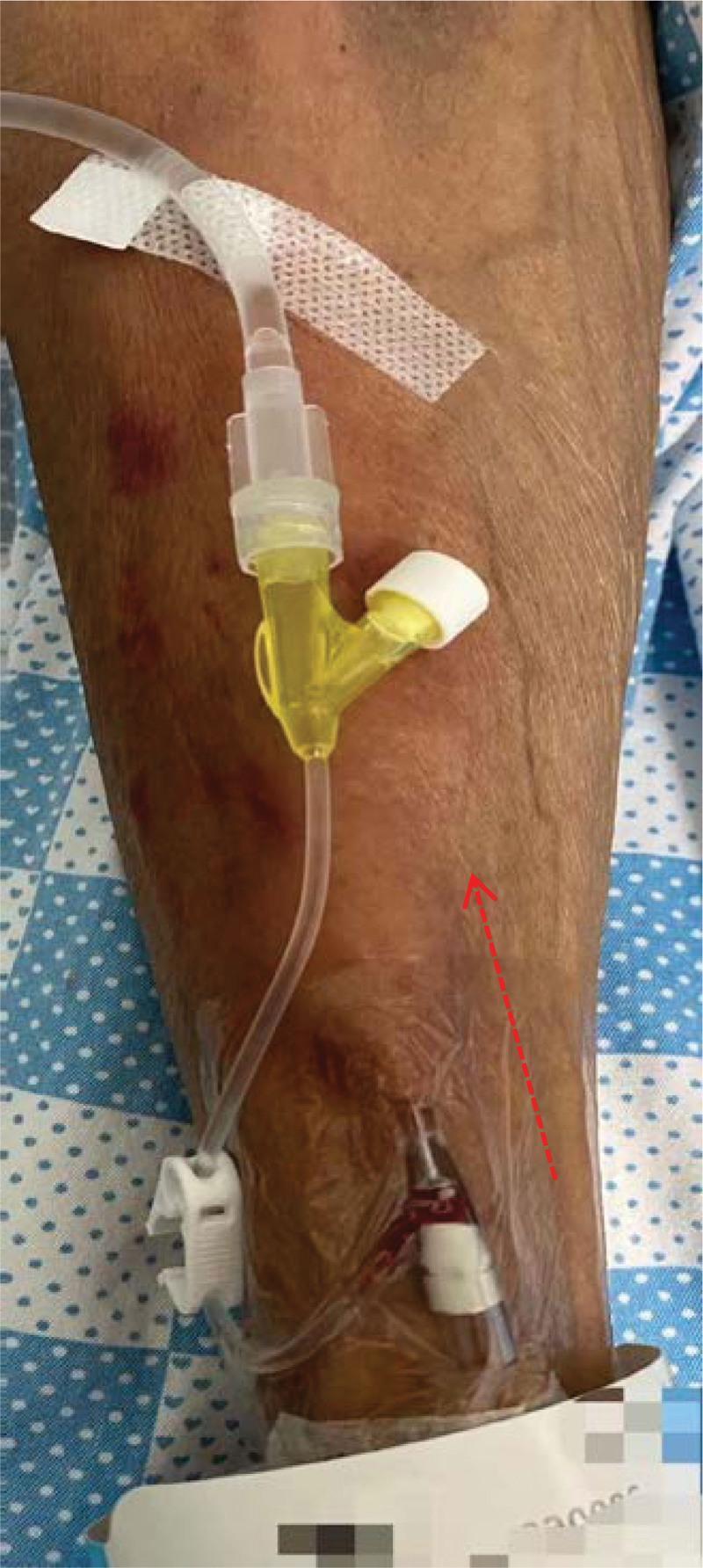
This clinical photograph displays a patient's left upper limb during intravenous (IV) infusion, illustrating a localized cutaneous reaction. A prominent area of linear swelling and erythema, measuring approximately 19 cm x 6 cm, is visible along the proximal path of the cephalic vein. The skin surface in this region appears tense and edematous with exaggerated skin markings. The IV apparatus is secured with a transparent film dressing and medical tape. The IV tubing features a Y-connector containing a yellowish fluid, likely a chemotherapy or immunotherapy agent (such as sintilimab). A red dashed arrow indicates the linear progression of the swelling, which is characteristic of an infusion-related reaction or superficial phlebitis. The surrounding skin shows signs of secondary changes, including older ecchymotic patches and a somewhat leathery texture. This image serves as an educational example of monitoring for infusion-related adverse events, such as vascular-tracking hypersensitivity or localized drug-induced swelling, as distinguished from extravasation.
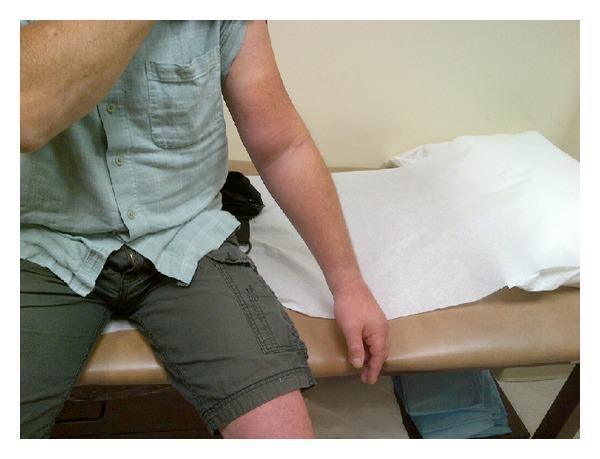
A clinical photograph depicting a patient seated on an examination table, illustrating a classic presentation of Upper Extremity Deep Vein Thrombosis (UEDVT). The focal point is the patient's left arm, which exhibits significant diffuse edema extending from the mid-humerus down through the forearm and hand. Distinct erythema (redness) and skin tautness are visible throughout the affected limb compared to the contralateral side. The swelling is particularly prominent in the antecubital and forearm regions, consistent with venous congestion. This image serves as an educational tool for identifying clinical signs of venous obstruction in a post-surgical or outpatient setting. The differential diagnosis for such presentation includes cellulitis, lymphedema, and superficial phlebitis, though the acute global swelling of the extremity strongly suggests DVT. The photograph is taken in a clinical environment, emphasizing the visual assessment necessary for early diagnosis of vascular complications.
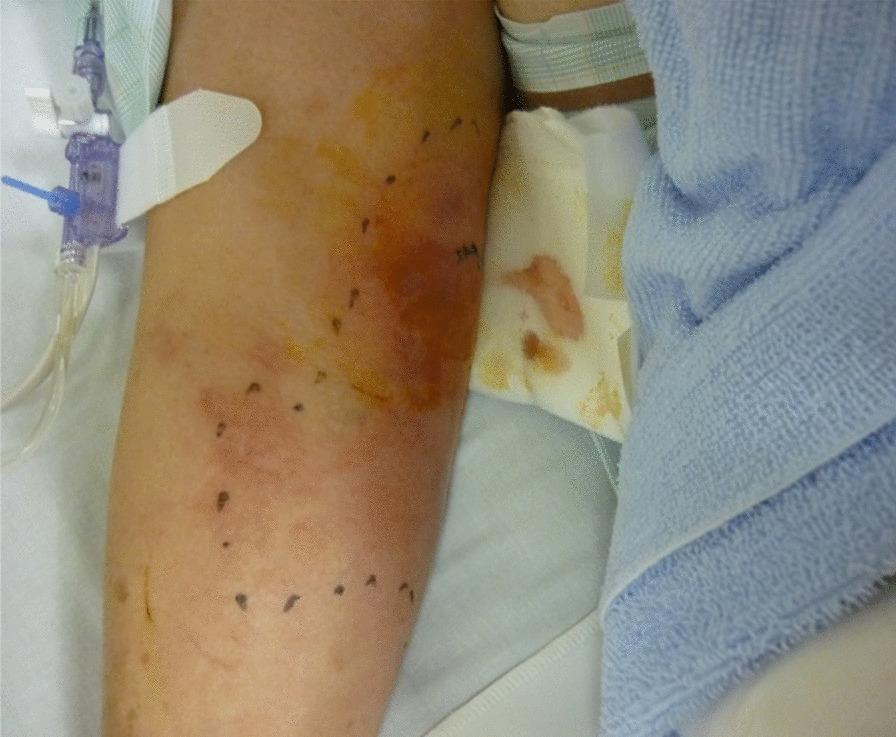
Clinical photograph of a patient's right upper arm demonstrating a significant inflammatory skin lesion. The image shows a large area of confluent erythema (redness) and edema (swelling) extending from the medial aspect of the upper arm down toward the elbow. The affected skin exhibits orange and reddish discoloration. A series of dark surgical marker dots trace the border of the inflamed region, a common clinical practice to monitor the progression or regression of cellulitis or soft tissue infection. Adjacent medical equipment is visible, including an intravenous (IV) catheter with clear tubing secured by a white adhesive dressing on the lateral side of the arm. A partially blood-stained white gauze dressing is located near the axillary region. Clinically, this presentation is consistent with a rapidly progressing soft tissue infection, such as cellulitis or early-stage necrotizing fasciitis, requiring urgent diagnostic evaluation for systemic involvement.
Phlebitis
Definition
Clinical Features (Diagnosis)
| Feature | Description |
|---|---|
| Pain / Tenderness | Along the vein track, often at the IV site |
| Erythema | Redness overlying the affected vein |
| Warmth | Local heat from the inflammatory process |
| Induration | Firmness or hardening of surrounding tissue |
| Palpable cord | A firm, tender, rope-like vein felt on palpation |
| Fever | Systemic sign, especially in infectious cases |
| Suppuration | Pus at the site (rare - indicates suppurative/septic phlebitis) |
"Phlebitis can be diagnosed based on the presence of fever, pain, redness, induration, or a palpable venous cord." - Berek & Novak's Gynecology
Clinical Image
Types of Phlebitis
| Type | Description |
|---|---|
| Chemical phlebitis | Caused by irritating IV fluids or medications (most common type) |
| Mechanical phlebitis | Caused by physical trauma - catheter movement, poor placement, joints |
| Infectious / Septic phlebitis | Caused by bacterial contamination of IV catheter |
| Suppurative thrombophlebitis | Rare, severe form with pus formation; seen in burns, prolonged cannulation |
| Thrombophlebitis | Phlebitis with an associated thrombus (blood clot) in the vein |
Causes & Risk Factors
- Duration of catheterization - incidence rises significantly after 72 hours
- Lower extremity placement - stagnant blood flow increases risk
- Placement across joints - repeated motion traumatizes the vein wall
- Chemical irritants infused through the vein:
- Potassium chloride (KCl)
- Vancomycin, erythromycin
- Phenytoin
- Cytotoxic/chemotherapy agents
- Hyperosmolar solutions (e.g., 50% dextrose)
- Particulates from reconstituted medications or glass from vials
"The incidence of phlebitis is clearly related to the duration of catheterization." - Roberts and Hedges' Clinical Procedures in Emergency Medicine
Management
- Remove the IV catheter immediately - mandatory; replace on a different extremity
- Warm, moist compresses - reduces inflammation and pain
- Elevation of the affected limb
- NSAIDs - for symptomatic relief if needed
- Antibiotics (antistaphylococcal) - only if catheter-related sepsis or suppurative phlebitis is suspected
- Surgical drainage or vein excision - rarely required, only for suppurative thrombophlebitis
"Phlebitis is usually self-limited and resolves within 3 to 4 days." - Berek & Novak's Gynecology
Thrombophlebitis vs. Deep Vein Thrombosis (DVT)
| Superficial Phlebitis | Thrombophlebitis | DVT | |
|---|---|---|---|
| Vein type | Superficial | Superficial (with clot) | Deep |
| Visible/palpable? | Yes | Yes | Usually not |
| PE risk | Low | Low-moderate | High |
| Anticoagulation? | Usually no | Sometimes | Yes |
Key Points for Clinical Practice (Nursing / ICU)
- Inspect and document IV sites every shift using a validated phlebitis scale (e.g., VIP - Visual Infusion Phlebitis score)
- Change peripheral IV catheters at 72-96 hours or sooner if signs develop
- Note: over 50% of phlebitis cases become evident more than 12 hours after the catheter is removed - keep monitoring even post-removal
- Vesicant and irritant drugs should ideally run through a central venous catheter to avoid peripheral phlebitis