
Choose, age-related changes in the artery wall consist in: a. its compaction b. accumulation of sulfated glycosaminoglycans c. thickening of collagen fibers d. thickening of elastic fibers and membranes
Age-Related Changes in the Artery Wall
Option-by-Option Analysis
| Option | Correct? | Explanation |
|---|---|---|
| a. Compaction (stiffening) | YES | The arterial wall stiffens with age due to collagen cross-linking, calcium deposition, and elastin degradation. This reduces distensibility and increases pulse wave velocity. |
| b. Accumulation of sulfated glycosaminoglycans | YES | Smooth muscle cells secrete excess glycosaminoglycans into the extracellular matrix with age, contributing to wall remodeling and altered biomechanics. |
| c. Thickening of collagen fibers | YES | Aging leads to increased collagen content, enzymatic cross-linking of extracellular matrix molecules, and irreversible non-enzymatic glycation forming AGEs - all of which thicken and stiffen collagen fibers. |
| d. Thickening of elastic fibers and membranes | NO | This is the opposite of what happens. Elastic fibers fray and fragment with age ("fraying of elastic fibers"), along with increased elastase activity. This elastin degradation is a key contributor to arterial stiffness and systolic hypertension. |
Summary of Arterial Aging (from Braunwald's Heart Disease)
- Smooth muscle cell hypertrophy and extracellular matrix accumulation → intimal-medial thickening
- Fraying/fragmentation of elastic fibers (NOT thickening) + increased elastase activity
- Increased collagen production and cross-linking (enzymatic + AGE-based non-enzymatic)
- Glycosaminoglycan accumulation
- Calcium deposition
- Net result: reduced distensibility, increased arterial stiffness/compaction, and systolic hypertension
Choose, age-related changes in the artery wall consist in: a. its compaction b. accumulation of sulfated glycosaminoglycans c. thickening of collagen fibers d. thickening of elastic fibers and membranes correct option is.?
✅ Correct Answers: a, b, and c
| Option | Verdict | Reason |
|---|---|---|
| a. Compaction (stiffening) | CORRECT | Arterial wall stiffens due to collagen cross-linking, calcium deposition, and elastin degradation - reducing distensibility |
| b. Accumulation of sulfated glycosaminoglycans | CORRECT | Smooth muscle cells secrete excess glycosaminoglycans into the extracellular matrix with age, contributing to wall remodeling |
| c. Thickening of collagen fibers | CORRECT | Increased collagen production, enzymatic cross-linking, and AGE (advanced glycation end-product) formation thickens and stiffens collagen |
| d. Thickening of elastic fibers and membranes | INCORRECT | This is the key distractor. Elastic fibers fray and fragment with age - they do NOT thicken. Elastin degradation is one of the primary drivers of arterial stiffness in aging |
Why d is Wrong
Choose where there are vessels of vessels? a. arteries b. veins c. lymphatic vessels d. in veins and lymphatic vessels e. in all vessel
✅ Correct Answer: a and b (arteries and veins) — but the most complete answer is e: in all vessels ... with an important caveat
✅ a and b — Arteries and Veins (large ones)
What is "Vasa Vasorum"?
Where Are They Found?
| Vessel Type | Vasa Vasorum Present? | Notes |
|---|---|---|
| Large arteries (elastic, muscular >1mm) | YES | In tunica adventitia and outer media |
| Large veins | YES | Even MORE vasa vasorum than arteries, because they carry deoxygenated blood |
| Small arteries (<0.5-1 mm lumen) | No | Wall thin enough for direct diffusion |
| Arterioles / capillaries / venules | No | Too small |
| Lymphatic vessels (large trunks) | Yes, but rarely discussed | Minor |
"Because they carry deoxygenated blood, large veins commonly have more vasa vasorum than arteries."
- Junqueira's Basic Histology, 17e
"In humans, vessels with a lumen of less than 0.5 mm in diameter usually do not have a vasa vasorum."
- Histology: A Text and Atlas (Pawlina)
Final Answer for This Question
- Lymphatic vessels (option c) do have vasa vasorum in their large trunks, but this is not a classical teaching point
- Option d ("in veins and lymphatic vessels") excludes arteries, which is wrong - arteries absolutely have vasa vasorum
- Option e ("in all vessels") is wrong - small vessels, arterioles, capillaries, and venules do NOT have vasa vasorum
100. The capillary electronogram clearly defines the fenestras in the endothelium and the time in the basement Omembrane. What is the type of capillary?a. sinusoidal; b. visceral; c. shunt; d. atypical; e. somatic.
✅ Correct Answer: b. Visceral (Fenestrated) capillary
- Fenestras (fenestrations) in the endothelium ✓
- Thin but CONTINUOUS basement membrane ✓
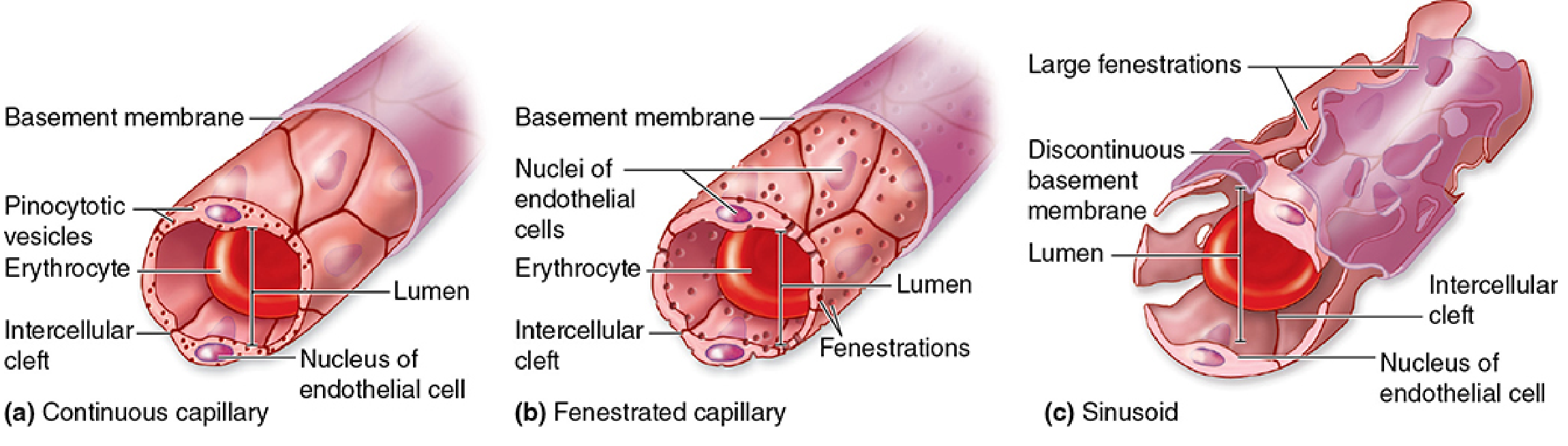
The Three Capillary Types Compared
| Feature | Somatic (Continuous) | Visceral (Fenestrated) ✅ | Sinusoidal (Discontinuous) |
|---|---|---|---|
| Endothelium | Continuous, no pores | Fenestrations (pores) present | Large gaps + large fenestrations |
| Basement membrane | Continuous | Continuous (thin) | Discontinuous / absent |
| Permeability | Low | Moderate-high | Very high |
| Found in | Muscle, skin, lung, brain | Kidneys, intestine, endocrine glands, choroid plexus | Liver, spleen, bone marrow |
Why the Other Options Are Wrong
| Option | Why Wrong |
|---|---|
| a. Sinusoidal | Has LARGE gaps in endothelium AND a discontinuous/absent basement membrane - not matching the question |
| c. Shunt | Not a standard capillary classification in histology |
| d. Atypical | Not a recognized capillary type |
| e. Somatic | Continuous capillary - NO fenestrations, tight junctions only |
"Fenestrated capillaries also have tight junctions, but perforations (fenestrations) through the endothelial cells themselves allow greater exchange... The basement membrane is continuous in both [continuous and fenestrated] capillary types."
- Junqueira's Basic Histology, 17e