
Tell about epithelial tissue
Reading File
Searching sources...
Finding Sources
Finding Sources
Good results. Let me read the dedicated epithelial tissue sections from Histology and Junqueira's:
Reading File
Reading File
Good. Let me continue reading the Junqueira's section for detailed classification and features:
Reading File
Excellent content. Let me read more - the classification of epithelia, types, and glands:
Reading File
I now have very rich content. Let me read the summary of key points for a clean overview:
Reading File
I now have enough comprehensive information from the textbooks. Let me fetch one of the key diagrams to include in the answer:
Loading Image
I now have all the content needed for a thorough, well-structured answer. Here it is:
Epithelial Tissue
Epithelial tissue (epithelia) is one of the four basic tissue types. It consists of closely aggregated polyhedral cells that adhere strongly to one another and to a thin layer of extracellular matrix (ECM), forming continuous cellular sheets that line cavities, cover body surfaces, and constitute glands. Every substance that enters or leaves an organ must cross this tissue.
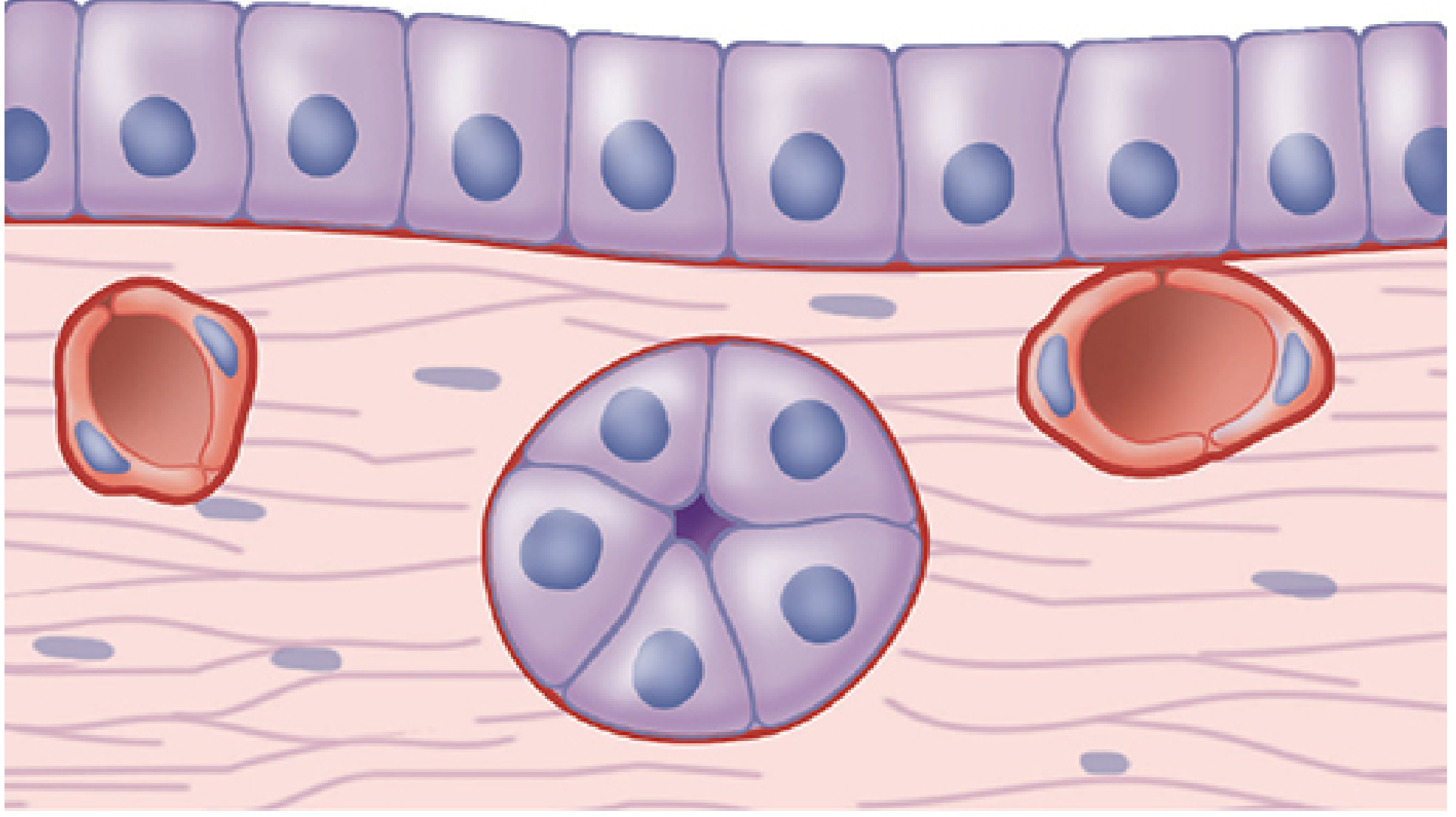
Cuboidal epithelial cells resting on the basement membrane (red line), with connective tissue cells below. Capillaries (being epithelial themselves) never enter the epithelium. - Junqueira's Basic Histology, 17e
General Characteristics
- Close cell apposition - very little ECM between cells; cells bind tightly to each other and to the basement membrane
- Avascular - epithelia contain no blood vessels; nutrients and O₂ diffuse from capillaries in the underlying connective tissue
- Polarity - each cell has a distinct apical pole (facing the free surface) and a basal pole (resting on the basement membrane), with lateral surfaces between cells
- Continuous renewal - epithelial cells have a high turnover rate; stem cells replenish damaged or shed cells
- Nerve supply - nerve fibers may penetrate the basement membrane, but blood capillaries do not
Functions
- Covering and protecting surfaces (e.g., epidermis shields underlying tissue)
- Absorption (e.g., intestinal lining absorbs nutrients)
- Secretion (e.g., glandular cells produce hormones, enzymes, mucus)
- Filtration (e.g., kidney tubules)
- Sensation - specialized sensory cells such as taste buds or olfactory epithelium
- Contractility - myoepithelial cells can contract despite being classified as epithelium
Classification of Covering/Lining Epithelia
Epithelia are classified by two criteria: number of cell layers and shape of cells at the free surface.
By Number of Layers
| Type | Description |
|---|---|
| Simple | Single layer; all cells contact the basement membrane |
| Stratified | Multiple layers; only the basal layer contacts the basement membrane |
| Pseudostratified | Appears multilayered but all cells contact the basement membrane; only some reach the surface |
By Cell Shape
| Shape | Description |
|---|---|
| Squamous | Flat, scale-like cells; flattened nuclei |
| Cuboidal | As tall as they are wide; spherical nuclei |
| Columnar | Taller than wide; elongated/oval nuclei |
| Transitional (urothelium) | Specialized; changes shape with organ distension |
Common Types and Locations
| Type | Location | Function |
|---|---|---|
| Simple squamous | Blood vessel endothelium, lung alveoli, mesothelium | Filtration, diffusion |
| Simple cuboidal | Kidney tubules, thyroid follicles, small ducts | Absorption, secretion |
| Simple columnar | GI tract lining, uterine tube | Absorption, secretion |
| Pseudostratified columnar | Trachea, bronchi, nasal cavity | Mucociliary clearance |
| Stratified squamous (non-keratinized) | Oral cavity, esophagus, vagina | Protection against abrasion |
| Stratified squamous (keratinized) | Epidermis (skin) | Protection, waterproofing |
| Stratified cuboidal/columnar | Large excretory ducts | Secretion, modification |
| Transitional | Urinary bladder, ureters, renal pelvis | Distensibility |
The Basement Membrane
All epithelia rest on a basement membrane, which has two layers:
- Basal lamina - produced by epithelial cells; composed of type IV collagen, laminin, entactin, and proteoglycans
- Reticular lamina - produced by underlying connective tissue cells; contains type III collagen and anchoring fibrils of type VII collagen
Functions of the basement membrane:
- Attaches epithelium to connective tissue
- Regulates/filters substances passing between compartments
- Acts as a scaffold for tissue regeneration after injury
- Compartmentalizes epithelial cells from other tissues
Intercellular Junctions
Epithelial cells are held together by well-developed junctions, forming the junctional complex:
1. Tight Junctions (Zonula Occludens)
- Formed by transmembrane proteins claudin and occludin
- Located at the apical end of lateral surfaces
- Seal the intercellular space to prevent paracellular passage of molecules
- Maintain cell polarity by restricting lateral diffusion of membrane proteins
2. Adherens Junctions (Zonula Adherens)
- Formed by cadherin family proteins
- Just below the tight junction; encircle the cell
- Attached internally to actin filaments
- Provide mechanical attachment between cells
3. Desmosomes (Macula Adherens)
- Spot-like attachment sites scattered along lateral surfaces
- Also use cadherins; linked internally to keratin intermediate filaments
- Provide strong resistance to mechanical stress (abundant in skin, cardiac muscle)
4. Gap Junctions
- Pairs of connexons (made of connexin proteins) form channels between adjacent cells
- Allow passage of small molecules (<1.5 nm): ions, cyclic nucleotides
- Enable coordinated cell behavior (e.g., rhythmic contractions of heart muscle)
5. Hemidesmosomes
- At the basal surface; attach cells to the basal lamina
- Use integrins (not cadherins) that bind laminin in the basal lamina
Apical Surface Specializations
| Structure | Composition | Function |
|---|---|---|
| Microvilli | Core of actin filaments; ~1 µm tall | Increase surface area for absorption (form the "brush border") |
| Stereocilia | Long microvilli; no motility | Mechanosensory function in inner ear; absorption in male reproductive tract |
| Cilia | "9+2" microtubule axoneme; powered by dynein | Beat to move mucus, fluid, or eggs (e.g., respiratory tract, uterine tube) |
Secretory Epithelia & Glands
When epithelial cells are primarily secretory, they form glands. Glands develop by the proliferation of surface epithelium into underlying connective tissue.
Endocrine Glands
- Lost their connection to the surface during development
- Secrete hormones directly into the bloodstream
- Examples: thyroid, adrenal gland, pituitary
Exocrine Glands
- Maintain ducts that carry secretions to a surface
- Classified by:
- Duct structure: simple (unbranched) vs. compound (branched)
- Secretory unit shape: tubular, acinar (saccular), or tubuloalveolar
- Mode of secretion:
- Merocrine/eccrine: secretion by exocytosis; cell integrity maintained (e.g., salivary glands, pancreas)
- Apocrine: apical cytoplasm is shed with the secretion (e.g., mammary glands, axillary sweat glands)
- Holocrine: entire cell disintegrates to release secretion (e.g., sebaceous glands)
Transport Across Epithelia
Epithelia can move substances selectively:
- Transcytosis: material is endocytosed at the apical surface (pinocytosis) and exocytosed at the basolateral surface, or vice versa
- Paracellular transport: regulated by tight junctions; varies in "leakiness" depending on the tissue
- Transcellular transport: via specific ion channels and transporters on apical and basolateral membranes
Embryological Origin
Epithelial tissues arise from all three germ layers:
| Germ Layer | Epithelial Derivatives |
|---|---|
| Ectoderm | Epidermis, cornea/lens, enamel, inner ear, oral mucosa, lower anal canal |
| Mesoderm | Mesothelium (body cavities), endothelium, kidney tubules, gonads |
| Endoderm | GI tract lining, respiratory epithelium, liver, pancreas, urinary bladder |
Sources: Junqueira's Basic Histology - Text and Atlas, 17e | Histology: A Text and Atlas with Correlated Cell and Molecular Biology
This is a shared conversation. Sign in to Orris to start your own chat.