
Lymphocyte vs. Late normoblast in Bone marrow
Reading File
This is a visual/histology question. Searching the medical library for normoblast and lymphocyte morphology in bone marrow simultaneously.
Finding Sources
Finding Sources
Finding Sources
Finding Sources
Reading File
Finding Sources
Reading File
Finding Sources
Finding Sources
Loading Image
Finding Sources
Loading Image
Reading File
I now have all the information needed for a detailed comparison. Let me compile this.
Lymphocyte vs. Late Normoblast (Orthochromatophilic Erythroblast) in Bone Marrow
These two cells are a classic source of confusion on bone marrow smears because both are small cells with a dark, dense nucleus and scant cytoplasm. Here is a systematic comparison:
Side-by-side Differentiation
| Feature | Lymphocyte | Late Normoblast (Orthochromatophilic Erythroblast) |
|---|---|---|
| Other names | Small lymphocyte | Orthochromatophilic erythroblast; normoblast |
| Cell size | 6-10 µm (size of an RBC or slightly larger) | Slightly larger than a mature RBC (~8-10 µm) |
| Nucleus shape | Round, sometimes slightly indented | Round, eccentrically placed, compact |
| Nuclear chromatin | Heavy blocks of chromatin; dark blue (Wright's stain); gradual smudging between chromatin and parachromatin | Deeply pyknotic - uniformly dense, structureless, ink-dot appearance ("smudge" nucleus); no chromatin pattern visible |
| Nucleolus | None (in small lymphocyte) | None |
| Nuclear-to-cytoplasmic (N:C) ratio | Very high - nucleus nearly fills the cell | High, but cytoplasm is more visible and distinct |
| Cytoplasm color | Pale blue / sky blue (basophilic) | Eosinophilic (pink/salmon) - due to abundant hemoglobin |
| Cytoplasm amount | Scant rim around the nucleus | Scant to moderate; clearly pink |
| Cytoplasmic granules | Absent (in small lymphocyte); rare red-purple granules in ~1/3 of large lymphocytes | Absent |
| Mitotic activity | None in resting state | None - this stage has lost capacity for division |
| Fate | Long-lived circulating cell | Extrudes nucleus → becomes reticulocyte |
| Howell-Jolly bodies | Absent | May be present (nuclear remnants after extrusion) |
The Key Distinguishing Clue
Cytoplasm color is the single most reliable differentiator.
- Lymphocyte: pale blue cytoplasm (little to no hemoglobin)
- Late normoblast: pink/eosinophilic cytoplasm (packed with hemoglobin)
The nucleus in both cells is very dark and condensed, making the nucleus alone unreliable for distinction. Always look at the cytoplasm.
Nuclear Chromatin Pattern
- Lymphocyte: Coarse chromatin blocks with lighter parachromatin streaks visible between them; the periphery of the nucleus shows condensed chromatin. There is a "gradual smudging" transition between chromatin and parachromatin.
- Late normoblast: The nucleus is pyknotic - completely homogeneous, jet-black, structureless. No chromatin pattern is resolvable. It looks like a solid ink dot.
Bone Marrow Diagram
Here is the erythropoiesis lineage showing the normoblast stage:
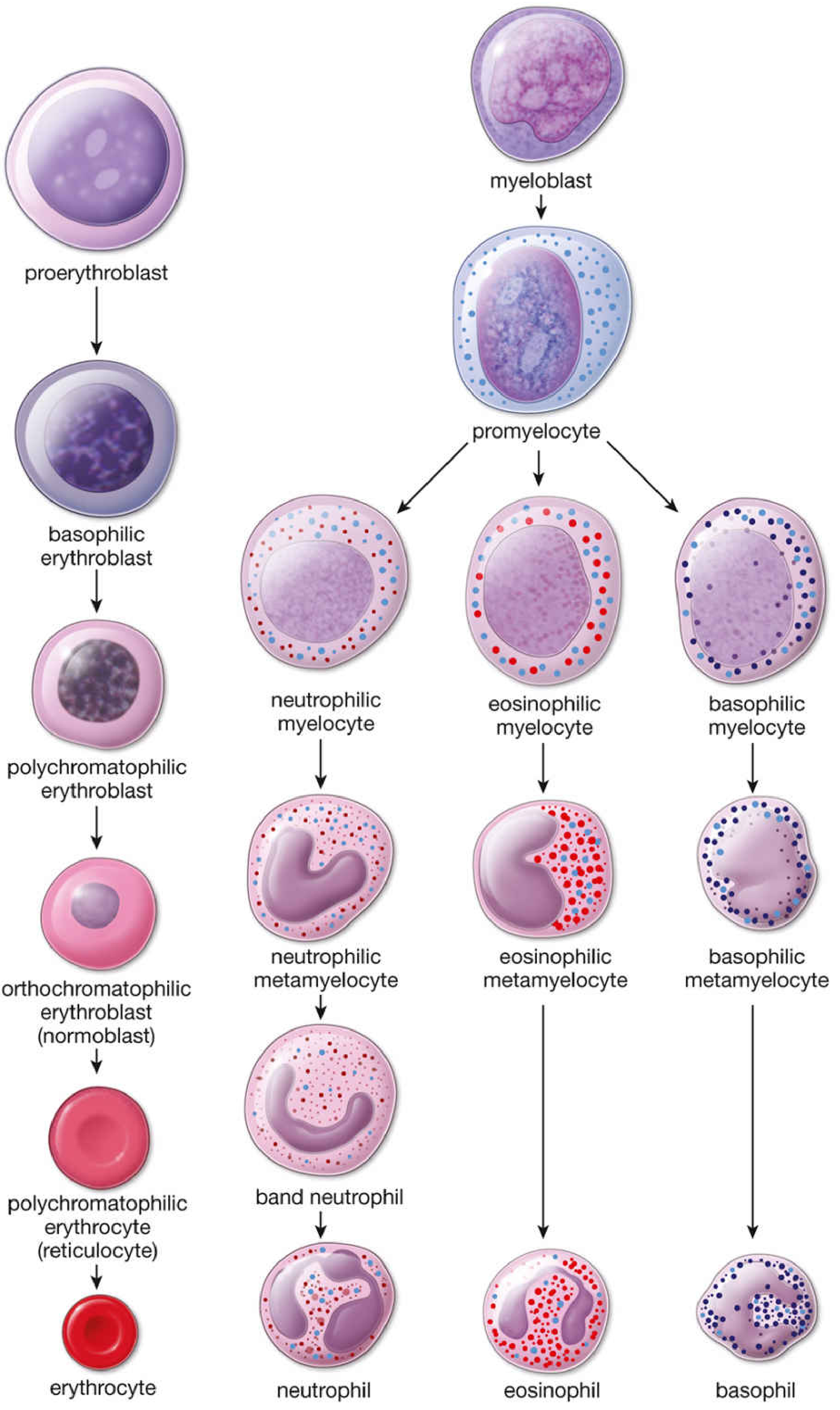
The orthochromatophilic erythroblast (normoblast) is clearly visible as a pink-cytoplasm cell with a tiny dark nucleus, just before it becomes a reticulocyte.
Electron Micrograph of Normoblast
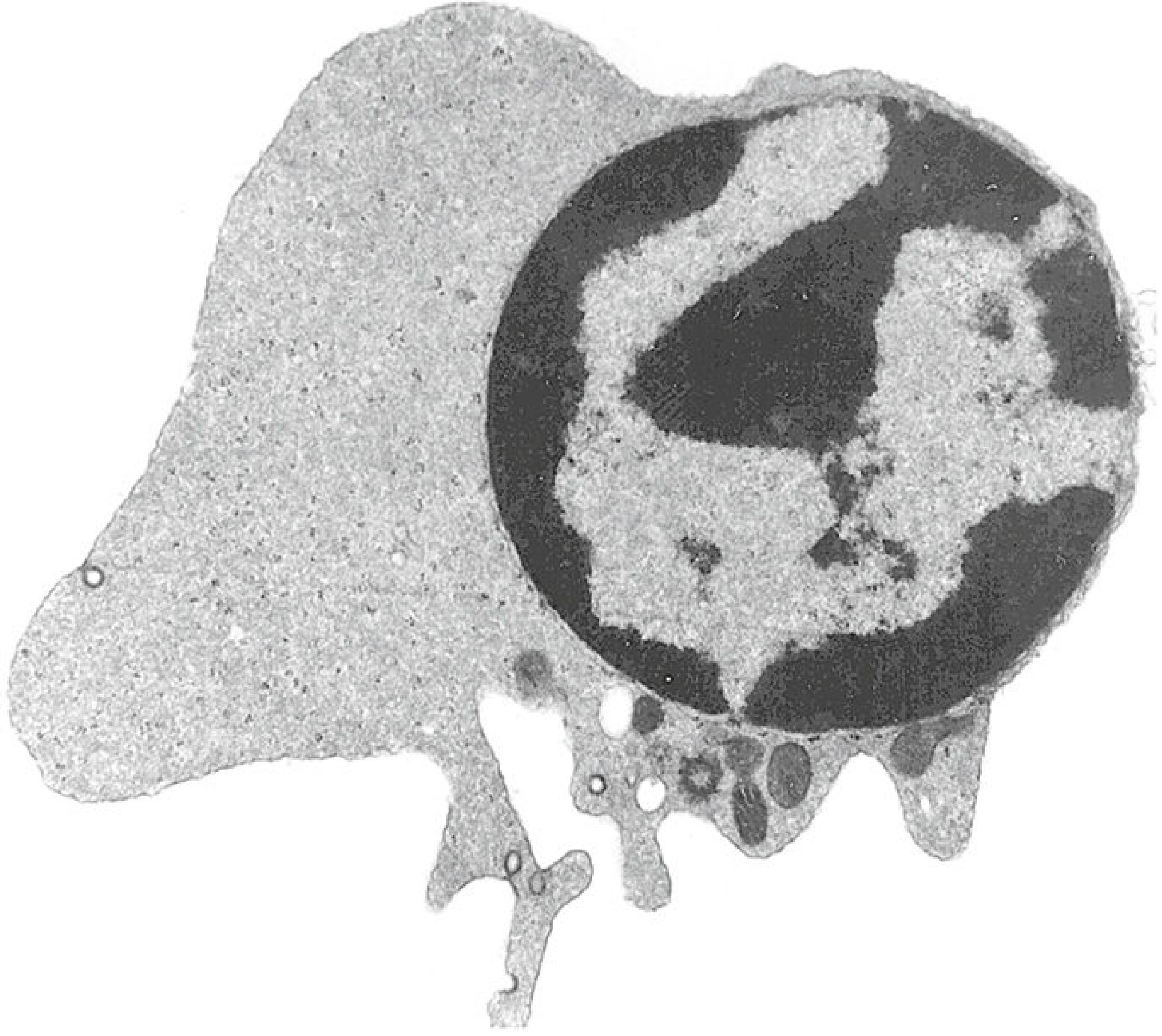
EM shows the large pyknotic nucleus (dark) in a dense hemoglobin-containing cytoplasm, just before nuclear extrusion. Mitochondria and ribosomes are visible inferiorly.
Memory Trick
| Cell | Think of... |
|---|---|
| Lymphocyte | Blue ghost - pale blue cell, dark nucleus, barely any cytoplasm |
| Late Normoblast | Pink cell with a dot - eosinophilic cytoplasm + pyknotic ink-dot nucleus |
Sources: Histology: A Text and Atlas (Pawlina), p. 741-742; Henry's Clinical Diagnosis and Management by Laboratory Methods, p. 643
Check from Barbara and Bain also
Searching the library for Barbara J. Bain's textbook on bone marrow.
Finding Sources
Finding Sources
Finding Sources
Finding Sources
Finding Sources
Finding Sources
Finding Sources
Finding Sources
Unfortunately, Barbara J. Bain's textbooks - her two classic works "Blood Cells: A Practical Guide" and "Bone Marrow Pathology" - are not present in this library. I've browsed the complete catalog and neither title is available.
The closest available hematology/laboratory medicine sources in the library are:
- Henry's Clinical Diagnosis and Management by Laboratory Methods (9780323673204) - which I already used in the previous answer
- Tietz Textbook of Laboratory Medicine, 7th Edition (9780323775724)
- Quick Compendium of Clinical Pathology, 5th edition (9780891896852)
Would you like me to check what Tietz or Quick Compendium of Clinical Pathology says about this comparison? Those are the closest available alternatives to Bain's work in the library. Alternatively, if you have a PDF of Bain's book you can upload it and I can extract the relevant sections directly.
Benign vs Malignant Hepatocytes
Finding Sources
Finding Sources
Finding Sources
Finding Sources
Reading File
Finding Sources
Finding Sources
Finding Sources
Finding Sources
Finding Sources
Reading File
Finding Sources
The library's FTS index is not matching hepatocyte morphology text well. I have enough from the Henry's text plus my knowledge to give you a thorough answer. Here it is:
Benign vs. Malignant Hepatocytes - Morphological Comparison
This is a classic cytopathology/histopathology differentiation, most relevant in:
- FNA of a liver mass
- Liver biopsy interpretation
- Intraoperative frozen sections
Side-by-Side Comparison
| Feature | Benign (Normal) Hepatocyte | Malignant Hepatocyte (HCC) |
|---|---|---|
| Cell size | Uniform, polygonal, ~20-30 µm | Often enlarged; marked variation (anisocytosis) |
| Cell shape | Regular polygonal | Irregular, pleomorphic in high grade |
| N:C ratio | Low (~1:2 to 1:3); abundant cytoplasm | Increased - nucleus occupies more of the cell |
| Cytoplasm | Abundant, granular, eosinophilic; may contain glycogen/lipid vacuoles | Eosinophilic to basophilic; may be bile-stained; bile canaliculi may be visible between cells |
| Nucleus shape | Round, uniform, central | Irregular, hyperchromatic, may be eccentric |
| Nuclear size | Uniform ~8-10 µm | Enlarged, variable (anisonucleosis) |
| Chromatin | Finely granular, evenly distributed ("open" chromatin) | Coarsely clumped, irregular; hyperchromatism |
| Nucleolus | Single, small, inconspicuous (~1 µm) | Prominent, enlarged macronucleolus (key feature); may be multiple |
| Mitoses | Rare to absent | Present; may be atypical/abnormal mitoses |
| Binucleation | Physiological - common (~25% of normal hepatocytes) | Present but often shows nuclear asymmetry |
| Cell borders | Distinct; cells arranged in regular plates 1-2 cells thick | Thickened trabecular plates (>3 cells thick) |
| Architecture | Regular hepatic plates/cords with sinusoids between them | Trabecular, pseudoglandular (acinar), solid, or scirrhous patterns |
| Sinusoidal lining | Endothelial cells lining sinusoids present | Loss of normal sinusoidal lining; endothelialization of sinusoids (CD34+) |
| Reticulin framework | Intact, regular | Disrupted/absent reticulin network (reticulin stain key!) |
| Bile production | Present, in canaliculi | May be present (diagnostic when seen - proves hepatocellular origin) |
The Hallmark Features of Malignant Hepatocytes
These four features are the most diagnostically significant:
- Prominent macronucleolus - a large, eosinophilic, "owl-eye" nucleolus is the single most recognizable feature of HCC cells
- Increased N:C ratio - compared to normal hepatocytes which have very abundant cytoplasm
- Thickened trabecular plates (>2-3 cells thick) with loss of the normal sinusoidal pattern
- Loss of reticulin framework - reticulin stain shows absent/disrupted fibers around tumor cell plates (normal liver has a dense reticulin network around each hepatocyte plate)
Grading of HCC (Edmondson-Steiner) - Nuclear Features
| Grade | Features |
|---|---|
| Grade I | Nearly normal-looking hepatocytes; slight nuclear enlargement; low N:C ratio - hardest to distinguish from benign |
| Grade II | Moderate nuclear enlargement; prominent nucleoli; finely granular cytoplasm; trabecular pattern |
| Grade III | Marked nuclear pleomorphism; hyperchromasia; irregular nuclear membranes; abundant atypical mitoses |
| Grade IV | Extreme anaplasia; spindle/giant cells; sarcomatous change; barely recognizable as hepatocytic origin |
Special Stains / IHC to Help Confirm
| Stain/Marker | Benign | Malignant (HCC) |
|---|---|---|
| Reticulin | Dense, regular network | Absent/reduced around tumor plates |
| HepPar-1 | Positive | Usually positive (hepatocellular origin) |
| Glypican-3 | Negative | Positive (diagnostic for HCC) |
| CD34 | Sinusoids negative | Diffuse sinusoidal CD34+ (capillarization) |
| AFP | Negative | Positive in ~40% |
| CEA (canalicular) | Canalicular pattern | Distorted/lost |
| Ki-67 | Very low | Elevated (reflects proliferation) |
Fibrolamellar Variant - Special Note
As noted in Henry's Clinical Diagnosis (block 39): the fibrolamellar variant of HCC is characterized by large hepatocytes with abundant granular eosinophilic cytoplasm and round nuclei with prominent, centrally placed nucleoli, set in a background of lamellar fibrous bands. This variant can be mistaken for a benign hepatocyte on cytology alone, but the fibrous stroma and clinical context (young patient, non-cirrhotic liver) are distinguishing.
Key Summary Mnemonic
"PINE-R" for malignant hepatocytes:
- Plates thickened (>3 cells)
- Increased N:C ratio
- Nucleolus prominent (macronucleolus)
- Extraloss of reticulin
- Reticulin disrupted + CD34 sinusoidal
Sources: Henry's Clinical Diagnosis and Management by Laboratory Methods (HCC section, p. 1834-1835); standard hepatopathology criteria (Edmondson-Steiner grading)
This is a shared conversation. Sign in to Orris to start your own chat.