
Intranasal corticosteroids
Reading File
Now let me search the library and PubMed in parallel for intranasal corticosteroids.
Finding Sources
Finding Sources
Searching PubMed
"intranasal corticosteroids" AND "allergic rhinitis"
Good. Let me now read the dedicated "Intranasal Corticosteroids" section from Cummings Otolaryngology and the Goldman-Cecil allergic rhinitis section in parallel.
Reading File
Reading File
Finding Sources
Now let me get the detailed content from K.J. Lee's Otolaryngology (which has a dedicated table of agents) and the Goldman-Cecil section on allergic rhinitis treatment.
Reading File
Reading File
Let me get the rest of the K.J. Lee agents table and the Goldman-Cecil treatment details, plus fetch the management algorithm image.
Reading File
Reading File
Loading Image
I now have comprehensive information. Let me compile the full answer.
Intranasal Corticosteroids (INCSs)
Overview
Intranasal corticosteroids are the first-line pharmacotherapy for moderate-to-severe allergic rhinitis and the mainstay of treatment for non-allergic eosinophilic rhinitis (NARES). They provide a 50-90% reduction in symptoms compared with only 20-30% for oral antihistamines. - Goldman-Cecil Medicine
Mechanism of Action
INCSs work by decreasing local mucosal inflammation. Specifically, they:
- Suppress activation of inflammatory cells: mast cells, eosinophils, and basophils
- Increase local concentrations of active steroid while limiting systemic absorption
- Reduce naso-ocular reflex, accounting for their benefit on ocular symptoms as well
They exert broad local anti-inflammatory effects through intracellular glucocorticoid receptors, downregulating pro-inflammatory cytokine transcription. - Cummings Otolaryngology
Available Agents
| Agent | Key Properties | Special Notes |
|---|---|---|
| Beclomethasone dipropionate | Higher systemic bioavailability than newer agents | Growth suppression reported in prepubescent children |
| Flunisolide | Significant systemic bioavailability; propylene glycol base | Largely supplanted by newer agents; poorly tolerated |
| Budesonide | Aqueous, scent/taste-free | Only INCS with Pregnancy Category B; FDA-approved for rhinitis |
| Triamcinolone acetonide | Aqueous, scent/taste-free | Available OTC in the US; 2 sprays (55 µg) per nostril daily |
| Fluticasone propionate | Low systemic bioavailability; onset ~12 h | Approved for both AR and nonallergic rhinitis; floral scent may limit tolerability; 2 sprays (50 µg) per nostril daily |
| Mometasone furoate | Aqueous, scent/taste-free; low bioavailability | Approved for AR and nasal polyps; down to age 2; 2 sprays (50 µg) per nostril daily |
| Fluticasone furoate | Aqueous, scent/taste-free; low bioavailability; onset ~12 h | Labeled effectiveness for ocular symptoms; down to age 2 |
| Ciclesonide | Aqueous, scent/taste-free; low bioavailability | Prodrug - activated by tissue esterases at site of action |
- K.J. Lee's Essential Otolaryngology
Indications
- Allergic rhinitis (AR) - preferred for perennial and moderate-to-severe seasonal AR
- Non-allergic rhinitis (NAR) - beclomethasone propionate and fluticasone propionate are the only FDA-approved agents specifically for NAR
- NARES (non-allergic rhinitis with eosinophilia syndrome) - mainstay of treatment
- Chronic rhinosinusitis - used as adjunctive medical therapy
- Nasal polyps - mometasone and fluticasone furoate have specific labeling
- Rhinitis in pregnancy - budesonide preferred (Pregnancy Category B)
Dosing Principles
- Daily dosing is more efficacious than as-needed dosing
- Onset of action: 3-5 hours after first dose, with full effect up to 60 hours; some newer agents within 12 hours
- For seasonal allergies, should be started 2 weeks prior to pollen season
- Evidence that dual therapy (INCS + antihistamine) is superior to INCS monotherapy is lacking
- When adding an antihistamine to an INCS, an intranasal antihistamine (azelastine, olopatadine) is preferred over an oral one
Place in Therapy - ARIA Algorithm
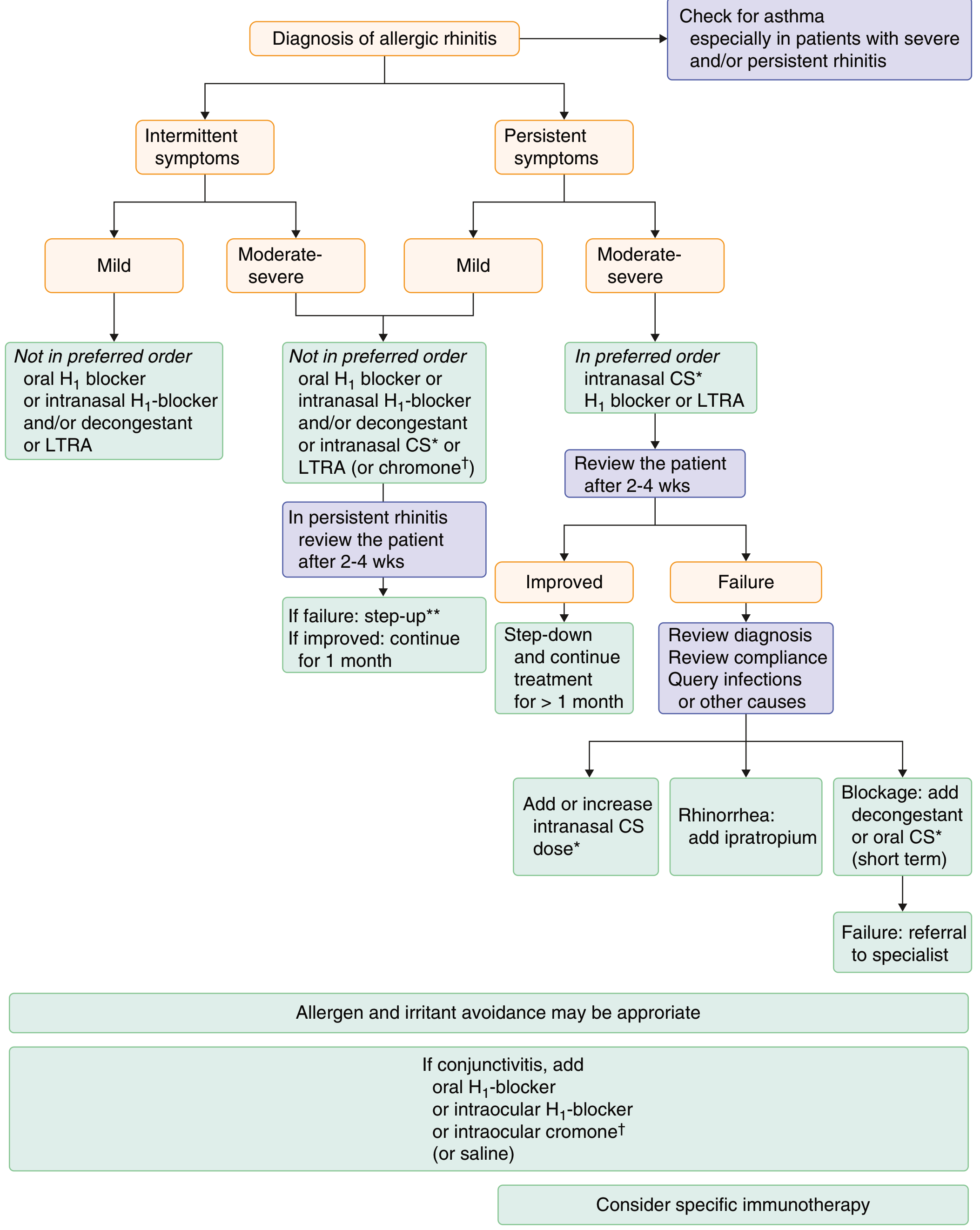
ARIA-based management algorithm (Goldman-Cecil Medicine): For persistent moderate-severe allergic rhinitis, intranasal CS is the first-line therapy in preferred order, combined with H1-blocker or LTRA. Review at 2-4 weeks; step-down if improved or step-up if failure.
Side Effects
- Local: Epistaxis, nasal dryness, throat dryness, local irritation, headaches
- Rare: Nasal septal perforation (especially with incorrect technique aimed at the septum)
- Technique: Aim the spray away from the nasal septum to reduce epistaxis risk
- Ocular: No clinically relevant impact on intraocular pressure, glaucoma, lens opacity, or cataract formation
- Growth in children: May have a negative effect on short-term growth in children - use the lowest effective dose
Systemic Safety & HPA Axis
- Newer agents (mometasone, fluticasone, ciclesonide, fluticasone furoate) have minimal systemic bioavailability and are free of clinically significant HPA axis suppression
- Older agents (beclomethasone, flunisolide) have higher bioavailability and greater systemic effects
- Budesonide is safe in pregnancy (Category B) but still aim for lowest effective dose
Comparison with Other Rhinitis Drugs
| Drug Class | Symptom Relief | Best For |
|---|---|---|
| INCS | 50-90% reduction | Perennial AR, moderate-severe AR, NAR, polyps |
| Oral antihistamines | 20-30% reduction | Mild/seasonal AR, urticaria/conjunctivitis |
| Intranasal antihistamines | Rapid onset | Additive to INCS; nonallergic rhinitis |
| Decongestants (oral) | Nasal stuffiness only | Short-term; rebound risk |
| Cromolyn sodium | Modest | Prophylaxis; pregnancy (safe) |
Recent Evidence (2024-2026)
A 2024 systematic review in J Allergy Clin Immunol (PMID 38685482) confirmed the efficacy of intranasal antihistamines and corticosteroids in allergic rhinitis, and a 2024 meta-analysis in J Allergy Clin Immunol Pract (PMID 39251016) found intranasal treatments superior to oral treatments overall for AR. A 2025 network meta-analysis (PMID 40675325) specifically examined intranasal treatments in preschool- and school-age children - no major safety signals were identified that contradict current practice, but reinforces using the lowest effective pediatric dose.
Brief about Antihistamines and its indications in ENT
Antihistamines block H1 receptors, reducing allergic symptoms like sneezing, itching, and rhinorrhea. First-generation agents (chlorphenamine, diphenhydramine) cross the blood-brain barrier causing sedation; second-generation agents (cetirizine, loratadine, fexofenadine) are largely non-sedating. In ENT, they are used primarily for allergic rhinitis, urticaria, and allergic conjunctivitis.
Searching sources...
Finding Sources
Finding Sources
Searching PubMed
"antihistamine" AND "allergic rhinitis"
Finding Sources
Finding Sources
Finding Sources
Finding Sources
Reading File
Reading File
Finding Sources
Reading File
Finding Sources
Reading File
Reading File
I now have comprehensive information from multiple authoritative textbooks. Here is the full answer:
Antihistamines in ENT
Classification
Antihistamines (H1 receptor antagonists) are divided into two generations based on their pharmacological profiles:
First-Generation (Sedating) Antihistamines
Examples: Diphenhydramine, chlorpheniramine, triprolidine, azatadine, promethazine, hydroxyzine
| Property | Detail |
|---|---|
| Lipophilicity | Highly lipophilic - cross the blood-brain barrier readily |
| Sedation | High incidence of CNS suppression and sedation |
| Anticholinergic effects | Prominent - dry mucous membranes, increased mucus viscosity, blurred vision, constipation, urinary retention |
| Tachyphylaxis | Significant - efficacy decreases with continued use |
| Drug interactions | Inhibit CYP2D6; interact with TCAs, beta-blockers, antipsychotics, anti-arrhythmics, tramadol |
| Recommendation | Not recommended for routine allergy treatment; significant negative impact on quality of life |
Second-Generation (Non-Sedating) Antihistamines
Examples: Cetirizine, levocetirizine, loratadine, desloratadine, fexofenadine
| Property | Detail |
|---|---|
| Lipophilicity | Low - do not cross the blood-brain barrier as readily |
| Sedation | Minimal; dose-dependent at most |
| Anticholinergic effects | Little or none |
| Tachyphylaxis | Little if any |
| Metabolism | CYP3A4 (be aware of CYP3A4 inhibitors like ketoconazole, erythromycin) |
| Availability | Many are OTC; once-daily dosing |
| Safety | Safe to use in patients with asthma |
- K.J. Lee's Essential Otolaryngology
Intranasal (Topical) Antihistamines
Examples: Azelastine, olopatadine
These act directly at the target organ (nose, eye), providing rapid onset of action.
- Azelastine is as effective as or superior to oral antihistamines for nasal congestion
- Intranasal antihistamines are at least as effective as intranasal corticosteroids for sneezing, itching, rhinorrhea, and ocular symptoms
- Recommendation: Not as monotherapy but combined with intranasal corticosteroids (the most effective combination for allergic rhinitis)
Mechanism of Action
-
Competitively block histamine H1 receptors on target tissues
-
Reduce histamine-mediated effects: vasodilation, vascular permeability, mucus secretion, itch, and smooth muscle contraction
-
Azelastine also has additional anti-inflammatory effects:
- Inhibits synthesis of leukotrienes, kinins, and cytokines
- Prevents generation of superoxide free radicals
- May modulate TRPV1 ion channel activity (explaining efficacy in non-allergic rhinitis)
-
Cummings Otolaryngology
Indications in ENT
1. Allergic Rhinitis (AR) - PRIMARY INDICATION
-
Oral long-acting H1 antihistamines (fexofenadine, loratadine, desloratadine, cetirizine, levocetirizine) are effective for:
- Nasopharyngeal itching, sneezing, and watery rhinorrhea
- Ocular symptoms (itching, tearing, erythema)
- Reduce nasal and ocular symptoms by ~30-35%
-
Less efficacious for nasal congestion (this is better handled by INCSs or decongestants)
-
Preferred for seasonal, mild disease; intranasal corticosteroids are preferred for perennial, severe disease
-
Antihistamines may become ineffective with continuous allergen exposure (perennial AR, peak season) - may be little better than placebo in those settings
-
When adding antihistamine to INCS, intranasal antihistamine is preferred over oral
-
Harrison's Principles of Internal Medicine 22E; Goldman-Cecil Medicine
2. Non-Allergic Rhinitis (NAR)
- Intranasal azelastine and olopatadine are effective for vasomotor rhinitis (VMR) and non-NARES subtypes
- Oral antihistamines have a limited role in NAR but may benefit patients with the NARES subtype who have sneezing and itching as dominant symptoms
- Azelastine's TRPV1 modulation may explain its efficacy even in non-inflammatory NAR subtypes
- Side effect to note: azelastine has a persistent bitter taste (can be masked with sucralose)
- Olopatadine not FDA-approved for NAR but has demonstrated efficacy
3. Allergic Conjunctivitis (associated with AR)
- Topical antihistamines (olopatadine, azelastine, ketotifen, epinastine) administered to the eye are more effective than oral antihistamines for rapid relief of itching and redness
- Topical antihistamine + mast cell stabilizer combinations (dual-action agents: azelastine, ketotifen, olopatadine) are often very effective for exacerbations
- Topical antihistamine-decongestant combinations (naphazoline + antazoline; naphazoline + pheniramine) are available OTC
4. Vestibular Disorders / Vertigo
-
Antihistamines are vestibulosuppressants - decrease excitability of the labyrinth
-
Used in Meniere's disease and other causes of peripheral vertigo
-
First-generation agents (meclizine, promethazine) are used for this indication due to their anticholinergic and sedating properties
-
Cyclizine: used for motion sickness, nausea/vomiting, and vertigo
-
Ganong's Review of Medical Physiology; Bradley & Daroff's Neurology
5. Urticaria and Angioedema (may present to ENT with laryngeal/pharyngeal angioedema)
- Second-generation antihistamines (cetirizine 10 mg, levocetirizine 5 mg, fexofenadine 180 mg, loratadine 10 mg) are first-line for acute urticaria
- For chronic urticaria: start with second-generation antihistamine once daily; advance dose up to 4× daily at 2-4 week intervals if needed
- First-generation hydroxyzine may be added as an evening dose in refractory cases
6. Post-Nasal Drip and Cough
- First-generation antihistamines are used for cough caused by post-nasal drip/direct nasal irritation
- Sequential treatment for chronic cough includes oral first-generation antihistamine + decongestant ± intranasal steroid
7. Upper Respiratory Tract Infections
- Antihistamines do not reduce complications such as otitis media in children with URTIs
- They do not benefit rhinorrhea or cough in children with common colds (note for pediatric ENT practice)
Comparison: Oral vs. Intranasal vs. Topical Ocular
| Route | Onset | Nasal Congestion | Sneezing/Rhinorrhea | Ocular Symptoms |
|---|---|---|---|---|
| Oral (2nd-gen) | 1-2 h | Poor | Good (~30-35%) | Moderate |
| Intranasal (azelastine) | Rapid | Good | Very good | Good (via naso-ocular reflex) |
| Topical ocular | Minutes | N/A | N/A | Excellent (fastest) |
Side Effects Summary
| Generation | Key Side Effects |
|---|---|
| 1st generation | Sedation, anticholinergic effects (dry mouth, urinary retention, constipation, blurred vision), tachyphylaxis, drug interactions (CYP2D6) |
| 2nd generation | Minimal sedation (dose-dependent); headache; generally well-tolerated; CYP3A4 interactions possible |
| Intranasal | Bitter/unpleasant taste (azelastine - dysgeusia), local irritation; sedation less than oral 1st-gen but more than 2nd-gen oral |
Recent Evidence (2024-2026)
A 2024 systematic review confirmed efficacy of intranasal antihistamines in allergic rhinitis, reinforcing their role as add-on to INCS. A 2026 meta-analysis (PMID 41170705) found that combined montelukast + antihistamine therapy was superior to montelukast monotherapy in allergic rhinitis, supporting antihistamines as the backbone of AR pharmacotherapy. A 2024 systematic review on fexofenadine confirmed it is the most truly non-sedating antihistamine with negligible brain penetration, making it particularly suitable for patients requiring sustained cognitive performance.
This is a shared conversation. Sign in to Orris to start your own chat.