
Examination of PUH
I need to clarify what "PUH" refers to before diving into research.
Asking for Preferences
What does 'PUH' refer to in your question?
Para-umblical hernia
Para-umbilical hernia (PUH) is a protrusion through a defect in the linea alba just above or below the umbilicus (not through the umbilical ring itself). On examination, you inspect, palpate, and test reducibility, cough impulse, and check for complications like irreducibility or strangulation.
Searching sources...
Reading File
Finding Sources
Searching the Web
examination para-umbilical hernia clinical signs inspection palpation
S Das is the best clinical surgery reference for examination. Let me read from Bailey & Love and S Das together.
Reading File
Reading File
Good content found. Let me also read more from Bailey & Love and search for examination-specific content.
Reading File
Finding Sources
I have enough content. Let me also fetch the clinical image of the umbilical hernia.
Loading Image
I now have comprehensive content. Here is a detailed, well-structured answer.
Examination of Para-Umbilical Hernia (PUH)
Definition
A para-umbilical hernia (PUH) is the commonest acquired umbilical hernia in adults. The defect lies in the linea alba adjacent to (not through) the umbilical ring - most often just above it, so the lower half of the sac is covered by the umbilicus itself. It differs from a true umbilical hernia, which protrudes through the umbilical scar directly.
Typical Patient Profile (Before Examination)
- Middle-aged or elderly patient
- Obese women are most commonly affected
- Associated causes: pregnancy, ascites, chronic cough, bowel distension, ovarian cyst, fibroids (raised intra-abdominal pressure)
Clinical Photograph
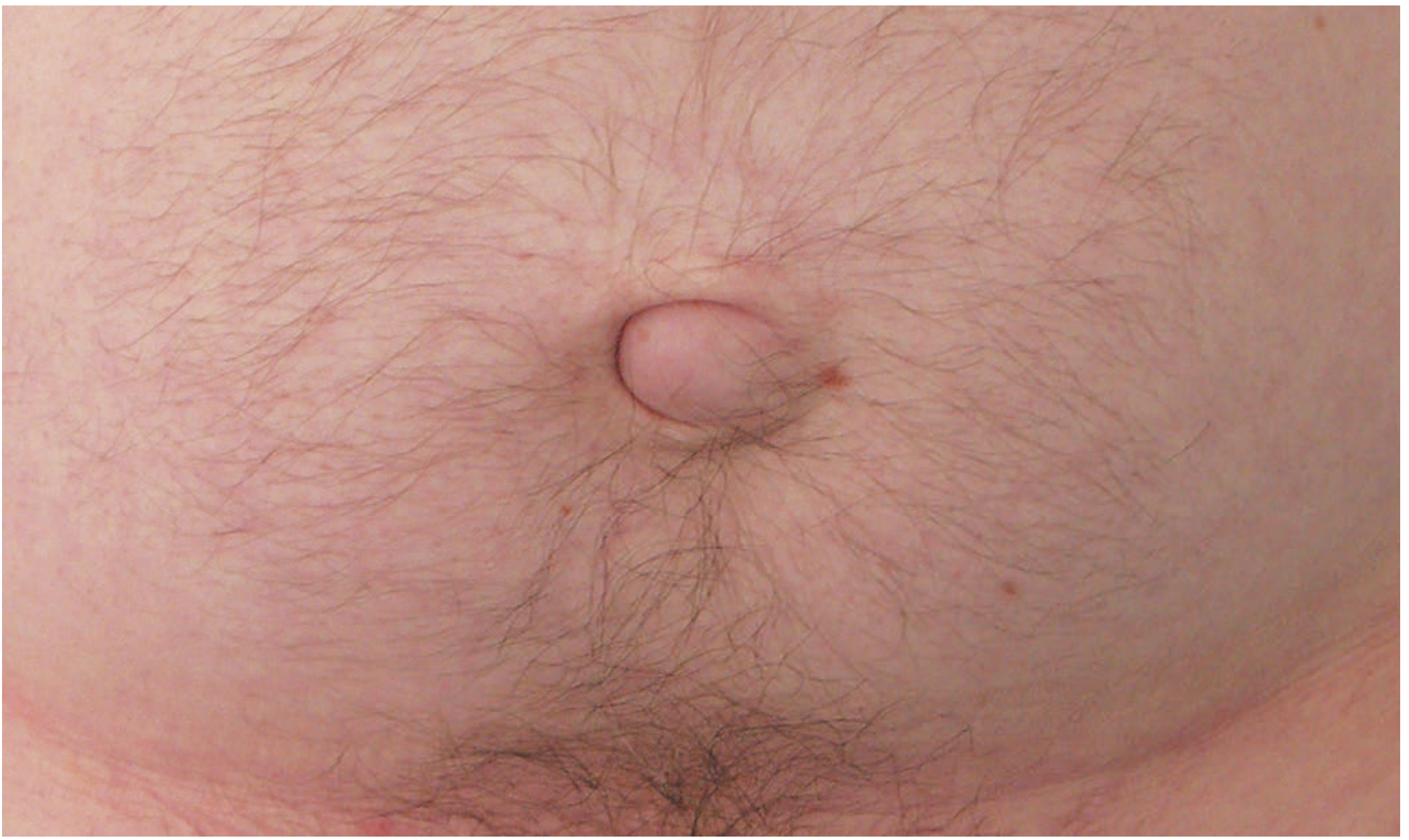
Examination Sequence
1. POSITION & EXPOSURE
- Patient supine, abdomen fully exposed from xiphisternum to groin
- Later ask to stand or cough to accentuate the swelling
2. INSPECTION
| Feature | Finding in PUH |
|---|---|
| Site | Immediately above (or occasionally below) the umbilicus, in the midline or just off it |
| Shape | Hemispherical or lobulated; umbilicus appears distorted or pushed aside |
| Appearance of umbilicus | Everted or obliterated; crescent-shaped asymmetry to the umbilical depression |
| Skin | Usually normal; in very large hernias - thin, shiny skin; rarely ulceration |
| Size | Varies widely from fingertip to large multilobular mass |
| On coughing/straining | Swelling becomes more prominent - visible expansile impulse |
| Ask patient to stand | Swelling increases in size due to gravity |
3. PALPATION
a. Surface and edge
- Surface is smooth; edge is distinct (except in very obese patients)
- Edge is firm and fibrous - this is the edge of the linea alba defect
b. Consistency / content
| Content | Feel | Percussion |
|---|---|---|
| Omentum | Firm / doughy | Dull |
| Bowel | Soft | Resonant |
c. Cough impulse
- Place fingers over the swelling and ask the patient to cough
- A positive cough impulse (expansile, transmitted thrust) confirms it is a hernia
d. Reducibility
- Attempt gentle reduction with the patient lying down
- Many PUHs are irreducible - the omentum or bowel becomes adherent to the sac, or the narrow neck prevents reduction
- If reducible: the firm fibrous edge of the defect in the linea alba can then be felt as a well-defined ring
e. Neck of sac
- Narrow neck relative to sac size - this is why strangulation risk is higher than inguinal hernias
- Assess whether the neck can be felt above the swelling (localises the defect to just above the umbilicus)
f. Tenderness
- Mild discomfort is common
- Acute severe tenderness + irreducibility = obstruction or strangulation
4. PERCUSSION
- Resonant if content is bowel (gas-containing)
- Dull if content is omentum or fluid
5. AUSCULTATION
- Bowel sounds heard over the swelling = bowel in the sac
- Absence of bowel sounds in an irreducible hernia with tenderness raises concern for strangulation
6. TRANSILLUMINATION
- Negative (does not transilluminate) - confirms solid/bowel content, not a cyst
7. CHECK FOR COMPLICATIONS
| Complication | Signs |
|---|---|
| Irreducibility | Cannot be manually reduced; most common in PUH |
| Obstruction | Abdominal distension, vomiting, absolute constipation; bowel sounds may be hyperactive over sac |
| Strangulation | Tense, tender, irreducible hernia; skin may become red/purple; systemic signs of sepsis |
8. COMPLETE EXAMINATION
- Examine all other hernial orifices (inguinal, femoral, incisional)
- Look for cause of raised intra-abdominal pressure: ascites (shifting dullness, fluid thrill), abdominal mass, distension
- Diastasis recti - assess separation of the recti (common in obese/multiparous patients; may coexist)
- General examination: BMI, liver disease signs (for ascites), cardiorespiratory status (for surgical fitness)
Summary of Key Diagnostic Features of PUH
- Middle/old age; obese woman
- Swelling immediately above (occasionally below) umbilicus - umbilicus obliterated or distorted
- Surface smooth; edge firm and distinct (fibrous ring of linea alba)
- Content - omentum (firm, dull) or bowel (soft, resonant)
- Often irreducible - omentum gets adherent or neck is narrow
- Positive cough impulse when reducible
- Intermittent pain is a common symptom (narrow neck causes tissue tension)
- Strangulation is less common than obstruction, but neck is narrow so risk exists
Sources: S Das - A Manual on Clinical Surgery, 13th Ed.; Bailey and Love's Short Practice of Surgery, 28th Ed.
This is a shared conversation. Sign in to Orris to start your own chat.