
Pathogenesis of the fever
"fever"[MeSH Terms] AND "pathogenesis"
pathogenesis of fever pyrogens IL-1 prostaglandin E2 hypothalamus set point
Pathogenesis of fever
Sequence of events
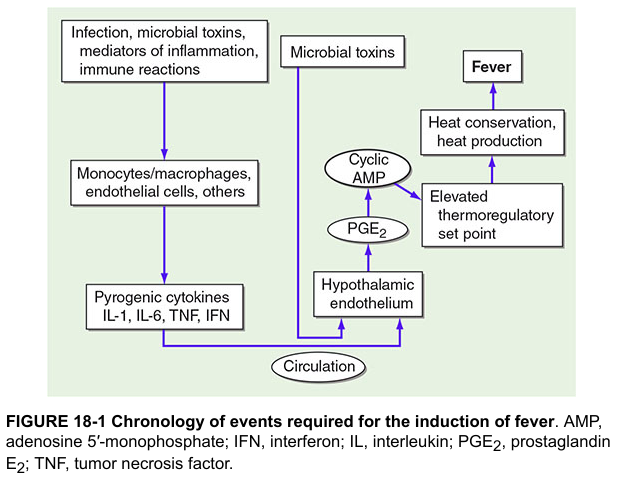
- Exogenous pyrogens come from outside the body. Examples are bacterial endotoxin (LPS from gram-negative cell walls), peptidoglycan, and superantigens or pyrogenic exotoxins. Viruses, immune complexes, and other microbial products also act this way.
- Endogenous pyrogens are host cytokines made by monocytes, macrophages, and Kupffer cells. They can also be produced in response to non-infectious triggers such as tissue injury, inflammation, malignancy, and antigen-antibody complexes.
- The main endogenous pyrogens are IL-1β, IL-6, TNF-α, and IFN-β/γ. Each can cause fever independently. - Ganong's Review of Medical Physiology, 26th ed., p. 2005 (block 3)
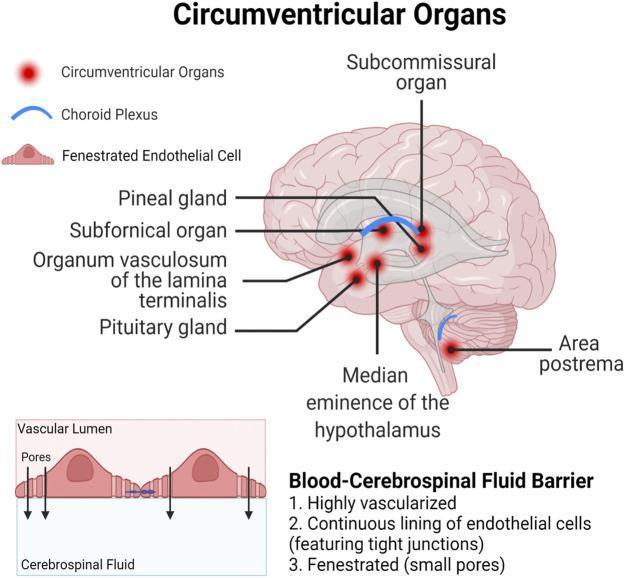
- These circulating cytokines are polypeptides and are unlikely to cross the blood-brain barrier. They are thought to act on the OVLT (organum vasculosum of the lamina terminalis). This circumventricular organ lacks a tight barrier. It then activates the preoptic area of the anterior hypothalamus.
- Cytokines made within the CNS during infection may also act directly on the thermoregulatory centers. - Ganong's Review of Medical Physiology, 26th ed.
- Cytokines also induce COX-2 in peripheral tissues and in the brain's vascular endothelium.
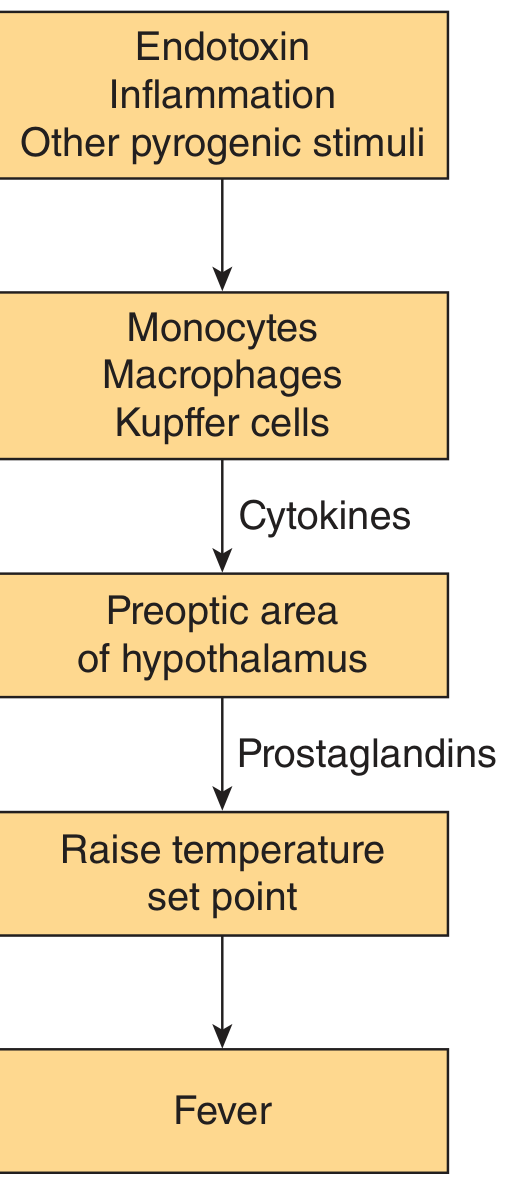
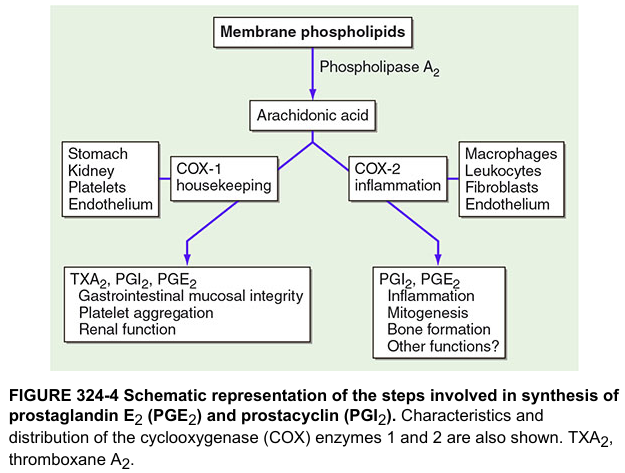
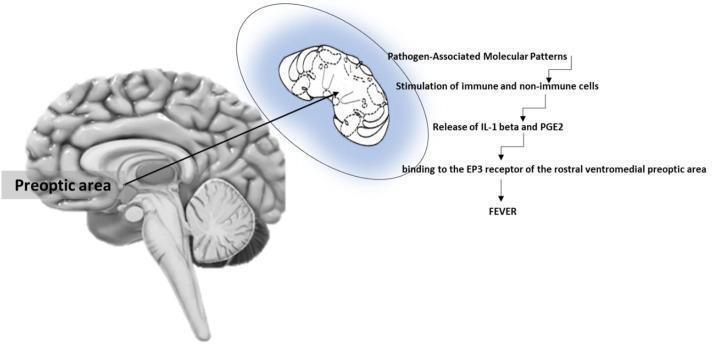
- Cytokines induce COX-2, which makes PGE2 from arachidonic acid (phospholipase A2 releases the arachidonic acid).
- PGE2 acts on EP receptors (EP1 to EP4) in the preoptic hypothalamus. EP3 is the key one: knockout of EP3 abolishes the fever response to PGE2, IL-1β, and LPS.
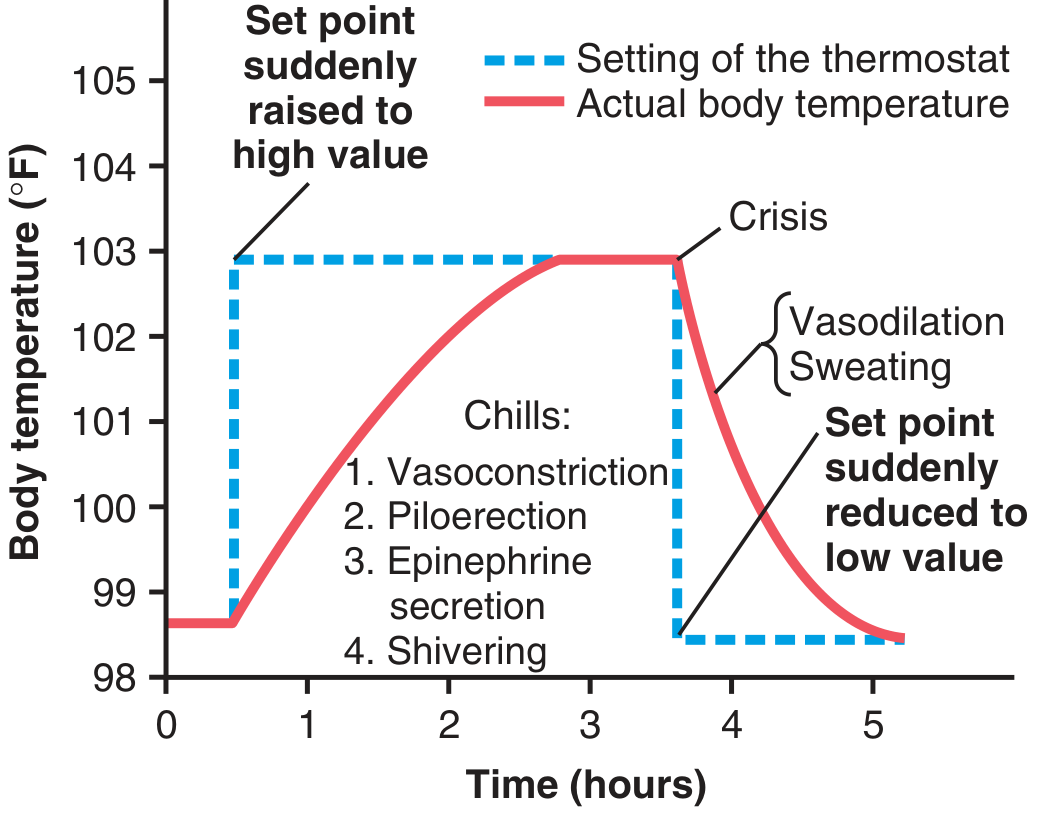
- PGE2 alters the firing of preoptic neurons and raises the thermoregulatory set point (for example, from 37°C to 39°C). - Ganong; Robbins & Kumar Basic Pathology (systemic effects of inflammation); Guyton and Hall
- Vasoconstriction of skin vessels reduces heat loss. The patient feels cold, and the hands and feet go cold first.
- Shivering and increased non-shivering thermogenesis (liver, brown fat) increase heat production.
- Behavioral changes such as adding clothes and blankets also raise temperature.
- Most fevers rise by 1 to 2°C.
- Once blood temperature at the hypothalamus matches the new set point, the body holds it there using the normal heat-balance mechanisms.
- When pyrogen levels fall, or an antipyretic is given, the set point drops. Vasodilation and sweating then begin and continue until temperature reaches the lower setting. - Harrison's Principles of Internal Medicine, 22nd ed., "Fever versus Hyperthermia"
Antipyretics
- Aspirin, paracetamol, and other NSAIDs reduce fever by inhibiting COX and therefore PGE2 synthesis in the hypothalamus.
- Glucocorticoids reduce fever by suppressing cytokine and COX-2 expression.
Possible benefits of fever
- Many microorganisms grow best in a narrow temperature range, and a rise in temperature inhibits their growth.
- Antibody production is increased at higher body temperature.
- The overall benefit to the host is uncertain. Prolonged temperatures above 41°C can cause permanent brain damage. - Ganong's Review of Medical Physiology, 26th ed.
Fever vs hyperthermia
| Fever | Hyperthermia | |
|---|---|---|
| Hypothalamic set point | Raised | Normal |
| Pyrogens involved | Yes | No |
| Mechanism | Regulated heat conservation and production | Heat gain or production exceeds loss (heat stroke, malignant hyperthermia, drugs) |
| Response to antipyretics | Yes | No |
Make a presentation on the pathogenesis of fever
fever pathogenesis endogenous pyrogens prostaglandin hypothalamus thermoregulation
ls -la /tmp/workspace/; python /tmp/skills/shared/scripts/fetch_images.py "https://cdn.orris.care/cdss_images/df403c4b09488ee9c33f9aef934fbf1b6166ff24d93f305c9861737b67de8113.png" | python -c "import json,sys; d=json.load(sys.stdin); print([(x['url'][-20:], x['error'], len(x['base64'] or '')) for x in d])"
mkdir -p /tmp/workspace/fever-ppt/assets /tmp/workspace/fever-ppt/output && cd /tmp/workspace/fever-ppt && python /tmp/skills/shared/scripts/fetch_images.py "https://cdn.orris.care/cdss_images/df403c4b09488ee9c33f9aef934fbf1b6166ff24d93f305c9861737b67de8113.png" > assets/img.json && python -c " import json,base64 d=json.load(open('assets/img.json'))[0] b=d['base64'].split('base64,')[1] open('assets/ganong_fig.png','wb').write(base64.b64decode(b)) from PIL import Image print(Image.open('assets/ganong_fig.png').size)"
~/fever-ppt/build.py
from pptx import Presentation
from pptx.util import Inches, Pt
from pptx.dml.color import RGBColor
from pptx.enum.text import PP_ALIGN, MSO_ANCHOR
from pptx.enum.shapes import MSO_SHAPE

NAVY = RGBColor(0x14, 0x2B, 0x4A)
RED = RGBColor(0xC8, 0x3C, 0x2F)
ORANGE = RGBColor(0xF2, 0x8C, 0x28)
CREAM = RGBColor(0xFB, 0xF6, 0xEF)
GREY = RGBColor(0x55, 0x5F, 0x6B)
LIGHT = RGBColor(0xE9, 0xEE, 0xF4)
WHITE = RGBColor(0xFF, 0xFF, 0xFF)
BLUE = RGBColor(0x2E, 0x6D, 0xA4)
FONT = "Calibri"

prs = Presentation()
prs.slide_width = Inches(13.333)
prs.slide_height = Inches(7.5)
BLANK = prs.slide_layouts[6]


def rect(slide, x, y, w, h, fill, line=None, shape=MSO_SHAPE.RECTANGLE):
    s = slide.shapes.add_shape(shape, Inches(x), Inches(y), Inches(w), Inches(h))
    s.fill.solid()
    s.fill.fore_color.rgb = fill
    if line is None:
        s.line.fill.background()
    else:
        s.line.color.rgb = line
        s.line.width = Pt(1.25)
    s.shadow.inherit = False
    return s


def text(slide, x, y, w, h, content, size=18, bold=False, color=NAVY,
         align=PP_ALIGN.LEFT, anchor=MSO_ANCHOR.TOP, shape=None):
    """content: str or list of str / (str, dict) paragraphs."""
    if shape is None:
        shape = slide.shapes.add_textbox(Inches(x), Inches(y), Inches(w), Inches(h))
    tf = shape.text_frame
    tf.word_wrap = True
    tf.vertical_anchor = anchor
    tf.margin_left = tf.margin_right = Inches(0.1)
    tf.margin_top = tf.margin_bottom = Inches(0.05)
    items = content if isinstance(content, list) else [content]
    for i, it in enumerate(items):
        opts = {}
        if isinstance(it, tuple):
            it, opts = it
        p = tf.paragraphs[0] if i == 0 else tf.add_paragraph()
        p.alignment = opts.get("align", align)
        p.space_after = Pt(opts.get("after", 4))
        r = p.add_run()
        r.text = it
        r.font.name = FONT
        r.font.size = Pt(opts.get("size", size))
        r.font.bold = opts.get("bold", bold)
        r.font.color.rgb = opts.get("color", color)
    return shape


def bullets(slide, x, y, w, h, items, size=18, color=NAVY, gap=8):
    tb = slide.shapes.add_textbox(Inches(x), Inches(y), Inches(w), Inches(h))
    tf = tb.text_frame
    tf.word_wrap = True
    tf.margin_left = Inches(0.1)
    for i, it in enumerate(items):
        p = tf.paragraphs[0] if i == 0 else tf.add_paragraph()
        p.space_after = Pt(gap)
        if isinstance(it, tuple):
            head, body = it
            r1 = p.add_run()
            r1.text = "\u25A0  " + head + " "
            r1.font.bold = True
            r1.font.color.rgb = RED
            r1.font.size = Pt(size)
            r1.font.name = FONT
            r2 = p.add_run()
            r2.text = body
            r2.font.size = Pt(size)
            r2.font.color.rgb = color
            r2.font.name = FONT
        else:
            r = p.add_run()
            r.text = "\u25A0  " + it
            r.font.size = Pt(size)
            r.font.color.rgb = color
            r.font.name = FONT
    return tb


def base(title, num, notes=None):
    s = prs.slides.add_slide(BLANK)
    bg = s.background.fill
    bg.solid()
    bg.fore_color.rgb = CREAM
    rect(s, 0, 0, 13.333, 1.15, NAVY)
    rect(s, 0, 1.15, 13.333, 0.06, ORANGE)
    text(s, 0.6, 0.15, 12, 0.85, title, size=32, bold=True, color=WHITE,
         anchor=MSO_ANCHOR.MIDDLE)
    text(s, 0.6, 7.05, 9, 0.35, "Pathogenesis of Fever", size=11, color=GREY)
    text(s, 12.0, 7.05, 0.8, 0.35, str(num), size=11, color=GREY, align=PP_ALIGN.RIGHT)
    if notes:
        s.notes_slide.notes_text_frame.text = notes
    return s


def arrow(slide, x, y, w, h, shape=MSO_SHAPE.RIGHT_ARROW, color=ORANGE):
    return rect(slide, x, y, w, h, color, shape=shape)


# ---------------- 1. Title ----------------
s = prs.slides.add_slide(BLANK)
s.background.fill.solid()
s.background.fill.fore_color.rgb = NAVY
rect(s, 0, 5.2, 13.333, 0.08, ORANGE)
rect(s, 0.8, 1.9, 0.12, 2.4, RED)
text(s, 1.1, 1.8, 11, 1.5, "Pathogenesis of Fever", size=54, bold=True, color=WHITE,
     anchor=MSO_ANCHOR.MIDDLE)
text(s, 1.1, 3.3, 11, 1.1,
     "From pyrogen to hypothalamic set point: cytokines, prostaglandin E2 and the thermoregulatory response",
     size=22, color=RGBColor(0xD6, 0xDF, 0xEA))
text(s, 1.1, 5.5, 11, 0.5,
     "Sources: Ganong's Review of Medical Physiology 26e; Harrison's Principles of Internal Medicine 22e; "
     "Robbins & Kumar Basic Pathology; Guyton and Hall Textbook of Medical Physiology",
     size=13, color=RGBColor(0xB5, 0xC3, 0xD3))
s.notes_slide.notes_text_frame.text = "Overview of how pyrogens raise the hypothalamic set point to produce fever."

# ---------------- 2. Definition ----------------
s = base("What is fever?", 2,
         "Fever is a regulated rise in set point. Hyperthermia is unregulated heat gain with a normal set point.")
text(s, 0.6, 1.5, 12.1, 1.0,
     "Fever is an elevation of body temperature above normal daily variation that occurs together with "
     "an increase in the hypothalamic set point (for example 37\u00B0C to 39\u00B0C).",
     size=20)
# comparison table
rows = [
    ("", "Fever", "Hyperthermia"),
    ("Hypothalamic set point", "Raised", "Unchanged"),
    ("Pyrogens involved", "Yes (exogenous and endogenous)", "No"),
    ("Mechanism", "Regulated heat conservation and production", "Heat gain or production exceeds heat loss"),
    ("Examples", "Infection, inflammation, malignancy", "Heat stroke, malignant hyperthermia, anticholinergic drugs"),
    ("Response to antipyretics", "Yes", "No"),
]
tbl = s.shapes.add_table(len(rows), 3, Inches(0.6), Inches(2.75), Inches(12.1), Inches(3.5)).table
tbl.columns[0].width = Inches(3.3)
tbl.columns[1].width = Inches(4.2)
tbl.columns[2].width = Inches(4.6)
for r, row in enumerate(rows):
    for c, val in enumerate(row):
        cell = tbl.cell(r, c)
        cell.text = val
        cell.vertical_anchor = MSO_ANCHOR.MIDDLE
        p = cell.text_frame.paragraphs[0]
        f = p.runs[0].font if p.runs else p.font
        f.name = FONT
        f.size = Pt(16)
        cell.fill.solid()
        if r == 0:
            cell.fill.fore_color.rgb = RED if c == 1 else (NAVY if c == 0 else BLUE)
            f.bold = True
            f.color.rgb = WHITE
        else:
            cell.fill.fore_color.rgb = WHITE if r % 2 else LIGHT
            f.color.rgb = NAVY
            f.bold = (c == 0)
text(s, 0.6, 6.4, 12.1, 0.5,
     "Hyperpyrexia: temperature above 41.5\u00B0C (106.7\u00B0F); most often seen with CNS haemorrhage or severe infection.",
     size=15, color=GREY)

# ---------------- 3. Thermoregulation ----------------
s = base("Normal thermoregulation: the thermostat", 3,
         "The preoptic area of the anterior hypothalamus integrates central and peripheral temperature inputs and compares them with the set point.")
# three columns: inputs -> hypothalamus -> effectors
rect(s, 0.6, 1.6, 3.6, 4.6, WHITE, line=BLUE)
text(s, 0.6, 1.65, 3.6, 0.5, "Inputs", size=22, bold=True, color=BLUE, align=PP_ALIGN.CENTER)
bullets(s, 0.75, 2.25, 3.3, 3.8, [
    "Peripheral thermoreceptors (skin)",
    "Core thermoreceptors (viscera, spinal cord)",
    "Temperature of blood bathing the hypothalamus",
], size=17)
arrow(s, 4.3, 3.6, 0.7, 0.6)
rect(s, 5.1, 1.6, 3.1, 4.6, NAVY)
text(s, 5.1, 1.65, 3.1, 0.5, "Integrator", size=22, bold=True, color=ORANGE, align=PP_ALIGN.CENTER)
text(s, 5.2, 2.4, 2.9, 3.6, [
    ("Preoptic area of the anterior hypothalamus", {"bold": True, "size": 20, "color": WHITE, "after": 12}),
    ("Compares body temperature with the set point and drives effectors to correct any difference.",
     {"size": 17, "color": RGBColor(0xD6, 0xDF, 0xEA)}),
])
arrow(s, 8.3, 3.6, 0.7, 0.6)
rect(s, 9.1, 1.6, 3.65, 4.6, WHITE, line=RED)
text(s, 9.1, 1.65, 3.65, 0.5, "Effectors", size=22, bold=True, color=RED, align=PP_ALIGN.CENTER)
bullets(s, 9.25, 2.25, 3.4, 3.8, [
    ("Too cold:", "vasoconstriction, shivering, non-shivering thermogenesis, behaviour"),
    ("Too warm:", "vasodilation, sweating, behaviour"),
], size=16)
text(s, 0.6, 6.4, 12.1, 0.5,
     "In fever, the thermostat works normally. Its set point is what changes.",
     size=18, bold=True, color=RED, align=PP_ALIGN.CENTER)

# ---------------- 4. Pyrogens ----------------
s = base("Step 1: Pyrogens", 4,
         "Exogenous pyrogens trigger host cells to release endogenous pyrogens (cytokines), which are the actual mediators.")
rect(s, 0.6, 1.6, 5.9, 4.9, WHITE, line=BLUE)
rect(s, 0.6, 1.6, 5.9, 0.7, BLUE)
text(s, 0.6, 1.6, 5.9, 0.7, "Exogenous pyrogens (from outside)", size=21, bold=True,
     color=WHITE, align=PP_ALIGN.CENTER, anchor=MSO_ANCHOR.MIDDLE)
bullets(s, 0.8, 2.5, 5.5, 3.9, [
    ("Endotoxin (LPS)", "from gram-negative cell walls, the classic example"),
    ("Peptidoglycan", "and other microbial products"),
    ("Exotoxins / superantigens", "e.g. staphylococcal and streptococcal pyrogenic exotoxins"),
    ("Viruses, immune complexes", "and other microbial or inflammatory stimuli"),
], size=17)
rect(s, 6.85, 1.6, 5.9, 4.9, WHITE, line=RED)
rect(s, 6.85, 1.6, 5.9, 0.7, RED)
text(s, 6.85, 1.6, 5.9, 0.7, "Endogenous pyrogens (host cytokines)", size=21, bold=True,
     color=WHITE, align=PP_ALIGN.CENTER, anchor=MSO_ANCHOR.MIDDLE)
bullets(s, 7.05, 2.5, 5.5, 3.9, [
    ("Source:", "monocytes, macrophages and Kupffer cells"),
    ("Main cytokines:", "IL-1\u03B2, IL-6, TNF-\u03B1, IFN-\u03B2, IFN-\u03B3"),
    ("Each can cause fever", "independently"),
    ("Non-infectious triggers", "also work: tissue injury, inflammation, malignancy, antigen-antibody complexes"),
], size=17)

# ---------------- 5. Flow ----------------
s = base("Pathway from pyrogen to fever", 5,
         "Summary pathway. Cytokines act on the OVLT and induce COX-2; PGE2 acts on EP3 receptors in the preoptic area to raise the set point.")
steps = [
    ("1", "Pyrogenic stimulus", "Endotoxin, microbes, inflammation"),
    ("2", "Macrophages, monocytes, Kupffer cells", "Release IL-1\u03B2, IL-6, TNF-\u03B1, IFN"),
    ("3", "Cytokines reach the brain", "Act at the OVLT; also induce COX-2 in brain endothelium"),
    ("4", "PGE2 synthesis", "Arachidonic acid \u2192 COX-2 \u2192 PGE2"),
    ("5", "EP receptors (esp. EP3)", "PGE2 acts on neurons in the preoptic hypothalamus"),
    ("6", "Set point raised", "e.g. 37\u00B0C to 39\u00B0C"),
    ("7", "Heat conservation and production", "Vasoconstriction, shivering, thermogenesis"),
    ("8", "FEVER", "Body temperature rises to the new set point"),
]
bw, bh = 2.65, 1.75
xs = [0.6, 3.75, 6.9, 10.05]
y1, y2 = 1.65, 4.3
for i, (n, head, sub) in enumerate(steps):
    if i < 4:
        x, y = xs[i], y1
    else:
        x, y = xs[7 - i], y2  # snake: right to left on second row
    last = i == 7
    box = rect(s, x, y, bw, bh, RED if last else (NAVY if i in (4, 5, 6) else BLUE),
               shape=MSO_SHAPE.ROUNDED_RECTANGLE)
    box.adjustments[0] = 0.08
    text(s, x, y, bw, bh, [
        (n + ". " + head, {"bold": True, "size": 16, "color": WHITE, "after": 4}),
        (sub, {"size": 13, "color": RGBColor(0xE8, 0xEE, 0xF5)}),
    ], shape=box, anchor=MSO_ANCHOR.MIDDLE, align=PP_ALIGN.CENTER)
    # arrows
    if i < 3:
        arrow(s, x + bw + 0.02, y + bh / 2 - 0.2, 0.46, 0.4)
    elif i == 3:
        arrow(s, x + bw / 2 - 0.2, y + bh + 0.05, 0.4, 0.45, shape=MSO_SHAPE.DOWN_ARROW)
    elif i > 3 and i < 7:
        arrow(s, x - 0.48, y + bh / 2 - 0.2, 0.46, 0.4, shape=MSO_SHAPE.LEFT_ARROW)
text(s, 0.6, 6.25, 12.1, 0.6,
     "OVLT = organum vasculosum of the lamina terminalis, a circumventricular organ without a tight blood-brain barrier.",
     size=14, color=GREY)

# ---------------- 6. Cytokines to brain ----------------
s = base("Step 2: How circulating cytokines signal the brain", 6,
         "Cytokines are polypeptides that are unlikely to cross the blood-brain barrier, so several indirect routes are proposed.")
text(s, 0.6, 1.5, 12.1, 0.9,
     "IL-1\u03B2, IL-6 and TNF-\u03B1 are polypeptides and are unlikely to penetrate the brain parenchyma. "
     "They signal across the barrier by indirect routes.", size=19)
cards = [
    ("OVLT pathway", "Cytokines act at the OVLT, a circumventricular organ lacking a tight barrier. This activates the preoptic area of the hypothalamus."),
    ("Endothelial COX-2", "Cytokines induce COX-2 in brain vascular endothelium, which releases PGE2 directly into the brain."),
    ("Local CNS cytokines", "CNS cells stimulated by infection also make cytokines, which may act directly on thermoregulatory centres."),
]
for i, (h, b) in enumerate(cards):
    x = 0.6 + i * 4.1
    rect(s, x, 2.7, 3.9, 3.6, WHITE, line=BLUE)
    rect(s, x, 2.7, 3.9, 0.12, ORANGE)
    text(s, x + 0.1, 2.95, 3.7, 0.6, h, size=22, bold=True, color=RED)
    text(s, x + 0.1, 3.65, 3.7, 2.6, b, size=17)

# ---------------- 7. PGE2 ----------------
s = base("Step 3: Prostaglandin E2 is the final mediator", 7,
         "Intrahypothalamic injection of prostaglandins produces fever. EP3 knockout abolishes the febrile response to PGE2, IL-1 beta and LPS.")
# chain graphic
chain = ["Membrane phospholipids", "Arachidonic acid", "PGH2", "PGE2"]
subs = ["Phospholipase A2", "COX-2 (induced by cytokines)", "PGE synthase", ""]
cx = 0.6
for i, c in enumerate(chain):
    b = rect(s, cx + i * 3.1, 1.65, 2.5, 0.9, RED if i == 3 else NAVY, shape=MSO_SHAPE.ROUNDED_RECTANGLE)
    text(s, 0, 0, 0, 0, c, size=17, bold=True, color=WHITE, shape=b,
         align=PP_ALIGN.CENTER, anchor=MSO_ANCHOR.MIDDLE)
    if i < 3:
        arrow(s, cx + i * 3.1 + 2.52, 1.9, 0.5, 0.4)
        text(s, cx + i * 3.1 + 1.55, 2.6, 2.6, 0.4, subs[i], size=12, color=GREY, align=PP_ALIGN.CENTER)
bullets(s, 0.6, 3.4, 7.3, 3.4, [
    ("Receptors:", "PGE2 acts on EP1, EP2, EP3 and EP4. EP3 is essential; knockout impairs fever to PGE2, IL-1\u03B2 and LPS."),
    ("Action:", "alters the firing of preoptic neurons and raises the set point."),
    ("Evidence:", "intrahypothalamic prostaglandin injection causes fever, and aspirin acts directly on the hypothalamus."),
], size=18)
rect(s, 8.3, 3.4, 4.45, 3.2, NAVY)
text(s, 8.4, 3.5, 4.25, 3.0, [
    ("Clinical link", {"bold": True, "size": 20, "color": ORANGE, "after": 8}),
    ("Aspirin, paracetamol and other NSAIDs lower fever by inhibiting COX and so reducing PGE2. "
     "Glucocorticoids suppress cytokine and COX-2 expression.", {"size": 17, "color": WHITE}),
])

# ---------------- 8. Effector phases ----------------
s = base("Step 4: The febrile response in three phases", 8,
         "Chill phase while the body rises to the new set point, plateau at the new set point, and flush when set point returns to normal.")
phases = [
    ("Rise (chill)", RED, [
        "Skin vasoconstriction cuts heat loss; hands and feet feel cold",
        "Shivering and non-shivering thermogenesis (liver) add heat",
        "Behaviour: more clothes and blankets",
        "Typical rise is 1 to 2\u00B0C",
    ]),
    ("Plateau", NAVY, [
        "Blood temperature at the hypothalamus matches the new set point",
        "Normal heat-balance mechanisms hold temperature at the febrile level",
        "Chills settle; skin feels warm",
    ]),
    ("Defervescence (flush)", BLUE, [
        "Set point falls as pyrogens decline or antipyretics act",
        "Vasodilation and sweating lose heat",
        "Behaviour: clothing removed",
        "Continues until temperature meets the lower set point",
    ]),
]
for i, (h, col, items) in enumerate(phases):
    x = 0.6 + i * 4.1
    rect(s, x, 1.6, 3.9, 0.75, col)
    text(s, x, 1.6, 3.9, 0.75, h, size=22, bold=True, color=WHITE,
         align=PP_ALIGN.CENTER, anchor=MSO_ANCHOR.MIDDLE)
    rect(s, x, 2.35, 3.9, 4.2, WHITE, line=col)
    bullets(s, x + 0.1, 2.5, 3.7, 4.0, items, size=16, gap=10)

# ---------------- 9. Benefits and harms ----------------
s = base("Does fever help? Benefits and harms", 9,
         "The benefit of fever is uncertain but assumed because it has been conserved through evolution.")
rect(s, 0.6, 1.6, 5.9, 4.9, WHITE, line=BLUE)
rect(s, 0.6, 1.6, 5.9, 0.7, BLUE)
text(s, 0.6, 1.6, 5.9, 0.7, "Possible benefits", size=22, bold=True, color=WHITE,
     align=PP_ALIGN.CENTER, anchor=MSO_ANCHOR.MIDDLE)
bullets(s, 0.8, 2.5, 5.5, 3.9, [
    "Many microorganisms grow best in a narrow temperature range; a rise inhibits growth",
    "Antibody production increases at higher temperature",
    "Fever has persisted through evolution as a response to infection",
    "Artificial fever was used to treat neurosyphilis before antibiotics",
], size=17)
rect(s, 6.85, 1.6, 5.9, 4.9, WHITE, line=RED)
rect(s, 6.85, 1.6, 5.9, 0.7, RED)
text(s, 6.85, 1.6, 5.9, 0.7, "Harms at extremes", size=22, bold=True, color=WHITE,
     align=PP_ALIGN.CENTER, anchor=MSO_ANCHOR.MIDDLE)
bullets(s, 7.05, 2.5, 5.5, 3.9, [
    "Rectal temperature above 41\u00B0C for long periods can cause permanent brain damage",
    "Above 43\u00B0C heat stroke develops and death is common",
    "Raised metabolic rate, tachycardia and increased fluid loss",
    "Seizures in susceptible children; delirium in the elderly",
], size=17)

# ---------------- 10. Summary ----------------
s = base("Key points", 10, "Summary slide.")
pts = [
    ("1", "Fever is a regulated rise in the hypothalamic set point, not a failure of heat control."),
    ("2", "Exogenous pyrogens (e.g. LPS) stimulate monocytes, macrophages and Kupffer cells to release IL-1\u03B2, IL-6, TNF-\u03B1 and IFN."),
    ("3", "Cytokines signal the brain via the OVLT and by inducing COX-2 in brain endothelium."),
    ("4", "PGE2, acting mainly on EP3 receptors in the preoptic area, raises the set point."),
    ("5", "The body conserves and generates heat until blood temperature reaches the new set point."),
    ("6", "Antipyretics (NSAIDs, paracetamol) block COX and PGE2; hyperthermia does not respond to them."),
]
for i, (n, t) in enumerate(pts):
    y = 1.55 + i * 0.9
    c = rect(s, 0.7, y + 0.05, 0.65, 0.65, RED, shape=MSO_SHAPE.OVAL)
    text(s, 0, 0, 0, 0, n, size=20, bold=True, color=WHITE, shape=c,
         align=PP_ALIGN.CENTER, anchor=MSO_ANCHOR.MIDDLE)
    text(s, 1.6, y, 11.1, 0.8, t, size=19, anchor=MSO_ANCHOR.MIDDLE)

# ---------------- 11. References ----------------
s = base("References", 11)
bullets(s, 0.6, 1.6, 12.1, 4.8, [
    "Ganong's Review of Medical Physiology, 26th ed. Fever and Figure 17-13, Pathogenesis of fever.",
    "Harrison's Principles of Internal Medicine, 22nd ed. Fever versus hyperthermia; pyrogens; pyrogenic cytokines.",
    "Robbins & Kumar Basic Pathology. Systemic effects of inflammation.",
    "Guyton and Hall Textbook of Medical Physiology. Resetting the hypothalamic temperature set point.",
    "Goldman-Cecil Medicine, International Edition. Pathobiology of fever.",
], size=18, gap=14)

out = "/tmp/workspace/fever-ppt/output/Pathogenesis_of_Fever.pptx"
prs.save(out)
print("saved", out)
cd /tmp/workspace/fever-ppt && python build.py
cd /tmp/workspace/fever-ppt/output && python -c " from pptx import Presentation p=Presentation('Pathogenesis_of_Fever.pptx') print(len(p.slides)) for i,s in enumerate(p.slides,1): t=[sh.text_frame.text for sh in s.shapes if sh.has_text_frame and sh.text_frame.text.strip()] print(i,t[0][:60]) "; ls -la
Pathogenesis of Fever
Presentation · PPTX
- Title
- What is fever? A table comparing fever with hyperthermia, plus the definition of hyperpyrexia
- Normal thermoregulation: inputs, the preoptic hypothalamus as integrator, and effectors
- Step 1, pyrogens: exogenous (LPS, exotoxins) and endogenous (IL-1β, IL-6, TNF-α, IFN)
- Pathway from pyrogen to fever: an 8-step flow diagram
- Step 2, how circulating cytokines signal the brain: the OVLT, endothelial COX-2, and cytokines made within the CNS
- Step 3, PGE2 as the final mediator: phospholipid to arachidonic acid to PGH2 to PGE2, EP3 receptors, and the link to antipyretics
- Step 4, the three phases of fever: rise (chill), plateau, and defervescence (flush)
- Benefits and harms of fever
- Key points
- References
- The PGH2 and PGE synthase steps on slide 7.
- The harms listed on slide 9 (raised metabolic rate, tachycardia, fluid loss, seizures in children, delirium in the elderly).
Presentation is not opening
cd /tmp/workspace/fever-ppt/output && python - <<'E' import zipfile from lxml import etree z=zipfile.ZipFile('Pathogenesis_of_Fever.pptx') print(z.testzip()) for n in z.namelist(): if n.endswith('.xml') or n.endswith('.rels'): try: etree.fromstring(z.read(n)) except Exception as e: print('BAD',n,e) print(len(z.namelist())) import re s=z.read('ppt/slides/slide2.xml').decode() print(s[:200]) # check zero-size shapes for n in z.namelist(): if re.match(r'ppt/slides/slide\d+\.xml',n): x=z.read(n).decode() print(n, x.count('cx="0"'), x.count('cy="0"')) E ls /tmp/skills/pptx/scripts /tmp/skills/pptx/scripts/office
cd /tmp/workspace/fever-ppt/output && python /tmp/skills/pptx/scripts/office/validate.py --help 2>&1 | head -20; python /tmp/skills/pptx/scripts/office/validate.py Pathogenesis_of_Fever.pptx 2>&1 | head -40
cd /tmp/workspace/fever-ppt && python - <<'E' import re src=open('build.py').read() # 1. drop shadow tweak and notes src=src.replace(" s.shadow.inherit = False\n","") src=src.replace(" if notes:\n s.notes_slide.notes_text_frame.text = notes\n","") src=src.replace('s.notes_slide.notes_text_frame.text = "Overview of how pyrogens raise the hypothalamic set point to produce fever."\n',"") # 2. replace table with plain shapes grid start=src.index("tbl = s.shapes.add_table") end=src.index("text(s, 0.6, 6.4, 12.1, 0.5,\n \"Hyperpyrexia") grid='''colw=[3.3,4.2,4.6] rowh=0.58 for r,row in enumerate(rows): xx=0.6 for c,val in enumerate(row): if r==0: fill=NAVY if c==0 else (RED if c==1 else BLUE) col=WHITE else: fill=WHITE if r%2 else LIGHT col=NAVY b=rect(s,xx,2.75+r*rowh,colw[c],rowh,fill,line=RGBColor(0xC9,0xD3,0xDE)) text(s,0,0,0,0,val,size=15,bold=(r==0 or c==0),color=col,shape=b,anchor=MSO_ANCHOR.MIDDLE) xx+=colw[c] ''' src=src[:start]+grid+src[end:] open('build.py','w').write(src) E python build.py && python /tmp/skills/pptx/scripts/office/validate.py output/Pathogenesis_of_Fever.pptx && python -c " import zipfile;z=zipfile.ZipFile('output/Pathogenesis_of_Fever.pptx');print([n for n in z.namelist() if 'notes' in n or 'table' in n.lower()]); from pptx import Presentation;print(len(Presentation('output/Pathogenesis_of_Fever.pptx').slides))"
cd /tmp/workspace/fever-ppt && python - <<'E' from pptx import Presentation from reportlab.lib.pagesizes import landscape, A4 from reportlab.pdfgen import canvas from reportlab.lib.utils import simpleSplit prs=Presentation('output/Pathogenesis_of_Fever.pptx') W,H=landscape(A4) c=canvas.Canvas('output/Pathogenesis_of_Fever.pdf',pagesize=(W,H)) for i,s in enumerate(prs.slides,1): shapes=[sh for sh in s.shapes if sh.has_text_frame and sh.text_frame.text.strip()] shapes.sort(key=lambda sh:(round(sh.top/914400*2),sh.left)) c.setFillColorRGB(.08,.17,.29); c.rect(0,H-70,W,70,fill=1,stroke=0) title=shapes[0].text_frame.text c.setFillColorRGB(1,1,1); c.setFont('Helvetica-Bold',24); c.drawString(30,H-45,title[:70]) y=H-100 c.setFillColorRGB(.1,.1,.1) for sh in shapes[1:]: t=sh.text_frame.text.replace('\u25A0','-').strip() if t in ('Pathogenesis of Fever',str(i)): continue for para in t.split('\n'): for ln in simpleSplit(para,'Helvetica',12,W-60): if y<30: break c.setFont('Helvetica',12); c.drawString(30,y,ln); y-=16 y-=4 c.showPage() c.save() E ls -la output
- The speaker notes.
- The native table on slide 2, which is now drawn with plain shapes.
- A shape shadow setting.
- Rebuilt presentation:
Pathogenesis of Fever
Presentation · PPTX
- Text-only PDF backup:
Pathogenesis of Fever
PDF Document · PDF
- Which app you're using (PowerPoint desktop, PowerPoint Online, Google Slides, Keynote, or a phone viewer).
- The exact error message, or whether the file just doesn't download or open.
Send the presentation content as a Word document instead
mkdir -p /tmp/workspace/fever-ppt/output && cat > /tmp/workspace/fever-ppt/build_docx.py <<'E' from docx import Document from docx.shared import Pt, Inches, RGBColor from docx.enum.text import WD_ALIGN_PARAGRAPH from docx.enum.table import WD_TABLE_ALIGNMENT from docx.oxml.ns import qn from docx.oxml import OxmlElement NAVY = RGBColor(0x14, 0x2B, 0x4A) RED = RGBColor(0xC8, 0x3C, 0x2F) doc = Document() sec = doc.sections[0] sec.left_margin = sec.right_margin = Inches(1) sec.top_margin = sec.bottom_margin = Inches(0.9) st = doc.styles["Normal"] st.font.name = "Calibri" st.font.size = Pt(11) st.element.rPr.rFonts.set(qn("w:eastAsia"), "Calibri") for name, size, color in (("Heading 1", 16, NAVY), ("Heading 2", 13, RED)): h = doc.styles[name] h.font.name = "Calibri" h.font.size = Pt(size) h.font.bold = True h.font.color.rgb = color h.element.rPr.rFonts.set(qn("w:eastAsia"), "Calibri") def shade(cell, hexcolor): tcPr = cell._tc.get_or_add_tcPr() shd = OxmlElement("w:shd") shd.set(qn("w:val"), "clear") shd.set(qn("w:color"), "auto") shd.set(qn("w:fill"), hexcolor) tcPr.append(shd) def para(text, bold_lead=None, style=None, italic=False): p = doc.add_paragraph(style=style) if bold_lead: r = p.add_run(bold_lead + " ") r.bold = True r = p.add_run(text) r.italic = italic p.paragraph_format.space_after = Pt(4) return p def bullet(text, lead=None): return para(text, bold_lead=lead, style="List Bullet") def table(rows, widths, header_fills=None): t = doc.add_table(rows=len(rows), cols=len(rows[0])) t.style = "Table Grid" t.alignment = WD_TABLE_ALIGNMENT.CENTER for i, row in enumerate(rows): for j, val in enumerate(row): c = t.cell(i, j) c.width = Inches(widths[j]) c.text = "" r = c.paragraphs[0].add_run(val) r.font.size = Pt(10.5) if i == 0: r.bold = True r.font.color.rgb = RGBColor(0xFF, 0xFF, 0xFF) shade(c, (header_fills or ["142B4A"] * len(row))[j]) elif j == 0: r.bold = True shade(c, "E9EEF4") doc.add_paragraph().paragraph_format.space_after = Pt(2) return t # Title p = doc.add_paragraph() p.alignment = WD_ALIGN_PARAGRAPH.CENTER r = p.add_run("Pathogenesis of Fever") r.bold = True r.font.size = Pt(26) r.font.color.rgb = NAVY p = doc.add_paragraph() p.alignment = WD_ALIGN_PARAGRAPH.CENTER r = p.add_run("From pyrogen to hypothalamic set point: cytokines, prostaglandin E2 and the thermoregulatory response") r.italic = True r.font.size = Pt(12) # 1 doc.add_heading("1. What is fever?", 1) para("Fever is an elevation of body temperature above normal daily variation that occurs together with an " "increase in the hypothalamic set point (for example 37\u00B0C to 39\u00B0C). It is a regulated process, " "not a failure of heat control.") table([ ["", "Fever", "Hyperthermia"], ["Hypothalamic set point", "Raised", "Unchanged"], ["Pyrogens involved", "Yes (exogenous and endogenous)", "No"], ["Mechanism", "Regulated heat conservation and production", "Heat gain or production exceeds heat loss"], ["Examples", "Infection, inflammation, malignancy", "Heat stroke, malignant hyperthermia, anticholinergic drugs"], ["Response to antipyretics", "Yes", "No"], ], [1.9, 2.3, 2.3], ["142B4A", "C83C2F", "2E6DA4"]) para("Hyperpyrexia is a temperature above 41.5\u00B0C (106.7\u00B0F). It is seen most often with CNS haemorrhage or severe infection.") # 2 doc.add_heading("2. Normal thermoregulation: the thermostat", 1) bullet("peripheral thermoreceptors in the skin, core thermoreceptors in viscera and spinal cord, and the temperature of blood bathing the hypothalamus.", "Inputs:") bullet("the preoptic area of the anterior hypothalamus compares body temperature with the set point.", "Integrator:") bullet("when too cold: vasoconstriction, shivering, non-shivering thermogenesis and behaviour change. " "When too warm: vasodilation, sweating and behaviour change.", "Effectors:") para("In fever the thermostat works normally. Its set point is what changes.") # 3 doc.add_heading("3. Step 1: Pyrogens", 1) doc.add_heading("Exogenous pyrogens (from outside the body)", 2) bullet("from gram-negative cell walls; the classic example.", "Endotoxin (LPS):") bullet("and other microbial products.", "Peptidoglycan") bullet("for example staphylococcal and streptococcal pyrogenic exotoxins.", "Exotoxins and superantigens:") bullet("and other microbial or inflammatory stimuli.", "Viruses, immune complexes") doc.add_heading("Endogenous pyrogens (host cytokines)", 2) bullet("monocytes, macrophages and Kupffer cells.", "Source:") bullet("IL-1\u03B2, IL-6, TNF-\u03B1, IFN-\u03B2 and IFN-\u03B3. Each can cause fever independently.", "Main cytokines:") bullet("tissue injury, inflammation, malignancy and antigen-antibody complexes can also trigger them.", "Non-infectious triggers:") # 4 doc.add_heading("4. Pathway from pyrogen to fever", 1) table([ ["Step", "Event", "Detail"], ["1", "Pyrogenic stimulus", "Endotoxin, microbes, inflammation"], ["2", "Macrophages, monocytes, Kupffer cells", "Release IL-1\u03B2, IL-6, TNF-\u03B1, IFN"], ["3", "Cytokines signal the brain", "Act at the OVLT; also induce COX-2 in brain endothelium"], ["4", "PGE2 synthesis", "Arachidonic acid, then COX-2, then PGE2"], ["5", "EP receptors (especially EP3)", "PGE2 acts on neurons in the preoptic hypothalamus"], ["6", "Set point raised", "For example 37\u00B0C to 39\u00B0C"], ["7", "Heat conservation and production", "Vasoconstriction, shivering, thermogenesis"], ["8", "Fever", "Body temperature rises to the new set point"], ], [0.6, 2.6, 3.3]) para("OVLT = organum vasculosum of the lamina terminalis, a circumventricular organ without a tight blood-brain barrier.", italic=True) # 5 doc.add_heading("5. Step 2: How circulating cytokines signal the brain", 1) para("IL-1\u03B2, IL-6 and TNF-\u03B1 are polypeptides and are unlikely to penetrate the brain parenchyma. They signal across the barrier by indirect routes.") bullet("cytokines act at the OVLT, which lacks a tight barrier. This activates the preoptic area of the hypothalamus.", "OVLT pathway:") bullet("cytokines induce COX-2 in brain vascular endothelium, which releases PGE2 into the brain.", "Endothelial COX-2:") bullet("CNS cells stimulated by infection also make cytokines, which may act directly on thermoregulatory centres.", "Local CNS cytokines:") # 6 doc.add_heading("6. Step 3: Prostaglandin E2 is the final mediator", 1) para("Phospholipase A2 releases arachidonic acid from membrane phospholipids. COX-2, induced by cytokines, converts it to PGH2, " "and PGE synthase converts PGH2 to PGE2.") bullet("PGE2 acts on EP1, EP2, EP3 and EP4. EP3 is essential: knockout impairs the febrile response to PGE2, IL-1\u03B2 and LPS.", "Receptors:") bullet("PGE2 alters the firing of preoptic neurons and raises the set point.", "Action:") bullet("intrahypothalamic injection of prostaglandins produces fever, and aspirin acts directly on the hypothalamus.", "Evidence:") bullet("aspirin, paracetamol and other NSAIDs lower fever by inhibiting COX and so reducing PGE2. " "Glucocorticoids suppress cytokine and COX-2 expression.", "Clinical link:") # 7 doc.add_heading("7. Step 4: The febrile response in three phases", 1) table([ ["Phase", "What happens"], ["Rise (chill)", "Skin vasoconstriction cuts heat loss, so hands and feet feel cold. Shivering and non-shivering " "thermogenesis (liver) add heat. Behaviour changes such as extra clothing help. Typical rise is 1 to 2\u00B0C."], ["Plateau", "Blood temperature at the hypothalamus matches the new set point. Normal heat-balance mechanisms hold " "temperature at the febrile level. Chills settle and skin feels warm."], ["Defervescence (flush)", "The set point falls as pyrogens decline or antipyretics act. Vasodilation and sweating lose heat, " "and clothing is removed, until temperature meets the lower set point."], ], [1.7, 4.8], ["142B4A", "142B4A"]) # 8 doc.add_heading("8. Does fever help? Benefits and harms", 1) doc.add_heading("Possible benefits", 2) bullet("Many microorganisms grow best in a narrow temperature range, and a rise inhibits growth.") bullet("Antibody production increases at higher temperature.") bullet("Fever has persisted through evolution as a response to infection.") bullet("Artificial fever was used to treat neurosyphilis before antibiotics.") doc.add_heading("Harms at extremes", 2) bullet("A rectal temperature above 41\u00B0C for long periods can cause permanent brain damage.") bullet("Above 43\u00B0C heat stroke develops and death is common.") bullet("Raised metabolic rate, tachycardia and increased fluid loss (general knowledge, not from the cited texts).") bullet("Seizures in susceptible children and delirium in the elderly (general knowledge, not from the cited texts).") # 9 doc.add_heading("9. Key points", 1) for i, t in enumerate([ "Fever is a regulated rise in the hypothalamic set point, not a failure of heat control.", "Exogenous pyrogens (for example LPS) stimulate monocytes, macrophages and Kupffer cells to release IL-1\u03B2, IL-6, TNF-\u03B1 and IFN.", "Cytokines signal the brain via the OVLT and by inducing COX-2 in brain endothelium.", "PGE2, acting mainly on EP3 receptors in the preoptic area, raises the set point.", "The body conserves and generates heat until blood temperature reaches the new set point.", "Antipyretics (NSAIDs, paracetamol) block COX and PGE2; hyperthermia does not respond to them.", ], 1): doc.add_paragraph(t, style="List Number").paragraph_format.space_after = Pt(3) # refs doc.add_heading("References", 1) for t in [ "Ganong's Review of Medical Physiology, 26th ed. Fever and Figure 17-13, Pathogenesis of fever.", "Harrison's Principles of Internal Medicine, 22nd ed. Fever versus hyperthermia; pyrogens; pyrogenic cytokines.", "Robbins & Kumar Basic Pathology. Systemic effects of inflammation.", "Guyton and Hall Textbook of Medical Physiology. Resetting the hypothalamic temperature set point.", "Goldman-Cecil Medicine, International Edition. Pathobiology of fever.", ]: doc.add_paragraph(t, style="List Bullet") # footer page number fp = sec.footer.paragraphs[0] fp.alignment = WD_ALIGN_PARAGRAPH.CENTER run = fp.add_run("Pathogenesis of Fever | Page ") run.font.size = Pt(9) r2 = fp.add_run() for typ, txt in (("begin", None), (None, "PAGE"), ("end", None)): if typ: e = OxmlElement("w:fldChar"); e.set(qn("w:fldCharType"), typ) else: e = OxmlElement("w:instrText"); e.set(qn("xml:space"), "preserve"); e.text = txt r2._r.append(e) r2.font.size = Pt(9) out = "/tmp/workspace/fever-ppt/output/Pathogenesis_of_Fever.docx" doc.save(out) print("saved", out) E cd /tmp/workspace/fever-ppt && python build_docx.py && python /tmp/skills/docx/scripts/office/validate.py output/Pathogenesis_of_Fever.docx; python -c " from docx import Document d=Document('/tmp/workspace/fever-ppt/output/Pathogenesis_of_Fever.docx');print(len(d.paragraphs),len(d.tables))"
cd /tmp/workspace/fever-ppt && python - <<'E' s=open('build_docx.py').read() s=s.replace('doc.save(out)','''zoom = doc.settings.element.find(qn("w:zoom")) if zoom is not None and zoom.get(qn("w:percent")) is None: zoom.set(qn("w:percent"), "100") doc.save(out)''') open('build_docx.py','w').write(s) E python build_docx.py && python /tmp/skills/docx/scripts/office/validate.py output/Pathogenesis_of_Fever.docx; ls -la output
Pathogenesis of Fever
Word Document · DOCX
- What is fever? (fever vs hyperthermia table, hyperpyrexia)
- Normal thermoregulation: the thermostat
- Step 1: Pyrogens (exogenous and endogenous)
- Pathway from pyrogen to fever (8-step table)
- Step 2: How circulating cytokines signal the brain
- Step 3: Prostaglandin E2 as the final mediator
- Step 4: The three phases of fever (rise, plateau, defervescence)
- Does fever help? Benefits and harms
- Key points
- References
Send the presentation content as a Word document instead
~/fever-ppt/output
Pathogenesis of Fever
Word Document · DOCX
- What is fever? (fever vs hyperthermia table, hyperpyrexia)
- Normal thermoregulation: the thermostat
- Step 1: Pyrogens (exogenous and endogenous)
- Pathway from pyrogen to fever (8-step table)
- Step 2: How circulating cytokines signal the brain
- Step 3: Prostaglandin E2 as the final mediator
- Step 4: The three phases of fever (rise, plateau, defervescence)
- Does fever help? Benefits and harms
- Key points
- References
Word document also not opening How to open it
Things to try
- Download first, then open. Tap or click the file link and save it to your device (Downloads folder). Then open it from there. Opening it directly from the chat preview often fails.
- Use the right app.
- Word (.docx): Microsoft Word, Google Docs (upload it to Google Drive, right-click, Open with Google Docs), or Word Online at office.com.
- PowerPoint (.pptx): PowerPoint, Google Slides (upload to Drive, then Open with Google Slides), or Keynote on Mac.
- Phone: install the free Word or PowerPoint app, or use Google Docs or Slides.
- Check the file size. If the downloaded file is 0 KB or only a few KB, the download failed. Try again on another browser or device. The correct sizes are about 41 KB for the Word file and about 49 KB for the PowerPoint file.
- Clear a "Protected View" or "blocked file" warning. On Windows, right-click the file, choose Properties, tick Unblock, and press OK. Then open it again.
- Check the extension. Some browsers save the file as
.zipor with no extension. Rename it to end in.docx.
Content, so you don't need the file
Pathogenesis of Fever
| Fever | Hyperthermia | |
|---|---|---|
| Set point | Raised | Unchanged |
| Pyrogens | Yes | No |
| Mechanism | Regulated heat conservation and production | Heat gain or production exceeds heat loss |
| Examples | Infection, inflammation, malignancy | Heat stroke, malignant hyperthermia, anticholinergic drugs |
| Antipyretics work | Yes | No |
- When too cold: vasoconstriction, shivering, non-shivering thermogenesis, behaviour change.
- When too warm: vasodilation, sweating, behaviour change.
- Exogenous: endotoxin (LPS), peptidoglycan, pyrogenic exotoxins and superantigens, viruses, and immune complexes.
- Endogenous: cytokines from monocytes, macrophages, and Kupffer cells. These are IL-1β, IL-6, TNF-α, IFN-β, and IFN-γ. Each can cause fever independently.
- Tissue injury, inflammation, and malignancy can also trigger them.
- Pyrogenic stimulus (endotoxin, microbes, inflammation).
- Macrophages, monocytes, and Kupffer cells release IL-1β, IL-6, TNF-α, and IFN.
- Cytokines signal the brain at the OVLT and induce COX-2 in brain endothelium.
- Arachidonic acid is converted by COX-2 to PGE2.
- PGE2 acts on EP receptors (mainly EP3) on preoptic neurons.
- The set point is raised.
- Heat is conserved (vasoconstriction) and produced (shivering, thermogenesis).
- Body temperature rises to the new set point, which is fever.
- The OVLT, a circumventricular organ with no tight barrier.
- COX-2 induction in brain endothelium, which releases PGE2.
- Cytokines made locally by CNS cells.
- Phospholipase A2 releases arachidonic acid, COX-2 makes PGH2, and PGE synthase makes PGE2.
- PGE2 acts on EP1 to EP4. EP3 knockout abolishes the fever response to PGE2, IL-1β, and LPS.
- Injecting prostaglandins into the hypothalamus causes fever.
- NSAIDs and paracetamol block COX and lower PGE2. Glucocorticoids suppress cytokine and COX-2 expression.
- Rise (chill): skin vasoconstriction, shivering, non-shivering thermogenesis, extra clothing. The rise is usually 1 to 2°C.
- Plateau: blood temperature matches the new set point and normal heat balance holds it there.
- Defervescence (flush): the set point falls, and vasodilation and sweating lose heat.
- Possible benefits: microbial growth is inhibited, antibody production rises, and fever has been conserved through evolution.
- Harms at extremes: above 41°C for long periods can cause permanent brain damage, and above 43°C heat stroke and death are common.
- From general knowledge, not the cited texts: raised metabolic rate, tachycardia, fluid loss, febrile seizures in children, and delirium in the elderly.
- Fever is a regulated rise in the hypothalamic set point.
- Pyrogens trigger release of IL-1β, IL-6, TNF-α, and IFN.
- Cytokines signal the brain via the OVLT and endothelial COX-2.
- PGE2 acting on EP3 receptors raises the set point.
- The body conserves and generates heat until the new set point is reached.
- Antipyretics block COX and PGE2; hyperthermia does not respond to them.
The download option is not visible at alla to download and see the files you have provided
Pathogenesis of Fever
Word Document · DOCX
Pathogenesis of Fever
Presentation · PPTX
Ways to get the content without the download
- Copy it from the chat into your own document.
- Select my last message that has the full content, from "Pathogenesis of Fever" through the references.
- Paste it into Word or Google Docs (docs.google.com, then Blank document).
- Headings and bullets usually carry over. The table may need Insert > Table if it pastes as plain text.
- Try another client. If you're on the mobile app, try the web version, or the other way round. Download options sometimes show in one and not the other.
- Try a different browser or turn off extensions. Ad blockers and strict privacy settings can hide download buttons.
- Contact the app's support. Tell them the file links in the chat don't show a download option. They control that feature.
Other formats I can give you in the chat
- A slide-by-slide outline you can paste into PowerPoint or Google Slides (titles and bullets for each of the 11 slides).
- A one-page revision summary in plain text.
- The content as Markdown or plain text with simple formatting, which pastes cleanly almost anywhere.
Make the presentation along with images in respective topics
pathogenesis of fever cytokines prostaglandin hypothalamus
hypothalamus thermoregulation set point body temperature
lipopolysaccharide Toll-like receptor 4 macrophage cytokine release
arachidonic acid cyclooxygenase prostaglandin NSAID pathway
fever curve temperature chart
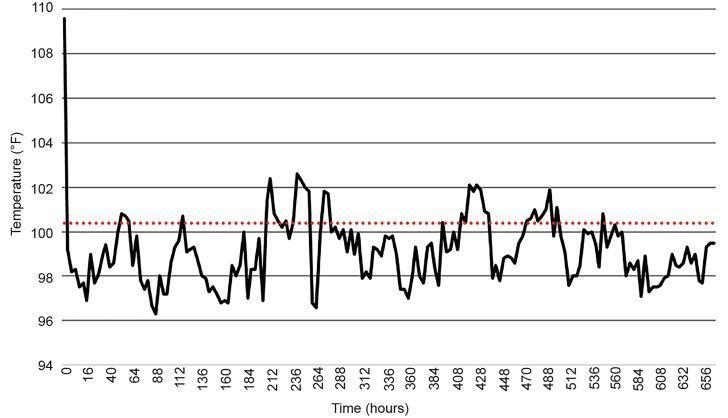
A line graph representing a patient's body temperature over a prolonged clinical course, specifically categorized under clinical data visualization. The y-axis displays temperature in degrees Fahrenheit (°F), ranging from 94 to 110, while the x-axis represents time in hours, spanning from 0 to 656 hours (approximately 27 days). A red dotted horizontal line is positioned at approximately 100.4°F, serving as a clinical threshold for fever. The data curve shows an initial extreme hyperpyrexic spike reaching approximately 109.5°F at time zero, followed by a rapid decline. The subsequent course is characterized by 'labile temperatures,' showing persistent fluctuations between 96.5°F and 102.5°F. Multiple episodic fever spikes above the 100.4°F threshold are visible throughout the tracking period. This chart illustrates the thermoregulatory instability often seen in severe clinical conditions such as Neuroleptic Malignant Syndrome (NMS) or toxic metabolic encephalopathy, where patients may require long-term monitoring and pharmacological intervention with agents like dantrolene or bromocriptine.
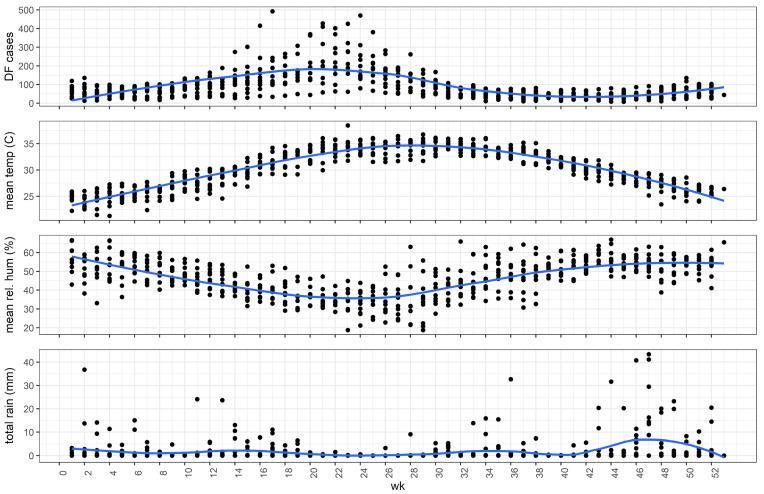
This Comparison Chart illustrates the seasonal relationship between Dengue Fever (DF) cases and meteorological factors in Jeddah, Saudi Arabia, over a multi-year period (2009-2018). The visualization consists of four vertically stacked scatter plots with time represented on the x-axis by epidemiological weeks (0-52). Each plot features individual data points and a blue Locally Weighted Scatterplot Smoothing (LOWESS) line to indicate general trends. The top panel shows DF cases, peaking significantly between weeks 22 and 30, with a secondary minor peak near week 50. The second panel displays Mean Temperature (°C), exhibiting a sinusoidal curve that peaks at approximately 35°C around week 30. The third panel shows Mean Relative Humidity (%), which demonstrates an inverse relationship with temperature, reaching its lowest point during the peak summer weeks. The bottom panel displays Total Rainfall (mm), characterized by low baseline precipitation with sporadic spikes in the early and late weeks of the year. This infographic is designed for public health surveillance and infectious disease epidemiology, highlighting how climate variables influence vector-borne disease transmission cycles.
cd /tmp/workspace/fever-ppt/assets && python /tmp/skills/shared/scripts/fetch_images.py \ "https://cdn.orris.care/cdss_images/HARRISON_1763030978379_258f26fa-56da-4dfb-a358-ad5566dd34a4.png" \ "https://cdn.orris.care/cdss_images/pmc_clinical_VQA_18fce41ffbc5174de76d09c67ab11efd5caf5f90baebb3f27dbaeb01c12db50f.jpg" \ "https://cdn.orris.care/cdss_images/HARRISON_1763035623169_1376bfa8-6600-4e6e-aa2f-aa2905b14e0d.png" \ "https://cdn.orris.care/cdss_images/pmc_clinical_VQA_4d9b28aec330f7a5b4622a46a73e4c3b9d43a1a0834b2007c9d52f919e8617ff.jpg" \ "https://cdn.orris.care/cdss_images/a0c8984b2639e74aa12ff34020b854330a0790c02baf3b548bbf2d830daa6300.png" \ "https://cdn.orris.care/cdss_images/e5db21090847c369937d7cd0a1aa36ee3d83a28a3336e45d5bbd41b553067703.png" \ "https://cdn.orris.care/cdss_images/pmc_clinical_VQA_0b9f522c3427f74630178c7d3cd2ede22820eb3e50bbf967b93818e96701397f.jpg" \ "https://cdn.orris.care/cdss_images/pmc_clinical_VQA_43ac6c06b983e0ae868790c02c9615ea8726bb8cf49393120c52ef33078a1e98.jpg" > all.json python - <<'E' import json,base64 from PIL import Image names=['fever_flow','preoptic_ep3','pge2_synth','thermo_paths','setpoint_graph','body_temps','tlr4','cvo'] d=json.load(open('all.json')) for n,x in zip(names,d): if x['error'] or not x['base64']: print(n,'ERR',x['error']); continue hdr,b=x['base64'].split('base64,') ext='png' if 'png' in hdr else 'jpg' f=f'{n}.{ext}' open(f,'wb').write(base64.b64decode(b)) print(n,f,Image.open(f).size) E
cd /tmp/workspace/fever-ppt && python - <<'E' src=open('build.py').read() # keep helpers (everything before slide 1) and rewrite slides head=src[:src.index("# ---------------- 1. Title")] head=head.replace("from pptx.enum.shapes import MSO_SHAPE","from pptx.enum.shapes import MSO_SHAPE\nfrom PIL import Image") helpers=''' A = "/tmp/workspace/fever-ppt/assets/" def figure(slide, path, x, y, w, h, caption): rect(slide, x, y, w, h, WHITE, line=RGBColor(0xC9, 0xD3, 0xDE)) aw, ah = w - 0.2, h - 0.75 iw, ih = Image.open(path).size sc = min(aw / iw, ah / ih) pw, ph = iw * sc, ih * sc slide.shapes.add_picture(path, Inches(x + 0.1 + (aw - pw) / 2), Inches(y + 0.1 + (ah - ph) / 2), Inches(pw), Inches(ph)) text(slide, x + 0.05, y + h - 0.62, w - 0.1, 0.58, caption, size=10.5, color=GREY, align=PP_ALIGN.CENTER, anchor=MSO_ANCHOR.MIDDLE) def card(slide, x, y, w, h, title, color, items, size=14): rect(slide, x, y, w, h, WHITE, line=color) rect(slide, x, y, 0.12, h, color) text(slide, x + 0.2, y + 0.05, w - 0.3, 0.5, title, size=18, bold=True, color=color) bullets(slide, x + 0.2, y + 0.55, w - 0.35, h - 0.6, items, size=size, gap=3) ''' body=''' # ---------------- 1. Title ---------------- s = prs.slides.add_slide(BLANK) s.background.fill.solid() s.background.fill.fore_color.rgb = NAVY rect(s, 0, 5.2, 13.333, 0.08, ORANGE) rect(s, 0.8, 1.9, 0.12, 2.4, RED) text(s, 1.1, 1.8, 11, 1.5, "Pathogenesis of Fever", size=54, bold=True, color=WHITE, anchor=MSO_ANCHOR.MIDDLE) text(s, 1.1, 3.3, 11, 1.1, "From pyrogen to hypothalamic set point: cytokines, prostaglandin E2 and the thermoregulatory response", size=22, color=RGBColor(0xD6, 0xDF, 0xEA)) text(s, 1.1, 5.5, 11, 0.5, "Sources: Ganong's Review of Medical Physiology 26e; Harrison's Principles of Internal Medicine 21e and 22e; " "Robbins & Kumar Basic Pathology; Guyton and Hall Textbook of Medical Physiology", size=13, color=RGBColor(0xB5, 0xC3, 0xD3)) # ---------------- 2. Definition ---------------- s = base("What is fever?", 2) text(s, 0.6, 1.5, 12.1, 1.0, "Fever is an elevation of body temperature above normal daily variation that occurs together with " "an increase in the hypothalamic set point (for example 37\\u00B0C to 39\\u00B0C).", size=20) rows = [ ("", "Fever", "Hyperthermia"), ("Hypothalamic set point", "Raised", "Unchanged"), ("Pyrogens involved", "Yes (exogenous and endogenous)", "No"), ("Mechanism", "Regulated heat conservation and production", "Heat gain or production exceeds heat loss"), ("Examples", "Infection, inflammation, malignancy", "Heat stroke, malignant hyperthermia, anticholinergic drugs"), ("Response to antipyretics", "Yes", "No"), ] colw = [3.3, 4.2, 4.6] rowh = 0.58 for r, row in enumerate(rows): xx = 0.6 for c, val in enumerate(row): if r == 0: fill = NAVY if c == 0 else (RED if c == 1 else BLUE) col = WHITE else: fill = WHITE if r % 2 else LIGHT col = NAVY b = rect(s, xx, 2.75 + r * rowh, colw[c], rowh, fill, line=RGBColor(0xC9, 0xD3, 0xDE)) text(s, 0, 0, 0, 0, val, size=15, bold=(r == 0 or c == 0), color=col, shape=b, anchor=MSO_ANCHOR.MIDDLE) xx += colw[c] text(s, 0.6, 6.4, 12.1, 0.5, "Hyperpyrexia: temperature above 41.5\\u00B0C (106.7\\u00B0F); most often seen with CNS haemorrhage or severe infection.", size=15, color=GREY) # ---------------- 3. Thermoregulation ---------------- s = base("Normal thermoregulation: the thermostat", 3) card(s, 0.6, 1.5, 6.3, 1.45, "Inputs", BLUE, [ "Skin and core (visceral, spinal cord) thermoreceptors", "Temperature of blood bathing the hypothalamus"], size=15) card(s, 0.6, 3.05, 6.3, 1.45, "Integrator", NAVY, [ "Preoptic area of the anterior hypothalamus", "Compares body temperature with the set point"], size=15) card(s, 0.6, 4.6, 6.3, 1.75, "Effectors", RED, [ "Too cold: vasoconstriction, shivering, non-shivering thermogenesis, behaviour", "Too warm: vasodilation, sweating, behaviour"], size=15) text(s, 0.6, 6.45, 6.3, 0.5, "In fever, the thermostat works normally. Its set point changes.", size=16, bold=True, color=RED) figure(s, A + "thermo_paths.jpg", 7.2, 1.5, 5.55, 5.0, "Afferent and efferent pathways of thermoregulation centred on the preoptic area (POA). Open-access figure (PMC).") # ---------------- 4. Pyrogens ---------------- s = base("Step 1: Pyrogens", 4) card(s, 0.6, 1.5, 7.0, 2.45, "Exogenous pyrogens (from outside)", BLUE, [ ("Endotoxin (LPS)", "from gram-negative cell walls, the classic example"), ("Peptidoglycan", "and other microbial products"), ("Exotoxins, superantigens", "e.g. staphylococcal and streptococcal"), ("Viruses, immune complexes", "and other inflammatory stimuli"), ], size=15) card(s, 0.6, 4.05, 7.0, 2.75, "Endogenous pyrogens (host cytokines)", RED, [ ("Source:", "monocytes, macrophages, Kupffer cells"), ("Main cytokines:", "IL-1\\u03B2, IL-6, TNF-\\u03B1, IFN-\\u03B2, IFN-\\u03B3"), ("Each can cause fever", "independently"), ("Non-infectious triggers:", "tissue injury, inflammation, malignancy, antigen-antibody complexes"), ], size=15) figure(s, A + "tlr4.jpg", 7.9, 1.5, 4.85, 5.3, "LPS recognition by the TLR4/MD-2 complex leads to NF-\\u03BAB activation and cytokine production. Open-access figure (PMC).") # ---------------- 5. Flow (shapes) ---------------- s = base("Pathway from pyrogen to fever", 5) steps = [ ("1", "Pyrogenic stimulus", "Endotoxin, microbes, inflammation"), ("2", "Macrophages, monocytes, Kupffer cells", "Release IL-1\\u03B2, IL-6, TNF-\\u03B1, IFN"), ("3", "Cytokines reach the brain", "Act at the OVLT; also induce COX-2 in brain endothelium"), ("4", "PGE2 synthesis", "Arachidonic acid \\u2192 COX-2 \\u2192 PGE2"), ("5", "EP receptors (esp. EP3)", "PGE2 acts on neurons in the preoptic hypothalamus"), ("6", "Set point raised", "e.g. 37\\u00B0C to 39\\u00B0C"), ("7", "Heat conservation and production", "Vasoconstriction, shivering, thermogenesis"), ("8", "FEVER", "Body temperature rises to the new set point"), ] bw, bh = 2.65, 1.75 xs = [0.6, 3.75, 6.9, 10.05] y1, y2 = 1.65, 4.3 for i, (n, head, sub) in enumerate(steps): if i < 4: x, y = xs[i], y1 else: x, y = xs[7 - i], y2 last = i == 7 box = rect(s, x, y, bw, bh, RED if last else (NAVY if i in (4, 5, 6) else BLUE), shape=MSO_SHAPE.ROUNDED_RECTANGLE) box.adjustments[0] = 0.08 text(s, x, y, bw, bh, [ (n + ". " + head, {"bold": True, "size": 16, "color": WHITE, "after": 4}), (sub, {"size": 13, "color": RGBColor(0xE8, 0xEE, 0xF5)}), ], shape=box, anchor=MSO_ANCHOR.MIDDLE, align=PP_ALIGN.CENTER) if i < 3: arrow(s, x + bw + 0.02, y + bh / 2 - 0.2, 0.46, 0.4) elif i == 3: arrow(s, x + bw / 2 - 0.2, y + bh + 0.05, 0.4, 0.45, shape=MSO_SHAPE.DOWN_ARROW) elif 3 < i < 7: arrow(s, x - 0.48, y + bh / 2 - 0.2, 0.46, 0.4, shape=MSO_SHAPE.LEFT_ARROW) text(s, 0.6, 6.25, 12.1, 0.6, "OVLT = organum vasculosum of the lamina terminalis, a circumventricular organ without a tight blood-brain barrier.", size=14, color=GREY) # ---------------- 6. Textbook flowchart ---------------- s = base("Chronology of events in the induction of fever", 6) figure(s, A + "fever_flow.jpg", 0.6, 1.5, 6.6, 5.3, "Chronology of events required for the induction of fever. Harrison's Principles of Internal Medicine, 21st ed., Fig. 18-1.") bullets(s, 7.5, 1.6, 5.25, 5.2, [ ("Trigger:", "infection, microbial toxins, inflammatory mediators, immune reactions."), ("Cytokine release:", "monocytes, macrophages, and endothelial cells release IL-1, IL-6, TNF, and IFN into the circulation."), ("Hypothalamic endothelium:", "cytokines act here to make PGE2."), ("Direct route:", "microbial toxins can act on the same endothelium through Toll-like receptors, which share signalling with the IL-1 receptor."), ("cAMP:", "PGE2 acts on glial cells, which release cAMP. This raises the set point."), ("EP3:", "the one PGE2 receptor essential for fever."), ], size=16, gap=9) # ---------------- 7. Cytokines to brain ---------------- s = base("Step 2: How circulating cytokines signal the brain", 7) card(s, 0.6, 1.5, 7.1, 1.55, "OVLT pathway", BLUE, [ "Cytokines act at the OVLT, a circumventricular organ lacking a tight barrier", "This activates the preoptic area of the hypothalamus"], size=15) card(s, 0.6, 3.15, 7.1, 1.55, "Endothelial COX-2", RED, [ "Cytokines induce COX-2 in brain vascular endothelium", "PGE2 is released from the brain side of the endothelium"], size=15) card(s, 0.6, 4.8, 7.1, 1.55, "Local CNS cytokines", NAVY, [ "CNS cells stimulated by infection also make cytokines", "These may act directly on thermoregulatory centres"], size=15) text(s, 0.6, 6.45, 7.1, 0.5, "IL-1\\u03B2, IL-6 and TNF-\\u03B1 are polypeptides and unlikely to cross the blood-brain barrier.", size=14, color=GREY) figure(s, A + "cvo.jpg", 8.0, 1.5, 4.75, 5.3, "Circumventricular organs, including the OVLT, lack a tight blood-brain barrier. Open-access figure (PMC).") # ---------------- 8. PGE2 ---------------- s = base("Step 3: Prostaglandin E2 is the final mediator", 8) figure(s, A + "pge2_synth.jpg", 0.6, 1.5, 4.6, 3.45, "Synthesis of PGE2: phospholipase A2, then COX-1 or COX-2. Harrison's 21st ed., Fig. 324-4.") figure(s, A + "preoptic_ep3.jpg", 5.4, 1.5, 7.35, 3.45, "Pathogen-associated molecular patterns lead to IL-1\\u03B2 and PGE2, which bind EP3 receptors in the preoptic area. Open-access figure (PMC).") bullets(s, 0.6, 5.1, 7.6, 1.9, [ ("Receptors:", "PGE2 acts on EP1 to EP4. EP3 is essential: knockout abolishes fever to IL-1 and endotoxin."), ("Action:", "PGE2 from the hypothalamic endothelium stimulates glial cells to release cAMP, which resets the set point."), ], size=15, gap=6) rect(s, 8.5, 5.1, 4.25, 1.8, NAVY) text(s, 8.6, 5.15, 4.05, 1.7, [ ("Clinical link", {"bold": True, "size": 17, "color": ORANGE, "after": 4}), ("NSAIDs and paracetamol block COX and lower PGE2. Glucocorticoids suppress cytokine and COX-2 expression.", {"size": 14, "color": WHITE}), ]) # ---------------- 9. Phases ---------------- s = base("Step 4: The febrile response in three phases", 9) figure(s, A + "setpoint_graph.jpg", 0.6, 1.5, 6.0, 5.3, "Effect of changing the hypothalamic set point on body temperature. Guyton and Hall, Fig. 74.11.") card(s, 6.9, 1.5, 5.85, 1.75, "Rise (chill)", RED, [ "Vasoconstriction, piloerection, shivering, thermogenesis", "Behaviour: extra clothing. Typical rise 1 to 2\\u00B0C"], size=14) card(s, 6.9, 3.35, 5.85, 1.55, "Plateau", NAVY, [ "Blood temperature matches the new set point", "Normal heat balance holds it at the febrile level"], size=14) card(s, 6.9, 5.0, 5.85, 1.8, "Defervescence (flush)", BLUE, [ "Set point falls as pyrogens decline or antipyretics act", "Vasodilation and sweating lose heat until the lower set point is reached"], size=14) # ---------------- 10. Benefits and harms ---------------- s = base("Does fever help? Benefits and harms", 10) figure(s, A + "body_temps.jpg", 0.6, 1.5, 4.9, 5.3, "Body temperatures under different conditions. Guyton and Hall, Fig. 74.10.") card(s, 5.8, 1.5, 6.95, 2.55, "Possible benefits", BLUE, [ "Microbial growth is inhibited at higher temperature", "Antibody production increases", "Fever has persisted through evolution as a response to infection", "Artificial fever treated neurosyphilis before antibiotics", ], size=14) card(s, 5.8, 4.15, 6.95, 2.65, "Harms at extremes", RED, [ "Above 41\\u00B0C for long periods: permanent brain damage", "Above 43\\u00B0C: heat stroke, and death is common", "General knowledge: tachycardia, fluid loss, febrile seizures in children, delirium in the elderly", ], size=14) # ---------------- 11. Summary ---------------- s = base("Key points", 11) pts = [ ("1", "Fever is a regulated rise in the hypothalamic set point, not a failure of heat control."), ("2", "Exogenous pyrogens (e.g. LPS) stimulate monocytes, macrophages and Kupffer cells to release IL-1\\u03B2, IL-6, TNF-\\u03B1 and IFN."), ("3", "Cytokines signal the brain via the OVLT and by inducing COX-2 in brain endothelium."), ("4", "PGE2, acting mainly on EP3 receptors in the preoptic area, raises the set point."), ("5", "The body conserves and generates heat until blood temperature reaches the new set point."), ("6", "Antipyretics (NSAIDs, paracetamol) block COX and PGE2; hyperthermia does not respond to them."), ] for i, (n, t) in enumerate(pts): y = 1.55 + i * 0.9 c = rect(s, 0.7, y + 0.05, 0.65, 0.65, RED, shape=MSO_SHAPE.OVAL) text(s, 0, 0, 0, 0, n, size=20, bold=True, color=WHITE, shape=c, align=PP_ALIGN.CENTER, anchor=MSO_ANCHOR.MIDDLE) text(s, 1.6, y, 11.1, 0.8, t, size=19, anchor=MSO_ANCHOR.MIDDLE) # ---------------- 12. References ---------------- s = base("References", 12) bullets(s, 0.6, 1.6, 12.1, 5.0, [ "Ganong's Review of Medical Physiology, 26th ed. Fever, and Figure 17-13, Pathogenesis of fever.", "Harrison's Principles of Internal Medicine, 22nd ed. Fever versus hyperthermia; pyrogens; elevation of the hypothalamic set point by cytokines.", "Harrison's Principles of Internal Medicine, 21st ed. Fig. 18-1 (chronology of events in fever) and Fig. 324-4 (PGE2 synthesis).", "Guyton and Hall Textbook of Medical Physiology. Figures 74.10 and 74.11.", "Robbins & Kumar Basic Pathology. Systemic effects of inflammation.", "Open-access figures (PMC) on thermoregulatory pathways, TLR4 signalling, circumventricular organs, and EP3 signalling in the preoptic area.", ], size=17, gap=12) out = "/tmp/workspace/fever-ppt/output/Pathogenesis_of_Fever_with_images.pptx" prs.save(out) print("saved", out) ''' open('build2.py','w').write(head+helpers+body) E python build2.py && python /tmp/skills/pptx/scripts/office/validate.py output/Pathogenesis_of_Fever_with_images.pptx && ls -la output
cd /tmp/workspace/fever-ppt/output && python - <<'E' from pptx import Presentation p=Presentation('Pathogenesis_of_Fever_with_images.pptx') W,H=p.slide_width,p.slide_height for i,s in enumerate(p.slides,1): pics=0 for sh in s.shapes: if sh.shape_type==13: pics+=1 if sh.left+sh.width>W+10 or sh.top+sh.height>H+10: print('OUT',i,sh.name) print(i,'pictures:',pics) E
Pathogenesis of Fever with images
Presentation · PPTX
| Slide | Topic | Image |
|---|---|---|
| 3 | Thermoregulation | Afferent and efferent pathways centred on the preoptic area (PMC open-access figure) |
| 4 | Pyrogens | TLR4/MD-2 recognition of LPS, leading to NF-κB activation (PMC open-access figure) |
| 6 | Pathway of fever induction | Harrison's 21e, Fig. 18-1, chronology of events in fever |
| 7 | Cytokines signalling the brain | Circumventricular organs, including the OVLT (PMC open-access figure) |
| 8 | PGE2 | Harrison's 21e, Fig. 324-4, PGE2 synthesis, plus a preoptic-area EP3 signalling diagram (PMC) |
| 9 | Phases of fever | Guyton and Hall, Fig. 74.11, set point vs actual temperature |
| 10 | Benefits and harms | Guyton and Hall, Fig. 74.10, body temperatures under different conditions |
Give the download option for the file you have provided
mkdir -p /tmp/workspace/downloads && cp /tmp/workspace/fever-ppt/output/Pathogenesis_of_Fever_with_images.pptx /tmp/workspace/downloads/Pathogenesis_of_Fever_with_images.pptx && ls -la /tmp/workspace/downloads/
Pathogenesis of Fever with images
Presentation · PPTX
If the link doesn't work
- Try the other version of the app. Use the web version if you're on mobile, or the mobile app if you're on the web. Download buttons often show in one and not the other.
- Try another browser and turn off extensions, since ad blockers can hide download options.
- Report it to the app's support. Tell them that file links in chat show no download option.
- Use the images and text in the chat instead. The figures from my last message display inline, and the full text of the content is in my earlier message. You can paste that into PowerPoint or Google Slides, and you can right-click or long-press the images to save them.