
Management of acute ge
"acute gastroenteritis" AND management
acute gastroenteritis management algorithm oral rehydration dehydration
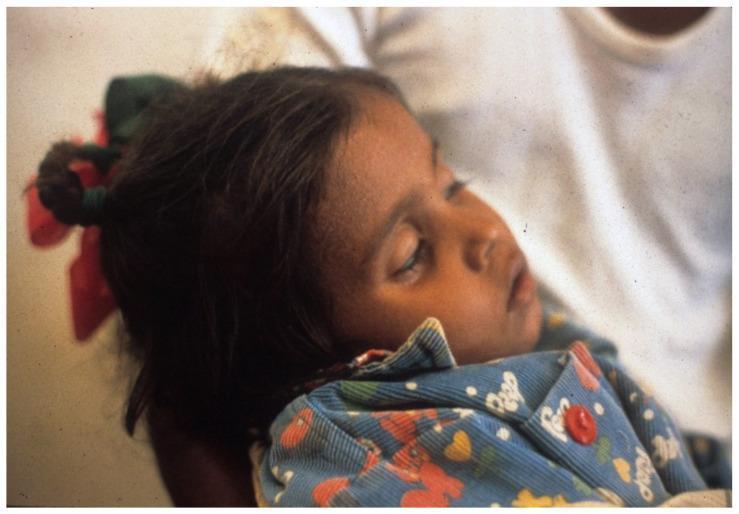
This clinical photograph displays a young child exhibiting classic signs of severe dehydration, likely secondary to acute watery diarrhea. The primary visual finding is the presence of deeply sunken eyes (enophthalmos), a critical physical marker of significant fluid volume deficit. The child demonstrates a depressed level of consciousness, appearing obtunded or lethargic with eyes closed and a lack of responsiveness to the surrounding environment. The facial features appear pinched, and there is a suggestion of reduced tissue turgor. This image serves as an educational tool for identifying the clinical 'danger signs' of dehydration in pediatric patients, emphasizing the need for urgent fluid resuscitation, such as intravenous therapy or intensive oral rehydration salts (ORS) protocols. The context suggests a global health setting where monitoring and managing electrolyte balance is vital for survival in cases of severe diarrheal illness.
This medical infographic presents three clinical algorithms (A, B, and C) for managing massive bleeding in acute settings. Algorithm A details a ROTEM-guided approach for uncoagulated patients, using viscoelastic parameters (EXTEM, FIBTEM, APTEM) to differentiate and treat hyperfibrinolysis (tranexamic acid), hypofibrinogenemia (fibrinogen concentrate), thrombin deficiency (prothrombin complex), and thrombocytopenia. Algorithm B outlines management for uncoagulated patients when ROTEM is unavailable, focusing on monitoring for the 'lethal triad' (acidosis, hypothermia, coagulopathy), lab values like hemoglobin and base excess, and the administration of blood products or PCC. Algorithm C addresses oral anticoagulant overdose, branching by agent type: Vitamin K Antagonists (VKA) or Direct Oral Anticoagulants (DOACs). It provides decision nodes based on INR levels and hemorrhage severity, recommending reversal agents such as Vitamin K, prothrombin complex (PCC), or Idarucizumab for dabigatran. The diagrams use standardized medical terminology and dosage guidelines suitable for emergency medicine, hematology, and trauma surgery education.
This medical illustration depicts the effects of acute plasma osmolality shifts on the brain in a coronal cross-section. The diagram is divided into three panels: a central 'Normal Brain' (normal osmolarity), a 'Hypo-osmotic State' (left), and a 'Hyper-osmotic State' (right). The hypo-osmotic panel illustrates cerebral swelling typically caused by SIADH, rapid rehydration, or dialysis disequilibrium. Key findings include brainstem downward displacement (indicated by blue arrows) and contusions (red X/XX) from contact with the meninges and foramen magnum. The hyper-osmotic panel illustrates water loss and brain shrinkage due to dehydration, renal insufficiency, or rapid mannitol therapy. Significant markers include the brain 'sinking' (magenta arrows), stretching of cortical vessels (indicated by 'O'), and pontine white matter demyelination ('XXX'). A horizontal axis at the bottom highlights the risks of 'Too rapid dehydration' and 'Too rapid rehydration' as iatrogenic drivers of these transitions. The illustration serves as a clinical guide for understanding the Monro-Kellie doctrine and the mechanical consequences of osmotic brain injury, specifically focusing on herniation and vascular damage.
Management of Acute Gastroenteritis (AGE)
Overview
Step 1 - Assess Dehydration Severity
| Score | Appearance | Eyes | Oral Mucosa | Tears | Interpretation |
|---|---|---|---|---|---|
| 0 | Normal | Normal | Moist | Normal | No dehydration |
| 1 | Thirsty/restless | Mildly sunken | Sticky | Decreased | Some dehydration |
| 2 | Drowsy/limp/cold/diaphoretic | Very sunken | Dry | None | Severe dehydration |
Step 2 - Oral Rehydration Therapy (ORT) - First-Line
ORS Formulations
| Solution | Na⁺ (mmol/L) | Glucose (mmol/L) | Osmolarity |
|---|---|---|---|
| WHO reduced-osmolarity (2002) | 75 | 75 | 245 mOsm/L |
| Pedialyte | 45 | 139 | ~250 mOsm/L |
| Sports drinks / juices | Very low | Very high | NOT suitable |
- The WHO reduced-osmolarity ORS reduces stool output, vomiting, and need for IV therapy compared to the older high-osmolarity formula.
- Sports drinks, juice, and tea are not appropriate rehydration fluids - they are low in sodium and may worsen osmotic losses.
- In mild dehydration in high-income settings, dilute apple juice followed by preferred fluids is an acceptable, evidence-supported alternative.
ORT Technique
- Give small, frequent volumes (5 mL every 1-2 minutes via syringe or spoon).
- Replace ongoing losses: approximately 10 mL/kg for each loose stool, 2 mL/kg for each episode of vomiting.
- Educate caregivers before discharge and provide written instructions. - Tintinalli's Emergency Medicine, p. 887-888
Step 3 - IV Rehydration (Reserved Cases)
- Severe dehydration or hemodynamic instability
- Inability to tolerate oral fluids (persistent vomiting, altered consciousness)
- Failed ORT (approximately 1 in 25 children on ORT will require IV escalation)
Step 4 - Antiemetics
- Ondansetron (5-HT3 antagonist): First-line antiemetic, 0.15 mg/kg PO (single dose). A 2016 meta-analysis confirmed robust evidence for use in children. A single oral dose is sufficient - IV and multiple doses add side effects without additional benefit.
- Avoid dopamine receptor antagonists (promethazine, prochlorperazine, metoclopramide, droperidol) in children - risk of extrapyramidal reactions and respiratory depression. Promethazine is contraindicated in children <2 years (FDA black-box warning for fatal respiratory depression).
- In adults, antiemetics (ondansetron, metoclopramide) are used freely to facilitate oral intake and comfort.
Step 5 - Diet and Feeding
- Resume an age-appropriate, nutritionally complete diet as soon as the initial fluid deficit is replaced - do not withhold feeds for >4 hours in a dehydrated child, or at all in a non-dehydrated child.
- Early refeeding is supported by all major guidelines and is associated with increased weight gain and faster mucosal recovery.
- Full-strength formula or regular diet can be restarted immediately after rehydration - dilution is not necessary.
- Most children tolerate lactose-containing milk/formula; lactose-free products may slightly reduce diarrhea duration in hospitalized patients.
- The BRAT diet (banana, rice, applesauce, toast) is no longer recommended - it is unnecessarily restrictive and calorically insufficient.
- Low-fat diets are discouraged (fats are important caloric sources during recovery). - Tintinalli's Emergency Medicine, p. 889
Step 6 - Adjunct Agents
Antidiarrheal Medications
- Loperamide: Absolutely contraindicated in children <2 years old and with bloody stools, suspected bacterial gastroenteritis (Salmonella, Shigella, Campylobacter) - risk of lethargy, paralytic ileus, and potentially HUS in E. coli O157:H7. May be used cautiously in adults with mild-moderate watery diarrhea.
- Bismuth subsalicylate: Modest antisecretory effect; avoid exceeding recommended doses in children <12 years (salicylate toxicity risk).
- Racecadotril (enkephalinase inhibitor): Available in Europe/SE Asia; reduces stool frequency but does not reduce hospitalization rates.
- Smectite: Used in some European countries; limited evidence.
Probiotics
- Not recommended in current guidelines for acute pediatric gastroenteritis in ED settings. Two large multicenter RCTs (>1500 combined participants) showed no benefit for Lactobacillus rhamnosus GG. Product labeling is also often inaccurate. Only a minority of published AGE management guidelines endorse probiotics.
- However, a 2025 meta-analysis (PMID: 40739406) suggests some benefit in reducing duration and severity in children - this may prompt future guideline updates.
Zinc
- Beneficial primarily in malnourished children >6 months in low-income settings (reduces diarrhea duration by ~27 hours). Not routinely recommended in well-nourished children in high-income countries. Reduces morbidity and mortality in resource-poor settings. - Tintinalli's Emergency Medicine, p. 890
Step 7 - Antibiotics
| Pathogen | Recommendation |
|---|---|
| Shigella | Treat all cases - azithromycin (first-line); ceftriaxone for parenteral therapy. Ampicillin/TMP-SMX only if susceptible. |
| Salmonella (non-typhoidal) | Do NOT treat routine cases - a Cochrane review (12 trials, 767 patients) showed no benefit and more adverse events with antibiotics. Treat only high-risk patients: <3 months, immunocompromised, sickle cell disease, IBD. |
| Campylobacter | Treat if started within 3 days of onset; azithromycin preferred (high fluoroquinolone resistance). |
| E. coli O157:H7 / STEC | Contraindicated - antibiotics significantly increase the risk of hemolytic-uremic syndrome (HUS). |
| Cholera (V. cholerae) | Doxycycline, azithromycin, or TMP-SMX. |
| Yersinia | Treat only if severe disease, bacteremia, or extraintestinal infection - TMP-SMX, aminoglycosides, fluoroquinolones, doxycycline. |
| C. difficile | Stop offending antibiotic if possible; treat with oral vancomycin or fidaxomicin. |
Step 8 - Disposition
- Minimal or no dehydration
- Ability to tolerate ORT at home
- Caregiver able to administer ORT and recognize signs of deterioration
- Moderate-severe dehydration
- Intractable or bilious vomiting
- Suspected surgical condition (peritoneal signs, bilious emesis)
- Significant lab or neurologic abnormalities (lethargy, seizures)
- Young infants (low threshold for admission)
- Inadequate social support for home ORT
Summary Table: Treatment by Dehydration Status
| Severity | Management |
|---|---|
| None / Minimal | Early refeeding, replace ongoing losses with ORS, discharge with education |
| Mild-Moderate | ORT (50-100 mL/kg over 2-4 hours), reassess, resume diet after rehydration |
| Severe | IV rehydration (20 mL/kg boluses), correct electrolyte abnormalities, admit |