
Hernia. Direct inguinal ,indirect inguinal hernia & femoral hernia. Detail everything
Reading File
Now I'll search the medical library in parallel for all three hernia types plus anatomy and images.
Finding Sources
Finding Sources
Finding Sources
Searching Images
inguinal hernia anatomy direct indirect femoral diagram
Excellent results. Now let me read the most comprehensive sources in parallel — Schwartz's Surgery, Bailey & Love, S Das, and Gray's Anatomy.
Reading File
Reading File
Reading File
Reading File
Good data so far. Now let me read more of Bailey & Love's comprehensive hernia section, and S Das for femoral hernia, plus the Mulholland groin hernias section.
Reading File
Reading File
Reading File
Excellent content. Let me now read the Bailey & Love direct hernia section, the femoral hernia section, and more of S Das's femoral hernia content, plus the Mulholland surgery section on groin hernias.
Reading File
Reading File
Reading File
Excellent. Now let me read the surgery sections and the femoral hernia surgery section from Bailey & Love, plus the Current Surgical Therapy content:
Reading File
Reading File
Reading File
I now have comprehensive material. Let me fetch the key anatomical diagram images to include in the response:
Loading Image
Loading Image
I now have all the material needed. Let me compile a comprehensive, well-structured answer.
Groin Hernias: Direct Inguinal, Indirect Inguinal & Femoral
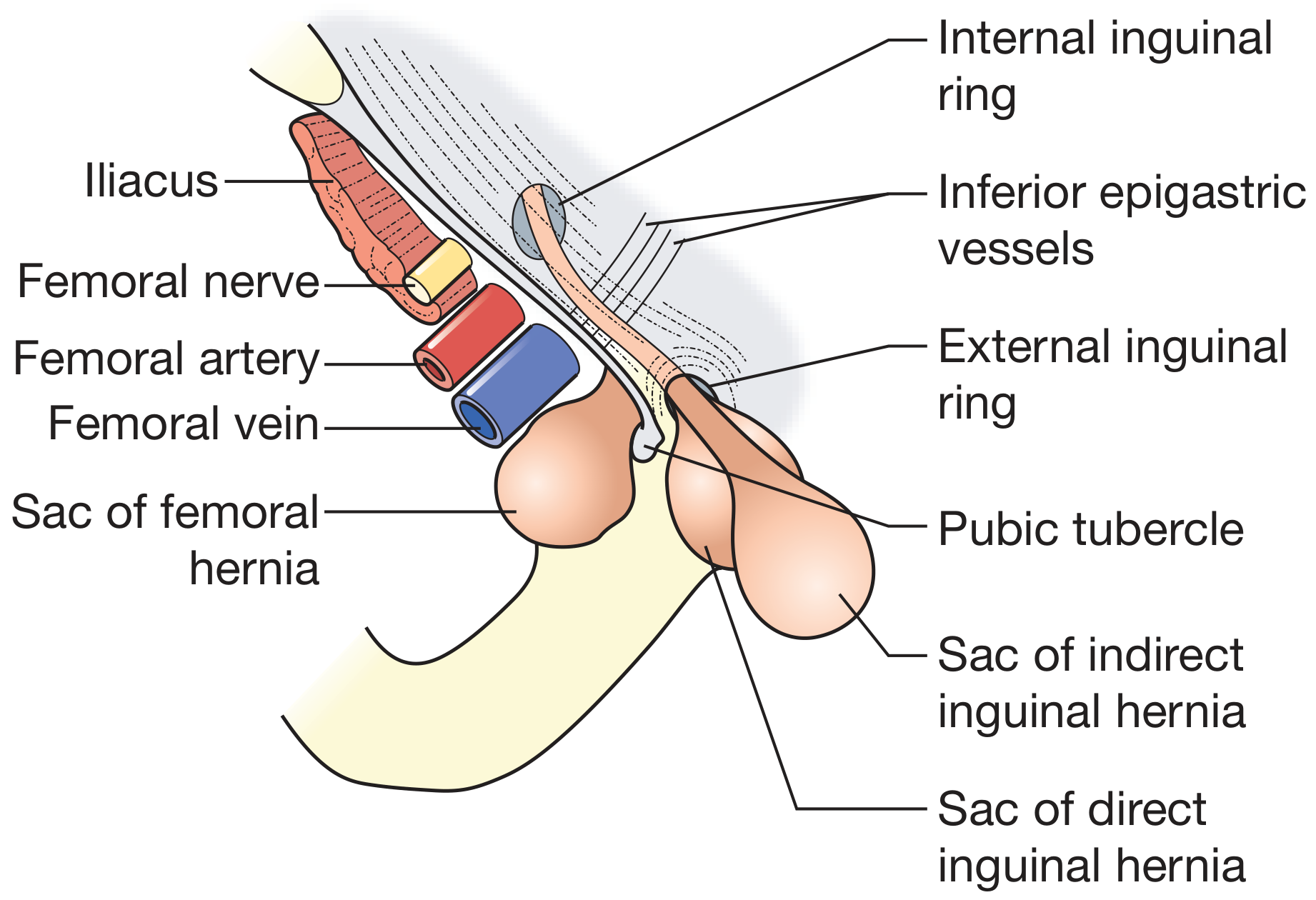
Figure: Close relationships of direct inguinal, indirect inguinal, and femoral hernias — Bailey & Love's Surgery, 28th Ed.
1. ANATOMY OF THE INGUINAL REGION (Foundation)
Inguinal Canal
The inguinal canal is an oblique passage (4 cm long) through the lower abdominal wall. Its four walls are:
| Wall | Structure |
|---|---|
| Anterior | External oblique aponeurosis |
| Posterior | Transversalis fascia |
| Roof | Arching fibres of internal oblique + transversus (forming conjoint tendon) |
| Floor | Inguinal (Poupart's) ligament |
- Deep (internal) inguinal ring: Defect in transversalis fascia, midway between ASIS and pubic tubercle, ~2–3 cm above and lateral to the femoral artery pulse. The inferior epigastric vessels run just medial to this ring — this is the single most important anatomical landmark for distinguishing hernia types.
- Superficial (external) inguinal ring: Inverted-V defect in the external oblique aponeurosis, just superolateral to the pubic tubercle.
Canal Contents
- Males: Spermatic cord (testicular artery, pampiniform plexus veins, vas deferens, lymphatics) + cremasteric muscle
- Females: Round ligament
- Both sexes: Ilioinguinal nerve, iliohypogastric nerve, genital branch of genitofemoral nerve
Hesselbach's Triangle (Direct Hernia Space)
| Border | Structure |
|---|---|
| Lateral | Inferior epigastric vessels |
| Medial | Lateral edge of rectus abdominis |
| Inferior | Inguinal ligament (iliopubic tract) |
This triangle is intrinsically weak — only transversalis fascia covered by external oblique aponeurosis (no muscle reinforcement here).
Femoral Canal
Located medial to the femoral vein, inferior to the inguinal ligament. Boundaries:
- Anterosuperior: Inguinal ligament
- Lateral: Femoral vein
- Medial: Lacunar (Gimbernat's) ligament — sharp, unyielding edge
- Posteroinferior: Pubic bone + pectineus covered by iliopectineal (Astley Cooper's) ligament
Contains: fat, lymphatics, and the node of Cloquet (Rosenmüller's node). Exits superficially through the saphenous opening (~1.5 inches below and lateral to the pubic tubercle).
2. INDIRECT INGUINAL HERNIA
Definition
A hernia that exits the abdominal cavity through the deep inguinal ring, passes obliquely through the inguinal canal, and emerges through the superficial inguinal ring — lateral to the inferior epigastric vessels. Also called lateral or oblique inguinal hernia.
Aetiology / Pathogenesis
- Congenital (most cases in children): Failure of the processus vaginalis to obliterate after testicular descent. The processus is a finger-like peritoneal projection that accompanies the testis into the scrotum. Normally obliterates before birth — explains high incidence in premature infants.
- Acquired (adults): Persistent patency or stretching of the deep inguinal ring under chronic positive intra-abdominal pressure; risk factors include heavy lifting, chronic cough, constipation, BPH, ascites.
- All congenital inguinal hernias are, by definition, indirect.
Epidemiology
- Most common hernia overall
- M:F ratio ~10:1
- More common on the right side (delayed obliteration of processus vaginalis on right due to later testicular descent)
- Highest incidence in infants and young men; can occur at any age
Anatomy of the Hernia Sac
- Sac passes within the spermatic cord through the entire inguinal canal
- Can enter the scrotum — forming a scrotal (complete) hernia or inguinoscrotal hernia
- Sac lies anteromedial to the spermatic cord
- Neck of sac is at the deep inguinal ring, lateral to the inferior epigastric vessels
Types by Contents
- Enterocele: Contains intestine (resonant on percussion)
- Epiplocele: Contains omentum (dull on percussion)
- Sliding hernia: Retroperitoneal structure (caecum on right, sigmoid on left) forms part of the sac wall itself — sac formed secondarily
Complications
- Irreducibility: Contents cannot be returned to abdominal cavity
- Obstruction: Intestinal obstruction without vascular compromise
- Strangulation: Vascular compromise → ischaemia/gangrene. More common in indirect (narrow neck) than direct hernia
- Inflammation / infection: Rare; hernia mimics acute abdomen
Clinical Features
- Symptoms: Groin swelling appearing on standing/straining; aching discomfort; reducible with lying down
- Swelling location: Above and medial to the pubic tubercle (inguinal hernias in general); passes into scrotum in complete hernia
- Cough impulse: Expansile impulse on coughing
- Reducibility: Reduces on lying + gentle pressure with thigh flexed/internally rotated
- Cannot get above it: In complete hernia, examiner cannot insinuate fingers above the swelling at the groin
Examination — Key Test: Deep Ring Occlusion Test
Occlude the deep inguinal ring with 2 fingers placed midway between ASIS and pubic symphysis (just above the midpoint of the inguinal ligament) and ask the patient to cough:
- Indirect hernia: Hernia does not appear (controlled by ring occlusion)
- Direct hernia: Hernia bulges medially (passes through Hesselbach's triangle, not the ring)
Invagination Test
Little finger invaginated from the bottom of the scrotum up through the superficial inguinal ring. Patient coughs:
- Impulse felt at the fingertip = indirect hernia (coming down the canal)
- Impulse against the side of the finger = direct hernia (pushing through posterior wall)
3. DIRECT INGUINAL HERNIA
Definition
A hernia that protrudes directly through the posterior wall of the inguinal canal within Hesselbach's triangle, medial to the inferior epigastric vessels. Also called medial inguinal hernia.
Aetiology / Pathogenesis
- Always acquired — never congenital
- Results from progressive weakening and stretching of the transversalis fascia in Hesselbach's triangle
- Risk factors: Elderly age (most characteristic), obesity, chronic straining (constipation, COPD, prostatic outflow obstruction), connective tissue disorders, previous surgery
- The area is inherently weak because there is no muscle reinforcement — only transversalis fascia + external oblique aponeurosis
Epidemiology
- Predominantly in elderly males
- Less common than indirect overall; in elderly men, may approach similar frequency to indirect
- Rarely seen in women or children
- Bilateral in up to 20% of cases
Anatomy of the Hernia Sac
- Does not pass through the deep inguinal ring
- Does not enter the scrotum (usually — may do so if very large)
- Broad-based neck → low risk of strangulation (most important distinguishing feature from indirect)
- Bladder may be dragged into a large direct hernia (medial portion of sac wall)
Clinical Features
- Usually a diffuse, broad-based bulge in the medial groin
- Reduces spontaneously on lying down; reappears on standing
- Less likely to be a complete scrotal hernia
- Lower complication risk than indirect hernia
Pantaloon Hernia
When both direct and indirect hernias coexist in the same patient (sac straddles the inferior epigastric vessels like a pair of trousers). Important to recognise intraoperatively.
4. COMPARISON: DIRECT vs. INDIRECT INGUINAL HERNIA
| Feature | Indirect (Lateral) | Direct (Medial) |
|---|---|---|
| Relation to epigastric vessels | Lateral | Medial |
| Aetiology | Congenital or acquired | Always acquired |
| Age | All ages; peak infants/young | Elderly |
| Sex | M >> F (10:1) | Predominantly male |
| Sac path | Through deep ring → along inguinal canal | Directly through Hesselbach's triangle |
| Scrotum | Can enter scrotum | Rarely enters scrotum |
| Neck | Narrow | Wide/broad |
| Strangulation risk | Higher | Lower |
| Deep ring occlusion | Controlled | Not controlled (bulges medially) |
| Impulse on invagination | Felt at fingertip | Felt against side of finger |
| Bassini's repair | Herniorrhaphy (sac ligation) | Posterior wall plication |
5. FEMORAL HERNIA
Definition
A protrusion of extraperitoneal fat, peritoneum, and sometimes abdominal contents through the femoral canal, emerging below and lateral to the pubic tubercle and below the inguinal ligament.
Epidemiology
- F:M ratio ~2:1 overall for femoral hernias — but even in women, inguinal hernia is still commoner than femoral in the groin
- Rare before age 20; incidence rises with age; peak over 50
- Right side twice as common as left; 20% bilateral
- Thin, elderly women are classically at highest risk (wider female pelvis enlarges femoral canal)
Pathogenesis
- The female pelvis is wider → femoral canal is larger → greater predisposition
- Weight loss or ageing further enlarges the femoral defect
- The neck is rigid and unyielding (lacunar ligament medially, femoral vein laterally) → extremely prone to strangulation
- ~50% of femoral hernias present as emergencies with strangulation
Shape — The "Retort" Sign
- While within the narrow femoral canal, the hernia is small
- Once through the saphenous opening into loose areolar tissue, it expands, then turns upward above the inguinal ligament → characteristic retort/flask shape
- This upward reflection can cause confusion with an inguinal hernia
Boundaries of the Femoral Canal
| Boundary | Structure |
|---|---|
| Anterosuperior | Inguinal ligament |
| Lateral | Femoral vein |
| Medial | Lacunar (Gimbernat's) ligament |
| Posteroinferior | Pubic bone / iliopectineal (Cooper's) ligament |
Clinical Features
- Swelling: Small, globular; below and lateral to the pubic tubercle; below the inguinal ligament
- Often only 1–2 cm and easily missed or mistaken for a lymph node
- Cough impulse may be absent due to tightness of the neck
- Rapidly becomes irreducible
- Symptoms less pronounced than inguinal hernia early on
Key Distinguishing Points from Inguinal Hernia
| Feature | Femoral | Inguinal |
|---|---|---|
| Relation to pubic tubercle | Below and lateral | Above and medial |
| Relation to inguinal ligament | Below | Above |
| Cough impulse location | Saphenous opening (~4 cm below and lateral to pubic tubercle) | Superficial inguinal ring |
| Invagination test | Inguinal canal empty | Impulse felt in canal |
| Ring occlusion test | Pressure over femoral canal prevents hernia | Does not respond |
| Strangulation risk | Very high | Moderate (indirect) / Low (direct) |
Differential Diagnosis of Femoral Hernia
- Enlarged inguinal lymph node (most common mimic — look for infection focus in drainage area: perineum, lower limb, anal canal)
- Saphena varix (disappears completely lying down; fluid thrill on coughing; positive Schwartz's test; associated varicose veins)
- Femoral artery aneurysm (pulsatile, expansile)
- Psoas abscess (cold abscess from Pott's disease; lateral to femoral vessels; fluctuant)
- Lipoma of cord
- Node of Cloquet enlargement within femoral canal
- Rupture/haematoma of adductor longus
Pre-vascular Femoral Hernia (Rare)
A special variant that descends posterior to the inguinal ligament and in front of femoral artery and vein (not through the femoral canal proper). Wide neck → rarely strangulates; difficult to repair.
6. SURGICAL MANAGEMENT
Inguinal Hernia
A. Open Suture Repairs (Tension)
- Bassini repair (1890): Opens external oblique aponeurosis; separates cord; reduces sac; sutures conjoint tendon to inguinal ligament from pubic tubercle to deep ring. Historical gold standard.
- Shouldice repair: Transversalis fascia opened and double-breasted (two-layer closure) + external oblique similarly. Lifetime recurrence <2% at expert centres. Technically demanding.
- Desarda repair: Strip of external oblique aponeurosis sutured to conjoint tendon and inguinal ligament as a dynamic reinforcement. Considered equivalent to Shouldice.
- Maloney darn: Continuous non-absorbable suture (nylon/polypropylene) between conjoint tendon and inguinal ligament. Most common where mesh is unavailable.
B. Open Flat Mesh Repair (Tension-free)
- Lichtenstein repair (1980s onwards): Prosthetic polypropylene mesh laid flat over the posterior wall and sutured to inguinal ligament + conjoint tendon. A slit in the mesh accommodates the cord. Recurrence <1%. Current standard for open repair in most settings.
- Mesh plug (Rutkow-Robbins): Cone-shaped mesh plug placed into the deep ring ± flat mesh overlay.
C. Laparoscopic / Minimally Invasive Repair
- TAPP (Trans-Abdominal Pre-Peritoneal): Laparoscopic access into peritoneum; mesh placed in preperitoneal space via intra-abdominal approach.
- TEP (Totally Extra-Peritoneal): Balloon dissection of preperitoneal space; peritoneum never entered. Preferred by many.
- Advantages: Bilateral hernia repair through same port sites; faster recovery; less chronic pain; excellent for recurrent hernia after open repair.
- Requires general anaesthesia; higher cost; longer learning curve.
Classification (European Hernia Society)
- P (primary) or R (recurrent)
- L (lateral/indirect), M (medial/direct), F (femoral)
- Defect size in fingerbreadths (1 = ≤1.5 cm, 2 = 1.5–4.5 cm, 3 = ≥4.5 cm)
- Example: Primary indirect inguinal hernia with 3-cm defect = PL2
Femoral Hernia — "No Alternative to Surgery; Treat Urgently"
There are three open approaches plus laparoscopic options:
1. Low Approach — Lockwood
- Simplest; suitable when bowel resection is NOT anticipated
- Can be done under local anaesthesia
- Transverse incision over the hernia below the inguinal ligament
- Sac opened and contents reduced; sac reduced; sutures placed between inguinal ligament above and pectineal (Cooper's) ligament below
- Medial lacunar ligament may be incised to aid reduction (caution: abnormal obturator artery branch may bleed)
- Femoral vein protected at all times
2. Inguinal Approach — Lotheissen
- Same incision as Lichtenstein; enters inguinal canal
- Transversalis fascia opened from deep ring to pubic tubercle → entry into extraperitoneal space
- Hernia lies immediately below; reduced by pulling from above + pushing from below
- Neck closed with sutures/mesh plug; flat mesh laid in extraperitoneal plane
- Allows simultaneous repair of coexisting inguinal hernia
3. High Approach — McEvedy
- Preferred when bowel resection may be necessary (strangulation)
- Vertical or oblique incision above inguinal ligament; enters extraperitoneal space from above
- Best access to the sac contents; allows opening of peritoneum if needed
- Obturator approach possible via same incision
4. Laparoscopic (TAPP/TEP)
- Appropriate for elective uncomplicated femoral hernias
- Mesh placed in preperitoneal space covering the myopectineal orifice (femoral, direct, and indirect spaces)
- Advantage: Simultaneous identification and repair of all three defect types
7. COMPLICATIONS OF HERNIA (All Types)
| Complication | Description |
|---|---|
| Irreducibility | Contents cannot be reduced — may become chronic |
| Obstruction | Intestinal lumen blocked at neck → intestinal obstruction; no vascular compromise yet |
| Strangulation | Vascular compromise at neck → ischaemia → gangrene; emergency — requires bowel resection; femoral and indirect inguinal most at risk |
| Inflammation | Sac contents become inflamed; mimics strangulation |
| Recurrence (post-repair) | <1% with mesh (Lichtenstein); higher with suture-only repairs |
Strangulation Risk by Type
Femoral > Indirect Inguinal >> Direct Inguinal
8. DIAGNOSTIC AIDS
| Modality | Indication |
|---|---|
| Clinical examination | Primary diagnosis in most cases |
| Ultrasound | Uncertain diagnosis; dynamic assessment with Valsalva |
| CT scan | Bowel obstruction workup; exclude malignancy; identify hernia type preoperatively |
| MRI | Athletes; occult hernia; athletic pubalgia differentiation |
| Herniography | Historical; contrast injection into peritoneal cavity; rarely used |
9. QUICK SUMMARY TABLE
| Feature | Indirect Inguinal | Direct Inguinal | Femoral |
|---|---|---|---|
| Exit point | Deep inguinal ring | Hesselbach's triangle | Femoral canal |
| Epigastric vessel relation | Lateral | Medial | Below inguinal ligament |
| Location of swelling | Above + medial to pubic tubercle | Above + medial to pubic tubercle | Below + lateral to pubic tubercle |
| Aetiology | Congenital/acquired | Acquired only | Acquired |
| Common in | Males, all ages | Elderly males | Thin, elderly females |
| Enters scrotum | Yes (complete) | Rarely | No |
| Neck | Narrow | Wide | Rigid, narrow |
| Strangulation | Moderate risk | Low risk | Very high risk (50% present as emergency) |
| Deep ring occlusion | Controlled | Not controlled | Not affected (different canal) |
Sources: Bailey & Love's Short Practice of Surgery, 28th Ed. | Schwartz's Principles of Surgery, 11th Ed. | S Das: A Manual on Clinical Surgery, 13th Ed. | Gray's Anatomy for Students | Mulholland & Greenfield's Surgery, 7th Ed.
This is a shared conversation. Sign in to Orris to start your own chat.