
Teriparatide INJECTION
Reading File
Teriparatide is a recombinant human PTH(1-34) fragment used as an anabolic agent in osteoporosis. Let me search the textbook library and recent literature simultaneously.
Searching sources...
Finding Sources
Searching PubMed
teriparatide osteoporosis
Good results. Now let me read the dedicated sections from Goodman & Gilman and Goldman-Cecil for detailed content.
Reading File
Reading File
Reading File
Reading File
Loading Image
I now have comprehensive information to provide a thorough answer on teriparatide injection.
Teriparatide Injection
What Is It?
Teriparatide [hPTH(1-34)] is a synthetic recombinant human parathyroid hormone analogue consisting of the biologically active N-terminal 34 amino acids of PTH. Unlike antiresorptive agents (bisphosphonates, denosumab, SERMs), teriparatide is an anabolic agent - it directly stimulates new bone formation.
Chemistry & Mechanism of Action
- PTH is a single polypeptide of 84 amino acids (~9500 Da). Residues 1-27 are required for optimal receptor binding and activity.
- Teriparatide acts on PTH-1 receptor (PTHR), a G protein-coupled receptor.
- Intermittent (once-daily) administration stimulates osteoblasts and promotes bone growth - in contrast to continuous PTH elevation (as in primary hyperparathyroidism) which causes bone demineralization.
- Both bone formation and resorption markers increase, but formation predominates with intermittent dosing, leading to net anabolic effect.
Goodman & Gilman's, Katzung's Basic and Clinical Pharmacology 16E
Pharmacokinetics (ADME)
| Parameter | Value |
|---|---|
| Route | Subcutaneous injection only (peptide - oral bioavailability nil) |
| Bioavailability (SC) | ~95% |
| Volume of distribution | ~0.1 L/kg |
| Peak serum PTH | 30 min post-injection |
| PTH undetectable by | ~3 hours |
| Serum Ca²⁺ peak | 4-6 hours post-injection |
| Elimination half-life (SC) | ~1 hour |
| Elimination half-life (IV) | ~5 minutes |
| Systemic clearance | 62 L/h (women); 94 L/h (men) |
| Elimination | Nonspecific enzymatic degradation in liver, then renal excretion |
Goodman & Gilman's
Dose & Administration
- Dose: 20 µg once daily by subcutaneous injection
- Injection site: Thigh or abdomen (rotate sites)
- Same time each day (giving at bedtime can help minimize side effects like dizziness)
- Supplied as a pre-filled pen device
- Maximum lifetime duration: 24 months (cumulative; not per course)
Approved Indications
- Postmenopausal osteoporosis at high risk for fracture
- Men with primary or hypogonadal osteoporosis
- Patients who failed or are intolerant to other osteoporosis therapy (glucocorticoid-induced osteoporosis)
- Severe osteoporosis with history of osteoporotic fracture or multiple risk factors
Goodman & Gilman's, Goldman-Cecil Medicine
Efficacy - Fracture Reduction
The landmark Neer et al. (2001) trial demonstrated:
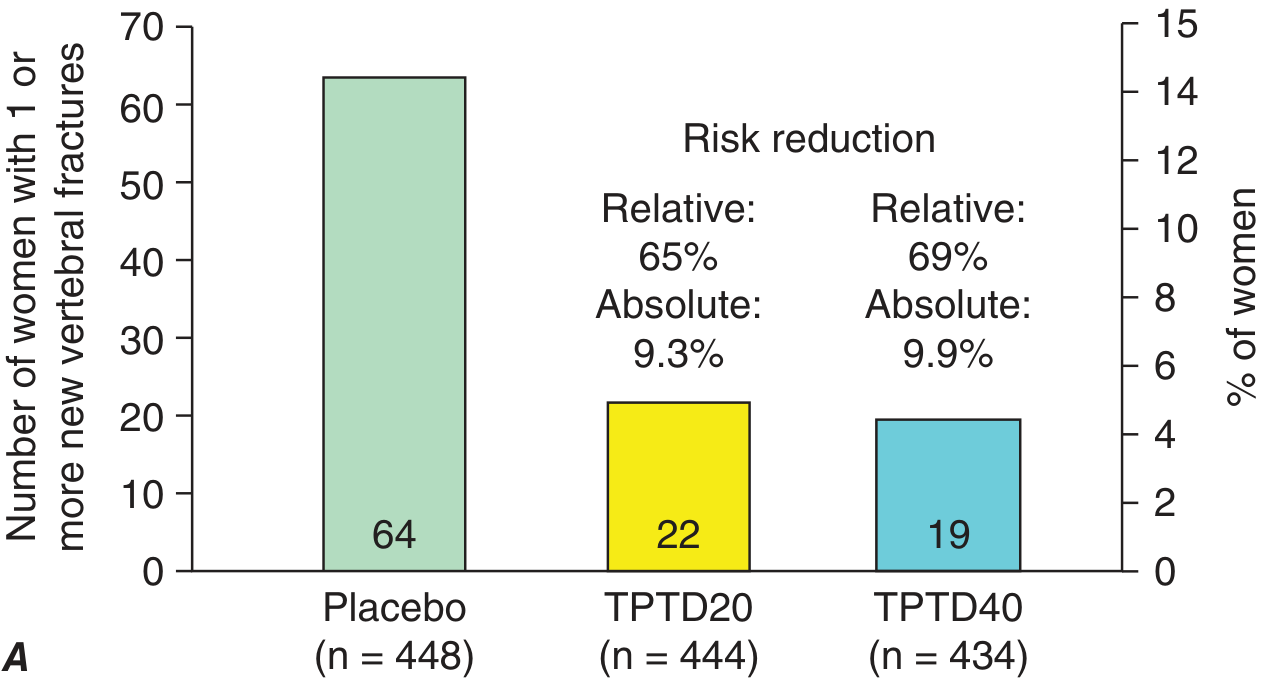
- Vertebral fractures: Reduced by ~65-69% (relative risk reduction)
- Nonvertebral fractures: Reduced by ~50%
- Lumbar spine BMD: Increases by ~10% over 2 years
- Vs risedronate: Teriparatide reduced subsequent vertebral fractures by ~50% in women with painful acute osteoporotic vertebral fractures
Harrison's Principles of Internal Medicine 22E (2025)
Sequencing & Combination Therapy
This is clinically important:
| Scenario | Recommendation |
|---|---|
| After teriparatide | Must follow with an anticatabolic agent (bisphosphonate or denosumab) to preserve BMD gains; bone loss occurs on cessation |
| Before teriparatide | Previously on bisphosphonate - acceptable; switch to teriparatide if needed |
| After denosumab | Teriparatide should NOT be used - proven decrease in BMD when denosumab is followed by teriparatide |
| Combination | Teriparatide + denosumab may have synergistic effect on BMD; combining with bisphosphonate - data inconclusive |
Goldman-Cecil Medicine, Harrison's 22E
Adverse Effects
| Effect | Details |
|---|---|
| Common | Dizziness, leg cramps, nausea, headache, muscle pain/weakness, injection-site pain |
| Hypercalcemia | Rare; may unmask undiagnosed primary hyperparathyroidism |
| Hyperuricemia | Elevation of serum uric acid |
| Nephrolithiasis | Exacerbation (use with caution in nephrolithiasis) |
| Osteosarcoma (black-box warning) | Rodent data showed osteosarcomas at 3-60x human doses; post-marketing surveillance has not confirmed causal association in humans; rare cases consistent with background incidence |
Contraindications (Osteosarcoma Risk Factors)
Teriparatide carries a black-box warning and is contraindicated in:
- Paget's disease of bone
- Unexplained elevation of alkaline phosphatase
- Open epiphyses (pediatric patients, young adults)
- Prior skeletal radiation therapy
- Bone metastases or skeletal malignancy
- Pre-existing hypercalcemia
Recent Evidence (2024-2026)
Recent meta-analyses confirm and update the evidence base:
- Li et al., 2024 - Arch Osteoporos (PMID 39312040): Systematic review/meta-analysis comparing teriparatide vs bisphosphonates in treatment-naive patients - confirmed teriparatide superiority for BMD and fracture outcomes.
- Beaudart et al., 2025 - Osteoporos Int (PMID 40047881): Network meta-analysis of PTH1 receptor agonists (teriparatide, abaloparatide) for fracture risk - supports use in high-risk patients.
- Nayak & Greenspan, 2026 - Osteoporos Int (PMID 41105226): Systematic review of sequential treatment strategies - confirms the importance of following teriparatide with an antiresorptive to maintain benefits.
Key Clinical Points (Summary)
- Only anabolic (bone-forming) agent in widespread use for osteoporosis
- 20 µg SC once daily, max 24 months lifetime use
- Must be followed by antiresorptive to preserve BMD gains
- Do not use after denosumab (BMD loss occurs)
- Black-box warning for osteosarcoma but no proven causal link in humans
- Side effects mild and usually remit; giving at bedtime reduces dizziness
- Generic/biosimilar versions (same dose) now available
Sources: Goodman & Gilman's Pharmacological Basis of Therapeutics, Goldman-Cecil Medicine, Harrison's Principles of Internal Medicine 22E (2025), Katzung's Basic and Clinical Pharmacology 16E
Search for recent 2024-2026 guidelines on teriparatide duration limits
Searching sources...
Searching PubMed
teriparatide duration treatment guidelines osteoporosis
Searching the Web
teriparatide duration limit 2 years guideline update 2024 2025 FDA osteosarcoma
Good initial hits. Now let me dig deeper into the FDA 2020/2022 label update, recent major society guidelines, and extract the full BC PAD August 2024 document.
Searching PubMed
teriparatide osteosarcoma boxed warning removed label update
Searching PubMed
osteoporosis anabolic therapy sequential treatment guideline 2024
Reading Web Page
https://www2.gov.bc.ca/assets/gov/health/practitioner-pro/pr…
Good. Now let me pull the key ECTS guideline on glucocorticoid-induced osteoporosis, get the European guideline comparison abstract, and search for the JBMR Plus paper on the osteosarcoma boxed warning removal.
Reading Article
PMID: 39556468
Reading Article
PMID: 39235671
Searching PubMed
teriparatide osteosarcoma postmarketing surveillance label warning
Searching the Web
teriparatide 2024 2025 guideline duration beyond 24 months high fracture risk endocrine society ACP
Excellent. I now have comprehensive, multi-source data. Let me also pull the abstract for the osteosarcoma label paper and the Singapore 2025 consensus.
Reading Article
PMID: 36111201
Reading Web Page
https://annals.edu.sg/2025-singapore-consensus-statements-ma…
I now have a complete, authoritative picture. Here is a comprehensive synthesis:
Teriparatide Duration Limits: What 2024-2026 Guidelines Say
The Core Story: A Major Regulatory Shift in 2020
The original FDA-mandated 2-year lifetime limit on teriparatide was based entirely on rat carcinogenicity data. That picture changed significantly:
- In 2020, the FDA updated the teriparatide label based on large real-world observational studies (using pharmacy claims linked to cancer registries), which showed no increase in osteosarcoma risk in teriparatide-treated patients compared to untreated populations or expected background incidence.
- The black-box warning was removed and the 2-year lifetime limitation was revised - it was no longer presented as an absolute hard cap tied to osteosarcoma fear.
- Only 3 cases of osteosarcoma were identified in over 1 million patients treated, consistent with the expected background incidence.
- Key data point: 2 years represents ~2-3% of a human lifespan, vs ~90% of a rat's lifespan - making rat data non-translatable.
Krege et al., JBMR Plus 2022 (PMID 36111201) - the definitive account of this label update process.
Current Regulatory Position (Post-2020, Confirmed Through 2024-2026)
| Regulator | Current Stance on Duration |
|---|---|
| US FDA | Boxed warning removed (2020). 24 months is the standard course; extension beyond 24 months is permitted for patients at continued high fracture risk. Osteosarcoma contraindications (Paget's, open epiphyses, prior radiation) remain. |
| Health Canada | Consistent with FDA: approved max 24 months for most patients; continuation beyond 24 months only if high fracture risk persists. |
| EMA / European countries | 24 months standard, with country-specific reimbursement variations (France, Germany, Italy, Spain, UK guidelines generally align). |
BC PAD Service, August 2024 update; PubChem FDA label summary
2024-2026 Society Guidelines - What They Recommend
1. European Calcified Tissue Society (ECTS) - 2024
PMID: 39556468 - Glucocorticoid-induced osteoporosis (GIOP), published Nov 2024:
- Very high fracture risk (age ≥70 with recent hip/pelvic fracture or severe vertebral fracture): teriparatide as first-line treatment
- Explicitly mandates sequential therapy after teriparatide (transition to antiresorptive)
- Does not set a different duration limit; defers to standard 24-month course with mandatory follow-on
2. European Guidelines Comparison Review - 2024
PMID: 39235671 - Reviewed 10 national guidelines from France, Germany, Italy, Spain, UK (published Sep 2024):
"There was agreement that patients at high or very high risk of fracture or with severe osteoporosis should receive anabolic agents first, followed by antiresorptive drugs."
- All European guidelines align on anabolic-first (teriparatide or romosozumab) for high/very high risk, sequential treatment mandatory
- No guideline extended the duration cap beyond 24 months, but none re-imposed the osteosarcoma black-box restriction either
3. 2025 Singapore Consensus Statements (Asia-Pacific)
Published 2025 in the Annals, Academy of Medicine Singapore:
"Teriparatide may be extended beyond 24 months when clinically justified, with subsequent antiresorptive consolidation likewise imperative."
- Explicitly acknowledges that extension beyond 24 months is permissible in very high-risk patients
- References Asia-Pacific and East Asian real-world data supporting this
4. American College of Physicians (ACP) - 2023 (Most Recent ACP Guideline)
- Recommends teriparatide followed by bisphosphonate specifically for women with primary osteoporosis at very high fracture risk
- Supports the anabolic-then-antiresorptive sequence
5. B.C. Provincial Academic Detailing Service - August 2024 Update
A directly relevant 2024 synthesis of all major guidelines states:
- "US FDA 2020 review: evidence no longer supports a warning for osteosarcoma"
- "Health Canada & US FDA: continue beyond 24 months of lifetime exposure only if high risk for fracture"
- "Approved for a maximum of 24 months of use for most people; guidelines recommend subsequent treatment with a bisphosphonate or denosumab"
Summary: The Current Clinical Position (2026)
| Question | Current Answer |
|---|---|
| Standard duration | 24 months (unchanged) |
| Hard lifetime cap? | No longer absolute - post-2020 FDA label revision removed the hard osteosarcoma-driven cap |
| Can you go beyond 24 months? | Yes, if high/very high fracture risk persists and clinically justified |
| Black-box osteosarcoma warning? | Removed by FDA in 2020; osteosarcoma contraindications still apply (Paget's, prior skeletal radiation, open epiphyses) |
| After teriparatide? | Mandatory antiresorptive consolidation (bisphosphonate or denosumab) to preserve BMD gains |
| Anabolic-first strategy? | Now recommended in high/very high risk patients across all 2024-2025 major guidelines |
Recent Supporting Evidence
- Li et al., Arch Osteoporos, 2024 (PMID 39312040) - Meta-analysis confirming teriparatide superiority over bisphosphonates in treatment-naive high-risk patients
- Beaudart et al., Osteoporos Int, 2025 (PMID 40047881) - Network meta-analysis of PTH1R agonists supporting fracture risk reduction
- Nayak & Greenspan, Osteoporos Int, 2026 (PMID 41105226) - Sequential treatment strategies meta-analysis, confirming anabolic-then-antiresorptive is optimal
Bottom line: The 24-month duration limit is still the practical standard, but it is no longer a rigid black-box-driven lifetime maximum. Current 2024-2026 guidelines from the US, Europe, and Asia-Pacific all permit clinically justified extension beyond 24 months in very high-risk patients, provided antiresorptive consolidation follows.
This is a shared conversation. Sign in to Orris to start your own chat.