
What is inguinal ligament and what is it made of
Reading File
The inguinal ligament is a fibrous band stretching from the anterior superior iliac spine (ASIS) to the pubic tubercle. It forms the floor of the inguinal canal and is made mainly of the folded-under inferior edge of the external oblique aponeurosis. Now let me pull up the authoritative anatomical details from the library.
Searching sources...
Finding Sources
Searching the Web
inguinal ligament anatomy composition structure
Finding Sources
Reading File
Reading File
Reading File
Reading File
Loading Image
Here is a thorough breakdown of the inguinal ligament from authoritative anatomical sources:
The Inguinal Ligament
Definition
The inguinal ligament (also called Poupart's ligament or the groin ligament) is a strong, fibrous band that spans the lower border of the anterior abdominal wall in the groin region. It runs from the anterior superior iliac spine (ASIS) to the pubic tubercle, measuring roughly 12-15 cm in length.
What It Is Made Of
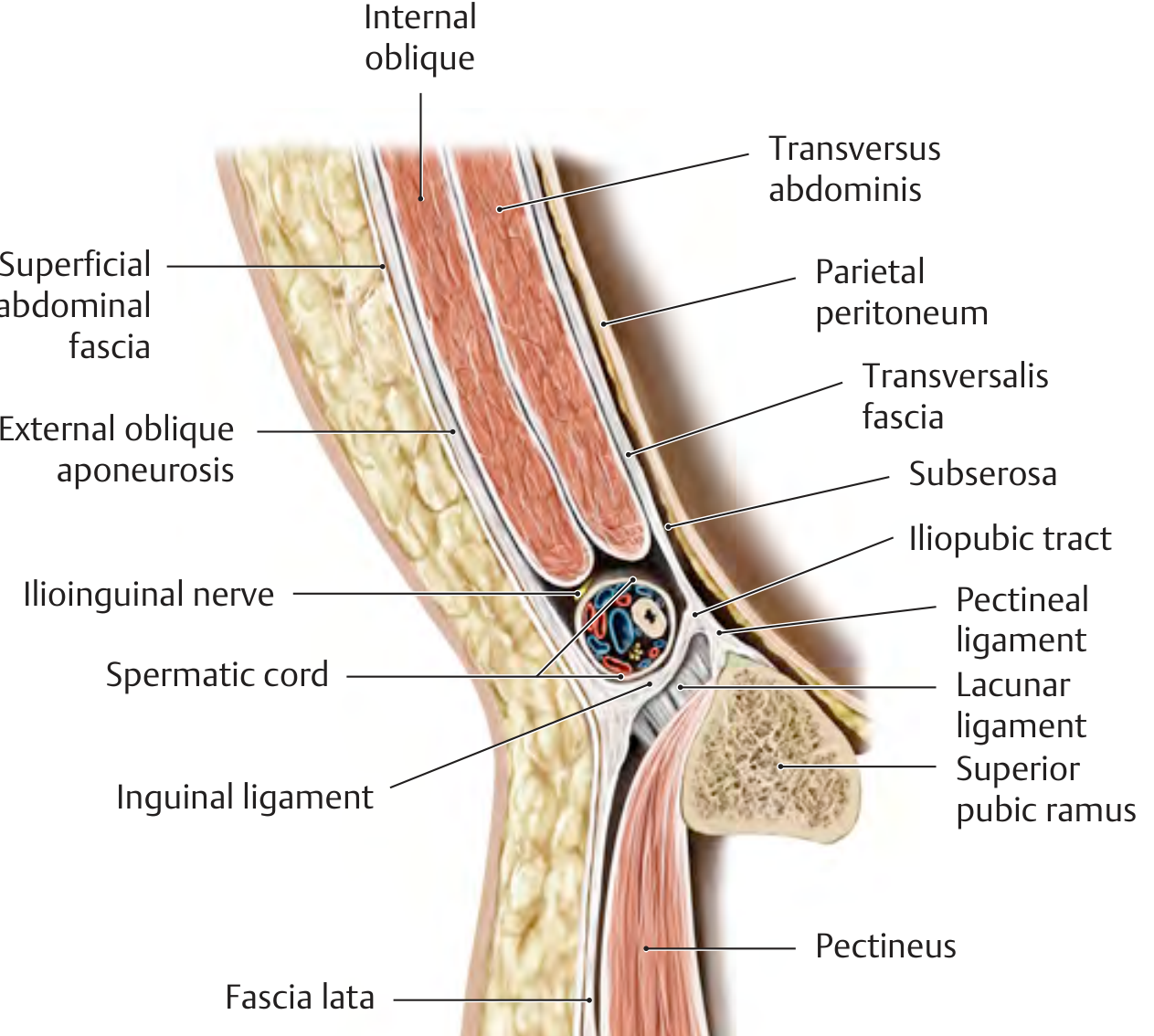
The inguinal ligament is formed by the lower border of the aponeurosis of the external oblique muscle, which is folded (rolled) back upon itself inferiorly. In structural terms, it is not a typical ligament made of separate connective tissue - it is a thickened, in-folded edge of the external oblique aponeurosis, which is itself a flat sheet of dense fibrous (collagenous) connective tissue.
More specifically, the floor of the inguinal canal - which is the inguinal ligament - consists of densely interwoven fibers of the lower external oblique aponeurosis and the adjacent fascia lata of the thigh (THIEME Atlas of Anatomy).
At its two ends, it has additional attachments and modifications:
-
Laterally: it fuses with the iliacus fascia
-
Inferiorly: it fuses with the fascia lata (the deep fascia of the thigh)
-
Medially: it flattens and spreads out to form the lacunar ligament (also called Gimbernat's ligament), which forms the medial border of the femoral ring
-
Berek & Novak's Gynecology, p. 151
-
THIEME Atlas of General Anatomy and Musculoskeletal System
Location and Relationships
Here is a sagittal cross-section showing the inguinal ligament in context with the surrounding structures:
Role as the Floor of the Inguinal Canal
The inguinal canal is a short oblique tunnel (~4 cm long) in the lower abdominal wall. Its boundaries are:
| Wall | Structure |
|---|---|
| Floor | Inguinal ligament |
| Roof | Transversus abdominis and internal oblique muscles |
| Anterior wall | External oblique aponeurosis |
| Posterior wall | Transversalis fascia and peritoneum |
- Schwartz's Principles of Surgery, 11th Ed.
The Gap Beneath It
The large crescent-shaped space between the inguinal ligament above and the anterosuperior pelvic bone below is the main communication route between the abdomen and the anteromedial thigh. Through this gap pass:
-
Psoas major, iliacus, and pectineus muscles (going to insert on the femur)
-
Femoral artery and vein
-
Femoral nerve
-
Lymphatics of the lower limb
-
Gray's Anatomy for Students
Related Ligaments (Same Region)
| Ligament | Description |
|---|---|
| Lacunar ligament | Medial extension of the inguinal ligament; triangular; forms the medial wall of the femoral ring |
| Cooper's ligament (pectineal ligament) | Strong fibrous ridge along the pectineal line of the pubis; used as anchor in hernia repair |
| Iliopubic tract | A deeper band that runs parallel to and just posterior to the inguinal ligament, from the ASIS to the superior pubic ramus |
Clinical Importance
- Hernia distinction: An inguinal hernia appears above the inguinal ligament and medial to the pubic tubercle; a femoral hernia appears below it. This is a key clinical landmark.
- Hernia repair: The inguinal ligament and Cooper's ligament are both used as fixation points in surgical hernia repairs.
- Surgical caution: Structures passing beneath the ligament (femoral vessels, femoral nerve) are at risk of injury during groin surgery.
In summary, the inguinal ligament is essentially the folded-under bottom edge of the external oblique aponeurosis - a dense, collagen-rich fibrous band that serves as a structural anchor between the abdominal wall and the pelvis, and forms the critical inferior boundary of the inguinal canal.
This is a shared conversation. Sign in to Orris to start your own chat.